WHERE TO BUY |
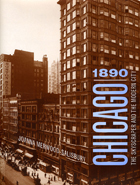
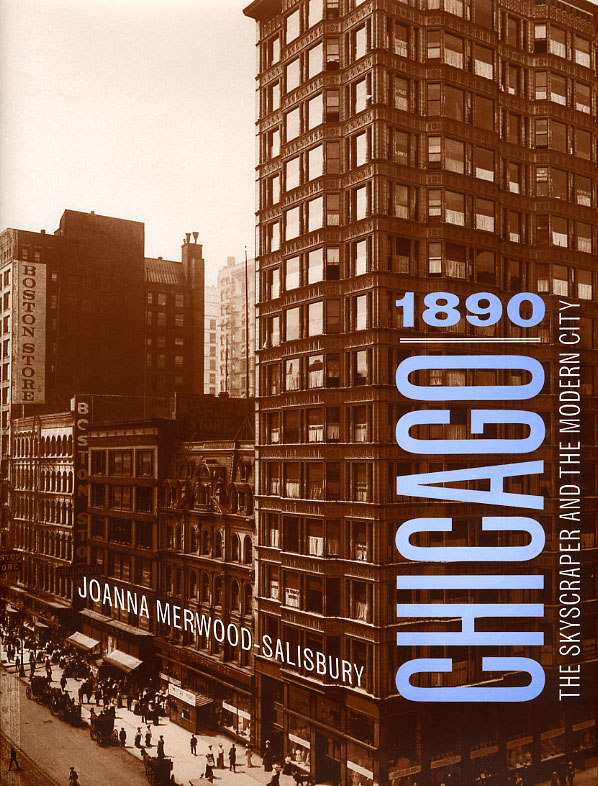
Chicago 1890: The Skyscraper and the Modern City
University of Chicago Press, 2009 Cloth: 978-0-226-52078-0
ABOUT THIS BOOK | AUTHOR BIOGRAPHY | REVIEWS | TOC | REQUEST ACCESSIBLE FILE | BUY THIS BOOK
ABOUT THIS BOOK
Chicago’s first skyscrapers are famous for projecting the city’s modernity around the world. But what did they mean at home, to the Chicagoans who designed and built them, worked inside their walls, and gazed up at their façades? Answering this multifaceted question, Chicago 1890 reveals that early skyscrapers offered hotly debated solutions to the city’s toughest problems and, in the process, fostered an urban culture that spread across the country. An ambitious reinterpretation of the works of Louis Sullivan, Daniel Burnham, and John Wellborn Root, this volume uses their towering achievements as a lens through which to view late nineteenth-century urban history. Joanna Merwood-Salisbury sheds new light on many of Chicago’s defining events—including violent building trade strikes, the Haymarket bombing, the World’s Columbian Exposition, and Burnham’s Plan of Chicago—by situating the Masonic Temple, the Monadnock Building, and the Reliance Building at the center of the city’s cultural and political crosscurrents. While architects and property owners saw these pioneering structures as manifestations of a robust American identity, immigrant laborers and social reformers viewed them as symbols of capitalism’s inequity. Illuminated by rich material from the period’s popular press and professional journals, Merwood-Salisbury’s chronicle of this contentious history reveals that the skyscraper’s vaunted status was never as inevitable as today’s skylines suggest.
AUTHOR BIOGRAPHY
Joanna Merwood-Salisbury is assistant professor in the Department of Architecture, Interior Design and Lighting at the Parsons The New School for Design. REVIEWS
“Impressively researched, splendidly illustrated, and beautifully written, Joanna Merwood-Salisbury’s Chicago 1890: The Skyscraper and the Modern City offers a truly fresh reconsideration of the nature and significance of Chicago’s iconic turn-of-the-century tall buildings. By focusing her analysis on the remarkably self-aware discussion among architects and critics of the purpose and meaning of such structures in their time combined with a meticulous and insightful examination of the construction process, contemporary context, and actual use of a cluster of key examples, Merwood-Salisbury shows how the history of the Chicago skyscraper is much more rich and complex than previously assumed. The result is revelatory.”—Carl Smith, author of The Plan of Chicago: Daniel Burnham and the Remaking of the American City
“This probing and original study of Chicago architecture during the boom years, for the first time joins a critical approach to the architecture, its theory and practice, and the social and political context of its construction and reception. A beautifully nuanced account that succeeds in enhancing our appreciation of Sullivan, Burnham and their colleagues as intellectuals and pragmatists in architecture in a moment of raw capitalism.” “In Chicago 1890, Joanna Merwood-Salisbury offers the reader new insights into the complex history of the Chicago skyscraper. As tall buildings produced disorderly streets and a chaotic skyline, architects replied with simplicity and repose in their color and massing. As sanitation engineers fought bacteria, germs, and pollution, architects designed buildings adorned with plate glass windows and clad in enameled tile as hygienic gestures. Tourism and consumerism demanded public places of spectacular experience and architects complied. Through detailed analysis of architects’ writings and designs, Merwood-Salisbury eloquently navigates the intricate and surprising ways in which skyscrapers were specific responses to the social, political, and aesthetic forces that built Chicago.” “Chicago 1890 presents a new perspective on the skyscraper and the city, revising and extending our view of Chicago’s place in modern architecture. Joanna Merwood-Salisbury very effectively links three important early skyscrapers to contemporaneous thought, speculation, and debates about the modernizing city. In doing so, she illuminates the environment of imagination and experiment that surrounded the skyscrapers, a kaleidoscopic world that couldn’t have diverged further from the way that twentieth-century modernists later presented it.” TABLE OF CONTENTS
List of Illustrations Acknowledgments Introduction Chapter 1 Western Architecture The Skyscraper as Regional Type Chapter 2 Louis Sullivan’s Democratic Architecture and the Labor Movement Chapter 3 The Monadnock John Wellborn Root and the Art of Pure Color Chapter 4 The Masonic Temple The Double Life of a Civic Skyscraper Chapter 5 The Reliance Building Urban Sanitation and Skyscraper Reform Chapter 6 Chicago 1900 The City Beautiful Movement and the Decline of the Skyscraper Postscript “The Architectonic Anticipation of the Future” Notes Selected Bibliography Index
REQUEST ACCESSIBLE FILE
BiblioVault may have an electronic file which would meet your requirements for this title: See other books on: Architecture and society | Buildings, structures, etc | Chicago | Chicago (Ill.) | Urban & Land Use Planning See other titles from University of Chicago Press |
|
More to explore:
Law and Legislation
| |