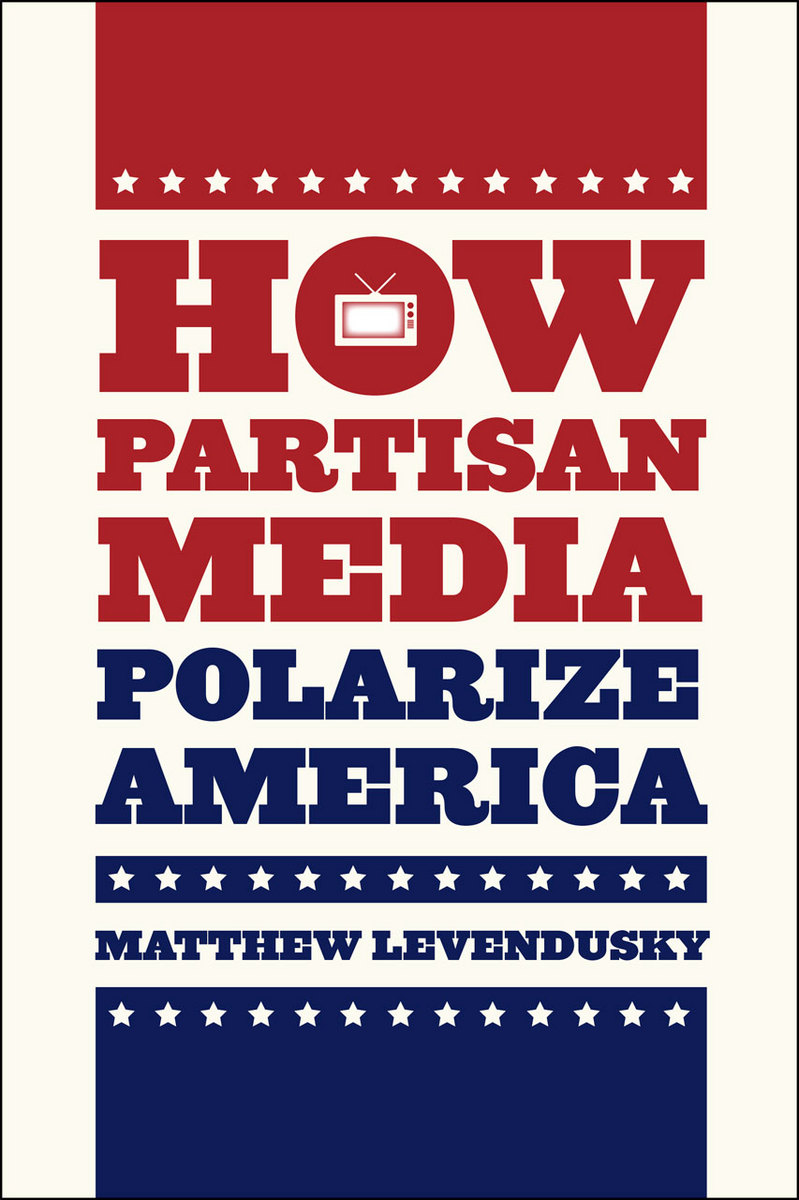
How Partisan Media Polarize America
by Matthew Levendusky
University of Chicago Press, 2013
Cloth: 978-0-226-06896-1 | Paper: 978-0-226-06901-2 | Electronic: 978-0-226-06915-9
DOI: 10.7208/chicago/9780226069159.001.0001
ABOUT THIS BOOKAUTHOR BIOGRAPHYREVIEWSTABLE OF CONTENTS

ABOUT THIS BOOK

Forty years ago, viewers who wanted to watch the news could only choose from among the major broadcast networks, all of which presented the same news without any particular point of view. Today we have a much broader array of choices, including cable channels offering a partisan take. With partisan programs gaining in popularity, some argue that they are polarizing American politics, while others counter that only a tiny portion of the population watches such programs and that their viewers tend to already hold similar beliefs.
           
In How Partisan Media Polarize America, Matthew Levendusky confirms—but also qualifies—both of these claims. Drawing on experiments and survey data, he shows that Americans who watch partisan programming do become more certain of their beliefs and less willing to weigh the merits of opposing views or to compromise. And while only a small segment of the American population watches partisan media programs, those who do tend to be more politically engaged, and their effects on national politics are therefore far-reaching.
           
In a time when politics seem doomed to partisan discord, How Partisan Media Polarize America offers a much-needed clarification of the role partisan media might play.

AUTHOR BIOGRAPHY

Matthew Levendusky is assistant professor of political science at the University of Pennsylvania and the author of The Partisan Sort: How Liberals Became Democrats and Conservatives Became Republicans, also published by the University of Chicago Press. He lives in Philadelphia.

REVIEWS

“With How Partisan Media Polarize America, Matthew Levendusky argues persuasively that partisan media matter to political attitudes and behavior—and that their influence extends far beyond the relatively few people who actually watch such programs. This is an important contribution to a topic that is critical to understanding the present and future of political communication in America, and Levendusky brings together rigorous research with lively prose and compelling anecdotes.”
— Matthew Baum, Harvard University

“A first-rate work of social science. The advent and expansion of the partisan press in America is well-known, but the question of what effect the rise of partisan media has had on political attitudes has been less well-understood. What Matthew Levendusky does here is elaborate substantially and persuasively on this question with highly original experiments informed by the latest research.”
— Robert Y. Shapiro, Columbia University

“Essential. . . . This is an important book on an important topic—the role cable television has played in helping create the hyper-partisan United States.”
— Choice

“Researchers of American public opinion should consider [How Partisan Media Polarize America] one of the most important books of the year. . . . Levendusky makes approachable complex theoretical and empirical material [on] a topic of wide interest. . . . I see the book as a great instructional example of quantitative research done right. It gives readers both refreshing scholarly perspectives and fascinating talking points for intellectual cocktail parties.”
— Public Opinion Quarterly

“Innovative work. . . . Taken together, [Matthew Levendusky's How Partisan Media Polarize America and Kevin Arceneaux and Martin Johnson's Changing Minds or Changing Channels?] give us a real advance in our understanding of the potentially polarizing effects of partisan cable news.”
— Political Communication

“Levendusky argues that the combination of partisan political news and the modern twenty-four-hour news cycle has fundamentally changed the relationship between media, governance, and society. . . . This book is of interest to political scientists and scholars of both media and culture. Its focus on presenting the results of a multimethod research project makes it a useful resource.”
— Journal of American Culture

TABLE OF CONTENTS

Acknowledgments


DOI: 10.7208/chicago/9780226069159.003.0001
[partisan media, cable TV news, MSNBC, Fox News, history of partisan media]
This chapter lays out the broad normative question that sits at the heart of the book: does partisan media contribute to the difficulty of governing in contemporary America? To answer that broad overall question, the book explores three empirical questions related to this overall theme: does partisan media polarize viewers' attitudes? Does partisan media lead viewers to distrust the opposition and become more skeptical toward bipartisanship and compromise? And does partisan media change electoral behavior, or how viewers understand and interpret elections? The book lays out the broad argument of the manuscript, explains the answer to each of those questions, and gives the plan for the book. It also situates the argument it in the relevant literature, and reviews the history of partisan media more generally. (pages 1 - 23)


DOI: 10.7208/chicago/9780226069159.003.0002
[partisan media, cable TV news, Fox News, MSBNC]
This chapter provides a series of content analyses that describe the content of partisan media. The chapter uses several different content analysis samples to document how partisan media present viewers with a one-sided view of the day's news and events. These include randomly selected days from the during the 2008 election season and the first year of the Obama administration, as well as several case studies of salient issues, such as the 2011 debt ceiling debate. Together, these analyses document the ways in which partisan media slant and bias their presentation of the news. (pages 24 - 49)


DOI: 10.7208/chicago/9780226069159.003.0003
[partisan media, media effects, motivated reasoning, social identity theory]
This chapter details the hypotheses that are empirically tested in chapters 4-6. Drawing on both motivated reasoning and social identity theory, this chapter explains why partisan media will impact viewers. In particular, it explains how partisan media will polarize viewers' beliefs, decrease their trust in the opposition and support for bipartisanship, and shape their electoral behavior. (pages 50 - 65)


DOI: 10.7208/chicago/9780226069159.003.0004
[partisan media, motivated reasoning, polarization, attitude polarization, attitude certainty]
This chapter documents four important empirical findings about the link between partisan media exposure and attitudinal polarization. First, it shows that partisan media do polarize viewers' attitudes, though the effects depend upon the slant of the media. Second, it shows that the largest effects are concentrated among those who regularly watch these programs. Although these viewers come to the experiment with somewhat more extreme views already, watching partisan media makes them even more extreme. Thus, partisan media polarize the electorate not by making moderates into extremists, but rather by moving those already somewhat extreme further toward the ideological poles. Third, the polarizing effects of partisan media endure, at least for several days after exposure. Finally, partisan media also make subjects more certain that their beliefs are correct. Thus, not only do subjects become more extreme, they also become more convinced that their beliefs are the correct ones. (pages 66 - 93)

Appendix


DOI: 10.7208/chicago/9780226069159.003.0005
[partisan media, affect, trust, bipartisanship, compromise]
This chapter shows how partisan media help to breed dislike and mistrust of the other party. I show that this biased portrait of the other party presented on partisan media decreases affect for them, and makes subjects think that the other party's leaders are less competent. As a result of this affective shift, viewers become less likely to trust the opposition, and less willing to support bipartisanship and compromise with them. Partisan media make viewers reject middle-ground solutions, foster distrust and gridlock, and make compromise and consensus more difficult to achieve. (pages 94 - 110)

Appendix


DOI: 10.7208/chicago/9780226069159.003.0006
[partisan media, vote choice, affect, election interpretation, election meaning]
This chapter highlights how partisan media consumption impacts elections. It shows that partisan media exposure makes viewers more likely to vote for their party's candidate and that this relationship is quite robust to a variety of different estimation techniques and methods. This effect is due to partisan media's effect on how viewers feel about candidates, consistent with the affect-based findings discussed in chapter 5. It further explains how partisan media influence the way citizens interpret election outcomes, by suggesting that the other party's candidate won by using illegitimate means, such as vote fraud. I show that partisan news outlets (particularly Fox News) led Republicans to adopt nefarious interpretations of the 2008 election. (pages 111 - 134)

Appendix


DOI: 10.7208/chicago/9780226069159.003.0007
[partisan media, media effects, polarization, trust, audience]
This chapter concludes the book by explaining why the empirical effects documented in chapters 4-6 matter for American politics more broadly--these effects matter because they shape governance. By polarizing viewers, making them more certain of their beliefs, and making them distrust those with different perspectives, partisan media make identifying consensus solutions more difficult. While the partisan media audience is relatively small, because it is more politically engaged, the effects multiply throughout the political sphere. As a result, all citizens live with the effects of partisan media on American politics today, whether or not they are part of its relatively limited audience. (pages 135 - 158)

Data Appendix

Notes

References

Index