Cloth: 978-0-226-16311-6 | Paper: 978-0-226-16312-3 | Electronic: 978-0-226-15453-4
DOI: 10.7208/chicago/9780226154534.001.0001
AVAILABLE FROM
University of Chicago Press (paper, ebook)Brytewave (CafeScribe-Follett Higher Ed)
Kno
ABOUT THIS BOOK
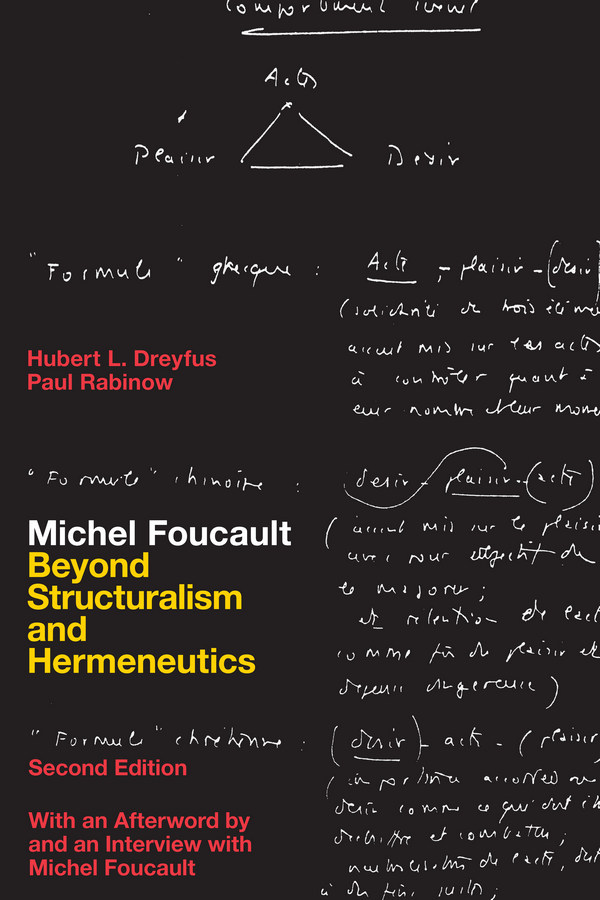
To demonstrate the sense in which Foucault's work is beyond structuralism and hermeneutics, the authors unfold a careful, analytical exposition of his oeuvre. They argue that during the of Foucault's work became a sustained and largely successful effort to develop a new method—"interpretative analytics"—capable fo explaining both the logic of structuralism's claim to be an objective science and the apparent validity of the hermeneutical counterclaim that the human sciences can proceed only by understanding the deepest meaning of the subject and his tradition.
"There are many new secondary sources [on Foucault]. None surpass the book by Hubert Dreyfus and Paul Rabinow. . . . The American paperback edition contains Foucault's 'On the Genealogy of Ethics,' a lucid interview that is now our best source for seeing how he construed the whole project of the history of sexuality."—David Hoy, London Review of Books
TABLE OF CONTENTS
Preface
List of Abbreviations
Introduction
Part I. The Illusion of Autonomous Discourse
The History of Madness
The Archaeology of Medicine
2. The Archeaology of the Human Sciences
The Rise of Representation in the Classical Age
Man and His Doubles: The Analytic of Finitude
The Empirical and the Transcendental
The Cogito and the Unthought
The Retreat and Return of the Origin
Conclusion to the Doubles
A Phenomenology to End All Phenomenologies
Beyond Structuralism: From Conditions of Possibility to Conditions of Existence
The Analysis of Discursive Formations
Objects
Enunciative Modalities
The Formation of Concepts
The Formation of Strategies
Historical Transformation: Disorder as a Type of Order
Discursive Strategies and the Social Background
Explanatory Power
Beyond Seriousness and Meaning
Conclusion: Double Trouble
Part II. The Genealogy of the Modern Individual: The Interpretive Analytics of Power, Truth, and the Body
Genealogy
History of the Present and Interpretive Analytics
6. From the Repressive Hypothesis to Bio-Power
The Repressive Hypothesis
Bio-Power
7. The Genealogy of the Modern Individual as Object
Sovereign Torture
Humanist Reform
Normalizing Detention
Disciplinary Technology
The Objectifying Social Sciences
8. The Genealogy of the Modern Individual as Subject
Sex and Bio-Power
Confessional Technology
The Subjectifying Social Sciences
Power
Meticulous Rituals of Power
Paradigms and Practices
Power and Truth
Conclusion
Resistance
Power
Why Study Power: The Question of the Subject
How is Power Exercised?
Afterword (1983)
History of the Project
Why the Ancient World Was Not a Golden Age, but What We Can Learn from It Anyway
The Structure of Genealogical Interpretation
From the Classical Self to the Modern Subject
Interpretive Diagnosis
Geneaology
Archaeology
Norms, Reasons, and Bio-Power
Beyond Foucault
Index