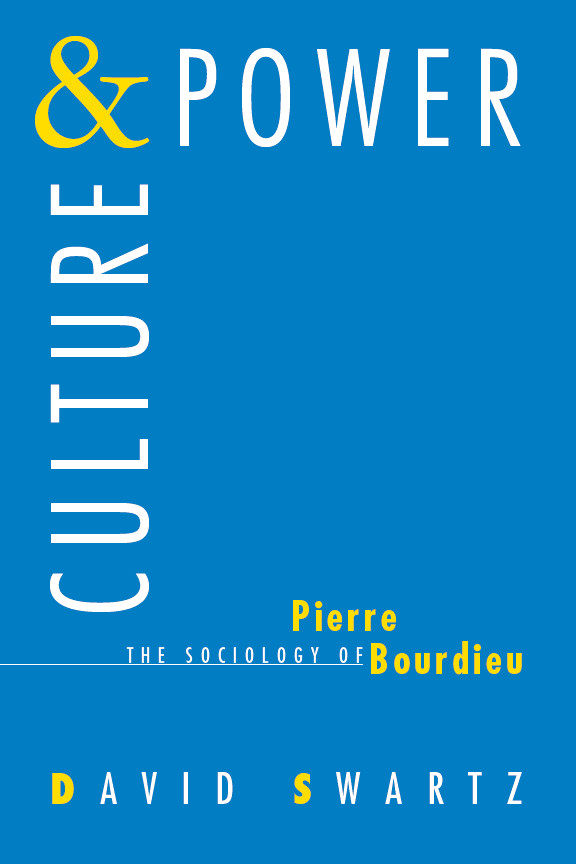
Culture and Power
The Sociology of Pierre Bourdieu
University of Chicago Press, 1997
Cloth: 978-0-226-78594-3 | Paper: 978-0-226-78595-0 | Electronic: 978-0-226-16165-5
DOI: 10.7208/chicago/9780226161655.001.0001
Cloth: 978-0-226-78594-3 | Paper: 978-0-226-78595-0 | Electronic: 978-0-226-16165-5
DOI: 10.7208/chicago/9780226161655.001.0001
AVAILABLE FROM
University of Chicago Press (paper, ebook)Brytewave (CafeScribe-Follett Higher Ed)
ebrary
EBSCO eBooks (formerly NetLibrary)
Kno
OverDrive
ABOUT THIS BOOKTABLE OF CONTENTS
ABOUT THIS BOOK
Pierre Bourdieu is one of the world's most important social theorists and is also one of the great empirical researchers in contemporary sociology. However, reading Bourdieu can be difficult for those not familiar with the French cultural context, and until now a comprehensive introduction to Bourdieu's oeuvre has not been available.
David Swartz focuses on a central theme in Bourdieu's work—the complex relationship between culture and power—and explains that sociology for Bourdieu is a mode of political intervention. Swartz clarifies Bourdieu's difficult concepts, noting where they have been misinterpreted by critics and where they have fallen short in resolving important analytical issues. The book also shows how Bourdieu has synthesized his theory of practices and symbolic power from Durkheim, Marx, and Weber, and how his work was influenced by Sartre, Levi-Strauss, and Althusser.
Culture and Power is the first book to offer both a sympathetic and critical examination of Bourdieu's work and it will be invaluable to social scientists as well as to a broader audience in the humanities.
TABLE OF CONTENTS
Acknowledgments
1. Introducing Pierre Bourdieu
2. Career and Formative Intellectual Influences
3. Bourdieu's Metatheory of Sociological Knowledge
4. Bourdieu's Political Economy of Symbolic Power
5. Habitus: A Cultural Theory of Action
6. Fields of Struggle for Power
7. Social Classes and the Struggle for Power
8. Education, Culture, and Social Inequality
9. Intellectuals and Intellectual Fields
10. The Scientific Intellectual and Politics
11. The Struggle for Objectivity: Bourdieu's Call for Reflexive Sociology
12. Conclusion
References
Author Index
Subject Index