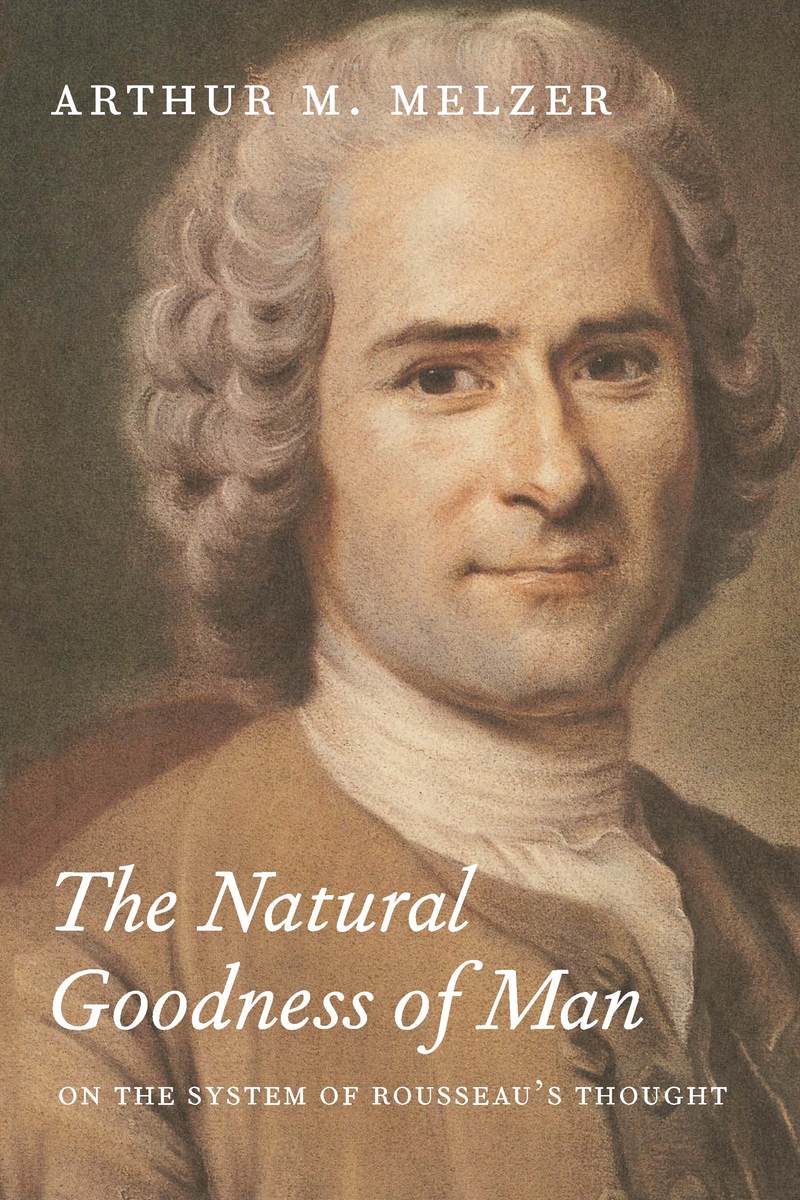
The Natural Goodness of Man
On the System of Rousseau's Thought
by Arthur M. Melzer
University of Chicago Press, 1990
Cloth: 978-0-226-51978-4 | Paper: 978-0-226-51979-1 | Electronic: 978-0-226-22600-2
DOI: 10.7208/chicago/9780226226002.001.0001
ABOUT THIS BOOKAUTHOR BIOGRAPHYREVIEWSTABLE OF CONTENTS
ABOUT THIS BOOK
The true key to all the perplexities of the human condition, Rousseau boldly claims, is the “natural goodness of man.” It is also the key to his own notoriously contradictory writings, which, he insists, are actually the disassembled parts of a rigorous philosophical system rooted in that fundamental principle. What if this problematic claim—so often repeated, but as often dismissed—were resolutely followed and explored?
Arthur M. Melzer adopts this approach in The Natural Goodness of Man. The first two parts of the book restore the original, revolutionary significance of this now time-worn principle and examine the arguments Rousseau offers in proof of it. The final section unfolds and explains Rousseau’s programmatic thought, especially the Social Contract, as a precise solution to the human problem as redefined by the principle of natural goodness.
The result is a systematic reconstruction of Rousseau’s philosophy that discloses with unparalleled clarity both the complex weave of his argument and the majestic unity of his vision. Melzer persuasively resolves one after another of the famous Rousseauian paradoxes–enlarging, in the process, our understanding of modern philosophy and politics. Engagingly and lucidly written, The Natural Goodness of Man will be of interest to general as well as scholarly readers.
AUTHOR BIOGRAPHY
Arthur M. Melzer is professor of political science at Michigan State University, where he is also cofounder and codirector of the Symposium on Science, Reason, and Modern Democracy. He is the author of Philosophy Between the Lines.
REVIEWS
“In this pathbreaking book, Melzer presents the most penetrating account available of the systemicity of Rousseau’s thought, a systemicity that Rousseau himself insisted on but whose contours for reasons Melzer persuasively adduced have gone largely undetected. Beginning with Rousseau’s own claim that the key to his system is the principle of man’s natural goodness,’ Melzer pursues with exemplary clarity and thoroughness the implications of that principle for Rousseau’s teaching as a whole.”
— History of European Ideas
“A major, indeed revelatory, contribution to our understanding of Rousseau’s place in the history of political thought. . . . A model of what philosophic scholarship should be.”
— Thomas Pangle, University of Toronto
“Political theorists have long been baffled by the apparent contradictions in Rousseau’s political and social thought. . . . Melzer challenges widespread views by arguing that, although Rousseau’s writings are anything but systematic, largely because most of them were written in circumstances out of his choosing, he was nevertheless a thoroughly consistent and systematic thinker whose distinctive political and social philosophy flows from a single fundamental principle, the natural goodness of man. . . . Melzer’s interpretation of Rousseau is ingenious, enlightening, often compelling, and shows at least one way in which Rousseau’s seemingly contradictory claims can be reconciled.”
— Political Theory
“An artistic analogy—that of an old painting’s restoration—best describes Melzer’s excellent analysis and study of one of Rousseau’s key ideas: his belief in the natural goodness of man. By systematically eliminating and disputing misinterpretations, glosses, and distortions, Melzer reveals Rousseau’s original historical and intellectual palette.”
— Library Journal
“A remarkably comprehensive and nuanced study… An ideal guide to a remarkable thinker.”
— Joel Schwartz, executive editor, Public Interest, National Review
"A brilliant and powerful new study of Rousseau."
— Marc F. Plattner, Public Interest
"Probably the most convincing demonstration yet undertaken of the systematic character of Rousseau's political thought... Melzer offers insights into Rousseau's thought that are clearly expressed, fresh, and compelling."
— Christopher Kelly, Review of Politics
TABLE OF CONTENTS
Preface
Acknowledgments
Abbreviations
Introduction
Part One: The Meaning of Rousseau's Fundamental Principle
1. The Natural Goodness of Man
Part Two: Rousseau's Proof of the Principle of Natural Goodness
2. The Inner Goodness of Existence: The Introspective and Psychological Arguments
3. A Species Transformed: The Historical Argument
4. Rousseau's Characterization of Civilized Man's Evil
5. The Contradiction of Society: The Social Argument
Part Three: The Consequences of Rousseau's Principle
6. Curing Humanity: Rousseau's Solutions
7. Rousseau's Doctrine: The Principles of Political Right and the Maxims of Politics
8. Replacing Natural Rule and Natural Law with the Social Contract and Sovereignty
9. The General Will as Sovereign
10. The General Will as the Foundation of a New Science of Politics
11. The Executive Power or "Government"
12. The Executive, the Legislator, and the "Authoritarian Rousseau"
13. Rousseau's "Mission" and the Practical Intention of His Writings
14. Conclusion: A Brief Evaluation
References
Index