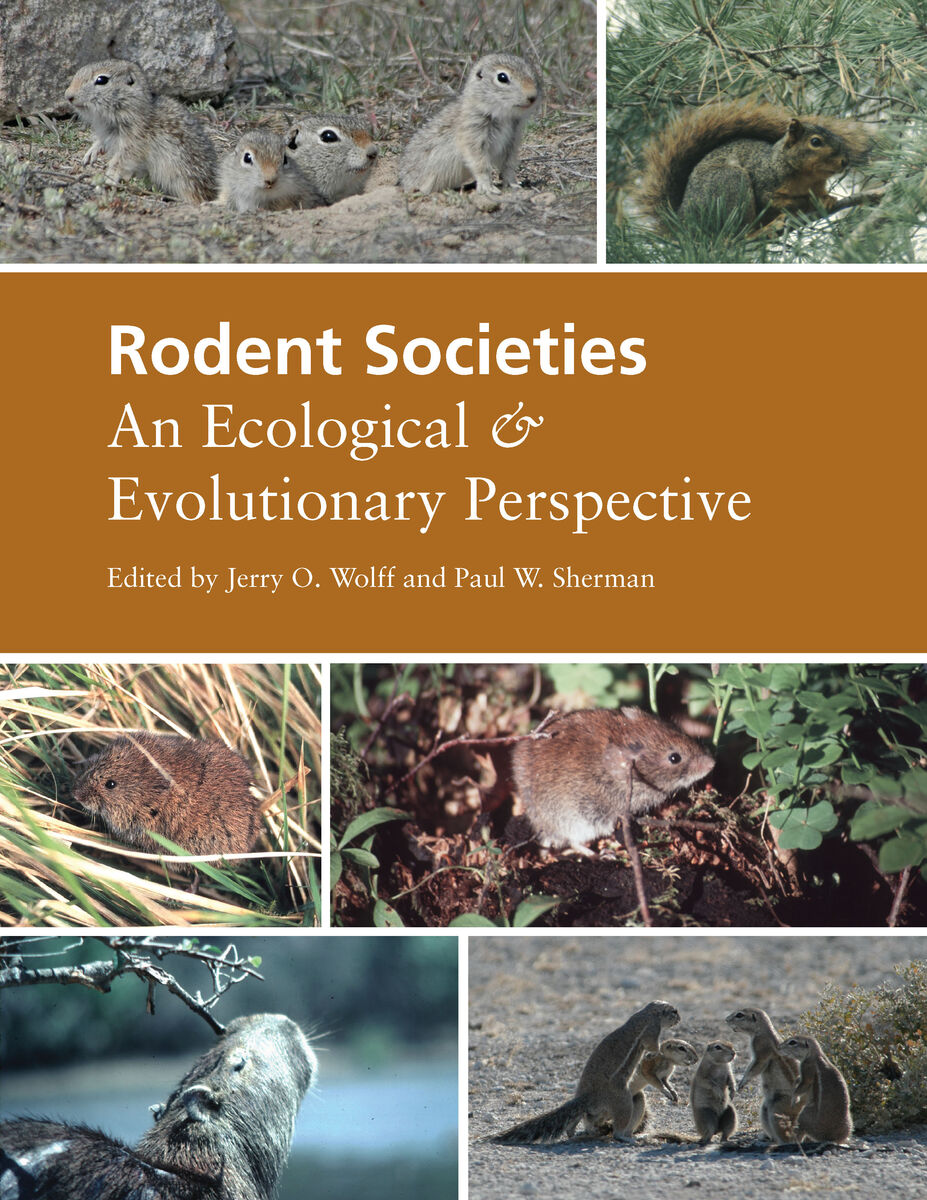
Cloth: 978-0-226-90536-5 | Paper: 978-0-226-90537-2 | Electronic: 978-0-226-90538-9
DOI: 10.7208/chicago/9780226905389.001.0001
AVAILABLE FROM
University of Chicago Press (paper, ebook)Apple Books
Brytewave (CafeScribe-Follett Higher Ed)
Chegg Inc
Copia Interactive
DeGruyter Multi-User Ebook Program
ebrary
EBSCO eBooks (formerly NetLibrary)
Google Play
Kno
OverDrive
ABOUT THIS BOOK
Rodent Societies synthesizes and integrates the current state of knowledge about the social behavior of rodents, providing ecological and evolutionary contexts for understanding their societies and highlighting emerging conservation and management strategies to preserve them. It begins with a summary of the evolution, phylogeny, and biogeography of social and nonsocial rodents, providing a historical basis for comparative analyses. Subsequent sections focus on group-living rodents and characterize their reproductive behaviors, life histories and population ecology, genetics, neuroendocrine mechanisms, behavioral development, cognitive processes, communication mechanisms, cooperative and uncooperative behaviors, antipredator strategies, comparative socioecology, diseases, and conservation. Using the highly diverse and well-studied Rodentia as model systems to integrate a variety of research approaches and evolutionary theory into a unifying framework, Rodent Societies will appeal to a wide range of disciplines, both as a compendium of current research and as a stimulus for future collaborative and interdisciplinary investigations.
AUTHOR BIOGRAPHY
Jerry O. Wolff is professor of biology at St. Cloud State University. Paul W. Sherman is professor of neurology and behavior at Cornell University.
REVIEWS
TABLE OF CONTENTS
Contributors
Acknowledgments
Introduction
1 Rodent Societies as Model Systems
2 Rodent Evolution, Phylogenetics, and Biogeography
Sexual Behavior
3 Male Mating Strategies in Rodents
4 Reproductive Strategies in Female Rodents
5 Sexual Selection: Using Social Ecology to Determine Fitness Differences
6 A Phylogenetic Analysis of the Breeding Systems of Neotomine-Peromyscine Rodents
7 Alternative Reproductive Tactics and Strategies of Tree Squirrels
Life Histories and Behavior
8 Fast and Slow Life Histories of Rodents
9 Acceleration and Delay of Reproduction in Rodents
10 Sexual Size Dimorphism in Rodents
11 Facultative Sex Ratio Adjustment
12 The Role of the Stress Axis in Life-History Adaptations
13 Dispersal and Philopatry
14 Gene Dynamics and Social Behavior
15 Social Behavior and Self-Regulation in Murid Rodents
Behavioral Development
16 Neural Regulation of Social Behavior in Rodents
17 Ontogeny of Adaptive Behaviors
18 Social Learning by Rodents
19 Kin Recognition in Rodents: Issues and Evidence
Social Behavior
20 Parental Care
21 The Ecology of Sociality in Rodents
22 Scent Marking
23 Nonparental Infanticide
24 Social Organization and Monogamy in the Beaver
25 Evolution of Pacifism and Sociality in Blind Mole-Rats
Antipredator Behavior
26 Social and Antipredator Systems: Intertwining Links in Multiple Time Frames
27 The Evolution of Alarm Communication in Rodents: Structure, Function, and thePuzzle of Apparently Altruistic Calling
28 Fear and the Foraging, Breeding, and Sociality of Rodents
Comparative Socioecology
29 Ecology, Kinship, and Ground Squirrel Sociality: Insights from Comparative Analyses
30 Evolution of Sociality in Marmots: It Begins with Hibernation
31 Environmental Constraints and the Evolution of Sociality in Semifossorial DesertRodents
32 Comparative Social Organization and Life History of Rattus and Mus
33 Social Organization and Resource Use in Capybaras and Maras
34 Social Structure in Octodontid and Ctenomyid Rodents
35 Socioecology of Rock-Dwelling Rodents
36 African Mole-Rats: Social and Ecological Diversity
37 Alarm Calling, Multiple Mating, and Infanticide among Black-Tailed, Gunnison’s, andUtah Prairie Dogs
Conservation and Disease
38 Issues in Rodent Conservation
39 Conservation of Ground Squirrels
40 Conservation of Prairie Dogs
41 Social Behavior, Demography, and Rodent-Borne Pathogens
Conclusions
42 Conclusions and Future Directions
References
Subject Index
Species Index