
 A SCHOLARLY BOOK REPOSITORY
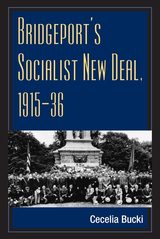
In November 1933, the Socialist Party of Bridgeport, Connecticut put slate roofer Jasper McLevy in the mayor's seat and nearly won control of the city council. Cecelia Bucki explores how labor gained first a foothold and then a stronghold in local politics as broad debates pitted previously unengaged working-class citizens against local business leaders and traditional party elites.
In the heat of the Great Depression, the skilled union craftsmen who made up the bulk of the city's Socialist Party filled a political void created by the crumbling of mainstream parties, the disintegration of traditional modes of ethnic politics, and the city's acute fiscal crisis. In time, however, legislative measures and compromise politics blunted the progressive agenda. The local party split from the Socialist Party of America and became narrowly focused and reformist while still serving as the voice of the working class.
A portrait of a stunning moment in American politics, Bridgeport's Socialist New Deal, 1915-36 offers a fascinating look at the volatility of politics in the early years of the Great Depression.
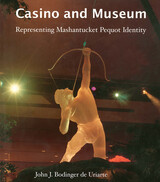
To some degree, both institutions offer Native representations yet create different strategies for attracting and engaging visitors. While the casino is crucial as an economic generator, the museum has an important role as the space for authentic Mashantucket Pequot images and narratives. The book’s focus is on how the casino and the museum successfully deploy different strategies to take control of the tribe’s identity, image, and cultural agency.
Photographs in the book provide a view of Mashantucket, allowing the reader to study the spaces of the book’s central arguments. They are a key methodology of the project and offer a non-textual opportunity to navigate the sites as well as one finely focused way to work through the representation and formation of the Native American photographic subject—the powerful popular imagining of Native Americans. Casino and Museum presents a unique understanding of the prodigious role that representation plays in the contemporary poetics and politics of Native America. It is essential reading for scholars of Native American studies, museum studies, cultural studies, and photography.

In 1861 at the age of eighteen, Edward Woolsey Bacon, a Yale student and son of well-known abolitionist minister Leonard Bacon, left his home in New Haven, Connecticut, to fight for the United States. Over the next four years Bacon served in both the Union navy and army, which gave him a sweeping view of the Civil War. His postings included being a captain’s clerk on the USS Iroquois, a hospital clerk in his hometown, a captain in the 29th Connecticut Infantry (Colored), and a major in the 117th U.S. Colored Infantry, and he described these experiences in vibrant letters to his friends and family. Historian George S. Burkhardt has compiled these letters, as well as Bacon’s diary in the impressive Double Duty in the Civil War: The Letters of Sailor and Soldier Edward W. Bacon.
Bacon tells of hunting Confederate commerce raiders on the high seas, enduring the tedium of blockade duty, and taking part in riverine warfare on the Mississippi. He recalls sweating in South Carolina as an infantry officer during drill and picket duty, suffering constant danger in the battlefield trenches of Virginia, marching victoriously on fallen Richmond, and tolerating the boredom of occupation duty in Texas.
His highly entertaining letters shed new light on naval affairs and reveal a close-knit family life. The narrative of his duty with black troops is especially valuable, since few first-hand accounts from white officers of the U.S. Colored Troops exist. Furthermore, his beliefs about race, slavery, and the Union cause were unconventional for the time and stand in contrast to those held by many of his contemporaries.
Double Duty in the Civil War is filled with lively descriptions of the men Bacon met and the events he experienced. With Burkhardt’s careful editing and useful annotations, Bacon’s letters and diary excerpts give rare insight into areas of the Civil War that have been neglected because of a lack of available sources. Given the scarcity of eyewitness testimonies to navy life and life in African American regiments, this book is a rarity indeed.

Written by a journalist, this book depicts the day-to-day struggles and concerns of inmates a the Connecticut Correctional Institution in Niantic (renamed the Janet S. York correctional Institution), the state's only prison for women. Build in 1917 as a work farm for prostitutes, unwed mothers, and other women of allegedly immoral character, “the Farm,” as it is still called, has long served as a barometer of prevailing social attitudes toward women.
In the summer of 1992, Andi Rierden obtained permission from the warden at Niantic to conduct research on life inside the institution. During the next three and a half years, she spent more than fifteen hundred hours among the women, recording interviews, strolling the grounds with inmates and corrections officers, sharing meals, attending classes and group counseling sessions, and tracking former inmates after their release.
The stories these women tell shed light ton a wide range of issues, from the effects of more stringent drug laws and sentences to the rise of violence among inmates. In the process it becomes clear that the ideal of rehabilitation has been largely abandoned and replaced by a belief in punishment and retribution.
Ryan draws on concepts from the study of organizations, social capital, and social networks to re-think questions such as “What kind of thing is a community?” and “Why is it so difficult to build community initiatives out of organizations?” He provides a social organizational explanation for problems familiar to anyone who has been involved in community programs, issues that are usually understood as personal incompetence, turf wars, greed, or corruption.
Ghosts of Organizations Past describes the challenges of using organizations to create change in places in dire need of it.

Public silence in policymaking can be deafening. When advocates for a disadvantaged group decline to speak up, not only are their concerns not recorded or acted upon, but also the collective strength of the unspoken argument is lessened—a situation that undermines the workings of deliberative democracy by reflecting only the concerns of more powerful interests.
But why do so many advocates remain silent on key issues they care about and how does that silence contribute to narrowly defined policies? What can individuals and organizations do to amplify their privately expressed concerns for policy change?
In Healthy Voices, Unhealthy Silence, Colleen M. Grogan and Michael K. Gusmano address these questions through the lens of state-level health care advocacy for the poor. They examine how representatives for the poor participate in an advisory board process by tying together existing studies; extensive interviews with key players; and an in-depth, first-hand look at the Connecticut Medicaid advisory board's deliberations during the managed care debate. Drawing on the concepts of deliberative democracy, agenda setting, and nonprofit advocacy, Grogan and Gusmano reveal the reasons behind advocates' often unexpected silence on major issues, assess how capable nonprofits are at affecting policy debates, and provide prescriptive advice for creating a participatory process that adequately addresses the health care concerns of the poor and dispossessed.
Though exploring specifically state-level health care advocacy for the poor, the lessons Grogan and Gusmano offer here are transferable across issue areas and levels of government. Public policy scholars, advocacy organizations, government workers, and students of government administration will be well-served by this significant study.

Performance accountability has been the dominant trend in education policy reform since the 1970s. State and federal policies set standards for what students should learn; require students to take “high-stakes” tests to measure what they have learned; and then hold students, schools, and school districts accountable for their performance. The goal of these policies is to push public school districts to ensure that all students reach a common threshold of knowledge and skills.
High-Stakes Reform analyzes the political processes and historical context that led to the enactment of state-level education accountability policies across the country. It also situates the education accountability movement in the broader context of public administration research, emphasizing the relationships among equity, accountability, and intergovernmental relations. The book then focuses on three in-depth case studies of policy development in Massachusetts, New Jersey, and Connecticut. Kathryn McDermott zeroes in on the most controversial and politically charged forms of state performance accountability sanctions, including graduation tests, direct state intervention in or closing of schools, and state takeovers of school districts.
Public debate casts performance accountability as either a cure for the problems of US public education or a destructive mistake. Kathryn McDermott expertly navigates both sides of the debate detailing why particular policies became popular, how the assumptions behind the policies influenced the forms they took, and what practitioners and scholars can learn from the successes and failures of education accountability policies.
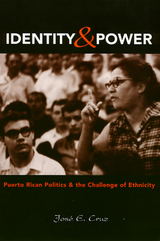
The activities of the Puerto Rican Political Action Committee from 1983 to 1991 illustrate the power of ethnic mobilization and strategy in an urban setting. Cruz examines their insistence on their right to be included in the political process in the context of both a typical mid-sized American city and the unique attributes of Hartford's predominantly white-collar population. At the same time, this study acknowledges the limitations of the exercise of such power in the political process.
Through extensive interviews Cruz brings to light the variety of ways in which politicians and political activists themselves view their own activities and achievements. This group of Puerto Rican activists attempted to penetrate the power structure of Hartford. Though their success was limited, their work constitutes a springboard for further change.
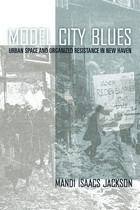
Model City Blues tells the story of how regular people, facing a changing city landscape, fought for their own model of the “ideal city” by creating grassroots plans for urban renewal. Filled with vivid descriptions of significant moments in a protracted struggle, it offers a street-level account of organized resistance to institutional plans to transform New Haven, Connecticut in the 1960s. Anchored in the physical spaces and political struggles of the city, it brings back to center stage the individuals and groups who demanded that their voices be heard.
By reexamining the converging class- and race-based movements of 1960s New Haven, Mandi Jackson helps to explain the city's present-day economic and political struggles. More broadly, by closely analyzing particular sites of resistance in New Haven, Model City Blues employs multiple academic disciplines to redefine and reimagine the roles of everyday city spaces in building social movements and creating urban landscapes.

Beginning with the hurricane of 1938, the biggest natural disaster to strike Connecticut since its settlement by Europeans, the authors demonstrate the continuing pattern of development of coastal land prone to flooding and high winds. Although the Connecticut coast faces Long Island and Block Island sounds, it is subject to the same natural hazards, land-use risks, and regulations as opean ocean shorelines. Global climatic events--glaciation, global warming, and rising sea levels--influence the shape and composition of the Connecticut shoreline, as do small-scale forces such as wind, waves, and tides.
Patton and Kent seek to instill a respect for the force of natural events and provide a guide for lessening the dangers of construction and development. A practical question-and-answer chapter explains what homeowners need to know to meet land-use regulations along the coast. In a state where the entire population lives within 100 miles of the coast, this important book will serve as a citizens’ guide to living with the Connecticut shore and will be of interest to coastal residents, developers, geologists, policymakers, and vacationers.
Narratives of Justice offers a provocative, contemporary look at the timeless questions of justice and fairness. Using face-to-face interviews, Grant Reeher plumbs the minds of legislators for their beliefs about distributive justice and attempts to discover the ways in which those beliefs influence their behavior. The book calls into question many notions of American political ideology and, in particular, the idea of an "American exceptionalism" regarding views from the political left, and the dominance in the United States of a "liberal tradition."
Political philosophers have amassed a large body of work on justice and fairness from a theoretical perspective, but there is comparatively little empirical work on the subject. The work that does exist concentrates on the beliefs of the public. We know very little concerning the beliefs about justice held by political elites. This work offers a window into the beliefs of legislators, a group for which such an inquiry is rarely undertaken.
The book is based on a set of extended, in-depth interviews with the members of the Connecticut State Senate as well as a year of close observation of the Senate in action. The interviews averaged four hours in length and covered a variety of topics related to fairness. Through this material, Reeher employs a narrative-based framework to understand the patterns in the senators' interview responses, and develops a typology of the senator's narratives. These narratives vary in both content and form, and as a whole present a surprising range of views.
Narratives of Justice will be of interest to those concerned with justice, political ideologies, and political beliefs, as well as state and local politics and, more generally, American politics. Its wide research and thorough documentation make it a useful guide to the literature within and beyond political science concerning beliefs, ideologies, legislative behavior, and qualitative research methods.
Grant Reeher is Assistant Professor, Maxwell School of Citizenship and Public Affairs, Department of Political Science, Syracuse University, and currently a Robert Wood Johnson Foundation Scholar in Health Policy Research, University of Michigan.
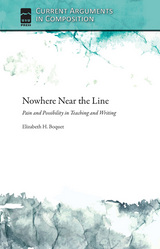
In this short work, Elizabeth Boquet explores the line Lawrence Schall describes above, tracing the overlaps and intersections of a lifelong education around guns and violence, as a student, a teacher, a feminist, a daughter, a wife, a citizen and across the dislocations and relocations that are part of a life lived in and around school. Weaving narratives of family, the university classroom and administration, her husband’s work as a police officer, and her work with students and the Poetry for Peace effort that her writing center sponsors in the local schools, she recounts her efforts to respond to moments of violence with a pedagogy of peace. “Can we not acknowledge that our experiences with pain anywhere should render us more, not less, capable of responding to it everywhere?” she asks. “Compassion, it seems to me, is an infinitely renewable resource.”

It is we who type the letters, mind the office without fail.
And until we get a contract, it is we who'll shut down Yale, For the union
makes us strong.
(To the tune of "John Brown's Body")
"Must reading for anyone who wants to learn what a revitalized labor
movement would look like." -- Labor Notes
"A textbook on solidarity unionism." -- Staughton Lynd
"One of the very best books on labor in the 1970s and 80s."
-- Dana Frank, University of California at Santa Cruz
"There are very few case studies in recent labor history as readable
and provocative as this one." -- Karen Sawislak, Stanford University
On Strike for Respect is a lively account of the 1984-85 strike
by clerical and technical workers at Yale University. Members of Local
34, with a strong female majority, mobilized themselves and the public,
breathing new life into the labor movement as they fought for and won
substantial gains. A short update on current conditions concludes this
volume.

How did the 1950s become “The Sixties”? This is the question at the heart of Daniel Horowitz's On the Cusp. Part personal memoir, part collective biography, and part cultural history, the book illuminates the dynamics of social and political change through the experiences of a small, and admittedly privileged, generational cohort.
A Jewish “townie” from New Haven when he entered Yale College in fall 1956, Horowitz reconstructs the undergraduate career of the class of 1960 and follows its story into the next decade. He begins by looking at curricular and extracurricular life on the all-male campus, then ranges beyond the confines of Yale to larger contexts, including the local drama of urban renewal, the lingering shadow of McCarthyism, and decolonization movements around the world. He ponders the role of the university in protecting the prerogatives of class while fostering social mobility, and examines the growing significance of race and gender in American politics and culture, spurred by a convergence of the personal and the political. Along the way he traces the political evolution of his classmates, left and right, as Cold War imperatives lose force and public attention shifts to the civil rights movement and the war in Vietnam.
Throughout Horowitz draws on a broad range of sources, including personal interviews, writings by classmates, reunion books, issues of the Yale Daily News, and other undergraduate publications, as well as his own letters and college papers. The end product is a work consistent with much of Horowitz's previously published scholarship on postwar America, further exposing the undercurrent of discontent and dissent that ran just beneath the surface of the so-called Cold War consensus.

Michelle Marchetti Coughlin combs through these writings to create a vivid portrait of a colonial American woman and the world she inhabited. Coughlin documents the activities of daily life as well as dramas occasioned by war, epidemics, and political upheaval. Though Coit's opportunities were circumscribed by gender norms of the day, she led a rich and varied life, not only running a household and raising a family, but reading, writing, traveling, transacting business, and maintaining a widespread network of social and commercial connections. She also took a lively interest in the world around her and played an active role in her community.
Coit's long life covered an eventful period in American history, and this book explores the numerous—and sometimes surprising—ways in which her personal history was linked to broader social and political developments. It also provides insight into the lives of countless other colonial American women whose history remains largely untold.
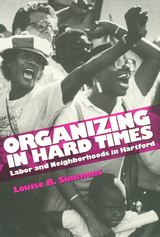
In 1990, Hartford, Connecticut, ranked as the eight poorest city in the country by the census; the real estate market was severely depressed; downtown insurance companies were laying off and the retail department stores were closing; public services were strained; and demolition sites abandoned for lack of funds pockmarked the streets. Hartford's problems are typical of those experienced in numerous U.S. cities affected by a lingering recession.
The harsh economic times felt throughout the city's workplaces and neighborhoods precipitated the formation of grassroots alliances between labor and community organizations. Coming together to create new techniques, their work has national implications for the development of alternative strategies for stimulating economic recovery.
Louise B. Simmons, a former Hartford City Councilperson, offers an insider's view of these coalitions, focusing on three activist unions—rhe New England Health Care Employees Union, the Hotel and Restaurant Employees, and the United Auto Workers—and three community groups—Hartford Areas Rally Together, Organized North Easterners-Clay Hill and North End, and Asylum Hill Organizing Project. Her in-depth analysis illustrates these groups' successes and difficulties in working together toward a new vision of urban politics.
In the series Labor and Social Change, edited by Paula Rayman and Carmen Sirianni.


An exposé of the realities facing poor black children in our consumer society.
What does it mean to be young, poor, and black in our consumer culture? Are black children “brand-crazed consumer addicts” willing to kill each other over a pair of the latest Nike Air Jordans or Barbie backpack? In this first in-depth account of the consumer lives of poor and working-class black children, Elizabeth Chin enters the world of children living in hardship in order to understand the ways they learn to manage living poor in a wealthy society.
To move beyond the stereotypical images of black children obsessed with status symbols, Chin spent two years interviewing poor children in New Haven, Connecticut, about where and how they spend their money. An alternate image of the children emerges, one that puts practicality ahead of status in their purchasing decisions. On a twenty-dollar shopping spree with Chin, one boy has to choose between a walkie-talkie set and an X-Men figure. In one of the most painful moments of her research, Chin watches as Davy struggles with his decision. He finally takes the walkie-talkie set, a toy that might be shared with his younger brother.Through personal anecdotes and compelling stories ranging from topics such as Christmas and birthday gifts, shopping malls, Toys-R-Us, neighborhood convenience shops, school lunches, ethnically correct toys, and school supplies, Chin critically examines consumption as a medium through which social inequalities-most notably of race, class, and gender-are formed, experienced, imposed, and resisted. Along the way she acknowledges the profound constraints under which the poor and working class must struggle in their daily lives.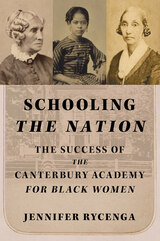
Jennifer Rycenga recovers a pioneering example of antiracism and Black-white cooperation. At once an inspirational and cautionary tale, Canterbury Academy succeeded thanks to far-reaching networks, alliances, and activism that placed it within Black, women’s, and abolitionist history. Rycenga focuses on the people like Sarah Harris, the Academy’s first Black student; Maria Davis, Crandall’s Black housekeeper and her early connection to the embryonic abolitionist movement; and Crandall herself. Telling their stories, she highlights the agency of Black and white women within the currents, and as a force changing those currents, in nineteenth-century America.
Insightful and provocative, Schooling the Nation tells the forgotten story of remarkable women and a collaboration across racial and gender lines.
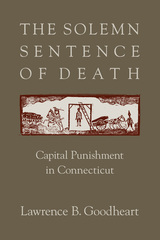

Looking back at what might have happened in 1976, the author discovers a Bicentennial year steeped in recession, racism, and unrelenting violence. It was also a time of flourishing second-wave feminism, when young women were encouraged to do anything, if only they knew how. Stamford was in the midst of urban renewal, destroying historically black neighborhoods to create space for corporations escaping a bankrupt and dangerous New York City, just forty miles away. Organized crime followed the money, infiltrating Stamford at all levels. The author reveals how racism, misogyny, the economy, and corruption affected the young people’s daily lives, and helped lead Margo and Howie to their deaths.


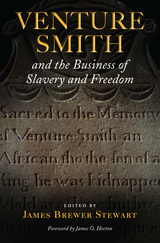
But what began as a scientific inquiry into African origins rapidly evolved into an unparalleled interdisciplinary collaboration between historians, literary analysts, geographers, genealogists, anthropologists, political philosophers, genomic biologists, and, perhaps most revealingly, a poet. Their common goal has been to reconstruct the life of an extraordinary African American and to assay its implications for the sprawling, troubled eighteenth-century world of racial exploitation over which he triumphed. This volume displays the rich results of that collaboration.
A highly intelligent, deeply self-motivated and immensely energetic slave transported from Africa, Venture Smith transformed himself through unstinting labor into a respectable Connecticut citizen, a successful entrepreneur, and the liberator of other enslaved African Americans. As James O. Horton emphasizes in his foreword to this volume, "Venture Smith's saga is a gift to all who seek to understand the complex racial beginnings of America. It helps to connect the broad American story with the stories of many Americans whose lives illustrate the national struggle to live out the national ideals."
In addition to Horton and volume editor James Brewer Stewart, contributors include Cameron Blevins, Vincent Carretta, Anna Mae Duane, Robert P. Forbes, Anne L. Hiskes, Paul Lovejoy, Marilyn Nelson, David Richardson, Chandler B. Saint, Linda Strausbaugh, Kevin Tulimieri, and John Wood Sweet.

In the early 1940s, the Bridgeport Hydraulic Company flooded Connecticut’s Saugatuck River Valley to create a reservoir that would meet the region’s growing population. Under twelve billion gallons of water lay Valley Forge, once a thriving iron and steel manufacturing town, which was seized by eminent domain to create the reservoir and dam. In Village of the Dammed, journalist James Lomuscio tells the story of the rise and fall of Valley Forge, drawing on Civil War-era photographs of the town and other sources to show what the town was like, document the futile battle to save it, and reveal the flooding’s life-altering repercussions. He also recounts a grassroots movement to prevent the development of nearby Trout Brook Valley in the 1990s, a heated fight with a different outcome. As the population of the American northeast continues to swell and spread, placing new demands on existing resources, communities are frequently confronted with forces and choices not unlike those faced by Valley Forge and Trout Brook Valley. Village of the Dammed reminds us to be ever vigilant in the protection of our irreplaceable environmental heritage.
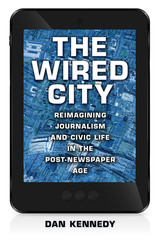
Although the Independent is the principal subject of The Wired City, Kennedy examines a number of other online news projects as well, including nonprofit organizations such as Voiceof San Diego and the Connecticut Mirror and for-profit ventures such as the Batavian, Baristanet, and CT News Junkie. Where legacy media such as major city newspapers are cutting back on coverage, entrepreneurs are now moving in to fill at least some of the vacuum.
The Wired City includes the perspectives of journalists, activists, and civic leaders who are actively re-envisioning how journalism can be meaningful in a hyperconnected age of abundant news sources. Kennedy provides deeper context by analyzing the decline of the newspaper industry in recent years and, in the case of those sites choosing such a path, the uneasy relationship between nonprofit status and the First Amendment.
At a time of pessimism over the future of journalism, The Wired City offers hope. What Kennedy documents is not the death of journalism but rather the uncertain and sometimes painful early stages of rebirth.

READERS
Browse our collection.
PUBLISHERS
See BiblioVault's publisher services.
STUDENT SERVICES
Files for college accessibility offices.
RECENTLY PUBLISHED






UChicago Accessibility Resources
home | accessibility | search | about | contact us
BiblioVault ® 2001 - 2026
The University of Chicago Press