
 A SCHOLARLY BOOK REPOSITORY


According to popular media and scholarship, Detroit, the once-vibrant city that crumbled with the departure of the auto industry, is where dreams can be reborn. It is a place that, like America itself, is gritty and determined. It has faced the worst kind of adversity, and supposedly now it’s back. But what does this narrative of “new Detroit” leave out? Beautiful Wasteland reveals that the contemporary story of Detroit’s rebirth is an upcycled version of the American Dream, which has long imagined access to work, home, and upward mobility as race-neutral projects. They’re not. As Rebecca J. Kinney shows, the narratives of Detroit’s rise, decline, and potential to rise again are deeply steeped in material and ideological investments in whiteness.
By remapping the narratives of contemporary Detroit through an extension of America’s frontier mythology, Kinney analyzes a cross-section of twentieth and twenty-first century cultural locations—an Internet forum, ruin photography, advertising, documentary film, and print and online media. She illuminates how the stories we tell about Detroit as a frontier of possibility enable the erasure of white privilege and systemic racism. By situating Detroit as a “beautiful wasteland,” both desirable and distressed, this shows how the narrative of ruin and possibility form a mutually constituted relationship: the city is possible precisely because of its perceived ruin.
Beautiful Wasteland tackles the key questions about the future of postindustrial America. As cities around the country reckon with their own postindustrial landscapes, Rebecca Kinney cautions that development that elides considerations of race and class will only continue to replicate uneven access to the city for the poor, working class, and people of color.


Black Power Praxis shows how four groups of activist-intellectuals—James and Grace Lee Boggs, Richard and Milton Henry, Reverend Albert Cleage, and a group of college students called Uhuru—shifted the consciousness and political perspectives of Black Detroiters in the 1960s and 1970s. By developing theories that they could unite with community-organizing practices, these activist-intellectuals turned the focus of the grassroots movement for racial equality from Civil Rights to Black Power. Following the 1967 Detroit Rebellion, these Black Power activist-intellectuals were already positioned to harness the energy that emerged from the uprising and directed it into the city’s first citywide Black Power organization, the Citywide Citizens Action Committee.
Even as Black Power theories became dominant over Detroit’s grassroots movement, their influence faltered when they failed to develop community organizing practices corresponding to the lived experiences of Black Detroiters. Black Power Praxis reveals how the relationships between ideas, practices, leadership, material reality, and consciousness drove the historical development of Black Power. Ideal for readers curious about social movements, Detroit history, African American history, and African American Studies, the book sheds light on how, why, and when Detroit’s activist-intellectual leaders successfully showed everyday people how their power might be used in transformative ways.
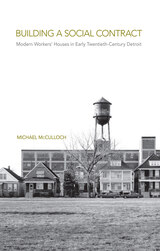
Through oral histories, letters, photographs, and period fiction, McCulloch traces wage earners’ agency in negotiating a new implicit social contract, one that rewarded hard work with upward mobility in modern houses. This promise reflected workers’ increased bargaining power but, at the same time, left them increasingly vulnerable to layoffs.
Building a Social Contract focuses on Detroit, the quintessential city of the era, where migrant workers came and were Americanized, and real estate agents and the speculative housebuilding industry thrived. The Motor City epitomized the struggle of Black workers in this period, who sought better lives through industrial labor but struggled to translate their wages into housing security amid racist segregation and violence. When Depression-era unemployment created an eviction crisis, the social contract unraveled, and workers rose up—at the polls and in the streets—to create a labor movement that reshaped American capitalism for decades.
Today, the lessons McCulloch provides from early twentieth-century Detroit are a necessary reminder that wages are not enough, and only working-class political power can secure affordable housing.
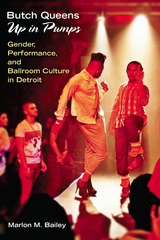
Butch Queens Up in Pumpsexamines Ballroom culture, in which inner-city LGBT individuals dress, dance, and vogue to compete for prizes and trophies. Participants are affiliated with a house, an alternative family structure typically named after haute couture designers and providing support to this diverse community. Marlon M. Bailey’s rich first-person performance ethnography of the Ballroom scene in Detroit examines Ballroom as a queer cultural formation that upsets dominant notions of gender, sexuality, kinship, and community.


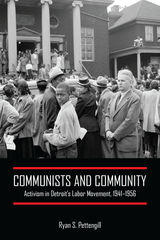
Communists and Community seeks to reframe the traditional chronology of the Communist Party in the United States as a means to better understand the change that occurred in community activism in the mid-twentieth century. Ryan Pettengill argues that Popular Front activism continued to flourish throughout the war years and into the postwar period. In Detroit, where there was a critical mass of heavy industry, Communist Party activists mobilized support for civil rights and affordable housing, brought attention to police brutality, sought protection for the foreign-born, and led a movement for world peace.
Communists and Community demonstrates that the Communist Party created a social space where activists became effective advocates for the socioeconomic betterment of a multiracial work force. Pettengill uses Detroit as a case study to examine how communist activists and their sympathizers maintained a community to enhance the quality of life for the city’s working class. He investigates the long-term effects of organized labor’s decision to force communists out of the unions and abandon community-based activism. Communists and Community recounts how leftists helped workers, people of color, and other under-represented groups became part of the mainstream citizenry in America.
Few U.S. locations provide a more vivid case study of this fight than Metro Detroit, where competing interest groups are waging war over the meaning of the figure of the refugee. This book dives deeply into the discourse on refugees occurring among various institutions in Metro Detroit. The way in which local institutions talk about refugees gives us vital clues as to how they are negotiating competing pressures and how the city overall is negotiating competing imperatives. Indeed, this local discourse gives us a crucial glimpse into how U.S. cities are defining and redefining themselves today. The figure of the refugee becomes a slate on which groups with varied interests write their stories, aspirations, and fears. Consequently, we can figure out from local refugee discourses the ongoing question of what it means to be a Metro Detroiter—and by extension, what it means to be a revitalizing U.S. city in this age.

The richness of Detroit’s music history has by now been well established. We know all about Motown, the MC5, and Iggy and the Stooges. We also know about the important part the Motor City has played in the history of jazz. But there are stories about the music of Detroit that remain untold. One of the lesser known but nonetheless fascinating histories is contained within Detroit’s country music roots. At last, Craig Maki and Keith Cady bring to light Detroit’s most important country and western and bluegrass stars, such as Chief Redbird, the York Brothers, and Roy Hall. Beyond the individuals, Maki and Cady also map out the labels, radio programs, and performance venues that sustained Detroit’s vibrant country and bluegrass music scene. In the process, Detroit Country Music examines how and why the city’s growth in the early twentieth century, particularly the southern migration tied to the auto industry, led to this vibrant roots music scene.
This is the first book—the first resource of any kind—to tell the story of Detroit’s contributions to country music. Craig Maki and Keith Cady have spent two decades collecting music and images, and visiting veteran musicians to amass more than seventy interviews about country music in Detroit. Just as astounding as the book’s revelations are the photographs, most of which have never been published before. Detroit Country Musicwill be essential reading for music historians, record collectors, roots music fans, and Detroit music aficionados.

The book first establishes the concept of the “Detroit genre” that emerged in late 1960s and traces the tropes of this white-centric narrative genre in popular culture, touching on key texts including Blue Collar, Robocop, The Crow, It Follows, and Barbarian. The second part shows how Black writers, including Alice Randall, adrienne maree brown, Stephen Mack Jones, and Angela Flournoy, reclaimed and revised the Detroit genre by un-fixing Detroit narratives of dispossession, criminality, and industrial and social failure through formal experimentations on genre itself.
Where Detroit has typically been painted in the news as one of three things—the center of the automotive industry; crime-ridden and in ruins; or as a “blank canvas” with limitless potential of entrepreneurship—Vincent Haddad shows that the Detroit genre in literature and film can be far more powerful than news media in narrating Black dispossession as a pragmatic, even liberal consensus. The texts studied here condition forgetfulness about Detroit’s history or expose it to a full reckoning, direct attention toward or away from the city’s agents of injustice, fetishize resilience or model resistance, and foreclose or imagine a future of Black liberation. Appealing to scholars of popular literature, media, race, and American studies, The Detroit Genre is an accessible and engaging study of the city’s influence on a wide array of genres in pop culture.

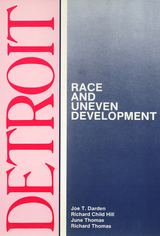
Hub of the American auto industry and site of the celebrated Riverfront Renaissance, Detroit is also a city of extraordinary poverty, unemployment, and racial segregation. This duality in one of the mightiest industrial metropolises of twentieth-century North America is the focus of this study. Viewing the Motor City in light of sociology, geography, history, and planning, the authors examine the genesis of modern Detroit. They argue that the current situation of metropolitan Detroit—economic decentralization, chronic racial and class segregation, regional political fragmentation—is a logical result of trends that have gradually escalated throughout the post-World War II era. Examining its recent redevelopment policies and the ensuing political conflicts, Darden, Hill, Thomas, and Thomas, discuss where Detroit has been and where it is going.
In the series Comparative American Cities, edited by Joe T. Darden.

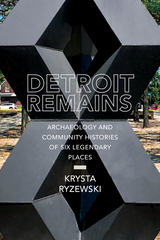
Winner of the University of Mary Washington Center for Historic Preservation 2022 Book Prize, the 2023 James Deetz Book Award, and the Joan Gero Book Award
An archaeologically grounded history of six legendary places in Detroit
The city of Detroit has endured periods of unprecedented industrial growth, decline, and revitalization between the late nineteenth century and the present. In Detroit Remains: Archaeology and Community Histories of Six Legendary Places, Krysta Ryzewski presents six archaeological case studies of legendary Detroit institutions—Little Harry speakeasy, the Ransom Gillis house, the Blue Bird Inn, Gordon Park, the Grande Ballroom, and the Halleck Street log cabin—that trace the contours of the city’s underrepresented communities and their relationship to local currents of capitalism and social justice. Through a combination of rigorous historical archaeological research and narrative storytelling, Ryzewski deftly contextualizes the cases within the city’s current struggles, including recovery from bankruptcy, and future-oriented recovery efforts.
This is the first historical archaeology book focused on Detroit and one of the few to foreground the archaeology of the Great Migration era (ca. 1915–1970). The archaeological scholarship is rooted in collaborative, community-involved, and public-facing initiatives. The case studies examine how power is and has been exercised in Detroit’s communities over the past century: how it was stripped from the city’s twentieth- and twenty-first-century residents, but also how they acquired alternative sources of agency by establishing creative and illicit economies, most of which still operated within the city’s capitalist framework.
Throughout this book, connections run deep between archaeology, heritage, politics, historic preservation, and storytelling. Detroit Remains demonstrates how the city’s past, present, and future lie not in ruins but in the tangible archaeological traces of the everyday lives of Detroiters and their legacies.

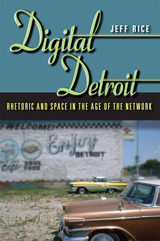
Since the 1967 riots that ripped apart the city, Detroit has traditionally been viewed either as a place in ruins or a metropolis on the verge of rejuvenation. In Digital Detroit: Rhetoric and Space in the Age of the Network, author Jeff Rice goes beyond the notion of Detroit as simply a city of two ideas. Instead he explores the city as a web of multiple meanings which, in the digital age, come together in the city’s spaces to form a network that shapes the writing, the activity, and the very thinking of those around it.
Rice focuses his study on four of Detroit’s most iconic places—Woodward Avenue, the Maccabees Building, Michigan Central Station, and 8 Mile—covering each in a separate chapter. Each of these chapters explains one of the four features of network rhetoric: folksono(me), the affective interface, response, and decision making. As these rhetorical features connect, they form the overall network called Digital Detroit. Rice demonstrates how new media, such as podcasts, wikis, blogs, interactive maps, and the Internet in general, knit together Detroit into a digital network whose identity is fluid and ever-changing. In telling Detroit’s spatial story, Rice deftly illustrates how this new media, as a rhetorical practice, ultimately shapes understandings of space in ways that computer applications and city planning often cannot. The result is a model for a new way of thinking and interacting with space and the imagination, and for a better understanding of the challenges network rhetorics pose for writing.
“The dynamics of Black Theology were at the center of the ‘Long New Negro Renaissance,’ triggered by mass migrations to industrial hubs like Detroit. Finally, this crucial subject has found its match in the brilliant scholarship of Angela Dillard. No one has done a better job of tracing those religious roots through the civil rights–black power era than Professor Dillard.”
—Komozi Woodard, Professor of History, Public Policy & Africana Studies at Sarah Lawrence College and author of A Nation within a Nation: Amiri Baraka (LeRoi Jones) and Black Power Politics
“Angela Dillard recovers the long-submerged links between the black religious and political lefts in postwar Detroit. . . . Faith in the City is an essential contribution to the growing literature on the struggle for racial equality in the North.”
—Thomas J. Sugrue, University of Pennsylvania, author of The Origins of the Urban Crisis: Race and Inequality in Postwar Detroit
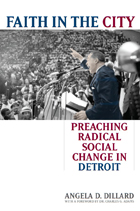
Spanning more than three decades and organized around the biographies of Reverends Charles A. Hill and Albert B. Cleage Jr., Faith in the City is a major new exploration of how the worlds of politics and faith merged for many of Detroit’s African Americans—a convergence that provided the community with a powerful new voice and identity. While other religions have mixed politics and creed, Faith in the City shows how this fusion was and continues to be particularly vital to African American clergy and the Black freedom struggle.
Activists in cities such as Detroit sustained a record of progressive politics over the course of three decades. Angela Dillard reveals this generational link and describes what the activism of the 1960s owed to that of the 1930s. The labor movement, for example, provided Detroit’s Black activists, both inside and outside the unions, with organizational power and experience virtually unmatched by any other African American urban community.
Angela D. Dillard is Associate Professor of Afroamerican and African Studies at the University of Michigan. She specializes in American and African American intellectual history, religious studies, critical race theory, and the history of political ideologies and social movements in the United States.

JoEllen McNergney Vinyard's comprehensive examination of parochial education in Detroit within the broader context of that city's urbanization patterns yields a richly detailed addition to our understanding of the European immigrant experience.
For Faith and Fortune will be of interest to historians and scholars of urban studies, particularly immigration, schooling, and the Catholic experience.
---Marshall Crenshaw
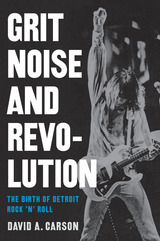
From the early days of John Lee Hooker to the heyday of Motown and beyond, Detroit has enjoyed a long reputation as one of the crucibles of American pop music. In Grit, Noise, and Revolution, David Carson turns the spotlight on those hard-rocking, long-haired musicians-influenced by Detroit's R&B heritage-who ultimately helped change the face of rock 'n' roll.
Carson tells the story of some of the great garage-inspired, blue-collar Motor City rock 'n' roll bands that exemplified the Detroit rock sound: The MC5, Iggy Pop and the Stooges, Mitch Ryder and the Detroit Wheels, SRC, the Bob Seger System, Ted Nugent and the Amboy Dukes, and Grand Funk Railroad.
An indispensable guide for rock aficionados, Grit, Noise, and Revolution features stories of these groundbreaking groups and is the first book to survey Detroit music of the 1960s and 70s-a pivotal era in rock music history.
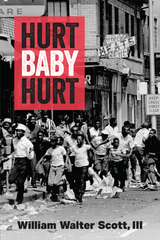
This memoir recounts Scott’s life from his birth up through the Rebellion. It tells the story of how the Rebellion started and provides an on-the-ground account of the Rebellion and its immediate aftermath, including the police detainment of the people involved. Now with a new foreword by Austin McCoy that considers the lasting impact of the rebellion, Hurt, Baby, Hurt offers valuable insight into an important part of Detroit history.
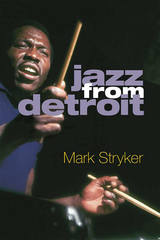
Stryker’s story starts in the 1940s and ’50s, when the auto industry created a thriving black working and middle class in Detroit that supported a vibrant nightlife, and exceptional public school music programs and mentors in the community like pianist Barry Harris transformed the city into a jazz juggernaut. This golden age nurtured many legendary musicians—Hank, Thad, and Elvin Jones, Gerald Wilson, Milt Jackson, Yusef Lateef, Donald Byrd, Tommy Flanagan, Kenny Burrell, Ron Carter, Joe Henderson, and others. As the city’s fortunes change, Stryker turns his spotlight toward often overlooked but prescient musician-run cooperatives and self-determination groups of the 1960s and ’70s, such as the Strata Corporation and Tribe. In more recent decades, the city’s culture of mentorship, embodied by trumpeter and teacher Marcus Belgrave, ensured that Detroit continued to incubate world-class talent; Belgrave protégés like Geri Allen, Kenny Garrett, Robert Hurst, Regina Carter, Gerald Cleaver, and Karriem Riggins helped define contemporary jazz. The resilience of Detroit’s jazz tradition provides a powerful symbol of the city’s lasting cultural influence.
Stryker’s 21 years as an arts reporter and critic at the Detroit Free Press are evident in his vivid storytelling and insightful criticism. Stryker has fully updated the paperback since the publication of the hardcover. This award-winning book will appeal to jazz aficionados, casual fans, and anyone interested in the vibrant and complex history of cultural life in Detroit.

In the minds of many, Detroit is undergoing a renaissance thanks to gentrifying urbanites who’ve been drawn to the city with the promise of cheap housing and thriving culture. But what happens when gentrification attempts to come to one of the most depopulated neighborhoods in the country—a place where every other property in the neighborhood was a vacant lot and every third house stood empty? To find out, Sharon Cornelissen moved to the Brightmoor neighborhood of Detroit for three years and became the owner of a $7,000 house.
The Last House on the Block takes us to Brightmoor to meet Cornelissen’s fellow residents. She introduces us to the long-time residents of the neighborhood who reveal their struggles to keep a home while keeping violence, tall grass, and yes—gentrification—at bay. We also meet the eclectic white newcomers of Brightmoor and learn about their real estate bargains, urban farms, and how they became the unlikely defenders of urban desolation. Where oldtimers take pride in neatly mowed lawns and hope for a return to residential density, newcomers love the open space and aim to buy more empty lots to raise chickens and goats. It is a story of gentrification, but not at all in the usual sense: it is a case of failed gentrification. We often think about gentrification as an unstoppable force—once the first white newcomers with yoga mats enter an often brown or Black community, the coffee shops and restaurants follow. But in Brightmoor, the dreams of white newcomers met the harsh reality of decade-long decline. Nearly a decade after Cornelissen’s fieldwork began, Brightmoor is even emptier than it was when she started.
Today, depopulation remains more common than gentrification in poor communities. Cornelissen’s story offers deep insights into what it is like to live in a declining neighborhood, and through the example of Brightmoor, Cornelissen reveals why depopulation continues and helps us imagine a more inclusive and equitable city turnaround.

In an American society both increasingly diverse and increasingly segregated, the signals children receive about race are more confusing than ever. In this context, how do children negotiate and make meaning of multiple and conflicting messages to develop their own ideas about race? Learning Race, Learning Place engages this question using in-depth interviews with an economically diverse group of African American children and their mothers.
Through these rich narratives, Erin N. Winkler seeks to reorient the way we look at how children develop their ideas about race through the introduction of a new framework—comprehensive racial learning—that shows the importance of considering this process from children’s points of view and listening to their interpretations of their experiences, which are often quite different from what the adults around them expect or intend. At the children’s prompting, Winkler examines the roles of multiple actors and influences, including gender, skin tone, colorblind rhetoric, peers, family, media, school, and, especially, place. She brings to the fore the complex and understudied power of place, positing that while children’s racial identities and experiences are shaped by a national construction of race, they are also specific to a particular place that exerts both direct and indirect influence on their racial identities and ideas.


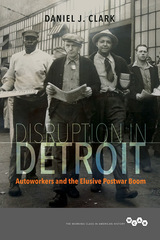
Historians and readers alike often overlook the everyday experiences of workers. Drawing on years of interviews and archival research, Daniel J. Clark presents the rich, interesting, and sometimes confounding lives of men and women who worked in Detroit-area automotive plants in the 1950s.
In their own words, the interviewees frankly discuss personal matters like divorce and poverty alongside recollections of childhood and first jobs, marriage and working women, church and hobbies, and support systems and workplace dangers. Their frequent struggles with unstable jobs and economic insecurity upend notions of the 1950s as a golden age of prosperity while stories of domestic violence and infidelity open a door to intimate aspects of their lives. Taken together, the narratives offer seldom-seen accounts of autoworkers as complex and multidimensional human beings.
Compelling and surprising, Listening to Workers foregoes the union-focused strain of labor history to provide ground-level snapshots of a blue-collar world.

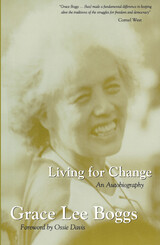
No one can tell in advance what form a movement will take. Grace Lee Boggs’s fascinating autobiography traces the story of a woman who transcended class and racial boundaries to pursue her passionate belief in a better society. Now with a new foreword by Robin D. G. Kelley, Living for Change is a sweeping account of a legendary human rights activist whose network included Malcolm X and C. L. R. James. From the end of the 1930s, through the Cold War, the Civil Rights era, and the rise of the Black Panthers to later efforts to rebuild crumbling urban communities, Living for Change is an exhilarating look at a remarkable woman who dedicated her life to social justice.
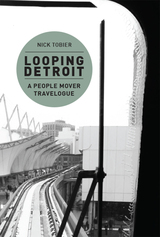
Looping Detroit invites artists and writers to ride the small loop as an explorer, mining the environs around each station as a poetic ramble, a psycho geographic wander, a cultural inquiry that simultaneously ponders the poetics of circulating above the city streets while probing the greater narrative of Detroit’s public transit conundrum.
Contributors include award-winning Detroit novelists Lolita Hernandez and Michael Zardoorian, poets Gloria House and Walter Lacy, music producer Cornelius Harris, Chace MicWrite Morris, frontman of the Detroit hip-hop trio Coldmen Young, and radio producer Zak Rosen.
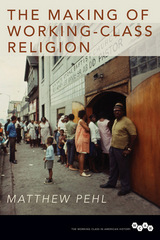
Pehl embarks on an integrative view of working-class faith that ranges across boundaries of class, race, denomination, and time. As he shows, workers in the 1910s and 1920s practiced beliefs characterized by emotional expressiveness, alliance with supernatural forces, and incorporation of mass culture's secular diversions into the sacred. That gave way to the more pragmatic class-conscious religion cultures of the New Deal era and, from the late Thirties on, a quilt of secular working-class cultures that coexisted in competitive, though creative, tension. Finally, Pehl shows how the ideology of race eclipsed class in the 1950s and 1960s, and in so doing replaced the class-conscious with the race-conscious in religious cultures throughout the city.
An ambitiously inclusive contribution to a burgeoning field, The Making of Working-Class Religion breaks new ground in the study of solidarity and the sacred in the American heartland.
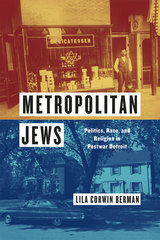
Complex and subtle, Metropolitan Jews pushes urban scholarship beyond the tenacious black/white, urban/suburban dichotomy. It demands a more nuanced understanding of the process and politics of suburbanization and will reframe how we think about the American urban experiment and modern Jewish history.
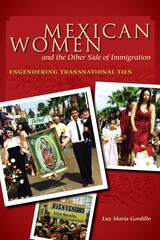
Weaving narratives with gendered analysis and historiography of Mexicans in the Midwest, Mexican Women and the Other Side of Immigration examines the unique transnational community created between San Ignacio Cerro Gordo, Jalisco, and Detroit, Michigan, in the last three decades of the twentieth century, asserting that both the community of origin and the receiving community are integral to an immigrant's everyday life, though the manifestations of this are rife with contradictions.
Exploring the challenges faced by this population since the inception of the Bracero Program in 1942 in constantly re-creating, adapting, accommodating, shaping, and creating new meanings of their environments, Luz María Gordillo emphasizes the gender-specific aspects of these situations. While other studies of Mexican transnational identity focus on social institutions, Gordillo's work introduces the concept of transnational sexualities, particularly the social construction of working-class sexuality. Her findings indicate that many female San Ignacians shattered stereotypes, transgressing traditionally male roles while their husbands lived abroad. When the women themselves immigrated as well, these transgressions facilitated their adaptation in Detroit. Placed within the larger context of globalization, Mexican Women and the Other Side of Immigration is a timely excavation of oral histories, archival documents, and the remnants of three decades of memory.
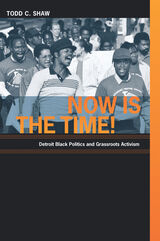
Shaw uses the tools of social movement analysis, including the quantitative analysis of budgets, electoral data, and housing statistics, as well as historical research and personal interviews, to better understand the dilemmas, innovations, and dynamics of grassroots activism. He begins with a history of discriminatory housing practices and racial divisions that deeply affected Detroit following the Second World War and set the stage for the election of the city’s first black mayor, Coleman Young. By emphasizing downtown redevelopment, Mayor Young’s administration often collided with low-income housing advocates. Only through grassroots activism were those advocates able to delay or derail governmental efforts to demolish low-income housing in order to make way for more upscale development. Shaw then looks at present-day public housing activism, assessing the mixed success of the nationally sponsored HOPE VI project aimed at fostering home ownership in low-income areas. Descriptive and prescriptive, Now Is the Time! traces the complicated legacy of community activism to illuminate what is required for grassroots activists to be effective in demanding public accountability to poor and marginalized citizens.
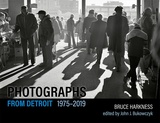
A retrospective survey of Bruce Harkness’s striking social documentary photographs and an invaluable historical record that bears witness to irrevocably lost swaths of Detroit’s social and urban fabric.
In 1980, the cities of Detroit and Hamtramck, Michigan, exercised eminent domain to develop nearly five hundred acres of land for a new industrial park and General Motors assembly plant. But the land was not vacant. Some thirty-five hundred people lived there in Poletown—some of them for their entire lives. They attended neighborhood schools and churches, worked for and patronized small businesses, walked the sidewalks, drove the streets, and tended to lawns and gardens. Harkness began photographing the area in February 1981. He recorded street scenes, intersections, panoramic views, homes, businesses, churches, and people. Ten months, ninety visits, and six hundred photographs later, it all disappeared forever.
The Poletown series established Harkness as a major Detroit documentarian. It came on the heels of late-1970s projects located in and around the city’s skid row: Cass Corridor. The images include gritty streetscapes, a portrait series depicting residents living in a crumbling apartment building, and the lively cultural milieu of a local gay and transgender bar. Most of this old portion of inner-city Detroit since has been supplanted by urban redevelopment and gentrification.
During the late 1980s, Harkness collaborated with urban historian John J. Bukowczyk on a major documentary project, Urban Interiors. While the Poletown project had documented the exteriors of buildings and streetscapes on Detroit’s East Side, Urban Interiors captured the insides of inner-city Detroit homes and businesses and included extended oral history interviews.
While Harkness has always found human dignity and resilience in his subjects, the tone of his work brightened in the 1990s alongside Detroit’s revival. Photographs from this era include blues musicians performing in clubs and at outdoor concerts and the distinctive, robust youth culture that flourished in Dearborn’s now-defunct Zone Coffee House.
Featuring images from these and other projects, Photographs from Detroit, 1975–2019 includes Harkness’s extensive notes, which describe and contextualize the encounters he shared with the people and places he photographed, and offer insight into his working methods and equipment. The volume and quality of Harkness’s work merits him recognition as one of Detroit’s most important documentary photographers during this pivotal, transitional era in the city’s history.
Harkness’s images depict the struggles and resilience of ordinary individuals and families in working-class communities who together have indelibly shaped the spirit of Detroit. This book is a must-have for Detroiters past and present as well as historians, anthropologists, social documentary advocates, and photobook collectors everywhere.

Jim Daniels, in his first book of poems, draws upon his experiences in living and working in his native Detroit to present a start, realistic picture of urban, blue-collar life. Daniels, his brothers, his father, and his grandfather have all worked in the auto industry, and that background seeps into nearly all these poems.
The first of the book’s three sections sketches out this background, then moves into a neighborhood full of people whose lives are so linked to the ups and downs of the auto industry that they have to struggle to find their own lives; in "Still Lives in Detroit, #2," Daniels writes, "There’s a man in this picture. / No one can find him." The second section contains the "Digger" poems, a series on the lives of a Detroit auto worker and his family which tries to capture the effects of the work on life outside the factory. Here, we listen to Digger think, dream, wander on psychological journeys while he moves through his routines, shoveling the snow, mowing the lawn, and so forth. In section three, the poems move into the workplace, whether that be a liquor store, a hamburger joint, or a factory.
These poems, sometimes dark, sometimes humorous, concentrate on the efforts of workers to rise above the often depressing work of blue-collar or minimum-wage jobs, to salvage some pride and dignity. The poems in this book try to give a voice to those who are often shut out of poetry. They are important. These lives are important, and the poems, more than anything, say that.
"This book is about the ramifications of raw corporate power going unchecked." -- John Conyers, Michigan congressman
"Racial class is a fundamental problem in America. But Poletown demonstrates that economic class is even more fundamental." -- Rev. Jesse Jackson
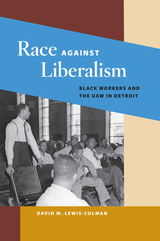
Race against Liberalism examines how black worker activism in Detroit shaped the racial politics of the labor movement and the white working class. David M. Lewis-Colman traces the substantive, long-standing disagreements between liberals and the black workers who embraced autonomous race-based action. As he shows, black autoworkers placed themselves at the center of Detroit's working-class politics and sought to forge a kind of working class unity that accommodated their interests as African Americans. The book covers the independent caucuses in the 1940s and the Trade Union Leadership Council in the 1950s; the black power movement and Revolutionary Union Movements of the mid-1960s; and the independent race-based activism of the 1970s that resulted in Coleman Young's 1973 election as the city's first black mayor.
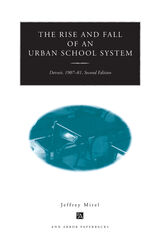
Detroit's public school system, lauded as a model for the nation in the 1920s and 1930s, has become one of the city's most conspicuous failures. Jeffrey Mirel draws on Detroit's experience to offer a new interpretation of urban educational decline in the twentieth century, suggesting specific answers to what ails America's public schools and how public education can be improved.
Jeffrey Mirel has won two prestigious book awards for The Rise and Fall of an Urban School System. Stanford University and the American Educational Research Association awarded the book the 1994-95 "Outstanding Book Award" stating, "Mirel's documentation and interpretations serve as valuable and refreshing commentary on the current status of urban education, and by extension, all American education and society. . . . The book is admirably written with touches of drama, pathos, and hope." The American Educational Studies Association awarded Mirel the 1994 "Critics' Choice Award" for his outstanding contribution to Educational Studies.
This new paperback edition includes a comprehensive epilogue focusing on recent events in Detroit educational reform. Detailing the formation and rapid collapse of a campaign in the late 1980s and early 1990s to radically restructure the Detroit public schools, Mirel's new analysis of this experiment illuminates both the persistence of historical trends in the school district and the possibilities for change.
Jeffrey Mirel is David L Angus Collegiate Professor of Education, University of Michigan.

and cultural oral history of the struggle to unionize the River Rouge
Plant near Detroit during the 1930s and 40s, this book affords us a rare
insight into the difficulties of organizing a union in the face of the
then anti-union Ford Motor Company. Against a backdrop of the depression
and entrenched racism, history was made by courageous individuals whose
rich, eloquent stories illuminate the character and views of others like
them across the nation, from all backgrounds: left, right, and center;
black and white; native and foreign born, Jew and gentile.
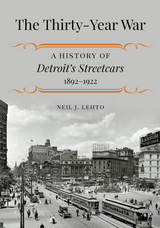

The gangland style slaying if State Senator Warren G. Hooper on January 11, 1945, three days before he was to testify before a grand jury investigating alleged corruption in the Michigan legislature, forced coverage of Allied war triumphs from the state's newspaper headlines. National media representatives flocked to Michigan to join local reporters in following the efforts of grand jury special prosecutor Kim Sigler and the State Police to apprehend the killers. Because no arrests ever were made, a 1951 journalistic prediction has proven true: "The Hooper case will continue to come back to remind the people and politicians of Michigan of the black days of 1945 when almost every official of the state had his price." For this reason, the Hooper murder has endured as one of the most intriguing unsolved mysteries in the annals of Michigan crime.
Utilizing interviews, trial transcripts, State police files, and a collection of grand jury testimony long thought to have been destroyed, Professors Bruce A. Rubenstein and Lawrence E. Ziewacz set forth the reason for Hooper's assassination. Written in a lively style, using dialogue taken from court records and correspondence, Three Bullets Sealed His Lips demonstrates that historical writing need not be dull.


Long before cable, prepackaged syndication, infomercials, do-it-yourselfers, and reality shows cluttered the television dial, there was a brand of entertainment that has today nearly vanished from the airwaves: local TV. And with its colorful and quirky cast of characters, Detroit TV arguably offered some of the best of the best of local programming anywhere in the nation-a smorgasbord of exuberant, one-of-a-kind television shows.
Based on actual interviews with the people who made Detroit TV, Gordon Castelnero's TV Land-Detroit awakens the emotional attachment and nostalgia our community has for these shows, bringing the beloved characters and memorable programs back to life.
From the glamorous Rita Bell to the insanity of the Ghoul, the zany Jingles in Boofland to the opinionated and often confrontational Lou Gordon and the gruff-voiced and somnolent George Pierrot, Castelnero reacquaints us with the talent and behind-the-scenes people, of the creative spirit in Detroit, and the intimacy they shared with the community both on and off the air.
Gordon Castelnero was a producer at WNIC radio for four years. He produced the acclaimed documentaries for WDIV and WTVS, Michigan, It Started Here! Michigan and the American Dream, and Titanic: The Final Chapter. He currently lives in Livonia, Michigan, and works at Technicolor in DVD and game media distribution. He can be contacted by e-mail at tvlanddetroit@yahoo.com

Intense attention has been paid to Detroit as a site of urban crisis. This crisis, however, has not only yielded the massive devaluation of real estate that has so often been noted; it has also yielded an explosive production of seemingly valueless urban property that has facilitated the imagination and practice of alternative urbanisms. The first sustained study of Detroit’s alternative urban cultures, The Unreal Estate Guide to Detroit initiates a new focus on Detroit as a site not only of urban crisis but also of urban possibility.
The Guide documents art and curatorial practices, community and guerilla gardens, urban farming and forestry, cultural platforms, living archives, evangelical missions, temporary public spaces, intentional communities, furtive monuments, outsider architecture, and other work made possible by the ready availability of urban space in Detroit. The Guide poses these spaces as “unreal estate”: urban territory that has slipped through the free- market economy and entered other regimes of value, other contexts of meaning, and other systems of use. The appropriation of this territory in Detroit, the Guide suggests, offers new perspectives on what a city is and can be, especially in a time of urban crisis.
On July 23, 1967, the Detroit police raided a blind pig (after-hours drinking establishment), touching off the most destructive urban riot of the 1960s. It took the U.S. Army, the Michigan National Guard, the Michigan State Police, and the Detroit police department—17,000 men—more than a week to restore order. When all was done, the riot had claimed 43 lives (mostly Black) and resulted in nearly 700 injuries. Over 7,000 individuals were arrested, with property damage estimates over $75 million. Yet, Detroit had been lauded nationally as a "model city" in the governance of a large industrial metropolis. On the 40th anniversary of this nation-changing event, we are pleased to reissue Sidney Fine's seminal work—a detailed study of what happened, why, and with what consequences.
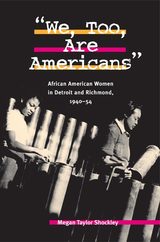
As demands on them intensified, the women working to provide American troops with clothing, medical supplies, and other services became increasingly aware of their key role in the war effort. A considerable number of the African Americans among them began to use their indispensability to leverage demands for equal employment, welfare and citizenship benefits, fair treatment, good working conditions, and other considerations previously denied them.
Shockley shows that as these women strove to redefine citizenship, backing up their claims to equality with lawsuits, sit-ins, and other forms of activism, they were forging tools that civil rights activists would continue to use in the years to come.
READERS
Browse our collection.
PUBLISHERS
See BiblioVault's publisher services.
STUDENT SERVICES
Files for college accessibility offices.
RECENTLY PUBLISHED







UChicago Accessibility Resources
home | accessibility | search | about | contact us
BiblioVault ® 2001 - 2026
The University of Chicago Press