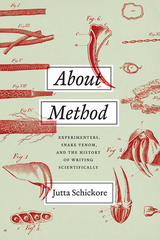
front cover of About Method
About Method
Experimenters, Snake Venom, and the History of Writing Scientifically
Jutta Schickore
University of Chicago Press, 2017
Scientists’ views on what makes an experiment successful have developed dramatically throughout history. Different criteria for proper experimentation were privileged at different times, entirely new criteria for securing experimental results emerged, and the meaning of commitment to experimentation altered. In About Method, Schickore captures this complex trajectory of change from 1660 to the twentieth century through the history of snake venom research. As experiments with poisonous snakes and venom were both challenging and controversial, the experimenters produced very detailed accounts of their investigations, which go back three hundred years—making venom research uniquely suited for such a long-term study. By analyzing key episodes in the transformation of venom research, Schickore is able to draw out the factors that have shaped methods discourse in science.
 
About Method shows that methodological advancement throughout history has not been simply a steady progression toward better, more sophisticated and improved methodologies of experimentation. Rather, it was a progression in awareness of the obstacles and limitations that scientists face in developing strategies to probe the myriad unknown complexities of nature. The first long-term history of this development and of snake venom research, About Method offers a major contribution to integrated history and philosophy of science.
[more]

front cover of Acanthaceae to Myricaceae
Acanthaceae to Myricaceae
Water Willows to Wax Myrtles
Robert H. Mohlenbrock
Southern Illinois University Press, 2008

Veteran botanist, scientific author, and professor Robert H. Mohlenbrock brings the full depth of his expertise and scholarship to his latest book, Acanthaceae to Myricaceae: Water Willows to Wax Myrtles, the third of four volumes in the Aquatic and Standing Water Plants of the Central Midwest series. This easy-to-use illustrated reference guide covers aquatic and standing water plants for the states of Iowa, Illinois, Indiana, Ohio, Kansas, Missouri, Nebraska, and Kentucky (excluding the biologically distinct Cumberland Mountain region of eastern Kentucky), from spearmint to wintergreen, from aster to waterwort.

The volume identifies, describes, and organizes species in three groups, including truly aquatic plants, which spend their entire life with their vegetative parts either completely submerged or floating on the water’s surface; emergents, which are usually rooted under water with their vegetative parts standing above the water’s surface; and wetland plants, which live most or all of their lives out of water, but which can live at least three months in water.

Mohlenbrock lists the taxa alphabetically, and within each taxon, he describes the species with the scientific names he deems most appropriate (indicating if his opinion differs from that of the U.S. Fish and Wildlife Service), common names, identification criteria, line drawings, geographical distribution, habitat description, and official U.S. Fish and Wildlife Service wetlands designation as described by the National Wetland Inventory Section in 1988.

Acanthaceae to Myricaceae is an essential reference for state and federal employees who deal with environmental conservation and mitigation issues in aquatic and wetland plants. It is also a useful guide for students and instructors in college and university courses focusing on the identification of aquatic and wetland plants.
[more]

front cover of The Accidental Species
The Accidental Species
Misunderstandings of Human Evolution
Henry Gee
University of Chicago Press, 2013
The idea of a missing link between humanity and our animal ancestors predates evolution and popular science and actually has religious roots in the deist concept of the Great Chain of Being. Yet, the metaphor has lodged itself in the contemporary imagination, and new fossil discoveries are often hailed in headlines as revealing the elusive transitional step, the moment when we stopped being “animal” and started being “human.” In The Accidental Species, Henry Gee, longtime paleontology editor at Nature, takes aim at this misleading notion, arguing that it reflects a profound misunderstanding of how evolution works and, when applied to the evolution of our own species, supports mistaken ideas about our own place in the universe.
 
Gee presents a robust and stark challenge to our tendency to see ourselves as the acme of creation. Far from being a quirk of religious fundamentalism, human exceptionalism, Gee argues, is an error that also infects scientific thought. Touring the many features of human beings that have recurrently been used to distinguish us from the rest of the animal world, Gee shows that our evolutionary outcome is one possibility among many, one that owes more to chance than to an organized progression to supremacy. He starts with bipedality, which he shows could have arisen entirely by accident, as a by-product of sexual selection, moves on to technology, large brain size, intelligence, language, and, finally, sentience. He reveals each of these attributes to be alive and well throughout the animal world—they are not, indeed, unique to our species.

The Accidental Species combines Gee’s firsthand experience on the editorial side of many incredible paleontological findings with healthy skepticism and humor to create a book that aims to overturn popular thinking on human evolution—the key is not what’s missing, but how we’re linked.
[more]

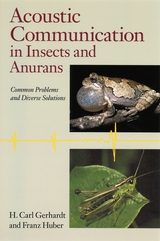
front cover of Acoustic Communication in Insects and Anurans
Acoustic Communication in Insects and Anurans
Common Problems and Diverse Solutions
H. Carl Gerhardt and Franz Huber
University of Chicago Press, 2002
Walk near woods or water on any spring or summer night and you will hear a bewildering (and sometimes deafening) chorus of frog, toad, and insect calls. How are these calls produced? What messages are encoded within the sounds, and how do their intended recipients receive and decode these signals? How does acoustic communication affect and reflect behavioral and evolutionary factors such as sexual selection and predator avoidance?

H. Carl Gerhardt and Franz Huber address these questions among many others, drawing on research from bioacoustics, behavior, neurobiology, and evolutionary biology to present the first integrated approach to the study of acoustic communication in insects and anurans. They highlight both the common solutions that these very different groups have evolved to shared challenges, such as small size, ectothermy (cold-bloodedness), and noisy environments, as well as the divergences that reflect the many differences in evolutionary history between the groups. Throughout the book Gerhardt and Huber also provide helpful suggestions for future research.

[more]

front cover of Across the Bridge
Across the Bridge
Understanding the Origin of the Vertebrates
Henry Gee
University of Chicago Press, 2018
Our understanding of vertebrate origins and the backbone of human history evolves with each new fossil find and DNA map. Many species have now had their genomes sequenced, and molecular techniques allow genetic inspection of even non-model organisms. But as longtime Nature editor Henry Gee argues in Across the Bridge, despite these giant strides and our deepening understanding of how vertebrates fit into the tree of life, the morphological chasm between vertebrates and invertebrates remains vast and enigmatic.

As Gee shows, even as scientific advances have falsified a variety of theories linking these groups, the extant relatives of vertebrates are too few for effective genetic analysis. Moreover, the more we learn about the species that do remain—from sea-squirts to starfish—the clearer it becomes that they are too far evolved along their own courses to be of much use in reconstructing what the latest invertebrate ancestors of vertebrates looked like. Fossils present yet further problems of interpretation. Tracing both the fast-changing science that has helped illuminate the intricacies of vertebrate evolution as well as the limits of that science, Across the Bridge helps us to see how far the field has come in crossing the invertebrate-to-vertebrate divide—and how far we still have to go.
[more]

front cover of Adaptation in Metapopulations
Adaptation in Metapopulations
How Interaction Changes Evolution
Michael J. Wade
University of Chicago Press, 2016
All organisms live in clusters, but such fractured local populations, or demes, nonetheless maintain connectivity with one another by some amount of gene flow between them. Most such metapopulations occur naturally, like clusters of amphibians in vernal ponds or baboon troops spread across the African veldt. Others have been created as human activities fragment natural landscapes, as in stands of trees separated by roads. As landscape change has accelerated, understanding how these metapopulations function—and specifically how they adapt—has become crucial to ecology and to our very understanding of evolution itself.

With Adaptation in Metapopulations, Michael J. Wade explores a key component of this new understanding of evolution: interaction. Synthesizing decades of work in the lab and in the field in a book both empirically grounded and underpinned by a strong conceptual framework, Wade looks at the role of interaction across scales from gene selection to selection at the level of individuals, kin, and groups. In so doing, he integrates molecular and organismal biology to reveal the true complexities of evolutionary dynamics from genes to metapopulations.
[more]

front cover of Advances in Legume Science
Advances in Legume Science
R. J. Summerfield and A. H. Bunting
Royal Botanic Gardens, Kew, 2001
An invaluable reference, reviewing research into commercial legume crops throughout the world. Topics covered include: diversity, adapatation and yield; nitrogen metabolism and plant nutrition; biochemistry and nutritional factors; pests, diseases, resistance and breeding; fodder, forage and cover legumes.
[more]

front cover of Advances in Legume Systematics Part  8
Advances in Legume Systematics Part 8
Legumes of Economic Importance
B. Pickersgill and J. M. Lock
Royal Botanic Gardens, Kew, 1996
Papers from the Kew International Legume Conference in 1992 dealing with cultivated legumes, their origins and relationships. Pulse crops, forage crops and fuelwood crops are all discussed.
[more]

front cover of Advances in Legume Systematics Part 5. The Nitrogen Factor
Advances in Legume Systematics Part 5. The Nitrogen Factor
J. L. Sprent and D. McKey
Royal Botanic Gardens, Kew, 1994
Collection of 16 papers addressing various aspects of the nitrogen economy of legumes, including nodulation and its evolution, the phytochemistry, costs and benefits of nitrogen compounds, and the relationship between legumes and their predators.
[more]

front cover of Advances in Legume Systematics Part 7. Phylogeny
Advances in Legume Systematics Part 7. Phylogeny
M. D. Crisp and J. J. Doyal
Royal Botanic Gardens, Kew, 1995
A collection of seventeen papers discussing the phylogeny of various legume groups. The first paper attempts a cladistic analysis of the whole family, and is followed by two dealing with molecular aspects of phylogeny. The remainder survey the phylogeny of various tribes and genera.
[more]

logo for University of Minnesota Press
Advances in the Zoology of Tapeworms, 1950-1970
Robert A. Wardle
University of Minnesota Press

This volume is a sequel to the comprehensive study by Professors Robert A. Wardle and James A. McLeod, The Zoology of Tapeworms, published by the University of Minnesota Press in 1952. The new book is based on research and publications which have become available since the earlier volume was published.

While much of the information in the earlier book was devoted to the identification, description, and classification of families, genera, and species, research efforts in the last two decades have been focused in new directions. Although some researchers have been engaged in revising the original classification in the light of new findings, others have been exploring specificity, serology, and genetics, and have undertaken studies of host-parasite relationships, pathogenesis, and therapeutics in the treatment of tapeworm infestation. These investigations have been facilitated by laboratory techniques which were not available for earlier studies.Following introductory chapters on the recent expansion of tapeworm research and the phylogeny of tapeworms, the authors devote a chapter each to 21 orders of tapeworms. The material is based on a survey of the literature including more than 2,000 papers on tapeworm zoology published since 1950. Chapters on laboratory propagation and on therapeutics complete the text, and there is an extensive list of references. Many drawings illustrate the text.
[more]

front cover of Aesthetics of Discomfort
Aesthetics of Discomfort
Conversations on Disquieting Art
Frederick Aldama and Herbert Lindenberger
University of Michigan Press, 2016
Through a series of provocative conversations, Frederick Luis Aldama and Herbert Lindenberger, who have written widely on literature, film, music, and art, locate a place for the discomforting and the often painfully unpleasant within aesthetics. The conversational format allows them to travel informally across many centuries and many art forms. They have much to tell one another about the arts since the advent of modernism soon after 1900—the nontonal music, for example, of the Second Vienna School, the chance-directed music and dance of John Cage and Merce Cunningham, the in-your-faceness of such diverse visual artists as Francis Bacon, Pablo Picasso, Willem de Kooning, Egon Schiele, Otto Dix, and Damien Hirst. They demonstrate as well a long tradition of discomforting art stretching back many centuries, for example, in the Last Judgments of innumerable Renaissance painters, in Goya’s so-called “black” paintings, in Wagner’s Tristan chord, and in the subtexts of Shakespearean works such as King Lear and Othello. This book is addressed at once to scholars of literature, art history, musicology, and cinema. Although its conversational format eschews the standard conventions of scholarly argument, it provides original insights both into particular art forms and into individual works within these forms. Among other matters, it demonstrates how recent work in neuroscience may provide insights in the ways that consumers process difficult and discomforting works of art. The book also contributes to current aesthetic theory by charting the dialogue that goes on—especially in aesthetically challenging works—between creator, artifact, and consumer.
 
[more]

front cover of African Plants
African Plants
Biodiversity Taxonomy and Uses
J. Timberlake and S. Kativu
Royal Botanic Gardens, Kew, 1999
Proceedings of the 1997 AETFAT Congress in Harare, Zimbabwe, focussing on the biodiversity and use of plants, whilst also covering aspects of taxonomy, biogeography and community ecology. 48 papers are presented, ranging from 'A Review of African forest Zingiberaceae' to 'Studies on indigenous plant use in Transkei'.
[more]

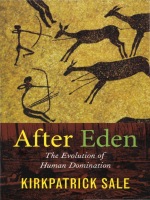
front cover of After Eden
After Eden
The Evolution of Human Domination
Kirkpatrick Sale
Duke University Press, 2006
When did the human species turn against the planet that we depend on for survival? Human industry and consumption of resources have altered the climate, polluted the water and soil, destroyed ecosystems, and rendered many species extinct, vastly increasing the likelihood of an ecological catastrophe. How did humankind come to rule nature to such an extent? To regard the planet’s resources and creatures as ours for the taking? To find ourselves on a seemingly relentless path toward ecocide?

In After Eden, Kirkpatrick Sale answers these questions in a radically new way. Integrating research in paleontology, archaeology, and anthropology, he points to the beginning of big-game hunting as the origin of Homo sapiens’ estrangement from the natural world. Sale contends that a new, recognizably modern human culture based on the hunting of large animals developed in Africa some 70,000 years ago in response to a fierce plunge in worldwide temperature triggered by an enormous volcanic explosion in Asia. Tracing the migration of populations and the development of hunting thousands of years forward in time, he shows that hunting became increasingly adversarial in relation to the environment as people fought over scarce prey during Europe’s glacial period between 35,000 and 10,000 years ago. By the end of that era, humans’ idea that they were the superior species on the planet, free to exploit other species toward their own ends, was well established.

After Eden is a sobering tale, but not one without hope. Sale asserts that Homo erectus, the variation of the hominid species that preceded Homo sapiens and survived for nearly two million years, did not attempt to dominate the environment. He contends that vestiges of this more ecologically sound way of life exist today—in some tribal societies, in the central teachings of Hinduism and Buddhism, and in the core principles of the worldwide environmental movement—offering redemptive possibilities for ourselves and for the planet.
[more]

front cover of After Preservation
After Preservation
Saving American Nature in the Age of Humans
Edited by Ben A. Minteer and Stephen J. Pyne
University of Chicago Press, 2015
From John Muir to David Brower, from the creation of Yellowstone National Park to the Endangered Species Act, environmentalism in America has always had close to its core a preservationist ideal. Generations have been inspired by its ethos—to encircle nature with our protection, to keep it apart, pristine, walled against the march of human development. But we have to face the facts. Accelerating climate change, rapid urbanization, agricultural and industrial devastation, metastasizing fire regimes, and other quickening anthropogenic forces all attest to the same truth: the earth is now spinning through the age of humans. After Preservation takes stock of the ways we have tried to both preserve and exploit nature to ask a direct but profound question: what is the role of preservationism in an era of seemingly unstoppable human development, in what some have called the Anthropocene?
           
Ben A. Minteer and Stephen J. Pyne bring together a stunning consortium of voices comprised of renowned scientists, historians, philosophers, environmental writers, activists, policy makers, and land managers to negotiate the incredible challenges that environmentalism faces. Some call for a new, post-preservationist model, one that is far more pragmatic, interventionist, and human-centered. Others push forcefully back, arguing for a more chastened and restrained vision of human action on the earth. Some try to establish a middle ground, while others ruminate more deeply on the meaning and value of wilderness. Some write on species lost, others on species saved, and yet others discuss the enduring practical challenges of managing our land, water, and air.

From spirited optimism to careful prudence to critical skepticism, the resulting range of approaches offers an inspiring contribution to the landscape of modern environmentalism, one driven by serious, sustained engagements with the critical problems we must solve if we—and the wild garden we may now keep—are going to survive the era we have ushered in.  

Contributors include: Chelsea K. Batavia, F. Stuart (Terry) Chapin III, Norman L. Christensen, Jamie Rappaport Clark, William Wallace Covington, Erle C. Ellis, Mark Fiege, Dave Foreman, Harry W. Greene, Emma Marris, Michelle Marvier, Bill McKibben, J. R. McNeill, Curt Meine, Ben A. Minteer, Michael Paul Nelson, Bryan Norton, Stephen J. Pyne, Andrew C. Revkin, Holmes Rolston III, Amy Seidl, Jack Ward Thomas, Diane J. Vosick, John A. Vucetich, Hazel Wong, and Donald Worster. 
[more]

front cover of Agaves of Continental North America
Agaves of Continental North America
Howard Scott Gentry
University of Arizona Press, 1982
This is an indispensable guide to agaves. The uses of agaves are as many as the arts of man have found it convenient to devise. At least two races of man have invaded Agaveland during the last ten to fifteen thousand years, where, with the help of agaves, they contrived several successive civilizations. The region of greatest use development is Mesoamerica. Here the great genetic diversity in a genus rich in use potential came into the hands of several peoples who developed the main agricultural center of the Americas. Perhaps, as the Aztec legends suggest, it was the animals that first showed man the edibility of agave. Evolution in use ranges all the way from the coincidental and spurious, through tool and food-drink subsistence with mystical overlay, to the practical specialties of modem industry and art. The historic period of agave will be outlined here as briefly as that complicated development will allow.
[more]

front cover of The Age of Everything
The Age of Everything
How Science Explores the Past
Matthew Hedman
University of Chicago Press, 2007
Taking advantage of recent advances throughout the sciences, Matthew Hedman brings the distant past closer to us than it has ever been. Here, he shows how scientists have determined the age of everything from the colonization of the New World over 13,000 years ago to the origin of the universe nearly fourteen billion years ago.

Hedman details, for example, how interdisciplinary studies of the Great Pyramids of Egypt can determine exactly when and how these incredible structures were built. He shows how the remains of humble trees can illuminate how the surface of the sun has changed over the past ten millennia. And he also explores how the origins of the earth, solar system, and universe are being discerned with help from rocks that fall from the sky, the light from distant stars, and even the static seen on television sets.

Covering a wide range of time scales, from the Big Bang to human history, The Age of Everything is a provocative and far-ranging look at how science has determined the age of everything from modern mammals to the oldest stars, and will be indispensable for all armchair time travelers.
 
“We are used to being told confidently of an enormous, measurable past: that some collection of dusty bones is tens of thousands of years old, or that astronomical bodies have an age of some billions. But how exactly do scientists come to know these things? That is the subject of this quite fascinating book. . . . As told by Hedman, an astronomer, each story is a marvel of compressed exegesis that takes into account some of the most modern and intriguing hypotheses.”—Steven Poole, Guardian
 
“Hedman is worth reading because he is careful to present both the power and peril of trying to extract precise chronological data. These are all very active areas of study, and as you read Hedman you begin to see how researchers have to be both very careful and incredibly audacious, and how much of our understanding of ourselves—through history, through paleontology, through astronomy—depends on determining the age of everything.”—Anthony Doerr, Boston Globe 
[more]

front cover of Ahab's Rolling Sea
Ahab's Rolling Sea
A Natural History of "Moby-Dick"
Richard J. King
University of Chicago Press, 2019
Although Herman Melville’s Moby-Dick is beloved as one of the most profound and enduring works of American fiction, we rarely consider it a work of nature writing—or even a novel of the sea. Yet Pulitzer Prize–winning author Annie Dillard avers Moby-Dick is the “best book ever written about nature,” and nearly the entirety of the story is set on the waves, with scarcely a whiff of land. In fact, Ishmael’s sea yarn is in conversation with the nature writing of Emerson and Thoreau, and Melville himself did much more than live for a year in a cabin beside a pond. He set sail: to the far remote Pacific Ocean, spending more than three years at sea before writing his masterpiece in 1851.

A revelation for Moby-Dick devotees and neophytes alike, Ahab’s Rolling Sea is a chronological journey through the natural history of Melville’s novel. From white whales to whale intelligence, giant squids, barnacles, albatross, and sharks, Richard J. King examines what Melville knew from his own experiences and the sources available to a reader in the mid-1800s, exploring how and why Melville might have twisted what was known to serve his fiction. King then climbs to the crow’s nest, setting Melville in the context of the American perception of the ocean in 1851—at the very start of the Industrial Revolution and just before the publication of On the Origin of Species. King compares Ahab’s and Ishmael’s worldviews to how we see the ocean today: an expanse still immortal and sublime, but also in crisis. And although the concept of stewardship of the sea would have been entirely foreign, if not absurd, to Melville, King argues that Melville’s narrator Ishmael reveals his own tendencies toward what we would now call environmentalism.

Featuring a coffer of illustrations and an array of interviews with contemporary scientists, fishers, and whale watch operators, Ahab’s Rolling Sea offers new insight not only into a cherished masterwork and its author but also into our evolving relationship with the briny deep—from whale hunters to climate refugees.
[more]

front cover of Alabama Wildlife, Volume 5
Alabama Wildlife, Volume 5
Edited by Ericha Shelton-Nix
University of Alabama Press, 2017
Collects the most recent findings of virtually all experts in the field as of 2012
 
Alabama Wildlife, Volume 5 offers a comprehensive update and provides a wealth of new information concerning changes and developments relative to the conservation status of wild animal populations of the state that have occurred in the decade since publication of the previous four volumes in 2004. Enhancements include the addition of any new or rediscovered taxon, species priority status changes, and taxonomic changes, plus the addition of the crayfishes, which were left out previously because so little was known about these understudied taxa.
 
A complete taxonomic checklist is included, which lists each imperiled taxon along with its priority designation followed by detailed species accounts. The eighty-four crayfish species accounts are comprised of a physical description (including a photograph, when available), distribution map, habitat summary, key life history, ecological information, basis for its status classification, and specific conservation and management recommendations. This revised expansion of the Alabama Wildlife set will be helpful to those seeking to broaden their knowledge of Alabama’s vast wildlife resources and will greatly influence future studies in the conservation of many of the imperiled species.
 
[more]

front cover of Albertus Magnus On Animals V1 2
Albertus Magnus On Animals V1 2
A Medieval Summa Zoologica Revised Edition
Kenneth F. Kitchell Jr.and Irven Michael Resnick
The Ohio State University Press, 2018
Albertus Magnus has long been recognized as one of the greatest minds of the Middle Ages; his contemporaries conferred upon him the title Doctor Universalis. An epitaph at his tomb described him as prince among philosophers, greater than Plato, and hardly inferior to King Solomon in wisdom. In 1941, Pope Pius XII named Albertus Magnus patron saint of scientists.
In his work De animalibus, Albert integrated the vast amount of information on nature that had come down to him in previous centuries: the exposition of Michael Scotus’s translation from the Arabic of Aristotle’s books on the natural world (Books 1–19), Albert’s own revisions to Aristotle’s teachings (Books 20–21), and a “dictionary” of animals appropriated largely from the De natura rerum of Thomas of Cantimpré (Books 22–26). Albert’s comprehensive treatise on living things was acknowledged as the reputable authority in biology for almost five hundred years.
In this translated and annotated edition, Kenneth F. Kitchell Jr. and Irven Michael Resnick illuminate the importance of this work, allowing Albert’s magnum opus to be better understood and more widely appreciated than ever before. Broken into two volumes (Books 1–10 and 11–26),Albertus Magnus On Animals is a veritable medieval scientific encyclopedia, ranging in topics from medicine, embryology, and comparative anatomy to women, hunting and everyday life, commerce, and much more—an essential work for historians, medievalists, scientists, and philosophers alike.      
 
[more]

front cover of Albertus Magnus On Animals V1
Albertus Magnus On Animals V1
A Medieval Summa Zoologica Revised Edition
Albertus Magnus, Edited by Kenneth F. Kitchell Jr.and Irven Michael Resnick
The Ohio State University Press, 2018
Albertus Magnus has long been recognized as one of the greatest minds of the Middle Ages; his contemporaries conferred upon him the title Doctor Universalis. An epitaph at his tomb described him as prince among philosophers, greater than Plato, and hardly inferior to King Solomon in wisdom. In 1941, Pope Pius XII named Albertus Magnus patron saint of scientists.
In his work De animalibus, Albert integrated the vast amount of information on nature that had come down to him in previous centuries: the exposition of Michael Scotus’s translation from the Arabic of Aristotle’s books on the natural world (Books 1–19), Albert’s own revisions to Aristotle’s teachings (Books 20–21), and a “dictionary” of animals appropriated largely from the De natura rerum of Thomas of Cantimpré (Books 22–26). Albert’s comprehensive treatise on living things was acknowledged as the reputable authority in biology for almost five hundred years.
In this translated and annotated edition, Kenneth F. Kitchell Jr. and Irven Michael Resnick illuminate the importance of this work, allowing Albert’s magnum opus to be better understood and more widely appreciated than ever before. Broken into two volumes (Books 1–10 and 11–26),Albertus Magnus On Animals is a veritable medieval scientific encyclopedia, ranging in topics from medicine, embryology, and comparative anatomy to women, hunting and everyday life, commerce, and much more—an essential work for historians, medievalists, scientists, and philosophers alike.
[more]

front cover of Albertus Magnus On Animals V2
Albertus Magnus On Animals V2
A Medieval Summa Zoologica Revised Edition
Albertus Magnus, Edited by Kenneth F. Kitchell Jr.and Irven Michael Resnick
The Ohio State University Press, 2019
Albertus Magnus has long been recognized as one of the greatest minds of the Middle Ages; his contemporaries conferred upon him the title Doctor Universalis. An epitaph at his tomb described him as prince among philosophers, greater than Plato, and hardly inferior to King Solomon in wisdom. In 1941, Pope Pius XII named Albertus Magnus patron saint of scientists.
In his work De animalibus, Albert integrated the vast amount of information on nature that had come down to him in previous centuries: the exposition of Michael Scotus’s translation from the Arabic of Aristotle’s books on the natural world (Books 1–19), Albert’s own revisions to Aristotle’s teachings (Books 20–21), and a “dictionary” of animals appropriated largely from the De natura rerum of Thomas of Cantimpré (Books 22–26). Albert’s comprehensive treatise on living things was acknowledged as the reputable authority in biology for almost five hundred years.
In this translated and annotated edition, Kenneth F. Kitchell Jr. and Irven Michael Resnick illuminate the importance of this work, allowing Albert’s magnum opus to be better understood and more widely appreciated than ever before. Broken into two volumes (Books 1–10 and 11–26),Albertus Magnus On Animals is a veritable medieval scientific encyclopedia, ranging in topics from medicine, embryology, and comparative anatomy to women, hunting and everyday life, commerce, and much more—an essential work for historians, medievalists, scientists, and philosophers alike.
[more]

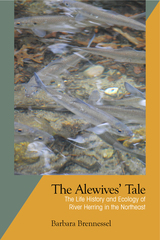
front cover of The Alewives' Tale
The Alewives' Tale
The Life History and Ecology of River Herring in the Northeast
Barbara Brennessel
University of Massachusetts Press, 2014
While on vacation in 1980, biologist Barbara Brennessel and her family came across an amazing sight: hundreds of small silver fish migrating from the Atlantic Ocean, across a channel connecting two ponds in the town of Wellfleet on Cape Cod. She later learned that these tiny river herring were important for the ecology and economy of the region and that volunteers were counting fewer and fewer fish migrating each year.

The Alewives' Tale describes the plight of alewives and blueback herring, two fish species that have similar life histories and are difficult to distinguish by sight. Collectively referred to as river herring, they have been economically important since colonial times as food, fertilizer, and bait. In recent years they have attracted much attention from environmentalists, especially as attempts are being made, on and beyond Cape Cod, to restore the rivers, streams, ponds, lakes, and estuaries that are crucial for their reproduction and survival.

Brennessel provides an overview of the biology of the fish—from fertilized eggs to large schools of adults that migrate in the Atlantic Ocean—while describing the habitats at different stages of their life history. She explores the causes of the dramatic decline of river herring since the mid-twentieth century and the various efforts to restore these iconic fish to the historic populations that treated many onlookers to spectacular inland migrations each spring.
[more]

front cover of An Alfred Russel Wallace Companion
An Alfred Russel Wallace Companion
Edited by Charles H. Smith, James T. Costa, and David A. Collard
University of Chicago Press, 2019
Although Alfred Russel Wallace (1823–1913) was one of the most famous scientists in the world at the time of his death at the age of ninety, today he is known to many as a kind of “almost-Darwin,” a secondary figure relegated to the footnotes of Darwin’s prodigious insights. But this diminution could hardly be less justified. Research into the life of this brilliant naturalist and social critic continues to produce new insights into his significance to history and his role in helping to shape modern thought.

Wallace declared his eight years of exploration in southeast Asia to be “the central and controlling incident” of his life. As 2019 marks one hundred and fifty years since the publication of The Malay Archipelago, Wallace’s canonical work chronicling his epic voyage, this collaborative book gathers an interdisciplinary array of writers to celebrate Wallace’s remarkable life and diverse scholarly accomplishments. Wallace left school at the age of fourteen and was largely self-taught, a voracious curiosity and appetite for learning sustaining him throughout his long life. After years as a surveyor and builder, in 1848 he left Britain to become a professional natural history collector in the Amazon, where he spent four years. Then, in 1854, he departed for the Malay Archipelago. It was on this voyage that he constructed a theory of natural selection similar to the one Charles Darwin was developing, and the two copublished papers on the subject in 1858, some sixteen months before the release of Darwin’s On the Origin of Species.

But as the contributors to the Companion show, this much-discussed parallel evolution in thought was only one epoch in an extraordinary intellectual life. When Wallace returned to Britain in 1862, he commenced a career of writing on a huge range of subjects extending from evolutionary studies and biogeography to spiritualism and socialism. An Alfred Russel Wallace Companion provides something of a necessary reexamination of the full breadth of Wallace’s thought—an attempt to describe not only the history and present state of our understanding of his work, but also its implications for the future.
[more]

front cover of All the Boats on the Ocean
All the Boats on the Ocean
How Government Subsidies Led to Global Overfishing
Carmel Finley
University of Chicago Press, 2017
Most current fishing practices are neither economically nor biologically sustainable. Every year, the world spends $80 billion buying fish that cost $105 billion to catch, even as heavy fishing places growing pressure on stocks that are already struggling with warmer, more acidic oceans. How have we developed an industry that is so wasteful, and why has it been so difficult to alter the trajectory toward species extinction?

In this transnational, interdisciplinary history, Carmel Finley answers these questions and more as she explores how government subsidies propelled the expansion of fishing from a coastal, in-shore activity into a global industry. While nation states struggling for ocean supremacy have long used fishing as an imperial strategy, the Cold War brought a new emphasis: fishing became a means for nations to make distinct territorial claims. A network of trade policies and tariffs allowed cod from Iceland and tuna canned in Japan into the American market, destabilizing fisheries in New England and Southern California. With the subsequent establishment of tuna canneries in American Samoa and Puerto Rico, Japanese and American tuna boats moved from the Pacific into the Atlantic and Indian Oceans after bluefin. At the same time, government subsidies in nations such as Spain and the Soviet Union fueled fishery expansion on an industrial scale, with the Soviet fleet utterly depleting the stock of rosefish (or Pacific ocean perch) and other groundfish from British Columbia to California. This massive global explosion in fishing power led nations to expand their territorial limits in the 1970s, forever changing the seas.

Looking across politics, economics, and biology, All the Boats on the Ocean casts a wide net to reveal how the subsidy-driven expansion of fisheries in the Pacific during the Cold War led to the growth of fisheries science and the creation of international fisheries management. Nevertheless, the seas are far from calm: in a world where this technologically advanced industry has enabled nations to colonize the oceans, fish literally have no place left to hide, and the future of the seas and their fish stocks is uncertain.
[more]

front cover of All the Fish in the Sea
All the Fish in the Sea
Maximum Sustainable Yield and the Failure of Fisheries Management
Carmel Finley
University of Chicago Press, 2011
Between 1949 and 1955, the State Department pushed for an international fisheries policy grounded in maximum sustainable yield (MSY). The concept is based on a confidence that scientists can predict, theoretically, the largest catch that can be taken from a species’ stock over an indefinite period. And while it was modified in 1996 with passage of the Sustained Fisheries Act, MSY is still at the heart of modern American fisheries management. As fish populations continue to crash, however, it is clear that MSY is itself not sustainable. Indeed, the concept has been widely criticized by scientists for ignoring several key factors in fisheries management and has led to the devastating collapse of many fisheries.

Carmel Finley reveals that the fallibility of MSY lies at its very inception—as a tool of government rather than science. The foundational doctrine of MSY emerged at a time when the US government was using science to promote and transfer Western knowledge and technology, and to ensure that American ships and planes would have free passage through the world’s seas and skies. Finley charts the history of US fisheries science using MSY as her focus, and in particular its application to halibut, tuna, and salmon fisheries. Fish populations the world over are threatened, and All the Fish in the Sea helps to sound warnings of the effect of any management policies divested from science itself.
[more]

front cover of Allowed to Grow Old
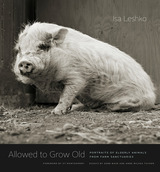
Allowed to Grow Old
Portraits of Elderly Animals from Farm Sanctuaries
Isa Leshko
University of Chicago Press, 2019
There’s nothing quite like a relationship with an aged pet—a dog or cat who has been at our side for years, forming an ineffable bond. Pampered pets, however, are a rarity among animals who have been domesticated. Farm animals, for example, are usually slaughtered before their first birthday. We never stop to think about it, but the typical images we see of cows, chickens, pigs, and the like are of young animals. What would we see if they were allowed to grow old?

Isa Leshko shows us, brilliantly, with this collection of portraits. To create these portraits, she spent hours with her subjects, gaining their trust and putting them at ease. The resulting images reveal the unique personality of each animal. It’s impossible to look away from the animals in these images as they unforgettably meet our gaze, simultaneously calm and challenging. In these photographs we see the cumulative effects of the hardships of industrialized farm life, but also the healing that time can bring, and the dignity that can emerge when farm animals are allowed to age on their own terms.

Each portrait is accompanied by a brief biographical note about its subject, and the book is rounded out with essays that explore the history of animal photography, the place of beauty in activist art, and much more.  Open this book to any page. Meet Teresa, a thirteen-year-old Yorkshire Pig, or Melvin, an eleven-year-old Angora Goat, or Tom, a seven-year-old Broad Breasted White Turkey. You’ll never forget them.
 
[more]

front cover of Aloes
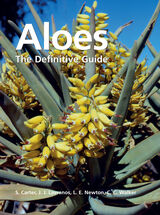
Aloes
The Definitive Guide
S. Carter, J. J. Lavranos, L. E. Newton, and C. C. Walker
Royal Botanic Gardens, Kew, 2011

Aloe vera is one of the most important cultivated medicinal plants and a key component of the floras of Africa, Arabia, and Madagascar. Here, for the first time since the 1960s, is a comprehensive account of all currently accepted aloe taxa in an easy-to-use and accessible format. Organized by habitat and size, entries for more than five hundred species each include descriptions, illustrations, and diagnostic features, accompanied by information on distribution, habitat, and relationship to other Aloe species. This volume is a must-have not only for succulent plant enthusiasts but for all who need a well-illustrated and comprehensive academic reference to the Aloe genus.
[more]

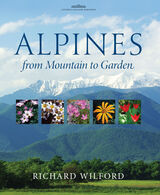
front cover of Alpines, from Mountain to Garden
Alpines, from Mountain to Garden
Richard Wilford
Royal Botanic Gardens, Kew, 2010

Alpines, From mountain to garden is a refreshing new perspective on the many stunning plant species that make their home above the treeline. Where most guides to alpine plants have favored collecting and rare species, Richard Wilford offers a holistic approach that describes their discovery and introduction into cultivation and why these factors must be taken in to consideration when planting these mountain dwellers in your garden.


Organized geographically, Alpines, From mountain to garden covers the conditions—drainage, climate, light levels, temperature, and precipitation—and species native to each of nine regions, including the United States and Canada, South America, China, Europe, and Africa.  In all, over three hundred plants are described and prolifically illustrated. Additional chapters cover cultivation, conservation, and the impact of indiscriminate collecting on the many species that are now on the verge of extinction. With its wealth of insight into where alpine plants come from and how this affects their cultivation, this new book from Kew’s Botanical Magazine Monograph series is sure to be a hit with gardeners, collectors, travelers, and photographers alike.
[more]

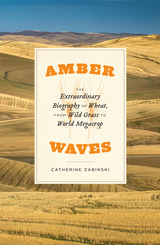
front cover of Amber Waves
Amber Waves
The Extraordinary Biography of Wheat, from Wild Grass to World Megacrop
Catherine Zabinski
University of Chicago Press, 2020
A biography of a staple grain we often take for granted, exploring how wheat went from wild grass to a world-shaping crop.

At breakfast tables and bakeries, we take for granted a grain that has made human civilization possible, a cereal whose humble origins belie its world-shaping power: wheat. Amber Waves tells the story of a group of grass species that first grew in scattered stands in the foothills of the Middle East until our ancestors discovered their value as a source of food. Over thousands of years, we moved their seeds to all but the polar regions of Earth, slowly cultivating what we now know as wheat, and in the process creating a world of cuisines that uses wheat seeds as a staple food. Wheat spread across the globe, but as ecologist Catherine Zabinski shows us, a biography of wheat is not only the story of how plants ensure their own success: from the earliest bread to the most mouthwatering pasta, it is also a story of human ingenuity in producing enough food for ourselves and our communities.

Since the first harvest of the ancient grain, we have perfected our farming systems to grow massive quantities of food, producing one of our species’ global mega crops—but at a great cost to ecological systems. And despite our vast capacity to grow food, we face problems with undernourishment both close to home and around the world. Weaving together history, evolution, and ecology, Zabinski’s tale explores much more than the wild roots and rise of a now-ubiquitous grain: it illuminates our complex relationship with our crops, both how we have transformed the plant species we use as food, and how our society—our culture—has changed in response to the need to secure food sources. From the origins of agriculture to gluten sensitivities, from our first selection of the largest seeds from wheat’s wild progenitors to the sequencing of the wheat genome and genetic engineering, Amber Waves sheds new light on how we grow the food that sustains so much human life.
[more]

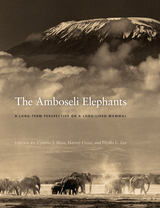
front cover of The Amboseli Elephants
The Amboseli Elephants
A Long-Term Perspective on a Long-Lived Mammal
Edited by Cynthia J. Moss, Harvey Croze, and Phyllis C. Lee
University of Chicago Press, 2011

Elephants have fascinated humans for millennia. Aristotle wrote of them with awe; Hannibal used them in warfare; and John Donne called the elephant “Nature’s greatest masterpiece. . . . The only harmless great thing.” Their ivory has been sought after and treasured in most cultures, and they have delighted zoo and circus audiences worldwide for centuries. But it wasn’t until the second half of the twentieth century that people started to take an interest in elephants in the wild, and some of the most important studies of these intelligent giants have been conducted at Amboseli National Park in Kenya.

            
The Amboseli Elephants is the long-awaited summation of what’s been learned from the Amboseli Elephant Research Project (AERP)—the longest continuously running elephant research project in the world. Cynthia J. Moss and Harvey Croze, the founders of the AERP, and Phyllis C. Lee, who has been closely involved with the project since 1982, compile more than three decades of uninterrupted study of over 2,500 individual elephants, from newborn calves to adult bulls to old matriarchs in their 60s. Chapters explore such topics as elephant ecosystems, genetics, communication, social behavior, and reproduction, as well as exciting new developments from the study of elephant minds and cognition. The book closes with a view to the future, making important arguments for the ethical treatment of elephants and suggestions to aid in their conservation.

            
The most comprehensive account of elephants in their natural environment to date, The Amboseli Elephants will be an invaluable resource for scientists, conservationists, and anyone interested in the lives and loves of these extraordinary creatures.        
[more]

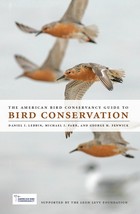
front cover of The American Bird Conservancy Guide to Bird Conservation
The American Bird Conservancy Guide to Bird Conservation
Daniel J. Lebbin, Michael J. Parr, and George H. Fenwick
University of Chicago Press, 2010

Whether we live in cities, in the suburbs, or in the country, birds are ubiquitous features of daily life, so much so that we often take them for granted. But even the casual observer is aware that birds don’t fill our skies in the number they once did. That awareness has spawned conservation action that has led to notable successes, including the recovery of some of the nation’s most emblematic species, such as the Bald Eagle, Brown Pelican, Whooping Crane, and Peregrine Falcon. Despite this, a third of all American bird species are in trouble—in many cases, they’re in imminent danger of extinction. The most authoritative account ever published of the threats these species face, The American Bird Conservancy Guide to Bird Conservation will be the definitive book on the subject.

The Guide presents for the first time anywhere a classification system and threat analysis for bird habitats in the United States, the most thorough and scientifically credible assessment of threats to birds published to date, as well as a new list of birds of conservation concern. Filled with beautiful color illustrations and original range maps, the Guide is a timely, important, and inspiring reference for birders and anyone else interested in conserving North America’s avian fauna. But this book is far more than another shout of crisis. The Guide also lays out a concrete and achievable plan of long-term action to safeguard our country’s rich bird life. Ultimately, it is an argument for hope. Whether you spend your early weekend mornings crouched in silence with binoculars in hand, hoping to check another species off your list, or you’ve never given much thought to bird conservation, you’ll appreciate the visual power and intellectual scope of these pages.

[more]

logo for University of Chicago Press Journals
The American Naturalist, volume 200 number 1 (July 2022)
The University of Chicago Press
University of Chicago Press Journals, 2022

logo for University of Chicago Press Journals
The American Naturalist, volume 200 number 2 (August 2022)
The University of Chicago Press
University of Chicago Press Journals, 2022

logo for University of Chicago Press Journals
The American Naturalist, volume 200 number 3 (September 2022)
The University of Chicago Press
University of Chicago Press Journals, 2022

logo for University of Chicago Press Journals
The American Naturalist, volume 200 number 4 (October 2022)
The University of Chicago Press
University of Chicago Press Journals, 2022

front cover of The American Naturalist, volume 200 number 5 (November 2022)
The American Naturalist, volume 200 number 5 (November 2022)
The University of Chicago Press
University of Chicago Press Journals, 2022
This is volume 200 issue 5 of The American Naturalist. Since its inception in 1867, The American Naturalist has maintained its position as one of the world’s premier peer-reviewed publications in ecology, evolution, and behavior research. Its goals are to publish articles that are of broad interest to the readership, pose new and significant problems, introduce novel subjects, develop conceptual unification, and change the way people think. The American Naturalist emphasizes sophisticated methodologies and innovative theoretical syntheses — all in an effort to advance the knowledge of organic evolution and other broad biological principles.
[more]

front cover of The American Naturalist, volume 200 number 6 (December 2022)
The American Naturalist, volume 200 number 6 (December 2022)
The University of Chicago Press
University of Chicago Press Journals, 2022
This is volume 200 issue 6 of The American Naturalist. Since its inception in 1867, The American Naturalist has maintained its position as one of the world’s premier peer-reviewed publications in ecology, evolution, and behavior research. Its goals are to publish articles that are of broad interest to the readership, pose new and significant problems, introduce novel subjects, develop conceptual unification, and change the way people think. The American Naturalist emphasizes sophisticated methodologies and innovative theoretical syntheses — all in an effort to advance the knowledge of organic evolution and other broad biological principles.
[more]

front cover of The American Naturalist, volume 201 number 1 (January 2023)
The American Naturalist, volume 201 number 1 (January 2023)
The University of Chicago Press
University of Chicago Press Journals, 2023
This is volume 201 issue 1 of The American Naturalist. Since its inception in 1867, The American Naturalist has maintained its position as one of the world’s premier peer-reviewed publications in ecology, evolution, and behavior research. Its goals are to publish articles that are of broad interest to the readership, pose new and significant problems, introduce novel subjects, develop conceptual unification, and change the way people think. The American Naturalist emphasizes sophisticated methodologies and innovative theoretical syntheses — all in an effort to advance the knowledge of organic evolution and other broad biological principles.
[more]

front cover of The American Naturalist, volume 201 number 2 (February 2023)
The American Naturalist, volume 201 number 2 (February 2023)
The University of Chicago Press
University of Chicago Press Journals, 2023
This is volume 201 issue 2 of The American Naturalist. Since its inception in 1867, The American Naturalist has maintained its position as one of the world’s premier peer-reviewed publications in ecology, evolution, and behavior research. Its goals are to publish articles that are of broad interest to the readership, pose new and significant problems, introduce novel subjects, develop conceptual unification, and change the way people think. The American Naturalist emphasizes sophisticated methodologies and innovative theoretical syntheses — all in an effort to advance the knowledge of organic evolution and other broad biological principles.
[more]

front cover of The American Naturalist, volume 201 number 3 (March 2023)
The American Naturalist, volume 201 number 3 (March 2023)
The University of Chicago Press
University of Chicago Press Journals, 2023
This is volume 201 issue 3 of The American Naturalist. Since its inception in 1867, The American Naturalist has maintained its position as one of the world’s premier peer-reviewed publications in ecology, evolution, and behavior research. Its goals are to publish articles that are of broad interest to the readership, pose new and significant problems, introduce novel subjects, develop conceptual unification, and change the way people think. The American Naturalist emphasizes sophisticated methodologies and innovative theoretical syntheses — all in an effort to advance the knowledge of organic evolution and other broad biological principles.
[more]

front cover of The American Naturalist, volume 201 number 4 (April 2023)
The American Naturalist, volume 201 number 4 (April 2023)
The University of Chicago Press
University of Chicago Press Journals, 2023
This is volume 201 issue 4 of The American Naturalist. Since its inception in 1867, The American Naturalist has maintained its position as one of the world’s premier peer-reviewed publications in ecology, evolution, and behavior research. Its goals are to publish articles that are of broad interest to the readership, pose new and significant problems, introduce novel subjects, develop conceptual unification, and change the way people think. The American Naturalist emphasizes sophisticated methodologies and innovative theoretical syntheses — all in an effort to advance the knowledge of organic evolution and other broad biological principles.
[more]

front cover of The American Naturalist, volume 201 number 5 (May 2023)
The American Naturalist, volume 201 number 5 (May 2023)
The University of Chicago Press
University of Chicago Press Journals, 2023
This is volume 201 issue 5 of The American Naturalist. Since its inception in 1867, The American Naturalist has maintained its position as one of the world’s premier peer-reviewed publications in ecology, evolution, and behavior research. Its goals are to publish articles that are of broad interest to the readership, pose new and significant problems, introduce novel subjects, develop conceptual unification, and change the way people think. The American Naturalist emphasizes sophisticated methodologies and innovative theoretical syntheses — all in an effort to advance the knowledge of organic evolution and other broad biological principles.
[more]

front cover of The American Naturalist, volume 201 number 6 (June 2023)
The American Naturalist, volume 201 number 6 (June 2023)
The University of Chicago Press
University of Chicago Press Journals, 2023
This is volume 201 issue 6 of The American Naturalist. Since its inception in 1867, The American Naturalist has maintained its position as one of the world’s premier peer-reviewed publications in ecology, evolution, and behavior research. Its goals are to publish articles that are of broad interest to the readership, pose new and significant problems, introduce novel subjects, develop conceptual unification, and change the way people think. The American Naturalist emphasizes sophisticated methodologies and innovative theoretical syntheses — all in an effort to advance the knowledge of organic evolution and other broad biological principles.
[more]

front cover of The American Naturalist, volume 202 number 1 (July 2023)
The American Naturalist, volume 202 number 1 (July 2023)
The University of Chicago Press
University of Chicago Press Journals, 2023
This is volume 202 issue 1 of The American Naturalist. Since its inception in 1867, The American Naturalist has maintained its position as one of the world’s premier peer-reviewed publications in ecology, evolution, and behavior research. Its goals are to publish articles that are of broad interest to the readership, pose new and significant problems, introduce novel subjects, develop conceptual unification, and change the way people think. The American Naturalist emphasizes sophisticated methodologies and innovative theoretical syntheses — all in an effort to advance the knowledge of organic evolution and other broad biological principles.
[more]

front cover of The American Naturalist, volume 202 number 2 (August 2023)
The American Naturalist, volume 202 number 2 (August 2023)
The University of Chicago Press
University of Chicago Press Journals, 2023
This is volume 202 issue 2 of The American Naturalist. Since its inception in 1867, The American Naturalist has maintained its position as one of the world’s premier peer-reviewed publications in ecology, evolution, and behavior research. Its goals are to publish articles that are of broad interest to the readership, pose new and significant problems, introduce novel subjects, develop conceptual unification, and change the way people think. The American Naturalist emphasizes sophisticated methodologies and innovative theoretical syntheses — all in an effort to advance the knowledge of organic evolution and other broad biological principles.
[more]

front cover of The American Naturalist, volume 202 number 3 (September 2023)
The American Naturalist, volume 202 number 3 (September 2023)
The University of Chicago Press
University of Chicago Press Journals, 2023
This is volume 202 issue 3 of The American Naturalist. Since its inception in 1867, The American Naturalist has maintained its position as one of the world’s premier peer-reviewed publications in ecology, evolution, and behavior research. Its goals are to publish articles that are of broad interest to the readership, pose new and significant problems, introduce novel subjects, develop conceptual unification, and change the way people think. The American Naturalist emphasizes sophisticated methodologies and innovative theoretical syntheses — all in an effort to advance the knowledge of organic evolution and other broad biological principles.
[more]

front cover of The American Naturalist, volume 202 number 4 (October 2023)
The American Naturalist, volume 202 number 4 (October 2023)
The University of Chicago Press
University of Chicago Press Journals, 2023
This is volume 202 issue 4 of The American Naturalist. Since its inception in 1867, The American Naturalist has maintained its position as one of the world’s premier peer-reviewed publications in ecology, evolution, and behavior research. Its goals are to publish articles that are of broad interest to the readership, pose new and significant problems, introduce novel subjects, develop conceptual unification, and change the way people think. The American Naturalist emphasizes sophisticated methodologies and innovative theoretical syntheses — all in an effort to advance the knowledge of organic evolution and other broad biological principles.
[more]

front cover of The American Naturalist, volume 202 number 5 (November 2023)
The American Naturalist, volume 202 number 5 (November 2023)
The University of Chicago Press
University of Chicago Press Journals, 2023
This is volume 202 issue 5 of The American Naturalist. Since its inception in 1867, The American Naturalist has maintained its position as one of the world’s premier peer-reviewed publications in ecology, evolution, and behavior research. Its goals are to publish articles that are of broad interest to the readership, pose new and significant problems, introduce novel subjects, develop conceptual unification, and change the way people think. The American Naturalist emphasizes sophisticated methodologies and innovative theoretical syntheses — all in an effort to advance the knowledge of organic evolution and other broad biological principles.
[more]

front cover of The American Naturalist, volume 202 number 6 (December 2023)
The American Naturalist, volume 202 number 6 (December 2023)
The University of Chicago Press
University of Chicago Press Journals, 2023
This is volume 202 issue 6 of The American Naturalist. Since its inception in 1867, The American Naturalist has maintained its position as one of the world’s premier peer-reviewed publications in ecology, evolution, and behavior research. Its goals are to publish articles that are of broad interest to the readership, pose new and significant problems, introduce novel subjects, develop conceptual unification, and change the way people think. The American Naturalist emphasizes sophisticated methodologies and innovative theoretical syntheses — all in an effort to advance the knowledge of organic evolution and other broad biological principles.
[more]

front cover of The American Naturalist, volume 203 number 1 (January 2024)
The American Naturalist, volume 203 number 1 (January 2024)
The University of Chicago Press
University of Chicago Press Journals, 2024
This is volume 203 issue 1 of The American Naturalist. Since its inception in 1867, The American Naturalist has maintained its position as one of the world’s premier peer-reviewed publications in ecology, evolution, and behavior research. Its goals are to publish articles that are of broad interest to the readership, pose new and significant problems, introduce novel subjects, develop conceptual unification, and change the way people think. The American Naturalist emphasizes sophisticated methodologies and innovative theoretical syntheses — all in an effort to advance the knowledge of organic evolution and other broad biological principles.
[more]

front cover of The American Naturalist, volume 203 number 2 (February 2024)
The American Naturalist, volume 203 number 2 (February 2024)
The University of Chicago Press
University of Chicago Press Journals, 2024
This is volume 203 issue 2 of The American Naturalist. Since its inception in 1867, The American Naturalist has maintained its position as one of the world’s premier peer-reviewed publications in ecology, evolution, and behavior research. Its goals are to publish articles that are of broad interest to the readership, pose new and significant problems, introduce novel subjects, develop conceptual unification, and change the way people think. The American Naturalist emphasizes sophisticated methodologies and innovative theoretical syntheses — all in an effort to advance the knowledge of organic evolution and other broad biological principles.
[more]

front cover of The American Naturalist, volume 203 number 3 (March 2024)
The American Naturalist, volume 203 number 3 (March 2024)
The University of Chicago Press
University of Chicago Press Journals, 2024
This is volume 203 issue 3 of The American Naturalist. Since its inception in 1867, The American Naturalist has maintained its position as one of the world’s premier peer-reviewed publications in ecology, evolution, and behavior research. Its goals are to publish articles that are of broad interest to the readership, pose new and significant problems, introduce novel subjects, develop conceptual unification, and change the way people think. The American Naturalist emphasizes sophisticated methodologies and innovative theoretical syntheses — all in an effort to advance the knowledge of organic evolution and other broad biological principles.
[more]

front cover of The American Naturalist, volume 203 number 4 (April 2024)
The American Naturalist, volume 203 number 4 (April 2024)
The University of Chicago Press
University of Chicago Press Journals, 2024
This is volume 203 issue 4 of The American Naturalist. Since its inception in 1867, The American Naturalist has maintained its position as one of the world’s premier peer-reviewed publications in ecology, evolution, and behavior research. Its goals are to publish articles that are of broad interest to the readership, pose new and significant problems, introduce novel subjects, develop conceptual unification, and change the way people think. The American Naturalist emphasizes sophisticated methodologies and innovative theoretical syntheses — all in an effort to advance the knowledge of organic evolution and other broad biological principles.
[more]

front cover of The American Naturalist, volume 203 number 5 (May 2024)
The American Naturalist, volume 203 number 5 (May 2024)
The University of Chicago Press
University of Chicago Press Journals, 2024
This is volume 203 issue 5 of The American Naturalist. Since its inception in 1867, The American Naturalist has maintained its position as one of the world’s premier peer-reviewed publications in ecology, evolution, and behavior research. Its goals are to publish articles that are of broad interest to the readership, pose new and significant problems, introduce novel subjects, develop conceptual unification, and change the way people think. The American Naturalist emphasizes sophisticated methodologies and innovative theoretical syntheses — all in an effort to advance the knowledge of organic evolution and other broad biological principles.
[more]

front cover of The American Naturalist, volume 203 number 6 (June 2024)
The American Naturalist, volume 203 number 6 (June 2024)
The University of Chicago Press
University of Chicago Press Journals, 2024
This is volume 203 issue 6 of The American Naturalist. Since its inception in 1867, The American Naturalist has maintained its position as one of the world’s premier peer-reviewed publications in ecology, evolution, and behavior research. Its goals are to publish articles that are of broad interest to the readership, pose new and significant problems, introduce novel subjects, develop conceptual unification, and change the way people think. The American Naturalist emphasizes sophisticated methodologies and innovative theoretical syntheses — all in an effort to advance the knowledge of organic evolution and other broad biological principles.
[more]

front cover of The American Naturalist, volume 204 number 1 (July 2024)
The American Naturalist, volume 204 number 1 (July 2024)
The University of Chicago Press
University of Chicago Press Journals, 2024
This is volume 204 issue 1 of The American Naturalist. Since its inception in 1867, The American Naturalist has maintained its position as one of the world’s premier peer-reviewed publications in ecology, evolution, and behavior research. Its goals are to publish articles that are of broad interest to the readership, pose new and significant problems, introduce novel subjects, develop conceptual unification, and change the way people think. The American Naturalist emphasizes sophisticated methodologies and innovative theoretical syntheses — all in an effort to advance the knowledge of organic evolution and other broad biological principles.
[more]

front cover of The American Naturalist, volume 204 number 2 (August 2024)
The American Naturalist, volume 204 number 2 (August 2024)
The University of Chicago Press
University of Chicago Press Journals, 2024
This is volume 204 issue 2 of The American Naturalist. Since its inception in 1867, The American Naturalist has maintained its position as one of the world’s premier peer-reviewed publications in ecology, evolution, and behavior research. Its goals are to publish articles that are of broad interest to the readership, pose new and significant problems, introduce novel subjects, develop conceptual unification, and change the way people think. The American Naturalist emphasizes sophisticated methodologies and innovative theoretical syntheses — all in an effort to advance the knowledge of organic evolution and other broad biological principles.
[more]

front cover of The American Naturalist, volume 204 number 3 (September 2024)
The American Naturalist, volume 204 number 3 (September 2024)
The University of Chicago Press
University of Chicago Press Journals, 2024
This is volume 204 issue 3 of The American Naturalist. Since its inception in 1867, The American Naturalist has maintained its position as one of the world’s premier peer-reviewed publications in ecology, evolution, and behavior research. Its goals are to publish articles that are of broad interest to the readership, pose new and significant problems, introduce novel subjects, develop conceptual unification, and change the way people think. The American Naturalist emphasizes sophisticated methodologies and innovative theoretical syntheses — all in an effort to advance the knowledge of organic evolution and other broad biological principles.
[more]

front cover of The American Naturalist, volume 204 number 4 (October 2024)
The American Naturalist, volume 204 number 4 (October 2024)
The University of Chicago Press
University of Chicago Press Journals, 2024
This is volume 204 issue 4 of The American Naturalist. Since its inception in 1867, The American Naturalist has maintained its position as one of the world’s premier peer-reviewed publications in ecology, evolution, and behavior research. Its goals are to publish articles that are of broad interest to the readership, pose new and significant problems, introduce novel subjects, develop conceptual unification, and change the way people think. The American Naturalist emphasizes sophisticated methodologies and innovative theoretical syntheses — all in an effort to advance the knowledge of organic evolution and other broad biological principles.
[more]

front cover of The American Naturalist, volume 204 number 5 (November 2024)
The American Naturalist, volume 204 number 5 (November 2024)
The University of Chicago Press
University of Chicago Press Journals, 2024
This is volume 204 issue 5 of The American Naturalist. Since its inception in 1867, The American Naturalist has maintained its position as one of the world’s premier peer-reviewed publications in ecology, evolution, and behavior research. Its goals are to publish articles that are of broad interest to the readership, pose new and significant problems, introduce novel subjects, develop conceptual unification, and change the way people think. The American Naturalist emphasizes sophisticated methodologies and innovative theoretical syntheses — all in an effort to advance the knowledge of organic evolution and other broad biological principles.
[more]

front cover of The American Naturalist, volume 204 number 6 (December 2024)
The American Naturalist, volume 204 number 6 (December 2024)
The University of Chicago Press
University of Chicago Press Journals, 2024
This is volume 204 issue 6 of The American Naturalist. Since its inception in 1867, The American Naturalist has maintained its position as one of the world’s premier peer-reviewed publications in ecology, evolution, and behavior research. Its goals are to publish articles that are of broad interest to the readership, pose new and significant problems, introduce novel subjects, develop conceptual unification, and change the way people think. The American Naturalist emphasizes sophisticated methodologies and innovative theoretical syntheses — all in an effort to advance the knowledge of organic evolution and other broad biological principles.
[more]

front cover of The American Naturalist, volume 205 number 1 (January 2025)
The American Naturalist, volume 205 number 1 (January 2025)
The University of Chicago Press
University of Chicago Press Journals, 2025
This is volume 205 issue 1 of The American Naturalist. Since its inception in 1867, The American Naturalist has maintained its position as one of the world’s premier peer-reviewed publications in ecology, evolution, and behavior research. Its goals are to publish articles that are of broad interest to the readership, pose new and significant problems, introduce novel subjects, develop conceptual unification, and change the way people think. The American Naturalist emphasizes sophisticated methodologies and innovative theoretical syntheses — all in an effort to advance the knowledge of organic evolution and other broad biological principles.
[more]

front cover of The American Naturalist, volume 205 number 2 (February 2025)
The American Naturalist, volume 205 number 2 (February 2025)
The University of Chicago Press
University of Chicago Press Journals, 2025
This is volume 205 issue 2 of The American Naturalist. Since its inception in 1867, The American Naturalist has maintained its position as one of the world’s premier peer-reviewed publications in ecology, evolution, and behavior research. Its goals are to publish articles that are of broad interest to the readership, pose new and significant problems, introduce novel subjects, develop conceptual unification, and change the way people think. The American Naturalist emphasizes sophisticated methodologies and innovative theoretical syntheses — all in an effort to advance the knowledge of organic evolution and other broad biological principles.
[more]

front cover of The American Naturalist, volume 205 number 3 (March 2025)
The American Naturalist, volume 205 number 3 (March 2025)
The University of Chicago Press
University of Chicago Press Journals, 2025
This is volume 205 issue 3 of The American Naturalist. Since its inception in 1867, The American Naturalist has maintained its position as one of the world’s premier peer-reviewed publications in ecology, evolution, and behavior research. Its goals are to publish articles that are of broad interest to the readership, pose new and significant problems, introduce novel subjects, develop conceptual unification, and change the way people think. The American Naturalist emphasizes sophisticated methodologies and innovative theoretical syntheses — all in an effort to advance the knowledge of organic evolution and other broad biological principles.
[more]

front cover of The American Naturalist, volume 205 number 4 (April 2025)
The American Naturalist, volume 205 number 4 (April 2025)
The University of Chicago Press
University of Chicago Press Journals, 2025
This is volume 205 issue 4 of The American Naturalist. Since its inception in 1867, The American Naturalist has maintained its position as one of the world’s premier peer-reviewed publications in ecology, evolution, and behavior research. Its goals are to publish articles that are of broad interest to the readership, pose new and significant problems, introduce novel subjects, develop conceptual unification, and change the way people think. The American Naturalist emphasizes sophisticated methodologies and innovative theoretical syntheses — all in an effort to advance the knowledge of organic evolution and other broad biological principles.
[more]

front cover of The American Naturalist, volume 205 number 5 (May 2025)
The American Naturalist, volume 205 number 5 (May 2025)
The University of Chicago Press
University of Chicago Press Journals, 2025
This is volume 205 issue 5 of The American Naturalist. Since its inception in 1867, The American Naturalist has maintained its position as one of the world’s premier peer-reviewed publications in ecology, evolution, and behavior research. Its goals are to publish articles that are of broad interest to the readership, pose new and significant problems, introduce novel subjects, develop conceptual unification, and change the way people think. The American Naturalist emphasizes sophisticated methodologies and innovative theoretical syntheses — all in an effort to advance the knowledge of organic evolution and other broad biological principles.
[more]

front cover of The American Naturalist, volume 205 number 6 (June 2025)
The American Naturalist, volume 205 number 6 (June 2025)
The University of Chicago Press
University of Chicago Press Journals, 2025
This is volume 205 issue 6 of The American Naturalist. Since its inception in 1867, The American Naturalist has maintained its position as one of the world’s premier peer-reviewed publications in ecology, evolution, and behavior research. Its goals are to publish articles that are of broad interest to the readership, pose new and significant problems, introduce novel subjects, develop conceptual unification, and change the way people think. The American Naturalist emphasizes sophisticated methodologies and innovative theoretical syntheses — all in an effort to advance the knowledge of organic evolution and other broad biological principles.
[more]

front cover of The American Naturalist, volume 206 number 1 (July 2025)
The American Naturalist, volume 206 number 1 (July 2025)
The University of Chicago Press
University of Chicago Press Journals, 2025
This is volume 206 issue 1 of The American Naturalist. Since its inception in 1867, The American Naturalist has maintained its position as one of the world’s premier peer-reviewed publications in ecology, evolution, and behavior research. Its goals are to publish articles that are of broad interest to the readership, pose new and significant problems, introduce novel subjects, develop conceptual unification, and change the way people think. The American Naturalist emphasizes sophisticated methodologies and innovative theoretical syntheses — all in an effort to advance the knowledge of organic evolution and other broad biological principles.
[more]

front cover of The American Naturalist, volume 206 number 2 (August 2025)
The American Naturalist, volume 206 number 2 (August 2025)
The University of Chicago Press
University of Chicago Press Journals, 2025
This is volume 206 issue 2 of The American Naturalist. Since its inception in 1867, The American Naturalist has maintained its position as one of the world’s premier peer-reviewed publications in ecology, evolution, and behavior research. Its goals are to publish articles that are of broad interest to the readership, pose new and significant problems, introduce novel subjects, develop conceptual unification, and change the way people think. The American Naturalist emphasizes sophisticated methodologies and innovative theoretical syntheses — all in an effort to advance the knowledge of organic evolution and other broad biological principles.
[more]

front cover of The American Naturalist, volume 206 number 3 (September 2025)
The American Naturalist, volume 206 number 3 (September 2025)
The University of Chicago Press
University of Chicago Press Journals, 2025
This is volume 206 issue 3 of The American Naturalist. Since its inception in 1867, The American Naturalist has maintained its position as one of the world’s premier peer-reviewed publications in ecology, evolution, and behavior research. Its goals are to publish articles that are of broad interest to the readership, pose new and significant problems, introduce novel subjects, develop conceptual unification, and change the way people think. The American Naturalist emphasizes sophisticated methodologies and innovative theoretical syntheses — all in an effort to advance the knowledge of organic evolution and other broad biological principles.
[more]

front cover of The American Naturalist, volume 206 number 4 (October 2025)
The American Naturalist, volume 206 number 4 (October 2025)
The University of Chicago Press
University of Chicago Press Journals, 2025
This is volume 206 issue 4 of The American Naturalist. Since its inception in 1867, The American Naturalist has maintained its position as one of the world’s premier peer-reviewed publications in ecology, evolution, and behavior research. Its goals are to publish articles that are of broad interest to the readership, pose new and significant problems, introduce novel subjects, develop conceptual unification, and change the way people think. The American Naturalist emphasizes sophisticated methodologies and innovative theoretical syntheses — all in an effort to advance the knowledge of organic evolution and other broad biological principles.
[more]

front cover of The American Naturalist, volume 206 number 5 (November 2025)
The American Naturalist, volume 206 number 5 (November 2025)
The University of Chicago Press
University of Chicago Press Journals, 2025
This is volume 206 issue 5 of The American Naturalist. Since its inception in 1867, The American Naturalist has maintained its position as one of the world’s premier peer-reviewed publications in ecology, evolution, and behavior research. Its goals are to publish articles that are of broad interest to the readership, pose new and significant problems, introduce novel subjects, develop conceptual unification, and change the way people think. The American Naturalist emphasizes sophisticated methodologies and innovative theoretical syntheses — all in an effort to advance the knowledge of organic evolution and other broad biological principles.
[more]

front cover of The American Naturalist, volume 206 number 6 (December 2025)
The American Naturalist, volume 206 number 6 (December 2025)
The University of Chicago Press
University of Chicago Press Journals, 2025
This is volume 206 issue 6 of The American Naturalist. Since its inception in 1867, The American Naturalist has maintained its position as one of the world’s premier peer-reviewed publications in ecology, evolution, and behavior research. Its goals are to publish articles that are of broad interest to the readership, pose new and significant problems, introduce novel subjects, develop conceptual unification, and change the way people think. The American Naturalist emphasizes sophisticated methodologies and innovative theoretical syntheses — all in an effort to advance the knowledge of organic evolution and other broad biological principles.
[more]

front cover of The American Naturalist, volume 207 number 1 (January 2026)
The American Naturalist, volume 207 number 1 (January 2026)
The University of Chicago Press
University of Chicago Press Journals, 2026
This is volume 207 issue 1 of The American Naturalist. Since its inception in 1867, The American Naturalist has maintained its position as one of the world’s premier peer-reviewed publications in ecology, evolution, and behavior research. Its goals are to publish articles that are of broad interest to the readership, pose new and significant problems, introduce novel subjects, develop conceptual unification, and change the way people think. The American Naturalist emphasizes sophisticated methodologies and innovative theoretical syntheses — all in an effort to advance the knowledge of organic evolution and other broad biological principles.
[more]

front cover of The American Naturalist, volume 207 number 2 (February 2026)
The American Naturalist, volume 207 number 2 (February 2026)
The University of Chicago Press
University of Chicago Press Journals, 2026
This is volume 207 issue 2 of The American Naturalist. Since its inception in 1867, The American Naturalist has maintained its position as one of the world’s premier peer-reviewed publications in ecology, evolution, and behavior research. Its goals are to publish articles that are of broad interest to the readership, pose new and significant problems, introduce novel subjects, develop conceptual unification, and change the way people think. The American Naturalist emphasizes sophisticated methodologies and innovative theoretical syntheses — all in an effort to advance the knowledge of organic evolution and other broad biological principles.
[more]

front cover of The American Naturalist, volume 207 number 3 (March 2026)
The American Naturalist, volume 207 number 3 (March 2026)
The University of Chicago Press
University of Chicago Press Journals, 2026
This is volume 207 issue 3 of The American Naturalist. Since its inception in 1867, The American Naturalist has maintained its position as one of the world’s premier peer-reviewed publications in ecology, evolution, and behavior research. Its goals are to publish articles that are of broad interest to the readership, pose new and significant problems, introduce novel subjects, develop conceptual unification, and change the way people think. The American Naturalist emphasizes sophisticated methodologies and innovative theoretical syntheses — all in an effort to advance the knowledge of organic evolution and other broad biological principles.
[more]

front cover of The American Naturalist, volume 207 number 4 (April 2026)
The American Naturalist, volume 207 number 4 (April 2026)
The University of Chicago Press
University of Chicago Press Journals, 2026
This is volume 207 issue 4 of The American Naturalist. Since its inception in 1867, The American Naturalist has maintained its position as one of the world’s premier peer-reviewed publications in ecology, evolution, and behavior research. Its goals are to publish articles that are of broad interest to the readership, pose new and significant problems, introduce novel subjects, develop conceptual unification, and change the way people think. The American Naturalist emphasizes sophisticated methodologies and innovative theoretical syntheses — all in an effort to advance the knowledge of organic evolution and other broad biological principles.
[more]

front cover of The American Naturalist, volume 207 number 5 (May 2026)
The American Naturalist, volume 207 number 5 (May 2026)
The University of Chicago Press
University of Chicago Press Journals, 2026
This is volume 207 issue 5 of The American Naturalist. Since its inception in 1867, The American Naturalist has maintained its position as one of the world’s premier peer-reviewed publications in ecology, evolution, and behavior research. Its goals are to publish articles that are of broad interest to the readership, pose new and significant problems, introduce novel subjects, develop conceptual unification, and change the way people think. The American Naturalist emphasizes sophisticated methodologies and innovative theoretical syntheses — all in an effort to advance the knowledge of organic evolution and other broad biological principles.
[more]

front cover of The American Naturalist, volume 207 number 6 (June 2026)
The American Naturalist, volume 207 number 6 (June 2026)
The University of Chicago Press
University of Chicago Press Journals, 2026
This is volume 207 issue 6 of The American Naturalist. Since its inception in 1867, The American Naturalist has maintained its position as one of the world’s premier peer-reviewed publications in ecology, evolution, and behavior research. Its goals are to publish articles that are of broad interest to the readership, pose new and significant problems, introduce novel subjects, develop conceptual unification, and change the way people think. The American Naturalist emphasizes sophisticated methodologies and innovative theoretical syntheses — all in an effort to advance the knowledge of organic evolution and other broad biological principles.
[more]

front cover of America's Founding Fruit
America's Founding Fruit
The Cranberry in a New Environment
Susan Playfair
University Press of New England, 2014
The cranberry, Vaccinium macrocarpon, is one of only three cultivated fruits native to North America. The story of this perennial vine began as the glaciers retreated about fifteen thousand years ago. Centuries later, it kept Native Americans and Pilgrims alive through the winter months, played a role in a diplomatic gesture to King Charles in 1677, protected sailors on board whaling ships from scurvy, fed General Grant’s men in 1864, and provided over a million pounds of sustenance per year to our World War II doughboys. Today, it is a powerful tool in the fight against various forms of cancer. This is America’s superfruit. This book poses the question of how the cranberry, and by inference other fruits, will fare in a warming climate. In her attempt to evaluate the effects of climate change, Susan Playfair interviewed growers from Massachusetts west to Oregon and from New Jersey north to Wisconsin, the cranberry’s temperature tolerance range. She also spoke with scientists studying the health benefits of cranberries, plant geneticists mapping the cranberry genome, a plant biologist who provided her with the first regression analysis of cranberry flowering times, and a migrant beekeeper trying to figure out why the bees are dying. Taking a broader view than the other books on cranberries, America’s Founding Fruit presents a brief history of cranberry cultivation and its role in our national history, leads the reader through the entire cultivation process from planting through distribution, and assesses the possible effects of climate change on the cranberry and other plants and animals. Could the American cranberry cease growing in the United States? If so, what would be lost?
[more]

front cover of America's Snake
America's Snake
The Rise and Fall of the Timber Rattlesnake
Ted Levin
University of Chicago Press, 2016
There’s no sound quite like it, or as viscerally terrifying: the ominous rattle of the timber rattlesnake. It’s a chilling shorthand for imminent danger, and a reminder of the countless ways that nature can suddenly snuff us out.
 
Yet most of us have never seen a timber rattler. Though they’re found in thirty-one states, and near many major cities, in contemporary America timber rattlesnakes are creatures mostly of imagination and innate fear.
 
Ted Levin aims to change that with America’s Snake, a portrait of the timber rattlesnake, its place in America’s pantheon of creatures and in our own frontier history—and of the heroic efforts to protect it against habitat loss, climate change, and the human tendency to kill what we fear. Taking us from labs where the secrets of the snake’s evolutionary history are being unlocked to far-flung habitats whose locations are fiercely protected by biologists and dedicated amateur herpetologists alike, Levin paints a picture of a fascinating creature: peaceable, social, long-lived, and, despite our phobias, not inclined to bite. The timber rattler emerges here as emblematic of America and also, unfortunately, of the complicated, painful struggles involved in protecting and preserving the natural world.
 
A wonderful mix of natural history, travel writing, and exemplary journalism, America’s Snake is loaded with remarkable characters—none more so than the snake at its heart: frightening, perhaps; endangered, certainly; and unquestionably unforgettable.
[more]

front cover of Amniote Paleobiology
Amniote Paleobiology
Perspectives on the Evolution of Mammals, Birds, and Reptiles
Edited by Matthew T. Carrano, Timothy J. Gaudin, Richard W. Blob, and John R. Wi
University of Chicago Press, 2006
Living amniotes—including all mammals, birds, crocodilians, snakes, and turtles—comprise an extraordinarily varied array of more than 21,000 species. Found in every major habitat on earth, they possess a truly remarkable range of morphological, ecological, and behavioral adaptations. The fossil record of amniotes extends back three hundred million years and reveals much about modern biological diversity of form and function.

A collaborative effort of twenty-four researchers, Amniote Paleobiology presents thirteen new and important scientific perspectives on the evolution and biology of this familiar group. It includes new discoveries of dinosaurs and primitive relatives of mammals; studies of mammalian chewing and locomotion; and examinations of the evolutionary process in plesiosaurs, mammals, and dinosaurs. Emphasizing the rich variety of analytical techniques available to vertebrate paleontologists—from traditional description to multivariate morphometrics and complex three-dimensional kinematics—Amniote Paleobiology seeks to understand how species are related to each other and what these relationships reveal about changes in anatomy and function over time. A timely synthesis of modern contributions to the field of evolutionary studies, Amniote Paleobiology furthers our understanding of this diverse group.
[more]

front cover of Among Giants
Among Giants
A Life with Whales
Charles "Flip" Nicklin with K. M. Kostyal
University of Chicago Press, 2011

It all started in 1965 with a guy riding a whale. The guy was Flip Nicklin’s father, Chuck, and the whale was an unlucky Bryde’s Whale that had gotten caught up in some anchor line. Hoping to free the whale, Chuck and some friends took their boat as near as they could, and, just before they cut it loose, Chuck posed astride it for a photo.


That image, carried on wire services nationwide, became a sensation and ultimately changed the life of Chuck’s young son, Flip. In the decades since that day, Flip Nicklin has made himself into the world’s premier cetacean photographer. It’s no exaggeration to say that his photos, published in such venues as National Geographic and distributed worldwide, have virtually defined these graceful, powerful creatures in the mind of the general public—even as they helped open new ground in the field of marine mammalogy.


Among Giants tells the story of Nicklin’s life and career on the high seas, from his first ill-equipped shoots in the mid-1970s through his long association with the National Geographic Society to the present, when he is one of the founders of Whale Trust, a nonprofit conservation and research group. Nicklin is equal parts photographer, adventurer, self-trained scientist, and raconteur, and Among Giants reflects all those sides, matching breathtaking images to firsthand accounts of their making, and highlighting throughout the importance of conservation and new advances in our understanding of whale behavior. With Nicklin as our guide, we see not just whales but also our slowly growing understanding of their hidden lives, as well as the evolution of underwater photography—and the stunning clarity and drama that can be captured when a determined, daring diver is behind the lens.


Humpbacks, narwhals, sperm whales, orcas—these and countless other giants of the ocean parade through these pages, spouting, breaching, singing, and raising their young. Nicklin’s photographs bring us so completely into the underwater world of whales that we can’t help but feel awe, while winning, personal accounts of his adventures remind us of what it’s like to be a lone diver sharing their sea.


For anyone who has marveled at the majesty of whales in the wild, Among Giants is guaranteed to be inspiring, even moving—its unmatched images of these glorious beings an inescapable reminder of our responsibility as stewards of the ocean.
[more]

front cover of Among Penguins
Among Penguins
A Bird Man in Antarctica
Noah Strycker
Oregon State University Press, 2011

The year he graduated from college, 22-year-old Noah Strycker was dropped by helicopter in a remote Antarctic field camp with two bird scientists and a three months’ supply of frozen food. His subjects: more than a quarter million penguins.

Compact, industrious, and approachable, the Adélie Penguins who call Antarctica home visit their breeding grounds each Antarctic summer to nest and rear their young before returning to sea. Because of long-term studies, scientists may know more about how these penguins will adjust to climate change than about any other creature in the world.

Bird scientists like Noah are less well known. Like the intrepid early explorers of Antarctica, modern scientists drawn to the frozen continent face an utterly inhospitable landscape, one that inspires, isolates, and punishes.

With wit, curiosity, and a deep knowledge of his subject, Strycker recounts the reality of life at the end of the Earth—thousand-year-old penguin mummies, hurricane-force blizzards, and day-to-day existence in below freezing temperatures—and delves deep into a world of science, obsession, and birds.

Among Penguins weaves a captivating tale of penguins and their researchers on the coldest, driest, highest, and windiest continent on Earth. Birders, lovers of the Antarctic, and fans of first-person adventure narratives will be fascinated by Strycker’s book.
[more]

front cover of The Amphibians and Reptiles of Arkansas
The Amphibians and Reptiles of Arkansas
Stanley E. Trauth
University of Arkansas Press, 2004
The product of fifteen years of work by top herpetologists, this book is a comprehensive examination of the amphibians and reptiles of Arkansas, featuring over 136 species and subspecies. With over five hundred four-color photos, line drawings, and over one hundred maps, this user-friendly book will become the definitive text on the subject.
[more]

front cover of The Amphibians and Reptiles of Costa Rica
The Amphibians and Reptiles of Costa Rica
A Herpetofauna between Two Continents, between Two Seas
Jay M. Savage
University of Chicago Press, 2006
World-renowned for its biological diversity and model conservation system, Costa Rica is home to a wide variety of amphibians and reptiles, from the golden toad to the scorpion lizard to the black-headed bushmaster. Jay M. Savage has studied these fascinating creatures for more than forty years, and in The Amphibians and Reptiles of Costa Rica he provides the most comprehensive, up-to-date treatment of their biology and evolution ever produced.

Costa Rica has played, and continues to play, a pivotal role in the study of tropical biology as well as the development of ecotourism and ecoprospecting, in part because more than half of the amphibians and reptiles in Costa Rica are also found elsewhere in Central America. The Amphibians and Reptiles of Costa Rica will be an essential book for a wide audience of nature lovers, naturalists, ecotourists, field biologists, conservationists, government planners, and those interested in Central America more generally.

"Written for the enthusiast as well as for the field researcher, this work is an excellent reference source for each of the 396 species of amphibians and reptiles that can be found in Costa Rica. Includes complete full-color photographs of all known species in the region, as well as maps showing their distribution patterns. . . . A must-have book for any library with interests in this subject area."—J. Elliott, Southeastern Naturalist

[more]

front cover of Amphibians, Reptiles, and Their Habitats at Sabino Canyon
Amphibians, Reptiles, and Their Habitats at Sabino Canyon
David W. Lazaroff, Philip C. Rosen, and Charles H. Lowe, Jr.
University of Arizona Press, 2006
Even in paradise, one needs to be mindful of what’s underfoot. The Sabino Canyon Recreation Area is a desert oasis in the Santa Catalina Mountains north of Tucson, a rich repository of wildlife and a favorite destination for Tucsonans and visitors for more than a century. This book presents annotated and illustrated descriptions of the amphibians and reptiles found at Sabino Canyon and an overview of their natural environment. Representing a study spanning nearly twenty-five years, it documents their present and past distribution and examines environmental and herpetofaunal change due to physical, biological, and human impact on species and habitats.

In this first publication to describe Sabino Canyon’s biota in scientific detail, three expert authors pool their knowledge to provide a detailed discussion of ecological change—especially as a consequence of drought, flooding, the introduction of exotic species, and direct human impact. Suburbia has arrived on the canyon’s doorstep, and human visitation has soared, inalterably affecting the area. Of particular concern, breeding habitats for amphibians were profoundly altered by flash flooding in Sabino’s streams following the 2003 Aspen Fire, which ravaged large parts of the Santa Catalina Mountains. The book contains richly detailed accounts of the 57 species found at Sabino—25 snakes, 17 lizards, 8 toads and frogs, 6 turtles, and 1 salamander—emphasizing their local ecology and the behavior likely to be witnessed by visitors. Physical descriptions and numerous photographs—many in color—facilitate identification. Up-to-date distribution maps provide an essential baseline against which future researchers can measure change.

Amphibians, Reptiles, and Their Habitats at Sabino Canyon is essential for anyone who seeks to understand this desert oasis, how it has changed, and how it may change in the future. Written with minimal technical jargon to make it as useful to students and visitors as it will be to scientists and resource managers, it makes a vital contribution to our understanding of creatures underfoot whose habitat we seek to share.
[more]

front cover of Analyzing Animal Societies
Analyzing Animal Societies
Quantitative Methods for Vertebrate Social Analysis
Hal Whitehead
University of Chicago Press, 2008
Animals lead rich social lives. They care for one another, compete for resources, and mate. Within a society, social relationships may be simple or complex and usually vary considerably, both between different groups of individuals and over time. These social systems are fundamental to biological organization, and animal societies are central to studies of behavioral and evolutionary biology. But how do we study animal societies?  How do we take observations of animals fighting, grooming, or forming groups and produce a realistic description or model of their societies?

Analyzing AnimalSocieties presents a conceptual framework for analyzing social behavior and demonstrates how to put this framework into practice by collecting suitable data on the interactions and associations of individuals so that relationships can be described, and, from these, models can be derived.  In addition to presenting the tools, Hal Whitehead illustrates their applicability using a wide range of real data on a variety of animal species—from bats and chimps to dolphins and birds. The techniques that Whitehead describes will be profitably adopted by scientists working with primates, cetaceans, birds, and ungulates, but the tools can be used to study societies of invertebrates, amphibians, and even humans. Analyzing AnimalSocieties will become a standard reference for those studying vertebrate social behavior and will give to these studies the kind of quality standard already in use in other areas of the life sciences.
[more]

front cover of An Ancient Mesopotamian Herbal
An Ancient Mesopotamian Herbal
Barbara Boeck, Shahina Ghazanfar, and Mark Nesbitt
Royal Botanic Gardens, Kew, 2024
A groundbreaking reassessment of existing research and new data on traditional botanical medicine.

Traditional medical systems continue to impact the lives of people around the globe. These systems vary greatly in their underlying beliefs, but all commonly rely on the consumption of plant matter as a central practice. An Ancient Mesopotamian Herbal is a new, fully illustrated book that explores the uses of plants in traditional medicine and how these botanical roots extend to modern, “conventional” medicinal treatments.

Divided into two parts, An Ancient Mesopotamian Herbal introduces the lands and ancient cultures of Mesopotamia before surveying the different forms of evidence and research methods informing this academic book. The book then looks to the modern day, focusing on thirty case studies of plant-based drugs. Bridging the divide between the humanities and sciences and using new research and data from modern-day Iraq and surrounding areas, An Ancient Mesopotamian Herbal draws on the expertise of archeo-botanists, scientists, and Assyriologists specializing in historic Mesopotamian medicine to provide new identifications of Assyrian and Babylonian herbal medicines while giving a concise overview of ancient Mesopotamian herbal lore.
 
[more]

front cover of Animal Body Size
Animal Body Size
Linking Pattern and Process across Space, Time, and Taxonomic Group
Edited by Felisa A. Smith and S. Kathleen Lyons
University of Chicago Press, 2013
Galileo wrote that “nature cannot produce a horse as large as twenty ordinary horses or a giant ten times taller than an ordinary man unless by miracle or by greatly altering the proportions of his limbs and especially of his bones”—a statement that wonderfully captures a long-standing scientific fascination with body size. Why are organisms the size that they are? And what determines their optimum size?          
           
This volume explores animal body size from a macroecological perspective, examining species, populations, and other large groups of animals in order to uncover the patterns and causal mechanisms of body size throughout time and across the globe. The chapters represent diverse scientific perspectives and are divided into two sections. The first includes chapters on insects, snails, birds, bats, and terrestrial mammals and discusses the body size patterns of these various organisms. The second examines some of the factors behind, and consequences of, body size patterns and includes chapters on community assembly, body mass distribution, life history, and the influence of flight on body size.
[more]

front cover of Animal Ecology
Animal Ecology
Charles S. Elton
University of Chicago Press, 2001
Charles Elton was one of the founders of ecology, and his Animal Ecology was one of the seminal works that defined the field. In this book Elton introduced and drew together many principles still central to ecology today, including succession, niche, food webs, and the links between communities and ecosystems, each of which he illustrated with well-chosen examples. Many of Elton's ideas have proven remarkably prescient—for instance, his emphasis on the role climatic changes play in population fluctuations anticipated recent research in this area stimulated by concerns about global warming.

For Chicago's reprint of this classic work, ecologists Mathew A. Leibold and J. Timothy Wootton have provided new introductions to each chapter, placing Elton's ideas in historical and scientific context. They trace modern developments in each of the key themes Elton introduced, and provide references to the most current literature. The result will be an important work for ecologists interested in the roots of their discipline, for educated readers looking for a good overview of the field, and for historians of science.
[more]

front cover of Animal Intimacies
Animal Intimacies
Interspecies Relatedness in India's Central Himalayas
Radhika Govindrajan
University of Chicago Press, 2018
What does ­it mean to live and die in relation to other animals?  Animal Intimacies posits this central question alongside the intimate—and intense—moments of care, kinship, violence, politics, indifference, and desire that occur between human and non-human animals. 
 
Built on extensive ethnographic fieldwork in the mountain villages of India’s Central Himalayas, Radhika Govindrajan’s book explores the number of ways that human and animal interact to cultivate relationships as interconnected, related beings.  Whether it is through the study of the affect and ethics of ritual animal sacrifice, analysis of the right-wing political project of cow-protection, or examination of villagers’ talk about bears who abduct women and have sex with them, Govindrajan illustrates that multispecies relatedness relies on both difference and ineffable affinity between animals.  Animal Intimacies breaks substantial new ground in animal studies, and Govindrajan’s detailed portrait of the social, political and religious life of the region will be of interest to cultural anthropologists and scholars of South Asia as well.  

[more]

logo for University of Chicago Press
Animal Minds
Donald R. Griffin
University of Chicago Press, 1992

front cover of Animal Minds
Animal Minds
Beyond Cognition to Consciousness
Donald R. Griffin
University of Chicago Press, 2001
In Animal Minds, Donald R. Griffin takes us on a guided tour of the recent explosion of scientific research on animal mentality. Are animals consciously aware of anything, or are they merely living machines, incapable of conscious thoughts or emotional feelings? How can we tell? Such questions have long fascinated Griffin, who has been a pioneer at the forefront of research in animal cognition for decades, and is recognized as one of the leading behavioral ecologists of the twentieth century.

With this new edition of his classic book, which he has completely revised and updated, Griffin moves beyond considerations of animal cognition to argue that scientists can and should investigate questions of animal consciousness. Using examples from studies of species ranging from chimpanzees and dolphins to birds and honeybees, he demonstrates how communication among animals can serve as a "window" into what animals think and feel, just as human speech and nonverbal communication tell us most of what we know about the thoughts and feelings of other people. Even when they don't communicate about it, animals respond with sometimes surprising versatility to new situations for which neither their genes nor their previous experiences have prepared them, and Griffin discusses what these behaviors can tell us about animal minds. He also reviews the latest research in cognitive neuroscience, which has revealed startling similarities in the neural mechanisms underlying brain functioning in both humans and other animals. Finally, in four chapters greatly expanded for this edition, Griffin considers the latest scientific research on animal consciousness, pro and con, and explores its profound philosophical and ethical implications.
[more]

front cover of Animal Personalities
Animal Personalities
Behavior, Physiology, and Evolution
Edited by Claudio Carere and Dario Maestripieri
University of Chicago Press, 2013
Ask anyone who has owned a pet and they’ll assure you that, yes, animals have personalities. And science is beginning to agree. Researchers have demonstrated that both domesticated and nondomesticated animals—from invertebrates to monkeys and apes—behave in consistently different ways, meeting the criteria for what many define as personality. But why the differences, and how are personalities shaped by genes and environment? How did they evolve? The essays in Animal Personalities reveal that there is much to learn from our furred and feathered friends.
           
The study of animal personality is one of the fastest-growing areas of research in behavioral and evolutionary biology. Here Claudio Carere and Dario Maestripieri, along with a host of scholars from fields as diverse as ecology, genetics, endocrinology, neuroscience, and psychology, provide a comprehensive overview of the current research on animal personality. Grouped into thematic sections, chapters approach the topic with empirical and theoretical material and show that to fully understand why personality exists, we must consider the evolutionary processes that give rise to personality, the ecological correlates of personality differences, and the physiological mechanisms underlying personality variation.
[more]

front cover of Animals as Domesticates
Animals as Domesticates
A World View through History
Juliet Clutton-Brock
Michigan State University Press, 2012

Drawing on the latest research in archaeozoology, archaeology, and molecular biology, Animals as Domesticates traces the history of the domestication of animals around the world. From the llamas of South America and the turkeys of North America, to the cattle of India and the Australian dingo, this fascinating book explores the history of the complex relationships between humans and their domestic animals. With expert insight into the biological and cultural processes of domestication, Clutton-Brock suggests how the human instinct for nurturing may have transformed relationships between predator and prey, and she explains how animals have become companions, livestock, and laborers. The changing face of domestication is traced from the spread of the earliest livestock around the Neolithic Old World through ancient Egypt, the Greek and Roman empires, South East Asia, and up to the modern industrial age.
[more]

front cover of Animals as Neighbors
Animals as Neighbors
The Past and Present of Commensal Animals
Terry O'Connor
Michigan State University Press, 2013

In this fascinating book, Terry O’Connor explores a distinction that is deeply ingrained in much of the language that we use in zoology, human-animal studies, and archaeology—the difference between wild and domestic. For thousands of years, humans have categorized animals in simple terms, often according to the degree of control that we have over them, and have tended to see the long story of human-animal relations as one of increasing control and management for human benefit. And yet, around the world, species have adapted to our homes, our towns, and our artificial landscapes, finding ways to gain benefit from our activities and so becoming an important part of our everyday lives. These commensal animals remind us that other species are not passive elements in the world around us but intelligent and adaptable creatures. Animals as Neighbors shows how a blend of adaptation and opportunism has enabled many species to benefit from our often destructive footprint on the world. O’Connor investigates the history of this relationship, working back through archaeological records. By requiring us to take a multifaceted view of human-animal relations, commensal animals encourage a more nuanced understanding of those relations, both today and throughout the prehistory of our species.
[more]

front cover of Animals Without Backbones
Animals Without Backbones
An Introduction to the Invertebrates
Ralph Buchsbaum, Mildred Buchsbaum, John Pearse, and Vicki Pearse
University of Chicago Press, 1987
Animals Without Backbones has been considered a classic among biology textbooks since it was first published to great acclaim in 1938. It was the first biology textbook ever reviewed by Time and was also featured with illustrations in Life. Harvard, Stanford, the University of Chicago, and more than eighty other colleges and universities adopted it for use in courses. Since then, its clear explanations and ample illustrations have continued to introduce hundreds of thousands of students and general readers around the world to jellyfishes, corals, flatworms, squids, starfishes, spiders, grasshoppers, and the other invertebrates that make up ninety-seven percent of the animal kingdom.

This new edition has been completely rewritten and redesigned, but it retains the same clarity and careful scholarship that have earned this book its continuing readership for half a century. It is even more lavishly illustrated than earlier editions, incorporating many new drawings and photographs. Informative, concise legends that form an integral part of the text accompany the illustrations. The text has been updated to include findings from recent research. Eschewing pure morphology, the authors use each group of animals to introduce one or more biological principles.

In recent decades, courses and texts on invertebrate zoology at many universities have been available only for advanced biology majors specializing in this area. The Third Edition of Animals Without Backbones remains an ideal introduction to invertebrates for lower-level biology majors, nonmajors, students in paleontology and other related fields, junior college and advanced high school students, and the general reader who pursues the rewarding study of the natural world.
[more]

front cover of Antidesma in Malesia and Thailand
Antidesma in Malesia and Thailand
Petra Hoffmann
Royal Botanic Gardens, Kew, 2005
Antidesma is a genus in the family Phyllanthaceae (Malpighiales; Euphorbiaceae sensu lato). It comprises trees and shrubs which are conspicuous by their racemes of often abundant red or purple fruits. The genus is most diverse in South-East Asia where it is commonly found in the understorey of tropical forests as well as in open vegetation. This taxonomic revision describes the 56 species and 13 varieties occurring in Malesia and Thailand. Separate identification keys for staminate and pistillate plants are presented, and critical characters are illustrated. The distribution of each taxon is shown in a map. Ecology, uses, common names, etymology and conservation status are given, and line drawings of 25 taxa are included.
[more]


Send via email Share on Facebook Share on Twitter