
 A SCHOLARLY BOOK REPOSITORY
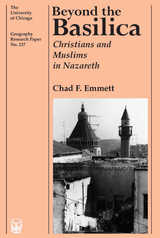
Emmett describes both the positive and negative effects of Nazareth’s residential patterns. He shows that the addition of new and ethnically mixed quarters has promoted mixed schools, joint holiday celebrations, a common political culture, and social networks that cross ethnic boundaries. But he also finds that tensions exist among Christian groups and between Muslims and Christians in regard to intersectarian marriages, religious conversion, attempts to establish a joint Christian cemetery, and the emergence of a local Islamic party.
Extensive interviews with leaders of religious groups, political parties, and residents reveal the way in which members of each ethnic community perceive one another. A survey of 300 families gives a wealth of details about the make-up of Nazareth’s population, including residential histories, religion, level of religious conviction, friendship and shopping patterns, and much more. Fourteen maps trace changes in the distribution of religious groups and political affiliation in Nazareth from the mid-nineteenth century to the present.
Beyond the Basilica will interest cultural geographers, historians, demographers, political scientists, and anyone who would like to learn more about an ethnically divided community in the residents cooperate more than they fight.
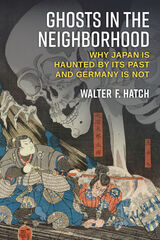
Germany, which brutalized its neighbors in Europe for centuries, has mostly escaped the ghosts of the past, while Japan remains haunted in Asia. The most common explanation for this difference is that Germany knows better how to apologize; Japan is viewed as “impenitent.” Walter F. Hatch rejects the conventional wisdom and argues that Germany has achieved reconciliation with neighbors by showing that it can be a trustworthy partner in regional institutions like the European Union and NATO; Japan has never been given that opportunity (by its dominant partner, the U.S.) to demonstrate such an ability to cooperate. This book rigorously defends the argument that political cooperation—not discourse or economic exchange—best explains Germany’s relative success and Japan’s relative failure in achieving reconciliation with neighbors brutalized by each regional power in the past. It uses paired case studies (Germany-France and Japan-South Korea; Germany-Poland and Japan-China) to gauge the effect of these competing variables on public opinion over time. With numerous charts, each of the four empirical chapters illustrates the powerful causal relationship between institution building and interstate reconciliation.
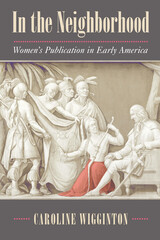
Winner of the 2018 Early American Literature Book Prize
In this compelling and original book, Caroline Wigginton reshapes our understanding of early American literary history. Overturning long-standing connections between the male-dominated print culture of pamphlets, broadsides, and newspapers and the transformative ideas that instigated the American Revolution, Wigginton explores how women's “relational publications”—circulated texts, objects, and performances—transformed their public and intimate worlds. She argues that Native, black, and white women's interpersonal "publications" revolutionized the dynamics of power and connection in public and private spaces, whether those spaces were Quaker meeting houses, Creek talwas, trading posts, burial grounds, or the women's own "neighborhoods."
Informed by deep and rich archival research, Wigginton's case studies explore specific instances of “relational publication.” The book begins with a pairing of examples—the statement a grieving Lenape mother made through a wampum belt and the political affiliations created when a salon hostess shared her poetry. Subsequent chapters trace a history of women's publication practice, including a Creek woman's diplomatic and legal procession-spectacles in the colonial Southeast, a black mother's expression of protest in Newport, Rhode Island, and the resulting evangelical revival, Phillis Wheatley's elegies that refigured neighborhoods of enslaved and free Bostonians, and a Quaker woman's pious and political commonplace book in Revolutionary Philadelphia.
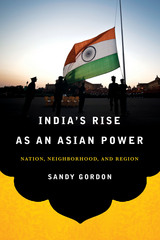
India’s Rise as an Asian Power examines India’s rise to power and the obstacles it faces in the context of domestic governance and security, relationships and security issues with its South Asian neighbors, and international relations in the wider Asian region. Instead of a straight-line projection based on traditional measures of power such as population size, economic growth rates, and military spending, Sandy Gordon’s nuanced view of India’s rise focuses on the need of any rising power to develop the means to deal with challenges in its domestic, neighborhood (South Asia), and regional (continental) spheres.
Terrorism, insurgency, border disputes, and water conflict and shortages are examples of some of India’s domestic and regional challenges. Gordon argues that before it can assume the mantle of a genuine Asian power or world power, India must improve its governance and security; otherwise, its economic growth and human development will continue to be hindered and its vulnerabilities may be exploited by competitors in its South Asian neighborhood or the wider region. This book will appeal to students and scholars of India and South Asia, security studies, foreign policy, and comparative politics, as well as country and regional specialists.

Gerald D. Suttles here offers an irreverent, highly critical guide to both the realities and myths of land-use planning and development in Chicago from 1976 through 1987.
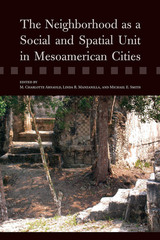
The contributions gathered here provide fieldwork data to document the existence of sociopolitically distinct neighborhoods within ancient Mesoamerican settlements, building upon recent advances in multi-scale archaeological studies of these communities. Chapters illustrate the cultural variation across Mesoamerica, including data and interpretations on several different cities with a thematic focus on regional contrasts. This topic is relatively new and complex, and this book is a strong contribution for three interwoven reasons. First, the long history of research on the “Teotihuacan barrios” is scrutinized and withstands the test of new evidence and comparison with other Mesoamerican cities. Second, Maya studies of dense settlement patterns are now mature enough to provide substantial case studies. Third, theoretical investigation of ancient urbanization all over the world is now more complex and open than it was before, giving relevance to Mesoamerican perspectives on ancient and modern societies in time and space.
This volume will be of interest not only to scholars and student specialists of the Mesoamerican past but also to social scientists and urbanists looking to contrast ancient cultures worldwide.
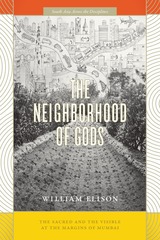
The Neighborhood of Gods explores this question, bringing an ethnographic lens to a range of visual and spatial practices: from the shrine construction that encroaches on downtown streets, to the “tribal art” practices of an indigenous group facing displacement, to the work of image production at two Bollywood film studios. A pioneering ethnography, this book offers a creative intervention in debates on postcolonial citizenship, urban geography, and visuality in the religions of India.

What can one neighborhood reveal about the making of a modern nation? The Neighborhood deciphers the unexpected significance of Xita, a half-square-mile quarter in Shenyang, in Northeast China. As the historian Nianshen Song shows, over nearly four centuries, Xita has been shaped and reshaped by empire, war, migration, and urban transformation. Remarkably, the history of this small area mirrors large-scale changes, including and especially China’s metamorphosis from a multiethnic Eurasian empire to a postindustrial society.
Song begins with Xita’s origins as a Qing-era Tibetan Buddhist center, following the lives of Mongol lamas and their imperial patrons. He tracks the neighborhood through the tumultuous twentieth century, when competing Russian and Japanese railway empires fueled its industrial growth, and Japanese colonizers turned it into a showcase for their imperial ambitions. Later, Xita became a vital enclave for Korea’s diaspora before emerging in the post-Mao era as a neon-lit hub of commerce and entertainment.
A thoroughly researched microhistory, The Neighborhood reveals how global forces play out in everyday spaces. By studying the emperors, warlords, merchants, laborers, and migrants who shaped Xita, Song presents a captivating and original perspective for understanding China’s past—not from the top down, but through the streets and people who lived it.
In 1990, Hartford, Connecticut, ranked as the eight poorest city in the country by the census; the real estate market was severely depressed; downtown insurance companies were laying off and the retail department stores were closing; public services were strained; and demolition sites abandoned for lack of funds pockmarked the streets. Hartford's problems are typical of those experienced in numerous U.S. cities affected by a lingering recession.
The harsh economic times felt throughout the city's workplaces and neighborhoods precipitated the formation of grassroots alliances between labor and community organizations. Coming together to create new techniques, their work has national implications for the development of alternative strategies for stimulating economic recovery.
Louise B. Simmons, a former Hartford City Councilperson, offers an insider's view of these coalitions, focusing on three activist unions—rhe New England Health Care Employees Union, the Hotel and Restaurant Employees, and the United Auto Workers—and three community groups—Hartford Areas Rally Together, Organized North Easterners-Clay Hill and North End, and Asylum Hill Organizing Project. Her in-depth analysis illustrates these groups' successes and difficulties in working together toward a new vision of urban politics.
In the series Labor and Social Change, edited by Paula Rayman and Carmen Sirianni.
The United States is rapidly changing from a country monochromatically divided between black and white into a multiethnic society. The Paradoxes of Integration helps us to understand America’s racial future by revealing the complex relationships among integration, racial attitudes, and neighborhood life.
J. Eric Oliver demonstrates that the effects of integration differ tremendously, depending on which geographical level one is examining. Living among people of other races in a larger metropolitan area corresponds with greater racial intolerance, particularly for America’s white majority. But when whites, blacks, Latinos, and Asian Americans actually live in integrated neighborhoods, they feel less racial resentment. Paradoxically, this racial tolerance is usually also accompanied by feeling less connected to their community; it is no longer "theirs." Basing its findings on our most advanced means of gauging the impact of social environments on racial attitudes, The Paradoxes of Integration sensitively explores the benefits and at times, heavily borne, costs of integration.
Why, even in the same high-crime neighborhoods, do robbery, drug dealing, and assault occur much more frequently on some blocks than on others? One popular theory is that a weak sense of community among neighbors can create conditions more hospitable for criminals, and another proposes that neighborhood disorder—such as broken windows and boarded-up buildings—makes crime more likely. But in his innovative new study, Peter K. B. St. Jean argues that we cannot fully understand the impact of these factors without considering that, because urban space is unevenly developed, different kinds of crimes occur most often in locations that offer their perpetrators specific advantages.
Drawing on Chicago Police Department statistics and extensive interviews with both law-abiding citizens and criminals in one of the city’s highest-crime areas, St. Jean demonstrates that drug dealers and robbers, for example, are primarily attracted to locations with businesses like liquor stores, fast food restaurants, and check-cashing outlets. By accounting for these important factors of spatial positioning, he expands upon previous research to provide the most comprehensive explanation available of why crime occurs where it does.
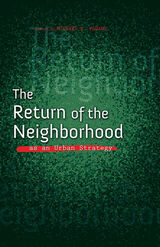
The topics focus on sustainable capital and societal investments in people and firms at the neighborhood level. Proposed solutions cover a range of possibilities for enhancing the quality of life for individuals, households, and neighborhoods. These include everything from microenterprises to factories; from social spaces for collective and social action to private facilities; from affordable housing and safety to gated communities; and from neighborhood public education to cooperative, charter, and private schools.
Contributors: Andy Clarno, Teresa Córdova, Nilda Flores-González, Pedro A. Noguera, Alice O'Connor, Mary Pattillo, Janet Smith, Nik Theodore, Elizabeth S. Todd-Breland, Stephanie Truchan, and Rachel Weber.
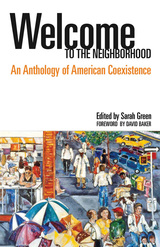
How to live with difference—not necessarily in peace, but with resilience, engagement, and a lack of vitriol—is a defining worry in America at this moment. The poets, fiction writers, and essayists (plus one graphic novelist) who contributed to Welcome to the Neighborhood don’t necessarily offer roadmaps to harmonious neighboring. Some of their narrators don’t even want to be neighbors. Maybe they grieve, or rage. Maybe they briefly find resolution or community. But they do approach the question of what it means to be neighbors, and how we should do it, with open minds and nuance.
The many diverse contributors give this collection a depth beyond easy answers. Their attentions to the theme of neighborliness as an ongoing evolution offer hope to readers: possible pathways for rediscovering community, even just by way of a shared wish for it. The result is an enormously rich resource for the classroom and for anyone interested in reflecting on what it means to be American today, and how place and community play a part.
Contributors include Leila Chatti, Rita Dove, Jonathan Escoffery, Rebecca Morgan Frank, Amina Gautier, Ross Gay, Mark Halliday, Joy Harjo, Edward Hirsch, Marie Howe, Sonya Larson, Dinty W. Moore, Robert Pinsky, Christine Schutt, and many more.

How to live with difference—not necessarily in peace, but with resilience, engagement, and a lack of vitriol—is a defining worry in America at this moment. The poets, fiction writers, and essayists (plus one graphic novelist) who contributed to Welcome to the Neighborhood don’t necessarily offer roadmaps to harmonious neighboring. Some of their narrators don’t even want to be neighbors. Maybe they grieve, or rage. Maybe they briefly find resolution or community. But they do approach the question of what it means to be neighbors, and how we should do it, with open minds and nuance.
The many diverse contributors give this collection a depth beyond easy answers. Their attentions to the theme of neighborliness as an ongoing evolution offer hope to readers: possible pathways for rediscovering community, even just by way of a shared wish for it. The result is an enormously rich resource for the classroom and for anyone interested in reflecting on what it means to be American today, and how place and community play a part.
Contributors include Leila Chatti, Rita Dove, Jonathan Escoffery, Rebecca Morgan Frank, Amina Gautier, Ross Gay, Mark Halliday, Joy Harjo, Edward Hirsch, Marie Howe, Sonya Larson, Dinty W. Moore, Robert Pinsky, Christine Schutt, and many more.
READERS
Browse our collection.
PUBLISHERS
See BiblioVault's publisher services.
STUDENT SERVICES
Files for college accessibility offices.
RECENTLY PUBLISHED




UChicago Accessibility Resources
home | accessibility | search | about | contact us
BiblioVault ® 2001 - 2026
The University of Chicago Press