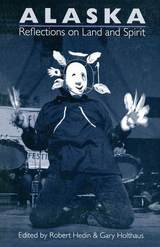
front cover of Alaska
Alaska
Reflections on Land and Spirit
Edited by Robert Hedin and Gary Holthaus
University of Arizona Press, 1989
This aptly named book contains 22 selections by John Muir, John McPhee, Barry Lopez, and others on Alaska and to some extent on the neighboring Yukon, accompanied by a small but evocative collection of photographs of Eskimos. The pieces, most of which are top-notch, vividly describe the harsh climate, the Arctic and sub-Arctic habitats, and the animals of Alaska, and tell the stories of the Native Americans and others who have made their home or worked in the North. This excellent sampler of some of the best writing on Alaska is recommended for academic and, especially, public libraries.
[more]

front cover of Betrayal of the Spirit
Betrayal of the Spirit
My Life behind the Headlines of the Hare Krishna Movement
Nori J. Muster
University of Illinois Press, 1996

Combining behind-the-scenes coverage of an often besieged religious group with a personal account of one woman's struggle to find meaning in it, Betrayal of the Spirit takes readers to the center of life in the Hare Krishna movement.

Nori J. Muster joined the International Society of Krishna Consciousness (ISKCON)--the Hare Krishnas--in 1978, shortly after the death of the movement's spiritual master, and worked for ten years as a public relations secretary and editor of the organization's newspaper, the ISKCON World Review. In this candid and critical account, Muster follows the inner workings of the movement and the Hare Krishnas' progressive decline.

Combining personal reminiscences, published articles, and internal documents, Betrayal of the Spirit details the scandals that beset the Krishnas--drug dealing, weapons stockpiling, deceptive fundraising, child abuse, and murder within ISKCON–as well as the dynamics of schisms that forced some 95 percent of the group's original members to leave. In the midst of this institutional disarray, Muster continued her personal search for truth and religious meaning as an ISKCON member until, disillusioned at last with the movement's internal divisions, she quit her job and left the organization.

In a new preface to the paperback edition, Muster discusses the personal circumstances that led her to ISKCON and kept her there as the movement's image worsened. She also talks about "the darkest secret"–child abuse in the ISKCON parochial schools--that was covered up by the public relations office where she worked.
[more]

front cover of Born to Belonging
Born to Belonging
Writings on Spirit and Justice
Mab Segrest
Rutgers University Press, 2002
Veteran activist Mab Segrest takes readers along on her travels to view a world experiencing extraordinary change. As she moves from place to place, she speculates on the effects of globalization and urban development on individuals, examines the struggles for racial, economic, and sexual equality, and narrates her own history as a lesbian in the American South. From the principle that we all belong to the human community, Segrest uses her personal experience as a filter for larger political and cultural issues. Her writings bring together such groups as the Ku Klux Klan in North Carolina, fledging gay rights activists in Zimbabwe, and resistance fighters in El Salvador. Segrest expertly plumbs her own personal experiences for organizing principles and maxims to combat racism, homophobia, sexism, and economic exploitation.


[more]

front cover of Building Womanist Coalitions
Building Womanist Coalitions
Writing and Teaching in the Spirit of Love
Edited by Gary L. Lemons
University of Illinois Press, 2019
Over the last generation, the womanist idea--and the tradition blooming around it--has emerged as an important response to separatism, domination, and oppression. Gary L. Lemons gathers a diverse group of writers to discuss their scholarly and personal experiences with the womanist spirit of women of color feminisms. Feminist and womanist-identified educators, students, performers, and poets model the powerful ways that crossing borders of race, gender, class, sexuality, and nation-state affiliation(s) expands one's existence. At the same time, they bear witness to how the self-liberating theory and practice of women of color feminism changes one's life. Throughout, the essayists come together to promote an unwavering vein of activist comradeship capable of building political alliances dedicated to liberty and social justice. Contributors: M. Jacqui Alexander, Dora Arreola, Andrea Assaf, Kendra N. Bryant, Rudolph P. Byrd, Atika Chaudhary, Paul T. Corrigan, Fanni V. Green, Beverly Guy-Sheftall, Susan Hoeller, Ylce Irizarry, M. Thandabantu Iverson, Gary L. Lemons, Layli Maparyan, and Erica C. Sutherlin
[more]

logo for Georgetown University Press
The Catholic Ethic and the Spirit of Community
John E. Tropman
Georgetown University Press, 2002

Starting where Max Weber's The Protestant Ethic and the Spirit of Capitalism left off, John E. Tropman develops the idea that there is another religious-based ethic permeating society, a Catholic ethic. Where Weber proposed that a Protestant ethic supported the development of capitalism, Tropman argues that there is a Catholic ethic as well, and that it is more caring and community-oriented.

Weber's notion of the Protestant ethic has become widely accepted, but until Tropman's work, beginning in the mid-1980s, there had been no discussion of another, religious-based ethic. He suggests that if the Protestant ethic is an "achievement" ethic, the Catholic ethic is a "helping" one. Tropman outlines a Catholic ethic that is distinctive in its sympathy and outreach toward the poor, and in its emphasis on family and community over economic success. This book fully explores the Catholic ethic and its differing focus by using both historical and survey research. It also points to the existence of other religious-based ethics.

This clearly written book, employing the tools of both sociology and religious thought, will appeal to a wide audience, including students and scholars in disciplines informed by the influence of religion on politics and on social and economic behavior.
[more]

front cover of Cindy Bentley
Cindy Bentley
Spirit of a Champion
Bob Kann
Wisconsin Historical Society Press, 2010
Cindy Bentley: Spirit of a Champion celebrates the life of one of Wisconsin's most inspirational leaders and activists. Born with an intellectual disability as the result of fetal alcohol syndrome, Cindy Bentley spent much of her childhood at the Southern Wisconsin Center for the Developmentally Disabled. No one expected her to learn the skills necessary to live on her own. To everyone's surprise, including her own, she did that and much more.

With the encouragement of a teacher at Southern Center, Cindy realized she had a deep passion for sports, and the discipline to train and compete. She began participating in Special Olympics, and gained confidence as she worked with teammates to earn medals in tennis, track and field, and even snowshoeing. Chosen as a Global Messenger for the Special Olympics International in 2000, Cindy has had dinner at the White House with two different American presidents, traveled around the world, and given speeches in front of thousands of people.

In these pages, young readers will learn what gives Cindy her champion spirit, and why she gave away some of her gold medals. Today, Cindy is still competing in Special Olympics. She also continues to advocate for people with disabilities, and helped to start People First, a statewide organization that encourages those with disabilities to speak up for their rights.

[more]

front cover of Critically Capitalist
Critically Capitalist
The Spirit of Asset Capitalism in South Korea
Bohyeong Kim
University of Michigan Press, 2025
Critically Capitalist presents an ethnography of South Korea’s asset seekers, including amateur stock investors, real estate enthusiasts, and money coaches, to demonstrate how financialized asset capitalism is sustained. As they hunt for profit margins, rent, and dividends, they simultaneously critique capitalism and posit their pursuit of assets as a form of resistance. Bohyeong Kim theorizes this new spirit of capitalism in South Korea as “critical capitalism,” arguing that it reflects the popular discontent with both national development and financial neoliberalism. As a paradoxical critique and legitimation, Bohyeong Kim argues that critical capitalism valorizes the capitalist economy not through a triumphant narrative, but by highlighting the emotional wounds, destroyed communities, and oppressive tactics of modern capitalism. 

Drawing on multi-sited ethnography and in-depth interviews with a broad community of aspiring millionaires, Critically Capitalist illuminates how contemporary capitalism thrives by channeling discontent into financial and real estate markets, which in turn has cemented critical capitalism as the cultural and affective backbone of South Korea’s economy.
[more]

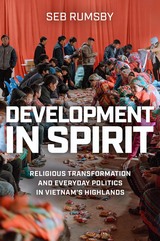
front cover of Development in Spirit
Development in Spirit
Religious Transformation and Everyday Politics in Vietnam’s Highlands
Seb Rumsby
University of Wisconsin Press, 2023
As state economic policies promote integration under a single logic of modernist development, many impoverished groups remain on the margins. Development in Spirit explores the practices employed by communities on the fringes of such nation-building projects. Using an everyday political economy lens, Seb Rumsby demonstrates how seemingly powerless actors actively engage with larger forces, shaping their experience of development in ways that are underexamined but have far-reaching consequences. 

Following state-led market reforms in the 1980s, Vietnam experienced stunning economic transformation. But for the Hmong communities of the country’s north and central highlands, the benefits proved elusive. Instead, the Hmong people have pursued their own alternative paths to development. Rumsby shows how mass conversion to Christianity led to a case of “unplanned development” that put the Hmong on a trajectory of simultaneous integration into the market economy and resistance to state authority. 

Many of the strategies community members employ are tied to the Christianization of everyday life. Religious actors play complex and often contradictory roles in facilitating networks of exchange, challenging or enforcing gender norms, promoting communalism and enforcing discipline, and shaping local ideas about progress. They are influenced by national and transnational religious networks, especially US-produced radio broadcasts by Hmong American Christians and local converts.

This compelling account provides fresh theoretical and empirical insights into the interplay of religion, neoliberal development, and marketization across the world. 

[more]

logo for Tupelo Press
Duties of the Spirit
Patricia Fargnoli
Tupelo Press, 2005
Duties of the Spirit is comprised of deeply moving, lyrical and unforgettable explorations of the joys and fears that come with growing older in America.

“These poems are stamped with an energetic and outgoing attentiveness to the world. This, so much more than just the humming examination of the self, is what makes writing a sacred thing. Who does this is a true poet, and few do it better than Patricia Fargnoli.”
— Mary Oliver
[more]

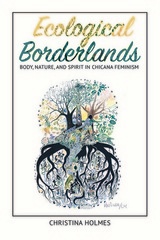
front cover of Ecological Borderlands
Ecological Borderlands
Body, Nature, and Spirit in Chicana Feminism
Christina Holmes
University of Illinois Press, 2016
Environmental practices among Mexican American woman have spurred a reconsideration of ecofeminism among Chicana feminists. Christina Holmes examines ecological themes across the arts, Chicana activism, and direct action groups to reveal how Chicanas can craft alternative models for ecofeminist processes.
 
Holmes revisits key debates to analyze issues surrounding embodiment, women's connections to nature, and spirituality's role in ecofeminist philosophy and practice. By doing so, she challenges Chicanas to escape the narrow frameworks of the past in favor of an inclusive model of environmental feminism that alleviates Western biases. Holmes uses readings of theory, elaborations of ecological narratives in Chicana cultural productions, histories of human and environmental rights struggles in the Southwest, and a description of an activist exemplar to underscore the importance of living with decolonializing feminist commitment in body, nature, and spirit.
 
[more]

front cover of Educating Mind, Body and Spirit
Educating Mind, Body and Spirit
The legacy of Quintin Hogg and The Polytechnic, 1864-1992
Helen Glew, Anthony Gorst, Michael Heller and Neil Matthews
University of Westminster Press, 2013

The story of the Polytechnic and of the legacy of Quintin Hogg is the third publication exploring the University of Westminster's long and diverse history. A fitting tribute to the life and legacy of Hogg, his holistic approach to education and the institute he created. This book is richly illustrated with images from the University's Archive.
[more]

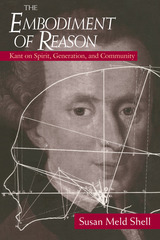
front cover of The Embodiment of Reason
The Embodiment of Reason
Kant on Spirit, Generation, and Community
Susan Meld Shell
University of Chicago Press, 1996
Commentators on the work of Immanuel Kant have long held that his later "critical" writings are a radical rejection of his earlier, less celebrated efforts. In this pathbreaking book, Susan Shell demonstrates not only the developmental unity of Kant's individual writings, but also the unity of his work and life experience.

Shell argues that the central animating issues of Kant's lifework concerned the perplexing relation of spirit to body. Through an exacting analysis of individual writings, Shell maps the philosophical contours of Kant's early intellectual struggles and their relation to his more mature thought. The paradox of mind in matter and the tensions it generates—between freedom and determinacy, independence and community, ideal and real—are shown to inform the whole of his work. Shell's fresh, penetrating analysis of the precritical works will surely catapult them to new prominence in Kant studies.

Shell's critique goes further to consider the context of contemporary intellectual life. She explores the fascinating realm of Kant's sexual and medical idiosyncracies, linking them to the primary concerns of his critical philosophy. She develops a sure-to-be controversial treatment of the connection between Kant's philosophy and his chronic hypochondria, and illuminates previously unforeseen connections in a remarkable convergence of life and thought, with important theoretical and practical implications for modern times.
[more]

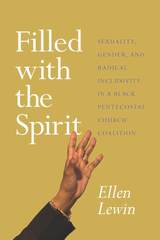
front cover of Filled with the Spirit
Filled with the Spirit
Sexuality, Gender, and Radical Inclusivity in a Black Pentecostal Church Coalition
Ellen Lewin
University of Chicago Press, 2018
In 2001, a collection of open and affirming churches with predominantly African American membership and a Pentecostal style of worship formed a radically new coalition. The group, known now as the Fellowship of Affirming Ministries or TFAM, has at its core the idea of “radical inclusivity”: the powerful assertion that everyone, no matter how seemingly flawed or corrupted, has holiness within. Whether you are LGBT, have HIV/AIDS, have been in prison, abuse drugs or alcohol, are homeless, or are otherwise compromised and marginalized, TFAM tells its people, you are one of God’s creations.

In Filled with the Spirit, Ellen Lewin gives us a deeply empathetic ethnography of the worship and community central to TFAM, telling the story of how the doctrine of radical inclusivity has expanded beyond those it originally sought to serve to encompass people of all races, genders, sexualities, and religious backgrounds. Lewin examines the seemingly paradoxical relationship between TFAM and traditional black churches, focusing on how congregations and individual members reclaim the worship practices of these churches and simultaneously challenge their authority. The book looks closely at how TFAM worship is legitimated and enhanced by its use of gospel music and considers the images of food and African American culture that are central to liturgical imagery, as well as how understandings of personal authenticity tie into the desire to be filled with the Holy Spirit. Throughout, Lewin takes up what has been mostly missing from our discussions of race, gender, and sexuality—close attention to spirituality and faith.
[more]

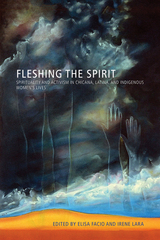
front cover of Fleshing the Spirit
Fleshing the Spirit
Spirituality and Activism in Chicana, Latina, and Indigenous Women’s Lives
Edited by Elisa Facio and Irene Lara
University of Arizona Press, 2014
Fleshing the Spirit brings together established and new writers exploring the relationships between the physical body, the spirit and spirituality, and social justice activism. Examining the complex and dynamic connections among these concepts, the writers emphasize the value of “flesh and blood experience” as a site of knowledge. They argue that spirituality—something quite different from institutional religious practice—can heal the mind/body split and set the stage for social change. Spirituality, they argue, is a necessary component of an alternative political agenda focused on equitable social and ecological change.

The anthology incorporates different genres of writing—such as poetry, testimonials, critical essays, and historical analysis—and stimulates the reader to engage spirituality in a critical, personal, and creative way. This interdisciplinary work is the first that attempts to theorize the radical interconnection between women of color, spirituality, and social activism. Before transformative political work can be done, the authors say in multiple ways, we must recognize that our spiritual need is a desire to more fully understand our relations with others. Conflict experienced on many levels sometimes severs those relations, separating us from others along racial, class, gender, sexual, national, or other socially constructed lines.

Fleshing the Spirit offers a spiritual journey of healing, health, and human revolution. The book’s open invitation to engage in critical dialogue and social activism—with the spirit and spirituality at the forefront—illuminates the way to social change and the ability to live in harmony with life’s universal energies.

Contributors
Volume Editors
Elisa Facio
Irene Lara
 
Chapter Authors
Angelita Borbón
Norma E. Cantú
Berenice Dimas
C. Alejandra Elenes
Alicia Enciso Litschi
Oliva M. Espín
Maria Figueroa
Patrisia Gonzales
Inés Hernández- Avila
Rosa María Hernández Juárez
Cinthya Martinez
Lara Medina
Felicia Montes
Sarahi Nuñez- Mejia
Laura E. Pérez
Brenda Sendejo
Inés Talamantez
Michelle Téllez
Beatriz Villegas
[more]

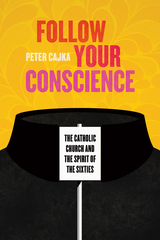
front cover of Follow Your Conscience
Follow Your Conscience
The Catholic Church and the Spirit of the Sixties
Peter Cajka
University of Chicago Press, 2021

Peter Cajka’s erudite book shows how even staunch Catholics were transformed by the maelstrom of the American Sixties, turning away from powerful and corrupt institutions and toward the inner moral compass provided by their own consciences.

What is your conscience? Is it, as Peter Cajka asks in this provocative book, “A small, still voice? A cricket perched on your shoulder? An angel and devil who compete for your attention?” Going back at least to the thirteenth century, Catholics viewed their personal conscience as a powerful and meaningful guide to align their conduct with worldly laws. But, as Cajka shows in Follow Your Conscience, during the national cultural tumult of the 1960s, the divide between the demands of conscience and the demands of the law, society, and even the church itself grew increasingly perilous. As growing numbers of Catholics started to consider formerly stout institutions to be morally hollow—especially in light of the Vietnam War and the church’s refusal to sanction birth control—they increasingly turned to their own consciences as guides for action and belief. This abandonment of higher authority had radical effects on American society, influencing not only the broader world of Christianity, but also such disparate arenas as government, law, health care, and the very vocabulary of American culture. As this book astutely reveals, today’s debates over political power, religious freedom, gay rights, and more are all deeply infused by the language and concepts outlined by these pioneers of personal conscience.

[more]

logo for Intellect Books
Franklin Furnace and the Spirit of the Avant-Garde
A History of the Future
Toni Sant
Intellect Books, 2011

Franklin Furnace is a renowned New York–based artsorganization whose mission is to preserve, document, and present works of avant-garde art by emerging artists—particularly those whose works may be vulnerable due to institutional neglect or politically unpopular content. Over more than thirty years, Franklin Furnace has exhibited works by hundreds of avant-garde artists, some of whom—Laurie Anderson, Vito Acconci, Karen Finley, Guillermo Gómez-Peña, Jenny Holzer, and the Blue Man Group, to name a few—are now established names in contemporary art.

Here, for the first time, is a comprehensive history of this remarkable organization from its conception to the present. Organized around the major art genres that emerged in the second half of the twentieth century, this book intersperses first-person narratives with readings by artists and scholars on issues critical to the organization's success as well as Franklin Furnace's many contributions to avant-garde art.

[more]

front cover of God Owes Us Nothing
God Owes Us Nothing
A Brief Remark on Pascal's Religion and on the Spirit of Jansenism
Leszek Kolakowski
University of Chicago Press, 1995
God Owes Us Nothing reflects on the centuries-long debate in Christianity: how do we reconcile the existence of evil in the world with the goodness of an omnipotent God, and how does God's omnipotence relate to people's responsibility for their own salvation or damnation. Leszek Kolakowski approaches this paradox as both an exercise in theology and in revisionist Christian history based on philosophical analysis. Kolakowski's unorthodox interpretation of the history of modern Christianity provokes renewed discussion about the historical, intellectual, and cultural omnipotence of neo-Augustinianism.

"Several books a year wrestle with that hoary conundrum, but few so dazzlingly as the Polish philosopher's latest."—Carlin Romano, Washington Post Book World

"Kolakowski's fascinating book and its debatable thesis raise intriguing historical and theological questions well worth pursuing."—Stephen J. Duffy, Theological Studies

"Kolakowski's elegant meditation is a masterpiece of cultural and religious criticism."—Henry Carrigan, Cleveland Plain Dealer
[more]

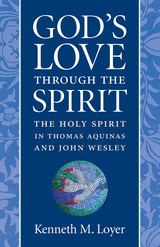
front cover of God's Love through the Spirit
God's Love through the Spirit
Kenneth M. Loyer
Catholic University of America Press, 2014
Although the doctrine of the Holy Spirit has often been a neglected subject in theology, it remains vital for understanding both the Christian confession of God as Trinity and the nature of the Christian life. In view of those two topics, God's Love through the Spirit examines the relationship between love and the person and work of the Holy Spirit in Thomas Aquinas and John Wesley - two very different figures whose teachings on the Spirit and the Christian life are found to be, on the whole, surprisingly compatible. An investigation into Aquinas's amor-based pneumatology, including a groundbreaking analysis of his recently discovered Pentecost sermon, and a fresh assessment of the doctrine of sanctification in Wesley show that in distinctive yet largely complementary ways, Aquinas and Wesley provide resources that can be used to reclaim a richer pneumatology, specifically in relation to the theological virtue of love.
[more]

front cover of Health in a Fragile State
Health in a Fragile State
Science, Sorcery, and Spirit in the Lower Congo
John M. Janzen
University of Wisconsin Press, 2019
Based on extensive field research in the Manianga region of the Lower Congo, Health in a Fragile State is an anthropological account of public health and health care after the collapse of the Congolese state in the 1980s and 1990s. This work brings into focus John M. Janzen's earlier books on African health and healing, revealing the collaborative effort by local, national, and international agencies to create viable alternative institutions to those that represented the centralized state. This book documents and analyzes the realignment of existing institutions and the creation of new ones that shape health and healing.
Janzen explores the manner in which power and information, including science, are legitimized in the preservation and improvement of health. Institutional validity and knowledge empower citizens and health practitioners to gain the upper hand over the region's principal diseases, including malaria, tuberculosis, typhoid, and HIV/AIDS.
[more]

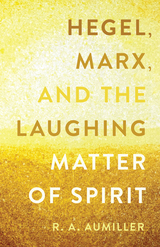
front cover of Hegel, Marx, and the Laughing Matter of Spirit
Hegel, Marx, and the Laughing Matter of Spirit
R. A. Aumiller
Northwestern University Press, 2026
Excavating the comedic crack in historical repetitions
 
What happens when those who have been denied political subjectivity fully play out their negative role in a historical drama that damned them from the beginning? Hegel, Marx, and the Laughing Matter of Spirit locates the eruption of revolutionary laughter in historical cracks across nineteenth- and twentieth-century Europe, where exiled philosophers, partisan fighters, and artists framed their political resistance as a historical comedy. Hegelian comedy fuels the Young Hegelian critique of Prussian censorship, Walter Benjamin’s staging of the anti-fascist resistance, and the Yugoslavian partisan attempt to begin again in fascism’s aftermath. Revolution erupts from a historical stage that can no longer look on its own contradictions with a straight face. Drawing on the defiant spirit of comedy, this Hegelian feminist manifesto defies political despair, overturning the perception that history tragically repeats itself. Invoking the phrase “Nothing changes” as a mantra, R. A. Aumiller turns a concession of defeat into a battle cry for political resistance.
[more]

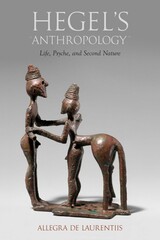
front cover of Hegel’s Anthropology
Hegel’s Anthropology
Life, Psyche, and Second Nature
Allegra de Laurentiis
Northwestern University Press, 2021
This book provides a critical analysis of Hegel’s Anthropology, a long-neglected treatise dedicated to the psyche, or “soul,” that bridges Hegel’s philosophy of organic nature with his philosophy of subjective spirit. Allegra de Laurentiis recuperates this overlooked text, guiding readers through its   essential arguments and ideas. She shows how Hegel conceives of the “sublation” of natural motion, first into animal sentience and then into the felt presentiment of selfhood, all the way to the threshold of self-reflexive thinking. She discusses the Anthropology in the context of Hegel’s mature system of philosophy (the Encyclopaedia) while also exposing some of the scientific and philosophical sources of his conceptions of unconscious states, psychosomatism, mental pathologies, skill formation, memorization, bodily habituation, and the self-conditioning capacities of our species. This treatise on the becoming of anthropos, she argues, displays the power and limitations of Hegel’s idealistic “philosophy of the real” in connecting such phenomena as erect posture, a discriminating hand, and the forward gaze to the emergence of the human ego, or the structural disintegration of the social world to the derangement of the individual mind.
 
A groundbreaking contribution to scholarship on Hegel and nineteenth-century philosophy, this book shows that the Anthropology is essential to understanding Hegel’s concept of spirit, not only in its connection with nature but also in its more sophisticated realizations as objective and absolute spirit. Future scholarship on this subject will recount—and build upon—de Laurentiis’s innovative study.
[more]

front cover of Hegel's Energy
Hegel's Energy
A Reading of The Phenomenology of Spirit
Michael Marder
Northwestern University Press, 2021
Hegel’s The Phenomenology of Spirit has been one of the most important works of philosophy since the nineteenth century, while the question of energy has been crucial to life in the twenty-first century. In this book, Michael Marder integrates the two, narrating a story about the trials and tribulations of energy embedded in Hegel’s dialectics. Through an original interpretation of actuality (Wirklichkeit) as energy in the Hegelian corpus, the book provides an exciting lens for understanding the dialectical project and the energy‑starved condition of our contemporaneity. To elaborate this theory, Marder undertakes a meticulous rereading of major parts of the Phenomenology, where the energy deficit of mere consciousness gives way to the energy surplus of self‑consciousness and its self‑delimitation in the domain of reason. In so doing, he denounces the current understanding of energy as pure potentiality, linking this mindset to pollution, profit-driven economies, and environmental crises. Surprising and deeply engaged with its contemporary implications, this book doesn’t simply illuminate aspects of The Phenomenology of Spirit—it provides an entirely new understanding of Hegel’s ideas.
 
[more]

front cover of Hegel's Phenomenology of Spirit
Hegel's Phenomenology of Spirit
A Commentary Based on the Preface and Introduction
Werner Marx
University of Chicago Press, 1988
Hegel's classic Phenomenology of Spirit is considered by many to be the most difficult text in all of philosophical literature. In interpreting the work, scholars have often used the Phenomenology to justify the ideology that has tempered their approach to it, whether existential, ontological, or, particularly, Marxist. Werner Marx deftly avoids this trap of misinterpretation by rendering lucid the objectives that Hegel delineates in the Preface and Introduction and using these to examine the whole of the Phenomenology. Marx considers selected materials from Hegel's text in order both to clarify Hegel's own view of it and to set the stage for an examination of post-Hegelian philosophy.

The primary focus of Marx's book is on the account. Hegel gives of the phenomenological journey from natural consciousness to philosophical wisdom (or absolute knowledge, as Hegel calls it). In showing that Hegel's many statements concerning consciousness 'finding itself' or 'knowing itself' in its world can be understood as discovering the rationality of the conditioning world, Marx offers a solution to several sets of interrelated problems that have troubled students of Hegel. His book contains valuable analyses of the relation between Hegel's thought and that of Descartes and Kant as well as that of Karl Marx, and it also sheds considerable light on the question of the internal unity or coherence of the Phenomenology.
[more]

logo for Ohio University Press
Hegel’s Phenomenology, Part 2
The Evolution of Ethical and Religious Consciousness to the Absolute Standpoint
Howard P. Kainz
Ohio University Press, 1983

The publication in 1807 of Georg Wilhelm Frederich Hegel’s Phanomenologie des Geistes (translated alternately as “Phenomenology of Mind” or “Phenomenology of Spirit”) marked the beginning of the modern era in philosophy. Hegel’s remarkable insights formed the basis for what eventually became the Existentialist movement. Yet the Phenomenology remains one of the most difficult and forbidding works in the canon of philosophical literature.

[more]

front cover of The High School
The High School
Sports, Spirit, and Citizens, 1903-2024
Michael A. Messner
Rutgers University Press, 2025
High school yearbooks provide both a vivid snapshot of student life and a reflection of what the adults in the community valued the most. For instance, athletics are often covered more than academics, and boys’ sports routinely receive more attention than girls’ sports. But how have those values changed over time?
 
In The High School, acclaimed sociologist Michael A. Messner reads through 120 years of El Gabilan, the yearbook from his own alma mater, Salinas High School in California, where his father taught and coached. Treating the yearbooks as a historical archive, Messner makes surprising discoveries about the school he thought he knew so well. For example, over fifty years before Title IX, the earliest yearbooks gave equal spotlights to boys’ and girls’ athletics, while the cheerleaders were all boys.
 
Tracing American life and culture from 1903 to 2024, Messner illuminates shifts in social practices at his high school that reflect broader changes in American culture across the twentieth century. The High School spotlights how the meanings and iconography of certain activities have changed radically over the decades, even as the “sports spirit complex”—involving athletes, cheerleaders, band members, and community boosters—has remained a central part of the high school experience. By exploring evolving sports cultures, socioeconomic conditions, racial demographics, and gender norms, Messner offers a fresh perspective on a defining feature of American teenage life.
 
[more]

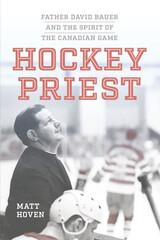
front cover of Hockey Priest
Hockey Priest
Father David Bauer and the Spirit of the Canadian Game
Matt Hoven
Catholic University of America Press, 2024
Born in Waterloo, Ontario, in 1924, to a prominent family, David Bauer attended St. Michael’s College-School run by the Basilian Fathers of Toronto. After serving in World War II, Bauer joined the religious community and coached its St. Michael’s Majors to a national championship in 1961. Influenced by philosophers like Jacques Maritain, Bauer tried to find solutions to problems created within elite hockey and thus founded Canada’s first ever National Team program. This team countered the cutthroat ideals of hockey’s powerbrokers and set out to return Canada to international glory. The team represented the nation at several global tournaments and three Winter Olympic Games. Bauer was posthumously inducted into the Hockey Hall of Fame in 1989. Hockey Priest looks past simply understanding Bauer as a do-gooder or hockey innovator. It shows how he attempted to create a different stream of hockey that could better support youth and so build up the nation. Archival research for the book uncovered Bauer-written hockey reports, speeches, and notes that detail his thinking about the game and his politicking to bring about change in it. Interviews with dozens of associates and family members told the story of his bold efforts to take on the National Hockey League. Despite his work being undermined by some supporters of the corporate game, Bauer offered a vision for Canada’s sport that remains an important counterpoint in the sport’s history and its ongoing challenges.
[more]

front cover of In the Spirit of Alinsky
In the Spirit of Alinsky
Community Organizing’s Fight to Strengthen Democracy
Robert T. Gannett Jr.
University of Illinois Press, 2026
Community-based organizing stands at a crossroads at a time when anti-democratic headwinds and authoritarian impulses threaten American society as never before. Robert T. Gannett Jr. draws on a forty-year career as a grassroots activist to make an impassioned plea for citizens to create the robust infrastructure of organizing that is necessary to sustain modern-day democracy.

As Gannett shows, the methods pioneered by legendary activist Saul Alinsky provide the means for channeling citizens’ anger and frustration into meaningful social change. Gannett weaves his personal journey as an “outside agitator” through in-depth studies of successful and unsuccessful campaigns. Gannett places financial sustainability, political independence, and a commitment to process as much as to purpose at the core of organizing. He also focuses on the importance of veterans mentoring the next generation to meet the challenges of the future.

Hard-headed but hopeful, In the Spirit of Alinsky distills decades of on-the-ground experience into a guide for effective radical action.
[more]

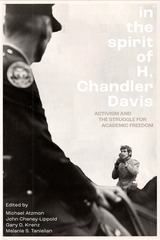
front cover of In the Spirit of H. Chandler Davis
In the Spirit of H. Chandler Davis
Activism and the Struggle for Academic Freedom
Edited by Michael Atzmon, John Cheney-Lippold , Gary D. Krenz, and Melanie S. Tanielian
Disobedience Press, 2026

The essays collected in this book honor H. Chandler Davis (1926-2022), a University of Michigan faculty member who became a symbol of principled dissent when suspended and fired in 1954 for refusing to testify about his political affiliations to the House Un-American Activities Committee. Invoking academic freedom and First Amendment protection, Davis was convicted of contempt of Congress. He served six months in prison before moving to Canada, where he established himself as a brilliant mathematician, prolific writer, and ardent and much beloved advocate for justice.

At a time when a new McCarthyism has come roaring back to threaten free inquiry everywhere, the 12 contributors to this book argue against censorship, the suppression of protest, the policed and surveilled campus, the self-silencing of "institutional neutrality," and other enemies of academic freedom. Also included in this volume is posthumously published work by Davis and by his late wife, the historian Natalie Zemon Davis, which reflects on the importance of facing, and not accepting, authoritarian threats. 

Inspired by Chandler Davis’ courage, integrity, and devotion to the struggle against oppression, injustice, and the persecution of speech, these essays offer crucial insights into the importance of defending intellectual independence, institutional autonomy, and the right to free expression.

Contributors: Michael Bérubé, Juan Cole, H. Chandler Davis, Stefan Hanß, Marjorie Heins, Dima Khalidi, Gene Nichol, Henry Reichman, Ellen Schrecker, Joan Scott, Catharine R. Stimpson, Alan Wald, Silke-Maria Weineck, and Natalie Zemon Davis.

[more]

front cover of In the Spirit of Wetlands
In the Spirit of Wetlands
Reviving Habitat in the Illinois River Watershed
Text by Clare Howard. Photographs by David Zalaznik
University of Illinois Press, 2022
Individuals from all walks of life have devoted their time, energy, and money to restoring the state's lost wetlands. Clare Howard and David Zalaznik take readers into the marshes, bogs, waterways, and swamps brought back to life by these wetland pioneers. Howard’s storytelling introduces grassroots conservators dedicated to learning through trial and error, persistence, and listening to the lessons taught by wetlands. They undertake hard work inspired by ever-increasing floods and nutrient runoff, and they reconnect the Earth’s natural rhythms. Zalaznik's stunning black and white photos illuminate changes in the land and the people themselves. Seeds sprout after lying dormant for one hundred years. Water winds through ancient channels. Animals and native plants return. As the forgiving spirit of a wetland emerges, it nurtures a renewed landscape that alters our view of the environment and the planet.

An inspiring document of passion and advocacy, In the Spirit of Wetlands reveals the transformative power of restoration.

[more]

front cover of Inside Tenement Time
Inside Tenement Time
Suss, Spirit, and Surveillance
Kezia Page
Rutgers University Press, 2025

Inside Tenement Time is the first comprehensive treatment of literary and cultural texts on surveillance in the Caribbean. Covering the long historical arc of the twentieth to the twenty-first centuries, Inside Tenement Time uses Jamaica as a case study to examine moments of crisis and particular spaces, especially urban yard enclaves and their environs, in the Caribbean encounter with surveillance. Making the argument that the Caribbean situation reveals flexible hegemonies rather than provinces of exclusive control, the book demonstrates the countervailing force of sussveillance and spiritveillance, Afro-Indigenous variations on surveillance. Sussveillance and spiritveillance are exemplars of vernacular arts and sciences that operate at and within the frangible borders of state power, exposing the unique dynamics of surveillance in the region and marshalling the acts of imagination with which it contends. For example, the Smile Jamaica concert of 1976, headlined by reggae Superstar Bob Marley, and the reputedly US government-backed 2010 Tivoli Gardens incursion in West Kingston, both moments that have dramatic, even mythic residue in Caribbean and global memory, are among the real-life events brought into conversation with literary representations of this history.
[more]

front cover of The Labour of Spirit
The Labour of Spirit
Massimo Cacciari
Seagull Books, 2025
A provocative examination of the fate of autonomous, creative labor under capitalism.

Between 1917 and 1919, Max Weber delivered two lectures titled Die geistige Arbeit als Beruf, which we might translate as The Labour of Spirit as Vocation. This weighty formula represented the hope that animated the world of bourgeois culture from the likes of Kant, Goethe, Schiller, Fichte, and Hegel and would later form the earliest threads of revolutionary thought from Feuerbach and Marx. The “labor of spirit” is creative, autonomous labor—human labor understood in its fully effectual power. To press for its realization is to liberate all activity from the condition of commanded or alienated work. But the dissolution of the labor of spirit into the capitalist form of production, into the universal machinism that swallows up that science which remains the true engine of development, also ends up delegitimating political authority, whose own foundation lies in the “promise of liberation.”

Massimo Cacciari takes up old questions and confronts them anew: Is the “iron cage” fated to imprison that “labor of spirit” that is political praxis? Will the spirit of capitalism end up completely undermining the space of the political? Or are relations between science and politics still thinkable that might free us from our “debt” as we proceed without means or ends within the techno-economic system?
[more]

front cover of Mad and Divine
Mad and Divine
Spirit and Psyche in the Modern World
Sudhir Kakar
University of Chicago Press, 2009

Sudhir Kakar, India’s foremost practitioner of psychoanalysis, has focused his career on infusing this preeminently Western discipline with ideas and views from the East. In Mad and Divine, he takes on the separation of the spirit and the body favored by psychoanalysts, cautioning that a single-minded focus on the physical denies a person’s wholeness. Similarly, Kakar argues, to focus on the spirit alone is to hold in contempt the body that makes us human.

Mad and Divine looks at the interplay between spirit and psyche and the moments of creativity and transformation that occur when the spirit overcomes desire and narcissism. Kakar examines this relationship in religious rituals and healing traditions— both Eastern and Western—as well as in the lives of some extraordinary men: the mystic and guru Rajneesh, Gandhi, and the Buddhist saint Drukpa Kunley.

Enriched with a novelist’s felicity of language and an analyst’s piercing insights and startling interpretations, Mad and Divine is a valuable addition to the literature on the integration of the spirit and psyche in the evolving psychology of the individual.
[more]

front cover of Metaphor, Morality, and the Spirit in Romans 8
Metaphor, Morality, and the Spirit in Romans 8
1-17
William E. W. Robinson
SBL Press, 2016

Engage compelling arguments that challenge prominent positions in Pauline studies

In this innovative book, William E. W. Robinson takes the reader on a journey through Romans 8:1–17 using Conceptual Metaphor Theory and Conceptual Integration Theory. Robinson delineates the underlying cognitive metaphors, their structure, their function, what they mean, and how Paul’s audiences then and now are able to comprehend their meaning. He examines each metaphor in the light of relevant aspects of the Greco-Roman world and Paul’s Jewish background. Robinson contends that Paul portrays the Spirit as the principal agent in the religious-ethical life of believers. At the same time, his analysis demonstrates that the conceptual metaphors in Romans 8:1–17 convey the integral role of believers in ethical conduct. In the process, he addresses thorny theological issues such as whether Spirit and flesh signal an internal battle within believers or two conflicting ways of life. Finally, Robinson shows how this study is relevant to related Pauline passages and challenges scholars to incorporate these methods into their own investigation of biblical texts.

Features:

  • Sustained argument that sheds new light on how Paul communicates with his audiences
  • Substantial contribution to current debates about central theological concepts
  • Conceptual Metaphor Theory and Conceptual Integration Theory applied to the metaphors in Romans 8:1-17
[more]

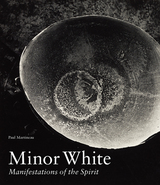
front cover of Minor White
Minor White
Manifestations of the Spirit
Paul Martineau
J. Paul Getty Trust, The, 2014
A beautifully illustrated tribute to one of the most influential photographers of the twentieth century.

Controversial, misunderstood, and sometimes overlooked, Minor White (1908–1976) is one of the great photographers of the twentieth century, whose ideas exerted a powerful influence on a generation of photographers and still resonate today. His photographic career began in 1938 in Portland, Oregon, with assignments for the WPA (Works Progress Administration). After serving in World War II and studying art history at Columbia University, White’s focus shifted toward the metaphorical. He began creating images charged with symbolism and a critical aspect called equivalency, referring to the invisible spiritual energy present in a photograph made visible to the viewer.

This book brings together White’s key biographical information—his evolution as a photographer, teacher of photography, and editor of Aperture, as well as particularly insightful quotations from his journals, which he kept for more than forty years. The result is an engaging narrative that weaves through the main threads of White’s life, his growth as an artist, as well as his spiritual search and ongoing struggle with his own sexuality and self-doubt. He sought comfort in a variety of religious practices that influenced his continually metamorphosing artistic philosophy.
[more]

logo for Catholic University of America Press
The Monastic In Each of Us
Heart, Mind, Body, Soul and Spirit
Tim Vivian
Catholic University of America Press, 2026
The Monastic in Each of Us offers eight chapters on early-monastic themes relevant for spiritual seekers today. In August 2024, at the invitation of Abbot James Wiseman, the author gave seven retreat talks for the brothers at St. Anselm’s Abbey in Washington, D.C., on early-monastic spirituality and its relevance for us today. The revised talks here, with an additional chapter, offer more accessible discussions both for a general non-monastic audience and monastic readers. Chapter 1, “The Desert Fathers and Mothers and the Ascetic Tradition,” offers an introduction to the early monastics and their teachings on asceticism and spirituality. Chapters 2 and 3 cover “Ego and Humility & The Path to Transformation” and “Some Monastic and Universal Virtues.” Chapter 4, “A Fire That Burns Without Consuming,” offers an imagined conversation with Mary Margaret Funk, O.S.B, author of Thoughts Matter: Discovering the Spiritual Tradition, on the importance of early-monastic spirituality for today. Chapters 5 and 6 discuss some major themes: asceticism, sin, the passions, thoughts, and the importance of community. Chapter 7 focuses on Poemen, an early monastic, and the theme of judging to discernment to compassion. The concerns these chapters look at, and the practices given and hope offered are human and still speak to us today. The final chapter offers brief discussions of what the early monastics call the eight “principal thoughts”: gluttony/greed, sexual immorality, love of money, gloominess, anger, acedia, self-importance, and excessive pride. Thoughts, and their discernment, are key in early monasticism, and can be for us. As John Chryssavgis stresses, “our thoughts” can “inhibit us in our relationships with others and with God. Disclosing our thoughts to a ‘physician’ is a step in the direction of trust and community. It is less a way of dealing with the past, than of directing our future.”
[more]

front cover of Money and Modernity
Money and Modernity
Pound, Williams, and the Spirit of Jefferson
Alec Marsh
University of Alabama Press, 1998
Marsh locates Pound and Williams firmly in the Jeffersonian tradition and examines their epic poems as manifestations of a Jeffersonian ideology in modernist terms.

The modernist poets William Carlos Williams and Ezra Pound were latter-day Jeffersonians whose politics and poetry were strongly marked by the populism of the late 19th century. They were sharply aware of the social contradictions of modernization and were committed to a highly politicized, often polemical poetry that criticized finance capitalism and its institutions--notably banks--in the strongest terms.

Providing a history of the aesthetics of Jeffersonianism and its collision with modernism in the works of Pound and Williams, Alec Marsh traces "the money question" from the republican period through the 1940s. Marsh can thus read two modernist epics--Pound's Cantos and Williams's Paterson--as the poets hoped they would be read, as attempts to break the hold of "false" financial values on the American imagination.

Marsh argues that Pound's and Williams's similar Jeffersonian outlooks were the direct result of the political battles of the 1890s concerning the meaning of money. Although Pound's interest in money and economics is well known, few people are aware that both poets were active in the Social Credit monetary-reform movement of the 1930s and 1940s, a movement shown by Marsh to have direct links to Jeffersonianism via American populism.  Ultimately, the two poets took divergent paths, with Pound swerving toward Italian fascism (as exemplified in his Jefferson and/or Mussolini) and Williams becoming deeply influenced by the American pragmatism of John Dewey. Thus, Marsh concludes, Pound embraced the fascist version of state-capitalism whereas his old friend proclaimed a pragmatic openness to the new selves engendered by corporate capitalism.

Money and Modernity exemplifies the best of recent literary criticism in its incorporation of American studies and cultural studies approaches to bring new insight to modern masterworks.
[more]

front cover of Montesquieu's Philosophy of Liberalism
Montesquieu's Philosophy of Liberalism
A Commentary on The Spirit of the Laws
Thomas L. Pangle
University of Chicago Press, 1973
This first comprehensive commentary on The Spirit of the Laws uncovers and explicates the plan of Montesquieu's famous but baffling treatise. Pangle brings to light Montesquieu's rethinking of the philosophical groundwork of liberalism, showing how The Spirit of the Laws enlarges and enriches the liberal conception of natural right by means of a new appeal to History as the source of basic norms.
[more]

front cover of Of Derrida Heidegger and Spirit
Of Derrida Heidegger and Spirit
David Wood
Northwestern University Press, 1993
Jacques Derrida's De l'espirit: Heidegger et la question is one of his most interesting and accessible later works. In it, Derrida attempts to come to terms with Heidegger's Nazi connections by way of an extended reflection on Heidegger's use of the term "Geist." In Of Derrida, Heidegger, and Spirit, David Wood presents a variety of powerful and distinctive responses to Derrida's book.
[more]

front cover of Of Spirit
Of Spirit
Heidegger and the Question
Jacques Derrida
University of Chicago Press, 1990
"I shall speak of ghost, of flame, and of ashes." These are the first words of Jacques Derrida's lecture on Heidegger. It is again a question of Nazism—of what remains to be thought through of Nazism in general and of Heidegger's Nazism in particular. It is also "politics of spirit" which at the time people thought—they still want to today—to oppose to the inhuman.

"Derrida's ruminations should intrigue anyone interested in Post-Structuralism. . . . . This study of Heidegger is a fine example of how Derrida can make readers of philosophical texts notice difficult problems in almost imperceptible details of those texts."—David Hoy, London Review of Books

"Will a more important book on Heidegger appear in our time? No, not unless Derrida continues to think and write in his spirit. . . . Let there be no mistake: this is not merely a brilliant book on Heidegger, it is thinking in the grand style."—David Farrell Krell, Research in Phenomenology

"The analysis of Heidegger is brilliant, provocative, elusive."—Peter C. Hodgson, Religious Studies Review
[more]

front cover of Of Spirit
Of Spirit
Heidegger and the Question
Jacques Derrida
University of Chicago Press, 1989
"I shall speak of ghost, of flame, and of ashes." These are the first words of Jacques Derrida's lecture on Heidegger. It is again a question of Nazism—of what remains to be thought through of Nazism in general and of Heidegger's Nazism in particular. It is also "politics of spirit" which at the time people thought—they still want to today—to oppose to the inhuman.

"Derrida's ruminations should intrigue anyone interested in Post-Structuralism. . . . . This study of Heidegger is a fine example of how Derrida can make readers of philosophical texts notice difficult problems in almost imperceptible details of those texts."—David Hoy, London Review of Books

"Will a more important book on Heidegger appear in our time? No, not unless Derrida continues to think and write in his spirit. . . . Let there be no mistake: this is not merely a brilliant book on Heidegger, it is thinking in the grand style."—David Farrell Krell, Research in Phenomenology

"The analysis of Heidegger is brilliant, provocative, elusive."—Peter C. Hodgson, Religious Studies Review
[more]

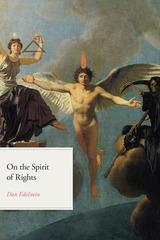
front cover of On the Spirit of Rights
On the Spirit of Rights
Dan Edelstein
University of Chicago Press, 2018
By the end of the eighteenth century, politicians in America and France were invoking the natural rights of man to wrest sovereignty away from kings and lay down universal basic entitlements. Exactly how and when did “rights” come to justify such measures?
 
In On the Spirit of Rights, Dan Edelstein answers this question by examining the complex genealogy of the rights that regimes enshrined in the American and French Revolutions. With a lively attention to detail, he surveys a sprawling series of debates among rulers, jurists, philosophers, political reformers, writers, and others who were all engaged in laying the groundwork for our contemporary systems of constitutional governance. Every seemingly new claim about rights turns out to be a variation on a theme, as late medieval notions were subtly repeated and refined to yield the talk of “rights” we recognize today. From the Wars of Religion to the French Declaration of the Rights of Man and of the Citizen to the 1948 Universal Declaration of Human Rights, On the Spirit of Rights is a sweeping tour through centuries of European intellectual history and an essential guide to our ways of thinking about human rights today.

[more]

logo for University of Chicago Press
One in Spirit
The University of Chicago Archives
University of Chicago Press, 1991

front cover of Origen
Origen
Spirit and Fire
Hans Urs von Balthasar
Catholic University of America Press, 1984

logo for University of Wisconsin Press
Political Fiction, the Spirit of Age, and Allen Drury
Tom Kemme
University of Wisconsin Press, 1987
The President of the United States, says the Constitution, cannot act in many specified instances without the "advice and consent" of Congress. But "advice" is not a strong word. And taking or not taking advice is a fairly nebulous situation . . . creating an instability, a fundamental ambiguity, at the very heart of power, between the Congress and the President. It is this instability, and this wide-openness, that allows the free play of the more intangible types of power that begin where the constitution breaks off: sex, personality, and character. Things which are left out of civics textbooks are what Allen Drury took as his subject in such novels as Advise and Consent, A Shade of Difference, and Capable of Honor.
[more]

front cover of Reckoning with Spirit in the Paradigm of Performance
Reckoning with Spirit in the Paradigm of Performance
Donnalee Dox
University of Michigan Press, 2016
Performance has become a paradigm for analyzing contemporary culture, a pattern that structures a particular view of human interaction and experience. Performance is also widely used to better understand how we express values and ideas, including religious beliefs. Reckoning with Spirit in the Paradigm of Performance asks how the sensibilities of religious experience, which many people call spirituality, shape people's performance. When we observe people performing words, dances, music, and rituals they consider sacred, what (if any) conclusions can we draw about their experiences from what we see, read, and hear? By analyzing performances of spirituality and what people experience as "spirit," this book adds a new dimension to the paradigm of performance.

Rather than reducing the spiritual dimension to either biology or culture, the book asks what such experiences might have to offer a reasoned analysis of vernacular culture. The specific performances presented are meditative dance and shamanic drumming, including descriptions of these practices and exegesis of practitioners' writings on the nature of spiritual experience and performance.

[more]

front cover of Reclaiming the Spirit
Reclaiming the Spirit
Gay Men and Lesbians Come to Terms with Their Religion
Shallenberger, David
Rutgers University Press, 1998

In a world in which religion and homosexuality are often by definition incompatible, it is crucial to hear from gay men and women about how they perceive themselves to be religious or spiritual people. Eliciting powerful, frank, and sometimes troubling responses, David Shallenberger interviewed gay men and women who grew up in families that belonged to traditional religions-Jewish, Roman Catholic, and Protestant-that rejected homosexuality as an unacceptable life-style. When these children grew into adulthood and "came out," many rejected the religion of their childhood as they sought out a more accepting gay community. But once they became comfortable with their new gay identity, they began to experience a spiritual hunger and a desire to be part of a religious community. Some sought to return to the traditions from which they came; others desired membership in new religious communities.

The quest for an integration of homosexuality and spirituality is the focus of Reclaiming the Spirit. Shallenberger asks how individuals can balance both a gay and a religious identity, whether coming out is a spiritual experience, and how coming out affects an individual's relationship to a traditional religious community. Divided into chapters that correspond to the common stages of spiritual integration, Reclaiming the Spirit is immensely readable and introduces an important group of voices into the hotly contested debates surrounding religion and gay participation.
[more]

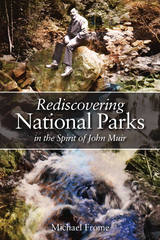
front cover of Rediscovering National Parks in the Spirit of John Muir
Rediscovering National Parks in the Spirit of John Muir
Michael Frome
University of Utah Press, 2015

As a journalist, advocate, and professor, Michael Frome has spent decades engaged with conservation topics and has taken particular interest in America’s national parks. He draws on this experience and knowledge to address what remains to be done in order to truly value and preserve these special places. Part memoir, part history, and part broadside against those who would diminish this heritage, Rediscovering National Parks in the Spirit of John Muir, through thoughtful reflections and ruminations, bears witness to the grandeur of our parks and to the need for a renewed sense of appreciation and individual responsibility for their care.

In recollections of his encounters and conversations with key people in national park history, Frome discusses park politics, conflicts between use and preservation, and impacts of commercialization. He proposes a dedicated return to the true spirit in which the parks were established, in the manner of John Muir. He advocates maintaining these lands as wild sanctuaries, places where we can find inspiration, solitude, silence, balance, and simplicity, reminding us why we must preserve our national treasures and why we need to connect with the deeper values they hold. 

[more]

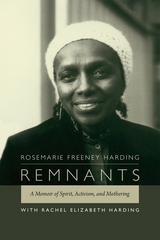
front cover of Remnants
Remnants
A Memoir of Spirit, Activism, and Mothering
Rosemarie Freeney Harding with Rachel Elizabeth Harding
Duke University Press, 2015
An activist influential in the civil rights movement, Rosemarie Freeney Harding’s spirituality blended many traditions, including southern African American mysticism, Anabaptist Christianity, Tibetan Buddhism, and Afro-Brazilian Candomblé. Remnants, a multigenre memoir, demonstrates how Freeney Harding's spiritual life and social justice activism were integral to the instincts of mothering, healing, and community-building. Following Freeney Harding’s death in 2004, her daughter Rachel finished this decade-long collaboration, using recorded interviews, memories of her mother, and her mother's journal entries, fiction, and previously published essays.
[more]

front cover of Riches for the Mind and Spirit
Riches for the Mind and Spirit
John Marks Templeton's Treasury of Words to Help, Inspire, and Live By
John Marks Templeton
Templeton Press, 2006

This book contains a collection of John Templeton's favorite inspirational passages.


“From the Bible, from philosophers and poets, and from other writers, we begin to form a clear understanding of the spiritual and ethical laws of life. The world's literature teaches us valuable lessons that no amount of money can buy. Those lessonsare there for everyone. They are free and they are priceless.”—John Marks Templeton

 
[more]

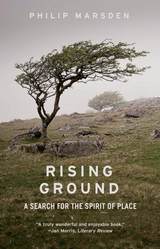
front cover of Rising Ground
Rising Ground
A Search for the Spirit of Place
Philip Marsden
University of Chicago Press, 2016
In 2010, Philip Marsden, whom Giles Foden has called “one of our most thoughtful travel writers,” moved with his family to a rundown farmhouse in the countryside in Cornwall. From the moment he arrived, Marsden found himself fascinated by the landscape around him, and, in particular, by the traces of human history—and of the human relationship to the land—that could be seen all around him. Wanting to experience the idea more fully, he set out to walk across Cornwall, to the evocatively named Land’s End.
 
Rising Ground is a record of that journey, but it is also so much more: a beautifully written meditation on place, nature, and human life that encompasses history, archaeology, geography, and the love of place that suffuses us when we finally find home. Firmly in a storied tradition of English nature writing that stretches from Gilbert White to Helen MacDonald, Rising Ground reveals the ways that places and peoples have interacted over time, from standing stones to footpaths, ancient habitations to modern highways. What does it mean to truly live in a place, and what does it take to understand, and honor, those who lived and died there long before we arrived?
 
Like the best travel and nature writing, Rising Ground is written with the pace of a contemplative walk, and is rich with insight and a powerful sense of the long skein of years that links us to our ancestors. Marsden’s close, loving look at the small patch of earth around him is sure to help you see your own place—and your own home—anew.
[more]

front cover of Rousseau and the Spirit of Revolt
Rousseau and the Spirit of Revolt
A Psychological Study
William H. Blanchard
University of Michigan Press, 1967
Jean-Jacques Rousseau was one of the most influential writers of the eighteenth century, and one of the most controversial. His writings are full of the paradoxes of his personality—his quest for natural truth and his own self-deceptions, his democratic and his despotic tendencies, his imperiousness and his submissiveness, his love of society and his love of solitude.In this study William H. Blanchard, a practicing psychologist, examines the interplay between Rousseau's complex personality and his political writings. Blanchard presents the biographical facts of Rousseau's life and, with the help of Rousseau's Confessions, interprets them according to modern psychology. Blanchard believes that almost all of Rousseau's works have political implications, and he considers such diverse writings as the Letter to d'Alembert on the Theatre, The Social Contract, Emile, and Rousseau's correspondence in the light of his interpretations.One of the major paradoxes of Rousseau's work is that it has been widely used as ideological support by both democratic and despotic forces. The name of Rousseau was invoked throughout the French Revolution by both the early democrats and the later terrorists. Blanchard explores the similarity between the rebel and the tyrant in Rousseau, discusses Rousseau's "urge to suffer for truth," and comments incisively on the dangers of these tendencies, which he finds present in modern society.The author has made excellent use of original documents and sources in his study of Rousseau, and he takes the opportunity to correct various misinterpretations of Rousseau's relations with his contemporaries, particularly David Hume.
[more]

front cover of Sacramental Shopping
Sacramental Shopping
Louisa May Alcott, Edith Wharton, and the Spirit of Modern Consumerism
Sarah Way Sherman
University of New Hampshire Press, 2013

Written a generation apart and rarely treated together by scholars, Little Women (1868) and The House of Mirth (1905) share a deep concern with materialism, moral development, and self-construction. The heroines in both grapple with conspicuous consumption, an aspect of modernity that challenges older beliefs about ethical behavior and core identity. 

Placing both novels at the historical intersection of modern consumer culture and older religious discourse on materialism and identity, Sarah Way Sherman analyzes how Alcott and Wharton rework traditional Protestant discourse to interpret their heroines' struggle with modern consumerism. Her conclusion reveals how Little Women's optimism, still buoyed by otherworldly justice, providential interventions, and the notion of essential identity, ultimately gives way to the much darker vision of modern materialistic culture in The House of Mirth.
[more]

front cover of The Sacramental Theology of Marriage
The Sacramental Theology of Marriage
One Flesh in One Spirit
Jose Granados
Catholic University of America Press, 2026
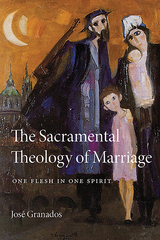
The Sacramental Theology of Marriage offers a comprehensive vision of the dogmatic theology of marriage. It takes into account biblical and patristic sources, the teaching of the Magisterium (with particular emphasis on the Councils of Trent and Vatican II), and the most important contemporary theological contributions. It begins with a vision of the sacrament of mar­riage as the sacrament that integrates the order of creation into the order of sacraments. This dual dimension of marriage justifies the division of the book into two parts: marriage as a sacrament of creation and marriage as a sacrament of redemption instituted by Christ. To describe the coordinates of marriage in creation, the book refers to St. Augustine (the goods of marriage), St. Thomas Aquinas (the ends of marriage), and modern personalism as re­flected in the Second Vatican Council (the gifts of marriage). The book also draws on the theology of St. Bonaventure, who emphasized the institution of marriage by God in creation. The presentation of marriage as a sacrament of the new law is rooted in the way Christ lived the various meanings of the body. Marriage’s foundation in the body and in the experience of love sheds new light on the key milestones of its sacramentality: its matter and form, its signification, the grace it transmits, its liturgy and ministers, its indissolubil­ity, its role in building up the Church, and the path of holiness it opens to the spouses. In all of this, marriage emerges as a pivotal sacrament for articulating Christianity’s relationship to the cosmos and to society. The Sacramental The­ology of Marriage includes modern philosophical and theological explorations of the language of the body and the meaning of love (including the proposal of St. John Paul II). It also outlines the main principles for the pastoral care of marriage and family.
[more]

front cover of Signs of the Spirit
Signs of the Spirit
Music and the Experience of Meaning in Ndau Ceremonial Life
Tony Perman
University of Illinois Press, 2020
In 2005, Tony Perman attended a ceremony alongside the living and the dead. His visit to a Zimbabwe farm brought him into contact with the madhlozi, outsider spirits that Ndau people rely upon for guidance, protection, and their collective prosperity.

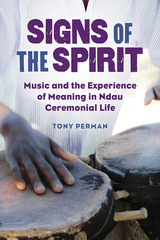
Perman's encounters with the spirits, the mediums who bring them back, and the accompanying rituals form the heart of his ethnographic account of how the Ndau experience ceremonial musicking. As Perman witnessed other ceremonies, he discovered that music and dancing shape the emotional lives of Ndau individuals by inviting them to experience life's milestones or cope with its misfortunes as a group. Signs of the Spirit explores the historical, spiritual, and social roots of ceremonial action and details how that action influences the Ndau's collective approach to their future. The result is a vivid ethnomusicological journey that delves into the immediacy of musical experience and the forces that transform ceremonial performance into emotions and community.
[more]

front cover of Sisters in Spirit
Sisters in Spirit
Christianity, Affect, and Community Building in East Africa, 1860–1970
Andreana C. Prichard
Michigan State University Press, 2017
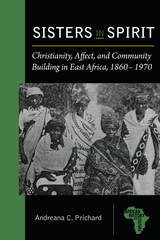
In this pioneering study, historian Andreana Prichard presents an intimate history of a single mission organization, the Universities’ Mission to Central Africa (UMCA), told through the rich personal stories of a group of female African lay evangelists. Founded by British Anglican missionaries in the 1860s, the UMCA worked among refugees from the Indian Ocean slave trade on Zanzibar and among disparate communities on the adjacent Tanzanian mainland. Prichard illustrates how the mission’s unique theology and the demographics of its adherents produced cohorts of African Christian women who, in the face of linguistic and cultural dissimilarity, used the daily performance of a certain set of “civilized” Christian values and affective relationships to evangelize to new inquirers. The UMCA’s “sisters in spirit” ultimately forged a united spiritual community that spanned discontiguous mission stations across Tanzania and Zanzibar, incorporated diverse ethnolinguistic communities, and transcended generations. Focusing on the emotional and personal dimensions of their lives and on the relationships of affective spirituality that grew up among them, Prichard tells stories that are vital to our understanding of Tanzanian history, the history of religion and Christian missions in Africa, the development of cultural nationalisms, and the intellectual histories of African women.
 
[more]

front cover of Sisters in Spirit
Sisters in Spirit
Mormon Women in Historical and Cultural Perspective
Edited by Maureen Ursenbach Beecher and Lavina Fielding Anderson
University of Illinois Press, 1987
This book of essays about Mormon women, all written and edited by scholars who are themselves Mormon women, is a brave and important work. Readers will fully appreciate just how brave and important it really is, however, if they can see how this work of historical theology fits into the history of historical writing about Mormon women, as well as how it fits into Mormon history itself.
 
"The women who contributed to this book are among the best of the Mormon literati . . . [they] hold that there is hope within the church for change, for reform, for expansion of the place of women." -- Women's Review of Books
 
"Historians of women in America have a great deal to learn from the history of Mormon women. This fine set of essays provides an excellent introduction to a subject about which we should all know more." -- Anne Firor Scott, author of Making the Invisible Woman Visible.

 
[more]

front cover of Song Noir
Song Noir
Tom Waits and the Spirit of Los Angeles
Alex Harvey
Reaktion Books, 2022
A gritty, smoke-filled, and boozy account of musician Tom Waits’s formative decade in Los Angeles.
 
Song Noir examines the formative first decade of Tom Waits’s career, when he lived, wrote, and recorded nine albums in Los Angeles: from his soft, folk-inflected debut, Closing Time in 1973, to the abrasive, surreal Swordfishtrombones in 1983. Starting his songwriting career in the seventies, Waits absorbed Los Angeles’s wealth of cultural influences. Combining the spoken idioms of writers like Kerouac and Bukowski with jazz-blues rhythms, he explored the city’s literary and film noir traditions to create hallucinatory dreamscapes. Waits mined a rich seam of the city’s low-life locations and characters, letting the place feed his dark imagination. Mixing the domestic with the mythic, Waits turned quotidian, autobiographical details into something more disturbing and emblematic, a vision of Los Angeles as the warped, narcotic heart of his nocturnal explorations.
[more]

front cover of Spirit and System
Spirit and System
Media, Intellectuals, and the Dialectic in Modern German Culture
Dominic Boyer
University of Chicago Press, 2005
Combining ethnography, history, and social theory, Dominic Boyer's Spirit and System exposes how the shifting fortunes and social perceptions of German intellectuals in the nineteenth and twentieth centuries influenced Germans' conceptions of modernity and national culture.

Boyer analyzes the creation and mediation of the social knowledge of "German-ness" from nineteenth-century university culture and its philosophies of history, to the media systems and redemptive public cultures of the Third Reich and the German Democratic Republic, to the present-day experiences of former East German journalists seeking to explain life in post-unification Germany. Throughout this study, Boyer reveals how dialectical knowledge of "German-ness"—that is, knowledge that emphasizes a cultural tension between an inner "spirit" and an external "system" of social life —is modeled unconsciously upon intellectuals' self-knowledge as it tracks their fluctuation between alienation and utopianism in their interpretations of nation and modernity.
[more]

front cover of The Spirit and the Letter
The Spirit and the Letter
On the Interpretation of Scripture
Giorgio Agamben
Seagull Books, 2026
Distinguished philosopher Giorgio Agamben offers an archaeological inquiry into the problem of scriptural interpretation. 

The problem of interpreting Scripture—above all, sacred scripture, but ultimately any form of writing—coincides with the very history of Western culture. It is no surprise, then, that an archaeological inquiry such as the one proposed here—on the problem of interpretation from Origen to Auerbach, from the Talmud to Benjamin—might hold unexpected revelations.

Essential reading for scholars of theology, religious studies, and hermeneutics interested in the history of scriptural interpretation, The Spirit and the Letter highlights how the interpretation of Scripture reveals itself as inseparable from ethics and politics.
 
[more]

front cover of Spirit in Session
Spirit in Session
Working with Your Client’s Spirituality (and Your Own) in Psychotherapy
Russell Siler Jones
Templeton Press, 2019

Spirituality is an important part of many clients’ lives. It can be a resource for stabilization, healing, and growth. It can also be the cause of struggle and even harm. More and more therapists—those who consider themselves spiritual and those who do not—recognize the value of addressing spirituality in therapy and increasing their skill for engaging it ethically and effectively.

In this immensely practical book, Russell Siler Jones helps therapists feel more competent and confident about having spiritual conversations with clients. With a refreshing, down-to-earth style, he describes how to recognize the diverse explicit and implicit ways spirituality can appear in psychotherapy, how to assess the impact spirituality is having on clients, how to make interventions to maximize its healthy impact and lessen its unhealthy impact, and how therapists can draw upon their own spirituality in ethical and skillful ways. He includes extended case studies and clinical dialogue so readers can hear how spirituality becomes part of case conceptualization and what spiritual conversation actually sounds like in psychotherapy.

Jones has been a therapist for nearly 30 years and has trained therapists in the use of spirituality for over a decade. He writes about a complex topic with an elegant simplicity and provides how-to advice in a way that encourages therapists to find their own way to apply it.

Spirit in Session is a pragmatic guide that therapists will turn to again and again as they engage their clients in one of the most meaningful and consequential dimensions of human experience.
 

[more]

front cover of The Spirit of 1848
The Spirit of 1848
German Immigrants, Labor Conflict, and the Coming of the Civil War
Bruce Levine
University of Illinois Press, 1992
Immigrants and their children became the chief component of the U.S. working class during the nineteenth century. Bruce Levine examines the early years of this social transformation, focusing on German-born craft workers and the key roles they played in the economic and political life of the wage-earning population of antebellum America. Interweaving themes often treated separately---immigration, industrialization, class formation, and the political polarization over slavery---Levine sheds new light on the development of the working class, the nature and appeals of partisan politics, and the conflicts that led to sectional war.
The Spirit of 1848 offers much new information and insight concerning craftwork, the nature of the antebellum labor movement (including the great New York City tailors' strike of 1850), the meaning of nativism, the significance of the push for land reform, the diverse character of the free-soil movement, and the popular appeals of both the Democratic and Republican parties.
 
[more]

front cover of The Spirit of 1976
The Spirit of 1976
Commerce, Community, and the Politics of Commemoration
Tammy S. Gordon
University of Massachusetts Press, 2013

The most important national commemoration of the twentieth century, the 1976 bicentennial celebration gave rise to a broad-ranging debate over how the American Revolution should be remembered and represented. Federal planners seeking an uncritical glorification of the nation's founding came up against an array of constituencies with other interests and objectives. Inspired by the “new social history” that looked at the past “from the bottom up,” Americans who had previously been disenfranchised by traditional national narratives—African Americans, women, American Indians, workers, young people—demanded a voice and representation in the planning. Local communities, similarly suspicious of federal direction, sought control over their own bicentennial events. Corporate representatives promoted an approach that championed the convergence of patriotism and private enterprise, while commercial interests applied the marketing techniques of an expanding consumerism to hawk every imaginable kind of patriotic souvenir to all of these groups.

The end result of these competing efforts, Tammy S. Gordon shows, was a national celebration that reflected some common themes, including a mistrust of federal power, an embrace of decentralized authority, and a new cultural emphasis on the importance of the self. The American Revolution Bicentennial can thus be seen as both a product of the social and political changes of the 1960s and a harbinger of things to come. After 1976, the postwar myth of a consensus view of American history came to an end, ensuring that future national commemorations would continue to be contested.

[more]

logo for University of Wisconsin Press
Spirit of Australia
The Crime Fiction of Arthur W. Upfield
Smith
University of Wisconsin Press, 1988
In the world of crime fiction, Arthur W. Upfield stands among the giants. His detective-inspector Napoleon Bonaparte, is one of the most memorable of all crime fighters. Upfield was an independent, fiercely self-assertive ex-Britisher, who loved Australia, especially the Outback. In many ways Upfield became Outback Australia—the “Spirit of Australia.”


Library of Congress subject headings for this publication:
Upfield, Arthur William, -- 1888-1964 -- Criticism and interpretation.
Detective and mystery stories, Australian -- History and criticism.
Bonaparte, Napoleon, Inspector (Fictitious character)
National characteristics, Australian, in literature.
Australia -- In literature.
Police in literature.
Crime in literature.
[more]

front cover of The Spirit of Colonial Williamsburg
The Spirit of Colonial Williamsburg
Ghosts and Interpreting the Recreated Past
Alena Pirok
University of Massachusetts Press, 2022

On any given night, hundreds of guests walk the darkened streets of Colonial Williamsburg looking for ghosts. Since the early 2000s, both the museum and private companies have facilitated these hunts, offering year-round ghost tours. Critics have called these excursions a cash grab, but in truth, ghosts and hauntings have long been at the center of the Colonial Williamsburg project.

The Spirit of Colonial Williamsburg examines how the long-dead past comes alive at this living-history museum. In the early twentieth century, local stories about the ghosts of former residents—among them Revolutionary War soldiers and nurses, tavern owners and prominent attorneys, and enslaved African Americans—helped to turn Williamsburg into a desirable site for historical restoration. But, for much of the twentieth century, the museum tried diligently to avoid any discussion of ghosts, considering them frivolous and lowbrow. Alena Pirok explores why historic sites have begun to embrace their spectral residents in recent decades, arguing that through them, patrons experience an emotional connection to place and a palpable understanding of the past through its people.

[more]

front cover of The Spirit of God
The Spirit of God
Short Writings on the Holy Spirit
Yves Congar
Catholic University of America Press, 2017
Yves Congar was the most significant voice in Catholic pneumatology in the twentieth century. This new collection of short pieces makes his thought accessible to a broad range of readers – scholars, teachers, ecumenists and laity – and thus helps to ensure that an important theological voice, one that influenced many of the documents of the Second Vatican Council, continues to be heard.

The Spirit of God brings together for the first time eight of Yves Congar’s previously untranslated writings on the Holy Spirit composed after Vatican II (from 1969 to 1985). Two of these selections offer general overviews of Congar’s pneumatology, a pneumatology based upon Scripture and the Tradition of the Church, but articulated in conversation with philosophers, ecumenical partners and non-believers. Other articles make clear the historical context of Vatican II’s pneumatology and the Holy Spirit’s crucial influence upon the unfolding of history and upon the moral life, the efficacy of the sacraments and, especially, upon ecclesial life.

The writings in The Spirit of God have been translated and edited by a team of scholars familiar with the work of the French Dominican theologian. An introduction situates each of the writings historically and highlights its theological significance. A bibliography lists Congar’s publications on the Holy Spirit, the major articles and books written about his pneumatology, and the major scholarly resources to which Congar made reference in the notes that accompanied these writings. An index of biblical references and of personal names is also included.
[more]

front cover of The Spirit of Mediterranean Places
The Spirit of Mediterranean Places
Michael Butor
Northwestern University Press, 1997
This book gathers French writer Michel Butor's essays on his travel in the Mediterranean. Included are pieces on Cordova, Istanbul, Salonica, Delphi, Crete, and northern Italy, as well as an extended essay on Egypt--where, when he was 24, Butor spent a year teaching French in a secondary school. Michel Butor is one of the leading exponents of the avant-garde writing that emerged in France in the 1950s .
[more]

front cover of The Spirit of Modern Republicanism
The Spirit of Modern Republicanism
The Moral Vision of the American Founders and the Philosophy of Locke
Thomas L. Pangle
University of Chicago Press, 1988
The Spirit of Modern Republicanism sets forth a radical reinterpretation of the foundations on which the American regime was constructed. Thomas L. Pangle argues that the Founders had a dramatically new vision of civic virtue, religious faith, and intellectual life, rooted in an unprecedented commitment to private and economic liberties. It is in the thought of John Locke that Pangle finds the fullest elaboration of the principles supporting the Founders' moral vision.

"A work of extraordinary ambition, written with great intensity. . . . [Pangle offers] a trenchant analysis of Locke's writings, designed to demonstrate their remarkable originality and to clarify by doing so as much as the objective predicament as the conscious intentions of the Founding Fathers themselves."—John Dunn, Times Higher Education Supplement

"A forcefully argued study of the Founding Fathers' debt to Locke. . . . What distinguishes Pangle's study from the dozens of books which have challenged or elaborated upon the republican revision is the sharpness with which he exposes the errors of the revisionists while at the same time leaving something of substantive value for the reader to consider."—Joyce Appleby, Canadian Journal of History

"Breathtaking in its daring and novelty. . . . Pangle's book is tense and tenacious, a stunning meditation on America's political culture."—John Patrick Diggins, Transactions of the C. S. Peirce Society

[more]

front cover of The
The "Spirit of Poesy"
Essays on Jewish and German Literature and Thought in Honor of Geza von Molnar
Richard Block and Peter Fenves
Northwestern University Press, 2000
A testament to the "spirit of poesy" that informs the life and work of Geza von Molnar, this volume of essays comes together around his principal preoccupations: the philosophical foundations of Goethe's writings, the structure and reception of German romanticism, the ethics of reading, and the fate of European Jewry. At the center of this work is the idea of a genuinely free humanity—from its ambiguous presence in the aesthetic projects of Goethe and German romanticism to its utter absence in the Nazi extermination camps. Combining works in philosophy, literature, and Jewish studies by established and younger scholars, this collection contributes significantly to an understanding of German culture.
[more]

front cover of Spirit of Rebellion
Spirit of Rebellion
Labor and Religion in the New Cotton South
Jared Roll
University of Illinois Press, 2010

Winner of the Herbert G. Gutman Prize from the Labor and Working-Class History Association 

In Spirit of Rebellion, Jarod Roll documents an alternative tradition of American protest by linking working-class political movements to grassroots religious revivals. He reveals how ordinary rural citizens in the south used available resources and their shared faith to defend their agrarian livelihoods amid the political and economic upheaval of the first half of the twentieth century. 

On the frontier of the New Cotton South in Missouri's Bootheel, the relationships between black and white farmers were complicated by racial tensions and bitter competition. Despite these divisions, workers found common ground as dissidents fighting for economic security, decent housing, and basic health, ultimately drawing on the democratic potential of evangelical religion to wage working-class revolts against commodity agriculture and the political forces that buoyed it. Roll convincingly shows how the moral clarity and spiritual vigor these working people found in the burgeoning Pentecostal revivals gave them the courage and fortitude to develop an expansive agenda of workers' rights by tapping into the powers of existing organizations such as the Socialist Party, the Universal Negro Improvement Association, the NAACP, and the interracial Southern Tenant Farmers' Union.

[more]

front cover of The Spirit of Religion and the Spirit of Liberty
The Spirit of Religion and the Spirit of Liberty
The Tocqueville Thesis Revisited
Edited by Michael P. Zuckert
University of Chicago Press Journals, 2017
Tocqueville’s thesis on the relation between religion and liberty could hardly be timelier. From events in the Middle East and the spread of Islamist violence in the name of religion to the mandated coverage under the Affordable Care Act, the interaction between religion and politics has once again become central to political life. Tocqueville, facing the coming of a new social and political order within the traditional society that was France, faced this relation between politics and religion with freshness and relevance. He was particularly interested in reporting to his French compatriots on how the Americans had successfully resolved what, to many Frenchmen, looked to be an insuperable conflict. His surprising thesis was that the right kind of arrangement—a certain kind of separation of church and state that was not also a complete separation of religion and politics—could be seen in nineteenth century America to be beneficial to both liberty and religion. This volume investigates whether Tocqueville’s depiction was valid for the America he investigated in the 1830s and whether it remains valid today.
 
[more]

front cover of The Spirit of Soul Food
The Spirit of Soul Food
Race, Faith, and Food Justice
Christopher Carter
University of Illinois Press, 2021

Soul food has played a critical role in preserving Black history, community, and culinary genius. It is also a response to--and marker of--centuries of food injustice. Given the harm that our food production system inflicts upon Black people, what should soul food look like today?

Christopher Carter's answer to that question merges a history of Black American foodways with a Christian ethical response to food injustice. Carter reveals how racism and colonialism have long steered the development of US food policy. The very food we grow, distribute, and eat disproportionately harms Black people specifically and people of color among the global poor in general. Carter reflects on how people of color can eat in a way that reflects their cultural identities while remaining true to the principles of compassion, love, justice, and solidarity with the marginalized.

Both a timely mediation and a call to action, The Spirit of Soul Food places today's Black foodways at the crossroads of food justice and Christian practice.

[more]

front cover of The Spirit of the City
The Spirit of the City
Marshall Fredericks Sculptures in Detroit
Janna Jones
Michigan State University Press, 2023
Marshall Fredericks’s Detroit sculptures capture the spirit of the Motor City and its dramatic transformation from the 1950s to the present day. In this book, Janna Jones analyzes eight of these enormous works of public art, situating them and their structures in metro Detroit’s distinctive midcentury milieu and bringing much-needed critical attention to this sculptor’s oeuvre. Sadly, some of these artworks have suffered along with the city as it shrank from its postwar zenith. Both the buildings and the sculptures erected for them deserve to be rescued from neglect, and then maintained and preserved for the future.
 
[more]

front cover of The Spirit of the Laws in Mozambique
The Spirit of the Laws in Mozambique
Juan Obarrio
University of Chicago Press, 2014
Mozambique has been hailed as a success story by the international community, which has watched it evolve through a series of violent political upheavals: from colonialism, through socialism, to its current democracy. As Juan Obarrio shows, however, this view neglects a crucial element in Mozambique’s transition to the rule of law: the reestablishment of traditional chieftainship and customs entangled within a history of colonial violence and civil war. Drawing on extensive historical records and ethnographic fieldwork, he examines the role of customary law in Mozambique to ask a larger question: what is the place of law in the neoliberal era, in which the juridical and the economic are deeply intertwined in an ongoing state of structural adjustment?
           
Having made the transition from a people’s republic to democratic rule in the 1990s, Mozambique offers a fascinating case of postwar reconstruction, economic opening, and transitional justice, one in which the customary has played a central role. Obarrio shows how its sovereignty has met countless ambiguities within the entanglements of local community, nation-state, and international structures. The postcolonial nation-state emerges as a maze of entangled jurisdictions. Ultimately, he looks toward local rituals and relations as producing an emergent kind of citizenship in Africa, which he dubs “customary citizenship,” forming not a vestige of the past but a yet ill-defined political future.
[more]

front cover of Spirit of the New England Tribes
Spirit of the New England Tribes
Indian History and Folklore, 1620–1984
William S. Simmons
University Press of New England, 1986
Spanning three centuries, this collection traces the historical evolution of legends, folktales, and traditions of four major native American groups from their earliest encounters with European settlers to the present. The book is based on some 240 folklore texts gathered from early colonial writings, newspapers, magazines, diaries, local histories, anthropology and folklore publications, a variety of unpublished manuscript sources, and field research with living Indians.
[more]

front cover of The Spirit of the Oxford Movement
The Spirit of the Oxford Movement
Christopher Dawson
Catholic University of America Press, 2022
“This is the book we have been waiting for… a permanent enrichment of our understanding of the Oxford Movement” proclaimed The Downside Review upon the publication of Christopher Dawson’s masterwork in 1933, exactly 100 years after John Keble’s sermon "National Apostasy" stirred a nation. Dawson himself regarded the book as one of his two greatest intellectual accomplishments. Dawson and John Henry Newman were Oxonians and both were converts to Catholicism; both stood against progressive and liberal movements within society. In both ideologies, Dawson saw a pathway that had once led to the French Revolution. Newman, for Dawson, was a kindred spirit. In The Spirit of the Oxford Movement, Dawson goes beyond a mere retelling of the events of 1833 - 1845. He shows us the prime movers who sought a deeper understanding of the Anglican tradition: the quixotic Hurrell Froude, for instance, who "had none of the English genius for compromise or the Anglican faculty of shutting the eyes to unpleasant facts." It was Froude who brought Newman and Keble together and who helped them understand each other. In many ways, Dawson sees these three as the true embodiment of the Tractarian ethos. Dawson probes deeply, though, to provide a richer, clearer understanding of the intellectual underpinnings of the Oxford Movement, revealing its spiritual raison d’être. We meet a group of gifted like-minded thinkers, albeit with sharp disagreements, who mock outsiders and each other, who pepper their letters with Latin, and forever urge each other on. Newman came to believe, as did Dawson, that the only intellectually coherent bastion against secular culture was religion, and the “on” to which they were urged was the Catholic church. The Spirit of the Oxford Movement provides insights into why Newman, and Dawson, came to this understanding.
[more]

front cover of Spirit of the Place
Spirit of the Place
From Mauthausen to Moma
Péter György
Central European University Press, 2008
These essays are case-studies, the cases unraveling our cultural roots, memory itself. If a museum is the subject, then for instance the way the museum changes face, function, its manner of speech; how, a repository of collections and the cultural memory of humankind itself turns into one of the objects, memories, a custodian and exponent of its own history, or the opposite: how it connects with its modernized environs and changing audience: us. How has, or might the sanctum be transformed into a public venue, go from an inward looking, reverential enclosure to a space full of life. In other studies included here the author speaks of spatial and incarnate remembrance: the radical difference between a monument and a memorial. The duality of “always remembering” and “never forgetting”: a past depersonalized and dehistoricized as it was seized and processed. Of the layers of meaning attached to concentration camps, transmuting essence of artworks, and the difficult, the contradictory but inescapable processing of history and the past, of self-identical existence in history. So that we know we are alive. And how that is so.
[more]

front cover of The Spirit of This Place
The Spirit of This Place
How Music Illuminates the Human Spirit
Patrick Summers
University of Chicago Press, 2018
Artists today are at a crossroads. With funding for the arts and humanities endowments perpetually under attack, and school districts all over the United States scrapping their art curricula altogether, the place of the arts in our civic future is uncertain to say the least. At the same time, faced with the problems of the modern world—from water shortages and grave health concerns to global climate change and the now constant threat of terrorism—one might question the urgency of this waning support for the arts. In the politically fraught world we live in, is the “felt” experience even something worth fighting for?

In this soul-searching collection of vignettes, Patrick Summers gives us an adamant, impassioned affirmative. Art, he argues, nurtures freedom of thought, and is more necessary now than ever before.

As artistic director of the Houston Grand Opera, Summers is well positioned to take stock of the limitations of the professional arts world—a world where the conversation revolves almost entirely around financial questions and whose reputation tends toward elitism—and to remind us of art’s fundamental relationship to joy and meaning. Offering a vehement defense of long-form arts in a world with a short attention span, Summers argues that art is spiritual, and that music in particular has the ability to ask spiritual questions, to inspire cathartic pathos, and to express spiritual truths. Summers guides us through his personal encounters with art and music in disparate places, from Houston’s Rothko Chapel to a music classroom in rural China, and reflects on musical works he has conducted all over the world. Assessing the growing canon of new operas performed in American opera houses today, he calls for musical artists to be innovative and brave as opera continues to reinvent itself.

This book is a moving credo elucidating Summers’s belief that the arts, especially music, help us to understand our own humanity as intellectual, aesthetic, and ultimately spiritual.
[more]

logo for University of Illinois Press
The Spirit of Youth and City Streets
Jane Addams
University of Illinois Press, 1972
"We may either smother the divine fire in youth or we may feed it," Jane Addams writes. Suffused with Addams's abiding compassion, tempered with her pragmatism and humor, and shot through with anecdotes of her own experiences with young people, The Spirit of Youth and the City Streets is a level-headed assessment of the challenges facing urban youth and the most effective ways to meet them.
When this book was first published in 1909, Addams was the most famous woman in America. A celebrity and a spiritual leader, she was widely regarded as practical, realistic, and endowed with a special insight into the problems of urban America. The Spirit of Youth and the City Streets--her favorite of her own books--establishes Addams as an accomplished writer as well as a reformer. In this compact volume she examines the causes for the discontent of youth in the city, chiding educators for their "persistent blindness to youth's most obvious needs."
Addams argues for the importance of providing direction and focus--for example, through public recreation, practical education, and experiences in the arts--for the pent-up energies of young men and women. She takes a realistic view of their basic social and sexual drives and their disaffection and alienation in an industrial world. At the same time, she rejects the hereditary explanations for delinquency that prevailed in her day. Allen F. Davis's introduction provides a biographical profile of Addams and a commentary on her importance as a writer and a social activist.
 
[more]

front cover of Spirit on the Move
Spirit on the Move
Black Women and Pentecostalism in Africa and the Diaspora
Judith Casselberry and Elizabeth Pritchard, editors
Duke University Press, 2019
Pentecostalism is currently the fastest-growing Christian movement, with hundreds of millions of followers. This growth overwhelmingly takes place outside of the West, and women make up 75 percent of the membership. The contributors to Spirit on the Move examine Pentecostalism's appeal to black women worldwide and the ways it provides them with a source of community and access to power. Exploring a range of topics, from Neo-Pentecostal churches in Ghana that help women challenge gender norms to evangelical gospel musicians in Brazil, the contributors show how Pentecostalism helps black women draw attention to and seek remediation from the violence and injustices brought on by civil war, capitalist exploitation, racism, and the failures of the state. In fleshing out the experiences, theologies, and innovations of black women Pentecostals, the contributors show how Pentecostal belief and its various practices reflect the movement's complexity, reach, and adaptability to specific cultural and political formations.

Contributors. Paula Aymer, John Burdick, Judith Casselberry, Deidre Helen Crumbley, Elizabeth McAlister, Laura Premack, Elizabeth A. Pritchard, Jane Soothill, Linda van de Kamp
[more]

front cover of Spirit, Structure, and Flesh
Spirit, Structure, and Flesh
Gender and Power in Yoruba African Instituted Churches
Deidre Helen Crumbley
University of Wisconsin Press, 2008
Although popularized in Africa by Western missionaries, the Christian faith as practiced by Africans has acquired unique traits over time. Some of the most radical reinterpretations of Christianity are offered by those churches known as “AICs” (variously, African Initiated, African Instituted, or African Independent Churches)—new denominations founded by Africans skeptical of dogma offered by mainstream churches with roots in European empires. As these churches spread throughout the African diaspora, they have brought with them distinct practices relating to gender. Such practices range from the expectation that women avoid holy objects and sites during menstruation to the maintenance of church structures in which both men and women may be ordained and assigned the same duties and responsibilities.
            How does having a female body affect one’s experience of indigenized Christianity in Africa? Spirit, Structure, and Flesh addresses this question by exploring the ways ritual, symbol, and dogma circumscribe, constrain, and liberate women in AICs. Through detailed description of worship and doctrine, as well as careful analyses of church history and organizational processes, Deidre Helen Crumbley explores gendered experiences of faith and power in three Nigerian indigenous AICs, demonstrating the roles of women in the day-to-day life of these churches.
[more]

front cover of To Foster the Spirit of Professionalism
To Foster the Spirit of Professionalism
Southern Scientists and State Academies of Science
Nancy Smith Midgette
University of Alabama Press, 1991

"A welcome contribution to the history of science in the South during the period since the Civil War. . . . By considering the academies in the larger context of scientific professionalism, South and North, Midgette has produced a surprisingly wide-ranging and informative study. This is overall a judicious and carefully researched work. The writing is straightforward and admirably clear, while the topic is effectively organized and presented. The book is a commendably original addition to local and regional history as well as history of American Science."
Journal of American History

"Midgette’s study is thorough and well organized and should be consulted by anyone interested in American science and American higher education."
Florida Historical Quarterly


"A very useful survey."
—Choice

[more]

front cover of The Unity of Hegel's
The Unity of Hegel's "Phenomenology of Spirit"
A Systematic Interpretation
Jon Stewart
Northwestern University Press, 2011
Hegel's Phenomenology is considered by many to be the most difficult book in the philosophical canon. While some authors have published excellent essays on various chapters and aspects of the book, few authors have successfully tackled the whole.

In The Unity of Hegel's "Phenomenology of Spirit", Jon Stewart interprets Hegel's work as a dialectical transformation of Kantian transcendental philosophy, providing from this unified standpoint a case for Hegel's own conception of philosophy as a system. In restoring them to their larger systematic contexts, Stewart clarifies Hegel's individual analyses, as well as indicating the meaning and significance of the transitions and illustrating the parallelisms between the respective analyses. Many of Hegel's main themes-
universal-particular, mediacy-immediacy-are traced through the text, demonstrating Hegel's formal continuity.

By examining at the microlevel the particulars of the dialectical movement, and by analyzing at the macrolevel the role of the argument in question in the context of the work as a whole, Stewart provides a detailed analysis of the Phenomenology and a significant scholarly demonstration of Hegel's own conception of the Phenomenology as a part of a systematic philosophy.
[more]

front cover of Virginia Woolf, Jane Ellen Harrison, and the Spirit of Modernist Classicism
Virginia Woolf, Jane Ellen Harrison, and the Spirit of Modernist Classicism
Jean Mills
The Ohio State University Press, 2014
In a work that re-investigates archival materials and deploys an innovative theoretical framework, Jean Mills explores the intellectual and political relationship between Virginia Woolf and the Cambridge classicist Jane Ellen Harrison. Virginia Woolf, Jane Ellen Harrison, and the Spirit of Modernist Classicism discovers an intimate connection crucial to Woolf’s professional identity and intellectual and artistic development in Harrison’s controversial, feminist interpretations of Greek mythology. Mills argues that cross-reading Jane Harrison and Virginia Woolf exposes a distinctive relationship between two women intellectuals, one that does not rehearse the linearity of influence but instead demonstrates the intricacy of intertextuality—an active and transformative use of one body of writing by another writer—that makes of Virginia Woolf’s modernism a specifically feminist amplification. This cross-reading reveals a dimension of modernism that has been overlooked or minimized: Mills demonstrates that the questions preoccupying Harrison also resonated with Woolf, who adapted Harrison’s ideas to her own intellectual, political, and literary pursuits.

To an extent, Virginia Woolf, Jane Ellen Harrison, and the Spirit of Modernist Classicism participates in an act of classical recovery. It is an effort to revive and reclaim Harrison’s work and to illustrate the degree to which her cultural, political, and scholastic example informed one of the major modernist voices of the twentieth century.
[more]

logo for University of Illinois Press
Voting and the Spirit of American Democracy
Essays on the History of Voting and Voting Rights in America
Edited by Donald W. Rogers
University of Illinois Press, 1992
Writing in a succinct and lively
  manner, leading historians and political scientists trace the history of American
  voting from the colonial period to the present incorporating the latest scholarship
  on suffrage reform, woman suffrage, black voting rights, and electoral participation.
  They explain how voting practices changed over time as the result of broad historical
  forces such as economic growth, demographic shifts, the results of war, and
  the rise of political reform movements.
 
[more]

front cover of Who Am I?
Who Am I?
An Autobiography of Emotion, Mind, and Spirit
Yi-Fu Tuan
University of Wisconsin Press, 1999

Who Am I? is the bittersweet memoir of a Chinese American who came to this country as a twenty-year-old graduate student and stayed to become one of America’s most innovative intellectuals, whose work has explored the aesthetic and moral dimensions of human relations with landscape, nature, and environment. This unusually introspective autobiography mixes Yi-Fu Tuan’s reflections on a life filled with recognition, accolades, and affection with what he deems moral failings, his lack of courage—including the courage to be open about his homosexuality.

[more]

front cover of The Word of Truth, Sealed by the Spirit
The Word of Truth, Sealed by the Spirit
Perspectives on the Inspiration and Truth of Sacred Scripture
Matthew C. Genung
Saint Paul Seminary Press, 2022
The Word of Truth, Sealed by the Spirit is a collection of seven essays pertaining to the topic of biblical inspiration and truth. Two chapters provide a critical analysis of the Pontifical Biblical Commission’s 2014 document The Inspiration and Truth of Sacred Scripture and reflect upon its relevance and outcome. Five chapters respond to a particular aspect of this document by investigating a hermeneutical or exegetical question in order to advance the dialogue on the questions of biblical inspiration and truth. This book is intended not only for Catholic seminary and university professors and students but also Protestant scholars and students, as well as catechized lay people of all Christian denominations. Luis Sánchez-Navarro, DCJM, writes on the importance of understanding the relationship between revelation, biblical inspiration, and truth for both biblical interpretation and for Christian living. Michael Magee provides a critical analysis of the PBC document by situating it within the recent history of the Church’s attempts to clarify the theology of biblical inspiration and truth. Matthew C. Genung studies Exodus 19 in its context, showing that the Bible itself indicates that its nature as emended Scripture pertains to its inspired character. Anthony Pagliarini writes about the Book of Ezekiel as inspired Scripture given the non-fulfillment of Ezekiel’s prophetic vision of the restored Temple. Aaron Pidel, SJ, analyzes Joseph Ratzinger’s writings on hermeneutics and biblical theology, to propose a reliable methodology for determining the historicity of conflicting biblical reports. Marcin Kowalski, analyzing 1 Corinthians 11:2–16, addresses the question of the inspired character of a text at variance with changing gender roles in society. Kelly Anderson evaluates biblical texts depicting an inner-trinitarian dialogue in order to shed light on the relationship of inspired Scripture to the eternal dialogue of God.
[more]

front cover of Working the Difference
Working the Difference
Science, Spirit, and the Spread of Motivational Interviewing
E. Summerson Carr
University of Chicago Press, 2023
A history of motivational interviewing and what its rise reveals about how cultural forms emerge and spread.

Motivational interviewing (MI) is a professional practice, a behavioral therapy, and a self-professed conversation style that encourages clients to talk themselves into change. Originally developed to treat alcoholics, MI quickly spread into a variety of professional fields including corrections, medicine, and sanitation. In Working the Difference, E. Summerson Carr focuses on the training and dissemination of MI to explore how cultural forms—and particularly forms of expertise—emerge and spread. The result is a compelling analysis of the American preoccupations at MI’s core, from democratic autonomy and freedom of speech to Protestant ethics and American pragmatism.
[more]

front cover of Workings of the Spirit
Workings of the Spirit
The Poetics of Afro-American Women's Writing
Houston A. Baker Jr.
University of Chicago Press, 1990
Turning on inspired interpretations of Zora Neale Hurston, Toni Morrison, and Ntozake Shange, Workings of the Spirit weighs current critical approaches to black women's writing against Baker's own explanation of the founding, theoretical state of Afro-American intellectual history.

"Brilliant, and tenderly riveted to gratitude as an indispensable facet of analysis, Houston Baker arrives, yet again, bearing the loveliest flowers of his devotion and delight: thank God he's here!"—June Jordan
[more]


Send via email Share on Facebook Share on Twitter