
 A SCHOLARLY BOOK REPOSITORY
Results by Title
4 books about 1483-1546
4 books about 1483-1546
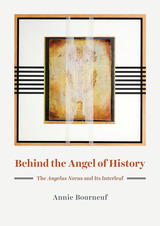
Behind the Angel of History
The "Angelus Novus" and Its Interleaf
Annie Bourneuf
University of Chicago Press, 2022
The story of artist R. H. Quaytman’s discovery of an engraving hidden behind a famous artwork by Paul Klee.
This book begins with artist R. H. Quaytman uncovering something startling about a picture by Paul Klee. Pasted beneath Klee’s 1920 Angelus Novus—famous for its role in the writings of its first owner, Walter Benjamin—Quaytman found that Klee had interleaved a nineteenth-century engraving of Martin Luther, leaving just enough visible to provoke questions.
Behind the Angel of History reveals why this hidden face matters, delving into the intertwined artistic, political, and theological issues consuming Germany in the wake of the Great War. With the Angelus Novus, Klee responded to a growing call for a new religious art. For Benjamin, Klee’s Angelus became bound up with the prospect of meaningful dialogue among religions in Germany.
Reflecting on Klee’s, Benjamin’s, and Quaytman’s strategies of superimposing conflicting images, Annie Bourneuf reveals new dimensions of complexity in this iconic work and the writing it inspired.
This book begins with artist R. H. Quaytman uncovering something startling about a picture by Paul Klee. Pasted beneath Klee’s 1920 Angelus Novus—famous for its role in the writings of its first owner, Walter Benjamin—Quaytman found that Klee had interleaved a nineteenth-century engraving of Martin Luther, leaving just enough visible to provoke questions.
Behind the Angel of History reveals why this hidden face matters, delving into the intertwined artistic, political, and theological issues consuming Germany in the wake of the Great War. With the Angelus Novus, Klee responded to a growing call for a new religious art. For Benjamin, Klee’s Angelus became bound up with the prospect of meaningful dialogue among religions in Germany.
Reflecting on Klee’s, Benjamin’s, and Quaytman’s strategies of superimposing conflicting images, Annie Bourneuf reveals new dimensions of complexity in this iconic work and the writing it inspired.
[more]
A Defense of Free Will Against Luther
Assertionis Lutheranae Confutatio, Article 36
Thomas P. St. John Fisher
Catholic University of America Press, 2024
Lord Acton said that of all the works written against Martin Luther in the beginning of the Reformation, Bishop John Fisher of Rochester's Assertionis Lutheranae Confutatio of 1523 was the most important. Oddly enough this massive work of Catholic apologetics, compsed in Latin, has never been rendered into the English language. It contains Fisher's detailed responses to all forty-one articles defended by Martin Luther against the censures of Pope Leo X found in the bull Exsurge Domine (1520).
In this volume Thomas Scheck presents for the first time in English translation, introduced, and annotated, Fisher's Preface to the Reader, Ten Truths, and the most important single article found in Fisher's Confutation, namely his Confutation of Luther's Assertion of Article 36, in which Fisher defends the existence of free will against Luther's claim that free will is a fiction with no reality. Fisher's reply is thoroughly grounded in Scripture and in the interpretation of Scripture found in the ancient Fathers of the Church. Interestingly to defend free will be makes abundant use of Augustine, Origen, Jerome, Tertullian and John Chrysostom.
Luther's controversy with the Catholic Church over free will is well known today from his debate with Erasmus of Rotterdam, which is easily accessible in English. Less well known is the fact that Bishop John Fisher's reply to Luther preceded Erasmus's by one year and was used extensively by Erasmus himself in arguing against Luther's positions. Also noteworthy is that Bishop John Fisher's particular response to Luther was well known to the bishops and theologians at the Council of Trent (1545-1563) and appears to have influenced the formulation of Catholic dogma in the Decree on Justification, where free will is affirmed and the power of human resistance recognized.
Bishop John Fisher was canonized along with St. Thomas More in 1935, 400 years after their bloody martyrdoms under King Henry VIII. Their mutual feast day is on June 22.
[more]
Fictions of God
English Renaissance Literature and the Invention of the Biblical Narrator
Raphael Magarik
University of Chicago Press, 2025
A new history of literary narration rooted in the turmoil of the Protestant Reformation.
We often identify secularization's characteristic literary form as the modern novel: out with divine scripture, in with human fictions. In Fictions of God, Raphael Magarik argues that this story overlooks the cultural upheavals of the Protestant Reformation. Early reformers imagined a Bible that was neither infallible nor inerrant but fictional, composed by a divine counterfactual: God crafted the text, they said, as if it had been written by the prophets. Early modern Protestants now found in their Bibles not a source of foundational truths but a model for unreliable narration, even fiction.
Fictions of God traces how this approach to literature passed from biblical commentators to poets like Abraham Cowley, John Milton, and Lucy Hutchinson amid the violent emergence of a new religious and political order—long before the eighteenth-century rise of the English novel. The result is a transformative account of the Reformation’s effect on imaginative literature and the secularization of the Bible itself.
We often identify secularization's characteristic literary form as the modern novel: out with divine scripture, in with human fictions. In Fictions of God, Raphael Magarik argues that this story overlooks the cultural upheavals of the Protestant Reformation. Early reformers imagined a Bible that was neither infallible nor inerrant but fictional, composed by a divine counterfactual: God crafted the text, they said, as if it had been written by the prophets. Early modern Protestants now found in their Bibles not a source of foundational truths but a model for unreliable narration, even fiction.
Fictions of God traces how this approach to literature passed from biblical commentators to poets like Abraham Cowley, John Milton, and Lucy Hutchinson amid the violent emergence of a new religious and political order—long before the eighteenth-century rise of the English novel. The result is a transformative account of the Reformation’s effect on imaginative literature and the secularization of the Bible itself.
[more]
Not by Reason Alone
Religion, History, and Identity in Early Modern Political Thought
Joshua Mitchell
University of Chicago Press, 1993
Masterfully interweaving political, religious, and historical themes, Not by Reason Alone creates a new interpretation of early modern political thought. Where most accounts assume that modern thought followed a decisive break with Christianity, Joshua Mitchell reveals that the line between the age of faith and that of reason is not quite so clear. Instead, he shows that the ideas of Luther, Hobbes, Locke, and Rousseau draw on history, rather than reason alone, for a sense of political authority.
This erudite and ambitious work crosses disciplinary boundaries to expose unsuspected connections between political theory, religion, and history. In doing so, it offers a view of modern political thought undistorted by conventional distinctions between the ancient and the modern, and between the religious and the political.
"Original. . . . A delight to read a political philosopher who takes the theologies of Hobbes and Locke seriously." —J. M. Porter, Canadian Journal of History
"Mitchell's argument both illuminates and fascinates. . . . An arresting, even stunning, contribution to our study of modern political thought."—William R. Stevenson, Jr., Christian Scholar's Review
This erudite and ambitious work crosses disciplinary boundaries to expose unsuspected connections between political theory, religion, and history. In doing so, it offers a view of modern political thought undistorted by conventional distinctions between the ancient and the modern, and between the religious and the political.
"Original. . . . A delight to read a political philosopher who takes the theologies of Hobbes and Locke seriously." —J. M. Porter, Canadian Journal of History
"Mitchell's argument both illuminates and fascinates. . . . An arresting, even stunning, contribution to our study of modern political thought."—William R. Stevenson, Jr., Christian Scholar's Review
[more]
READERS
Browse our collection.
PUBLISHERS
See BiblioVault's publisher services.
STUDENT SERVICES
Files for college accessibility offices.
RECENTLY PUBLISHED





UChicago Accessibility Resources
home | accessibility | search | about | contact us
BiblioVault ® 2001 - 2026
The University of Chicago Press