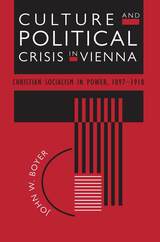
front cover of Culture and Political Crisis in Vienna
Culture and Political Crisis in Vienna
Christian Socialism in Power, 1897-1918
John W. Boyer
University of Chicago Press, 1995
In this sequel to Political Radicalism in Late Imperial Vienna, John Boyer picks up the history of the Christian Social movement after founder Karl Lueger's rise to power in Vienna in 1897 and traces its evolution from a group of disparate ward politicians, through its maturation into the largest single party in the Austrian parliament by 1907, to its major role in Imperial politics during the First World War.

Boyer argues that understanding the unprecedented success that this dissident bourgeois political group had in transforming the basic tenets of political life is crucial to understanding the history of the Central European state and the ways in which it was slowly undermined by popular electoral politics. The movement's efforts to save the Austrian Empire by trying to create an economically integrated but ethnically pluralistic state are particularly enlightening today in the shadow of ethnic violence in Sarajevo, where began the end of the Austrian Empire in 1914.

The most comprehensive account of any mass political movement in late-nineteenth century Central Europe, this two- volume work is crucial reading for anyone interested in Hapsburg history, German history or the history of social democracy.
[more]

front cover of Divide, Provide and Rule
Divide, Provide and Rule
An Integrative History of Poverty Policy, Social Reform, and Social Policy in Hungary under the Habsburg Monarchy
Susan Zimmermann
Central European University Press, 2011
A concise and comprehensive account of the transformation of social policy from traditional poor relief towards social insurance systems in a European state before World War One. Brings together the analysis of older, mostly local welfare policies with the history of social policy developed by the state and operated at a national level. Explores also the interaction of various layers of and actors in welfare policy, i.e. of poor relief, social reform policies and the unfolding welfare state over time, including often neglected elements of these policies such as e.g. protective policies at the work place, housing policy, child protection, and prostitution policies.
[more]


Send via email Share on Facebook Share on Twitter