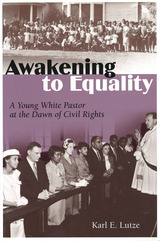
front cover of Awakening to Equality
Awakening to Equality
A Young White Pastor at the Dawn of Civil Rights
Karl E. Lutze
University of Missouri Press, 2006
When Karl Lutze arrived in Oklahoma in 1945, he stepped into another world. A newly ordained clergyman born in Wisconsin, he was a young white man assigned to minister among Muskogee’s African American community. He soon found that in the South, crosses were as likely to be burned as revered. His recollections of postwar Oklahoma provide a compelling testament to the era’s racial conflict and some steps taken toward its resolution.
Awakening to Equality offers a unique perspective on an often-violent era that witnessed the gradual dismantling of segregation. Serving congregations in Muskogee and Tulsa, Lutze encountered a cross section of both communities—from the white and black power brokers to the most disempowered black and biracial families—and a stratified society buttressed by intimidation, cross burnings, and bombs. His activism in the Urban League and other local civil rights organizations gave him firsthand experience with forces moving toward change, as well as with the more entrenched forces resisting it.
Blending personal anecdotes and recollections of key players in this unfolding drama, Lutze puts a human face on historical and journalistic accounts of social change during the crucial early years of the civil rights movement. He takes readers back to small-town and urban Oklahoma in a time when African Americans were beginning to challenge segregation in Muskogee’s public transportation and a handful of liberal whites were trying to move their communities toward desegregation. Throughout this rich memoir, we meet actual people creating a future—one that involved the very redefinition of America.
More than a view of an earnest young clergyman trying to grow beyond the racial and social limitations of the church of his day, Awakening to Equality also depicts the struggles of Lutze’s own denomination to overcome its earlier accommodation of racism. Lutze’s success in his ministries made his achievements a model for mission work among African Americans and led to his appointment in 1959 first as field secretary and then shortly thereafter as executive director of the Lutheran Human Relations Association, a pioneering civil rights organization. Simultaneously, he taught classes as Associate Professor of Theology at Valparaiso University.
Lutze not only witnessed important events but also participated in them and found that his entire career was shaped by the experience. Awakening to Equality is a moving story that captures the real-life education of a prominent clergyman during a critical period in American life.
[more]

front cover of Joseph of Arimathea
Joseph of Arimathea
Glyn S. Lewis
Westholme Publishing, 2017
Exploring the legend of the man who brought Christianity to the British Isles 

“This author testifieth Joseph of Arimathea to be the first preacher of the word of God within our realms. Long after that, when Austin came from Rome, this our realm had bishops and priests there-in, as is well known to the learned of our realm.”—Elizabeth I, in a 1559 letter to Roman Catholic bishops on the precedence of the Church of England

The name Joseph of Arimathea is generally well known, either from the accounts in each of the New Testament Gospels that tell of his providing a tomb for the burial of Jesus; from his depictions in medieval and Renaissance art; from his associations with the Holy Grail that later found greater expression in medieval Arthurian stories; and even from the story that has endured in western Britain that as a trader in tin, copper, and lead, he had traveled often to the region—and with him came the Christian religion. These stories are strongly rooted, despite the lack of impeccable source material—so much so that Elizabeth I used Joseph of Arimathea as proof that the Church of England predated the Catholic church in her country. In Joseph of Arimathea Glyn S. Lewis brings these fragments together in order to provide as fully as is possible what we can infer about this first-century apostle.
   The author first discusses Arimathea, a town that has yet to be positively identified. He then reviews the accounts of Joseph’s entombment of Jesus that appear in each of the four Gospels. From these earliest references, the author next consults the literary and oral tradition evidence of Joseph’s passage by ship to the south of France among a group of fugitives escaping persecution for being Christians, and his early visits to Britain as a trader in precious ores. These voyages are said to have brought him to the area around Glastonbury, which became a flourishing monastery in the Middle Ages. Whether or not Joseph of Arimathea visited Britain, his story remains an enthralling and fascinating mystery. 
[more]

front cover of Paul the Martyr
Paul the Martyr
The Cult of the Apostle in the Latin West
David L. Eastman
SBL Press, 2011

Ancient iconography of Paul is dominated by one image: Paul as martyr. Whether he is carrying a sword—the traditional instrument of his execution—or receiving a martyr's crown from Christ, the apostle was remembered and honored for his faithfulness to the point of death. As a result, Christians created a cult of Paul, centered on particular holy sites and characterized by practices such as the telling of stories, pilgrimage, and the veneration of relics. This study integrates literary, archaeological, artistic, and liturgical evidence to describe the development of the Pauline cult within the cultural context of the late antique West.

[more]

logo for Intellect Books
Spiritual Herstories
Call of the Soul in Dance Research
Edited by Amanda Williamson and Barbara Sellers-Young
Intellect Books, 2019
This is a collection of works by internationally recognized women leading the field of dance research and spirituality across the globe. Building on current soulful research scholarship in the discipline, these authors offer extensive and detailed research into spirituality, dance, gender, religion, and somatics. Written by women dance scholars in higher education, this evocative and illuminating work highlights a growing discourse on gendered leadership in dance research. Spiritual Herstories provides new pathways and innovative research methods that respond to the educational needs of women emerging in male-centric socio-historic research traditions.
[more]

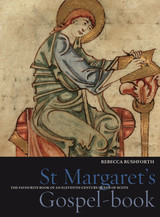
front cover of St. Margaret's Gospel
St. Margaret's Gospel
The Favourite Book of a Queen of Scotland
Rebecca Rushforth
Bodleian Library Publishing, 2007
Margaret was both a saint and a celebrated queen who, with her husband, led Scotland to great acclaim and power in eleventh-century Europe. Her favorite book was an illuminated manuscript of extracts from the gospels, and her personal copy, currently held in the Bodleian Library, is reproduced here for the pleasure of modern readers.

Margaret’s piety, dignity, and compassion made her a beloved figure long after her death. Her illuminated manuscript reveals the depths of her sanctity, opening with a Latin poem relating the one miracle attributed to her, where she preserved this book from damage. Exquisite illustrations transform the script into an arresting treasure, and Rebecca Rushforth uses incisive and comprehensive commentary to explain the story behind the manuscript and set it within Margaret’s historical context. She explores both the creation of the manuscript and its special meaning for Margaret, along with Margaret’s role as a significant figure in British and world history.

A fascinating piece of historical art, St Margaret’s Gospel-Book will be treasured by historians, religious scholars, and classicists alike.

[more]


Send via email Share on Facebook Share on Twitter