
 A SCHOLARLY BOOK REPOSITORY
A socio-cultural anthropologist who became a behavioral paleoanthropologist late in his career, Freeman took a unique approach, employing statistical or mathematical techniques in his analysis of archaeological data. All the papers in this collection blend theoretical statements with the archeological facts they are intended to help the reader understand.
Although he taught at the University of Chicago for the span of his 40-year career, Freeman is not well-known among Anglophone scholars, because his primary fieldwork and publishing occurred in Cantabrian, Spain. However, he has been a major player in Paleolithic prehistory, and this volume will introduce his work to more American Archaeologists.
This collection brings the work of an expert scholar, to a broad audience, and will be of interest to archaeologists, their students, and lay readers interested in the Paleolithic era.
In 1795 Benjamin Hawkins, a former US senator and advisor to George Washington, was appointed US Indian agent and superintendent of all the tribes south of the Ohio River. Unlike most other agents, he lived among the Creek Indians for his entire tenure, from 1796 to 1816. Journeying forth from his home on the Flint River in Georgia, he served southeastern Indians as government intermediary during one of the longest eras of peace in the historic period.
Hawkins’s journals provide detailed information about European-Indian relations in the 18th-century frontier of the South. His descriptions of the natural and cultural environment are considered among the best sources for the ethnohistory of the Choctaw, Cherokee, Chickasaw, and, especially, the Creek Indians and the natural history of their territory.
Two previously published bodies of work by Benjamin Hawkins are included here—A Sketch of the Creek Country in the Years 1798 and 1799 and The Letters of Benjamin Hawkins 1796-1806. A third body of work that has never been published, “A Viatory or Journal of Distances” (describing routes and distances of a 3,578-mile journey through parts of Georgia, Alabama, and Mississippi), has been added. Together, these documents make up the known body of Hawkins’ work—his talks, treaties, correspondence, aboriginal vocabularies, travel journals, and records of the manners, customs, rites, and civil polity of the tribes. Hawkins' work provides an invaluable record of the time period.
This cumulative index to the thirty-seven volumes of The Collected Works of John Dewey, 1882–1953, is an invaluable guide to The Collected Works.
The Collected Works Contents incorporates all the tables of contents of Dewey’s individual volumes, providing a chronological, volume-by-volume overview of every item in The Early Works, The Middle Works, and The Later Works.
The Title Index lists alphabetically by shortened titles and by key words all items in The Collected Works. Articles republished in the collections listed above are also grouped under the titles of those books.
The Subject Index, which includes all information in the original volume indexes, expands that information by adding the authors of introductions to each volume, authors and titles of books Dewey reviewed or introduced, authors of appendix items, and relevant details from the source notes.
Nana Asma'u Bint Usman 'dan Fodiyo, a nineteenth-century Muslim scholar, lived in the region now known as northern Nigeria and was an eyewitness to battles of the largest of the West-African jihads of the era. The preparation and conduct of the jihad provide the topics for Nana Asma'u's poetry. Her work also includes treatises on history, law, mysticism, theology, and politics, and was heavily influenced by the Arabic poetic tradition.
This volume contains annotated translations of works by the 19th century intellectual giant, Nana Asma'u, including 54 poems and prose texts. Asma'u rallied public opinion behind a movement devoted to the revival of Islam in West Africa, and organized a public education system for women.

The inaugural volume of The Collected Works of William Howard Taft is composed of two of his earliest books, Four Aspects of Civic Duty and Present Day Problems. Based on a series of lectures delivered at Yale in 1906, Four Aspects of Civic Duty is an attempt by then Secretary of War Taft to bring to the attention of his audience the importance of civic duty from the perspective of the university graduate, the judge on the bench, the colonial administrator, and the national executive branch of government. His remarks were drawn from his own experience, while at the same time he laid down the principles of citizenship with which all people could identify. In Present Day Problems, William Howard Taft demonstrates the depth of his knowledge and the seriousness of his reflections on a wide range of topics including Sino-American relations and the ongoing contest between capital and labor in America’s increasingly industrial socioeconomy. The problems he takes up are met head-on and discussed in a fashion likely to persuade his audience that he is well prepared to tackle the burdens of the presidency.
The Collected Works of William Howard Taft, in eight volumes, will include Taft’s complete published works as well as his presidential and state addresses and selected court opinions from his days as chief justice of the Supreme Court.
The second volume of The Collected Works of William Howard Taft is dedicated to the speeches and writings that displayed his thinking in the autumn of 1908 and the following winter.
At this time he was campaigning for the presidency against the well-known William Jennings Bryan, and in Taft’s writings is evidence of the contrast in style between Taft and Bryan and between Taft and his predecessor, Teddy Roosevelt. as well. Although uncomfortable with campaigning, he thoughtfully addresses the concerns of the day that framed the election, including race, the Philippines, and socialism.
Political Issues and Outlooks also contains speeches made after the election and leading up to his inauguration as the twenty-seventh president of the United States. Introduced by a commentary from the general series editor Professor David H. Burton, the second volume of The Collected Works of William Howard Taft is a revealing look at the machinations of United States politics at the beginning of the twentieth century and a glimpse into the mind of one of the century’s most influential political architects.
The third volume of The Collected Works of William Howard Taft imparts an appreciation of the range of the twenty-seventh president’s interests. Beginning with his inaugural address and concluding with a detailed exposition of governmental expenses and needed economies, President William Howard Taft showed himself willing to tackle the routine as well as the rarified responsibilities of executive rule.
Whether he was addressing the issue of strikes and labor unions or conservation, President Taft consistently demonstrated that, in word and action, he was prepared to be a modern president. What impresses the reader of these remarks is Taft’s willingness to administer to virtually every part of the nation, thereby proving that he was not a mere figurehead but a chief executive truly concerned about problems across the country. Perhaps, as his words here indicate, Taft was not a good politician after all but a kind man who saw himself as president of all the people. As the first of two volumes directly related to Taft’s tenure as president, Presidential Addresses and State Papers documents a pivotal time in the public life of this man from Ohio. Introduced by a commentary from the general series editor Professor David H. Burton, the third volume of The Collected Works of William Howard Taft underscores the presidential stature of William Howard Taft.
“A time when panics seem far removed is the best time to prepare our financial system to withstand a storm. The most crying need this country has is a proper banking and currency system. The existing one is inadequate, and everyone who has studied the question admits it.”—William Howard Taft
The interaction between President William Howard Taft and the Congress provides a window on his leadership. Volume IV of The Collected Works of William Howard Taft is devoted to his messages to the legislative branch and concerns some of the pressing issues of the day, issues that have relevance still.
Oftentimes President Taft was at odds with a somewhat reactionary Congress, causing him to veto legislation that he thought unwise. For example, his commitment to the independence of elected judges led him to reject statehood for Arizona until its constitution was altered to address his objection.
His messages also touched on subjects for which he led the way over the objections of Congress, such as his recommendation of a federal law to protect resident aliens against denial of their civil rights and his advocacy of free trade with Canada.
In his commentary to the volume, Professor Burton points out: “There is exhibited time after time concern for the American people, for men and women from different walks of life. Taft comes across less as a judge, which he had been, or the chief justice he was to become, and more as a sitting president of all the people.”
Taft’s Presidential Messages to Congress provides the documentary evidence to support that claim.
The fifth volume of The Complete Works of William Howard Taft presents two publications Taft wrote as Kent Professor of Constitutional Law at Yale University, the position he assumed in 1913 after he was defeated in his bid for re-election as U.S. president. The first, Popular Government, was prepared for a series of lectures, but was motivated by Taft’s passion over the issue of constitutional interpretation, which had been hotly contested during the campaign. Organized around the preamble of the Constitution, the lectures and later the book were opportunities for Taft to restate his opposition to the direct democracy movement and to reveal the workings of a conservative mind.
In the second, The Anti-trust Act and the Supreme Court, Taft articulates his position in the ongoing debate over the conventional nineteenth-century notion of “laissez faire” and the provisions of the Sherman Antitrust Act. Taft had pursued a policy of vigorous antitrust enforcement during his presidency. In this book he intended to demonstrate that restraint of trade was part of the common law, thereby arguing to good effect in favor of reasonable restraint of trade in his own time.
Taft's careful distinction between predatory monopolistic practices and the reasonable business practices of well-behaved corporations continues to inform today's chambers of government.
Volume VI of The Collected Works of William Howard Taft follows the career of William Howard Taft upon his leaving the White House. It consists of two short publications from 1914 and 1915.
The first, The President and His Powers, is based on a series of lectures delivered at Columbia University and draws on Taft’s experience in the presidency and the executive branch. It speaks particularly to the nature of executive power and its place in the American system and is rooted in his disagreement with Theodore Roosevelt regarding presidential power. Taft believed all presidential power must be traced to some specific grant of power or be necessary to its exercise, while Roosevelt saw the presidency as a position of “steward of the people” limited only by some express provision of the Constitution.
The second, The United States and Peace, reflects Taft’s interest in foreign policy, which was intensified by his years as governor of the Philippines and as secretary of war, as well as by his presidency. Originally four lectures delivered in 1914, The United States and Peace discusses the Monroe Doctrine, the threat to peace presented by incidents of violence to foreigners in the United States, the maintenance of peace through international arbitration, and the trend toward federation in international affairs. Taft hoped to see the latter result in the establishment of an independent judiciary to resolve international disputes.
Taft’s reasoned arguments, supplemented by the commentaries of Professors McWilliams and Gerrity, will stimulate interest among historians, lawmakers, political activists, and the general public.
Eager to turn the congressional election of 1918 into a confirmation of his foreign policy, President Woodrow Wilson was criticized for abandoning the spirit of the popular slogan “Politics adjourned!”
His predecessor, William Howard Taft, found Wilson difficult to deal with and took issue with his version of the League of Nations, which Taft felt was inferior to the model proposed by the League to Enforce Peace. Rather than join the massive Republican opposition to the Treaty of Versailles, however, Taft instead supported Wilson’s controversial decision to travel to Paris as the head of the American peace delegation, and he defended the critical tenth article in the covenant, which detractors saw as a surrender of American sovereignty. He also counseled Wilson to insert a clause concerning the Monroe Doctrine that would pacify the Senate’s group of “reservationists,” whose votes were essential to approval of the treaty.
Volume VII in The Collected Works of William Howard Taft consists of the Taft Papers on League of Nations originally published in 1920. This is a collection ofTaft’s speeches, newspaper articles, and complementary documents that reflect his consistent support for a league of nations and, eventually, for the Covenant of the League of Nations emanating from the Paris Peace Conference.
Although the failure of the treaty and its League of Nations can probably be laid at the feet of an obstinate Wilson and a wily Henry Cabot Lodge, William Howard Taft can be credited with rising above partisanship to emerge as the League’s most consistent supporter.
As in the rest of the Collected Works, Taft Papers on League of Nations provides a window on the machinations surrounding some of the most significant decisions of the era.
William Howard Taft’s presidency (1909-1913), succeeding Theodore Roosevelt’s, was mired in bitter partisan fighting, and Taft sometimes blundered politically. However, this son of Cincinnati assumed his true calling when President Warren G. Harding appointed him to the U.S. Supreme Court in 1921. Taft remains the only person to have served both as president of the United States and as chief justice of the Supreme Court.
The Collected Works of William Howard Taft, Volume VIII, consists of “Liberty under Law” and selected Supreme Court opinions, among the most instructive accomplishments of Taft’s ten years at the helm of the court. The writings reveal the sober judgments of a federalist who viewed state regulation with suspicion, championed national government, and saw an independent and powerful judiciary as the bulwark protecting the “vested rights” that the framers of the U.S. Constitution sought to guarantee.
Whatever his failings as a politician, Taft was an intellectual powerhouse who knew how to use the law as a lever to encourage society to move toward more stable and productive ends. Although Taft is considered an average president at best, historians and political scientists rank him among fifteen “near greats” who have served on the high court. His ability and his love for the law shine through in Volume VIII, the concluding volume of The Collected Works of William Howard Taft. As Taft reportedly said to President Harding upon his appointment as chief justice, “I love judges and I love courts. They are my ideals on earth of what we shall meet afterward in heaven under a just God.”


"This collection shines a light onto the character and experience of one of the most interesting of monarchs. . . . We are likely never to get a closer or clearer look at her. An intriguing and intense portrait of a woman who figures so importantly in the birth of our modern world."—Publishers Weekly
"An admirable scholarly edition of the queen's literary output. . . . This anthology will excite scholars of Elizabethan history, but there is something here for all of us who revel in the English language."—John Cooper, Washington Times
"Substantial, scholarly, but accessible. . . . An invaluable work of reference."—Patrick Collinson, London Review of Books
"In a single extraordinary volume . . . Marcus and her coeditors have collected the Virgin Queen's letters, speeches, poems and prayers. . . . An impressive, heavily footnoted volume."—Library Journal
"This excellent anthology of [Elizabeth's] speeches, poems, prayers and letters demonstrates her virtuosity and afford the reader a penetrating insight into her 'wiles and understandings.'"—Anne Somerset, New Statesman
"Here then is the only trustworthy collection of the various genres of Elizabeth's writings. . . . A fine edition which will be indispensable to all those interested in Elizabeth I and her reign."—Susan Doran, History
"In the torrent of words about her, the queen's own words have been hard to find. . . . [This] volume is a major scholarly achievement that makes Elizabeth's mind much more accessible than before. . . . A veritable feast of material in different genres."—David Norbrook, The New Republic

The papers are divided into six sections, each introduced by prominent researchers. Sections one and two cover the origins and history of the field and the emergence of basic methods and approaches. They provide a background for sections three through six, which focus on development and learning; neural and hormonal mechanisms of behavior; sensory processes, orientation, and communication; and the evolution of behavior.
This outstanding collection will serve as the basis for undergraduate and graduate seminars and as a reference for researchers in animal behavior, whether they focus on ethology, behavioral ecology, comparative psychology, or anthropology.
Published in association with the Animal Behavior Society
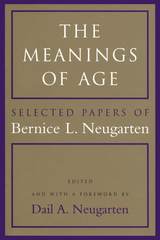
Carefully edited by Dail Neugarten, each chapter presents the reader with Bernice Neugarten's original formulations on topics such as age norms and age constraints, the changing meanings of age, and age neutral social policy. Including four previously unpublished papers, The Meanings of Age will be of interest to scholars, students, and practitioners of psychology, education, law, medicine, social policy, and gerontology.

Of the thousands of articles, columns, and profiles he has penned over the years, Didinger has selected his finest work to be included in this book. One Last Read contains entire chapters for each of the professional Philadelphia teams -- the Phillies, the Flyers, the Sixers and of course, the Eagles. But that is only half of the story. Included here is his coverage of college sports and the Olympics as well as the ful text of the speech he delivered in Canton, Ohio when he presented his boyhood idol, Tommy McDonald, for induction into the Pro Football Hall of Fame.
There are also some strongly-worded opinion pieces -- about former Eagles owner (and legendary high-roller) Leonard Tose, the career of Woody Hayes, and much, much more.
Didinger's introduction -- engaging, warm, whitty, and insightful -- is among his finest writing. For longtime readers, this essential collection of Didinger's work was worth the wait.

Few figures shaped the Stone-Campbell Restoration movement more than David Lipscomb, whose influence on its theology and practice rivaled that of any of his contemporaries. Yet the writings in this volume have long been unavailable to general readers, and most people are no longer familiar with his ideas, including his belief that Christians should not participate in secular politics.
In the early decades of the Stone-Campbell movement, adherents argued their positions in person and in print, and the direction of the movement was decided by these wide-ranging theological discussions. Dissent was built into the discourse and considered a part of the spiritual well-being of the movement. Followers were expected to read and have opinions on all these discussions. And now most of these books and articles have all but vanished from circulation—not just Lipscomb’s but many of the nineteenth-century Campbellite theologians’ writings.
This volume comprises three of Lipscomb’s most important works regarding Christians’ relationship to civil government, along with an introduction by Edward Peter Stringham and Norman R. Horn that explains how Lipscomb’s political writings receded from view within the movement he once shaped.
READERS
Browse our collection.
PUBLISHERS
See BiblioVault's publisher services.
STUDENT SERVICES
Files for college accessibility offices.
RECENTLY PUBLISHED






UChicago Accessibility Resources
home | accessibility | search | about | contact us
BiblioVault ® 2001 - 2026
The University of Chicago Press