
 A SCHOLARLY BOOK REPOSITORY
Mukherjee offers the first comprehensive cross-national framework for identifying the specific economic conditions that influence trade policy in developing countries. Laying out the causes of variation in trade policy in four developing or recently developed countries—Brazil, India, Indonesia, and South Africa—he argues persuasively that changing political interactions among parties, party leaders, and the labor market are often key to trade policy outcome. For instance, if workers are in a position to benefit from opening up to trade, party leaders in turn support trade reforms by decreasing tariffs and other trade barriers.
At a time when discussions about the stability of new democracies are at the forefront, Democracy and Trade Policy in Developing Countries provides invaluable insight into the conditions needed for a democracy to survive in the developing world in the context of globalization.
Moving next to de facto independence, Yadav and Mukherjee bring together data from 103 democracies in the developing world, complemented by case studies of Brazil, India, and Indonesia. Honing in on the effects of electoral institutions, the authors find that, when faced with short time horizons, governments that operate in personal vote electoral systems are likely to increase de facto judicial independence whereas governments in party-centered systems are likely to reduce it.
The volume, divided into four main sections, addresses: the role of exchange rates in stabilization programs and the adjustment process; the importance of exchange rate policy during liberalization reform in developing countries; exchange rate problems relevant and unique to developing countries, illustrated by case studies; and the problems defining, measuring, and identifying determinants of real exchange rates. Authors of individual papers examine the relation between commercial policies and exchange rates, the role of exchange rate policy in stabilization programs, the effectiveness of devaluations as a policy tool, and the interaction between exchange rate terms of trade an capital flow. This research will not only prove crucial to our understanding of the role of exchange rates in developing countries, but will clearly set the standard for future work in the field.
Surveying many aspects of education—from administrative structures to the availability of health care to parent and student incentives—the contributors synthesize an impressive diversity of data, paying special attention to the gross imbalances in educational achievement that still exist between developed and developing countries. They draw out clear implications for governmental policy at a variety of levels, conscious of economic realities such as budget constraints, and point to crucial areas where future research is needed. Offering a wealth of insights into one of the best investments a nation can make, Education Policy in Developing Countries is an essential contribution to this most urgent field.

Millions across the world face the daily challenge to find enough food to survive. Hunger is on the rise globally, with more than 1.2 billion people suffering from food insecurity. Rising prices are further restricting food access.
In this deeply informative study, Majda Bne Saad identifies the causes for global hunger embedded in the current global political and economic system and highlights the key challenges facing food deficit countries. She shows how Western countries share the blame for global hunger through their support for subsidies to agricultural production and biofuels, which have created new challenges to food security worldwide.
Bne Saad argues that, as world population rises from 7 billion to 9.2 billion by 2050, there needs to be a ‘second green revolution’ to grow more food. She looks at the factors constraining low-income nations from achieving food security and considers policies which could generate income and enhance individuals' entitlement to food.
In this seminal collection of articles on health care in the Third World, sociological perspectives are applied to medical issues in revealing ways. Fourteen essays (all but two of which are original to this volume) examine the social production of health, disease, and systems of care throughout the developing world. The volume covers a range of areas—central Africa, Nigeria, Singapore, Taiwan, Indonesia, Nepal, China, United Arab Emirates, Oman, and Mexico—and a broad scope of topics, from emergency care, the AIDS epidemic, and women's health care, to public health programs and national health care policies.
Contributors address the central question of whether health systems in developing areas should emphasize the role of clinical medicine and individual physicians or community and preventive medical resources. The major health problems faced by these societies—inadequate sanitation, infectious disease, high infant-child mortality, and a lack of family planning—indicate the greater need for health educators and public health workers despite many poor nations' desire for Western doctors. Other topics that are examined include the process of seeking medical aid; the relationship between traditional and modern medicines; medical education, hospital care, and communication between doctors and patients in developing countries; and the relevance and application of sociology in Third World settings.
This volume seeks to draw attention to the significance of medical sociology for understanding Third World health problems and to show how examining developing societies may necessitate reframing or modifying some Western sociological notions. In addition, these essays stretch the boundaries of medical sociology to include Third World issues.
This book is about the links that tie resource use, environmental quality, and economic development, and the way in which those links are affected by the distribution of income and resource ownership. The links may be relatively simple, as in the case of peasant farmers too poor to conserve resources for the future and with nothing to gain from sound environmental practices. Or they may be very complex—as the authors find when they demonstrate how achievement of higher incomes by the rich can increase environmentally destructive behavior by the poor. Many of the links in some way involve rural land use, whether for agriculture or forestry. Natural Resource Policymaking in Developing Countries argues that the policies that matter are not merely those dealing with resources and the environment, but a much broader set that includes income distribution and asset ownership.

"An important landmark in the growing field of economic demography."—Dudley Kirk, Journal of Developing Areas
Other conclusions include the apparently mutually reinforcing nature of tax simplification and tax rate reduction, and the role of indirect tax reforms (such as the value-added tax) in successful reform undertakings.
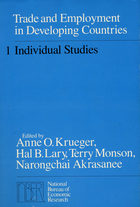
Ten countries are studied: Brazil, Chile, Colombia, Indonesia, the Ivory Coast, Pakistan, South Korea, Thailand, Tunisia, and Uruguay. The contributors to the volume analyze the link between trade strategies and employment within a common framework, and the analyses of trade policy include the level and structure of protection, the relation of trade policy to labor demand, the labor intensiveness of trade, and the extent of distortions in factor markets and their effects on trade.
READERS
Browse our collection.
PUBLISHERS
See BiblioVault's publisher services.
STUDENT SERVICES
Files for college accessibility offices.
RECENTLY PUBLISHED






UChicago Accessibility Resources
home | accessibility | search | about | contact us
BiblioVault ® 2001 - 2026
The University of Chicago Press