
 A SCHOLARLY BOOK REPOSITORY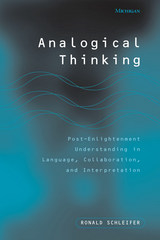
The book traces this mode of thinking in linguistics, collaborative intellectual work in the arts and sciences, and interpretations of literary and sacred texts, concluding with a reading of the concept of Enlightenment in a comparison of Descartes and Foucault. The book examines the poststructuralism of Derrida; the collaborations of information theory and modern science as opposed to the individualism of Adam Smith and others, and analogical interpretations of Yeats, Dinesen, the Bible, Dreiser, and Mailer. Its overall aim is to present an interdisciplinary examination of a particular kind of understanding that responds to the experiences of our time.
Ronald Schleifer is Professor of English, University of Oklahoma. His books include Rhetoric and Death: The Language of Modernism and Postmodern Discourse Theory, Criticism and Culture; and Culture and Cognition: The Boundaries of Literary and Scientific Inquiry.
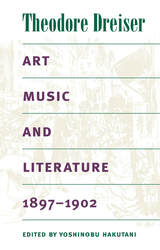
In this volume, liberally seasoned with period illustrations, Yoshinobu Hakutani has collected and annotated a rich selection of Theodore Dreiser's pre-fame writings on the cultural milieu of his day.
In these brief essays, Dreiser sallies into the vibrant world of creative work in turn-of-the-century America. He inspects the eccentric and revealing paraphernalia of artists' studios, probes the work habits of writers, and goes behind the scenes in the popular song-writing business, where this week's celebrity is next week's has-been. He profiles famous figures and introduces numerous women artists, novelists, and musicians, including the prolific and tireless Amelia Barr (mother of fourteen children and author of thirty-two novels), the illustrator Alice B. Stephens, and the opera singer Lillian Nordica. Hakutani's notes provide biographical detail on dozens of now-obscure individuals mentioned by Dreiser.
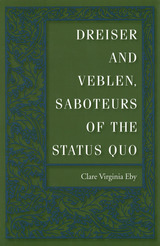
In this important interdisciplinary study, Clare Eby argues that the writings of Theodore Dreiser and Thorstein Veblen form a neglected chapter in the history of United States cultural criticism that is especially relevant today.
This study leaves behind the narrow frameworks through which most of Veblen's and Dreiser's writings have been interpreted, covering a wide range of both authors' major and minor works. Moving beyond Veblen's The Theory of the Leisure Class and Dreiser's Sister Carrie, Eby shows how the two writers, as saboteurs of the status quo, anticipated many preoccupations of cultural critics today: the cultural role of the intellectual, the relationship of science to society, the place of consumption in modern life, and the intersection of class, gender, and power.
Eby uses cultural criticism as a unifying concept that shows how Veblen fuses satire, sociology, economics, history, psychology, anthropology, political science, and philosophy; and how Dreiser connects fiction, travelogue, literary manifesto, occasional essay, autobiography, biography, and philosophy. By reading Veblen through Dreiser, and Dreiser through Veblen, Eby illustrates the striking parallels between their works, demonstrating how literature and social science can merge in cultural criticism.
Although Dreiser's interest in the natural and social sciences has often been noted, this study provides the only extended analysis of how his works actually resemble, and strive to become, critically informed social science. Similarly, despite the singularity of Veblen's rhetoric, the centrality of literary devices to his works has never been systematically examined. By placing the works of Veblen and Dreiser into dialogue, this study contributes significantly to the recent attempts to bring together the concerns of literary analysts and social scientists.
Dreiser and Veblen, Saboteurs of the Status Quo makes an important contribution not only to Dreiser and Veblen studies but also to cultural criticism itself.
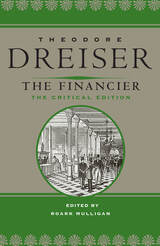
First published in 1912, Theodore Dreiser's third novel, The Financier, captures the ruthlessness and sparkle of the Gilded Age alongside the charismatic amorality of the power brokers and bankers of the mid-nineteenth century. This volume is the first modern edition of The Financier to draw on the uncorrected page proofs of the original 1912 version, which established Dreiser as a master of the American business novel. The novel was the first volume of Dreiser’s Trilogy of Desire, also known as the Cowperwood Trilogy, which includes The Titan (1914) and The Stoic (1947).
Dreiser laboriously researched the business practices and personal exploits of real-life robber baron Charles Yerkes to narrate Frank Algernon Cowperwood's early career in The Financier, which explores the unscrupulous world of finance from the Civil War through the panic incited by the 1871 Chicago fire. In 1927, the monumental novel reappeared in a radically revised version for which Dreiser, notorious for lengthy novels, agreed to cut more than two hundred and seventy pages. This revised version became the most familiar, reprinted by publishers and studied by scholars for decades.
For this new edition, Roark Mulligan meticulously reviewed earlier versions of the novel and its publication history, including the last-minute removal of paragraphs, pages, and even whole chapters from the 1912 edition, cuts based mainly on the advice of H. L. Mencken. The restored text better matches Dreiser's original vision for the work. More than three hundred additional pages not available to modern readers--including those cut from the 1927 edition and more than seventy hastily removed from the manuscript just days before publication in 1912--more effectively establish characterization and motivation. Restored passages dedicated to the internal thoughts of major and minor characters bring a softer dimension to a novel primarily celebrated for its realistic attention to the cold external world of finance.
Mulligan's historical commentary reveals new insights into Dreiser's creative practices and how his business knowledge shaped The Financier. This supplemental material considers the novel's place within the tradition of American business novels and its reflections on the scandalous business practices of the robber baron era.
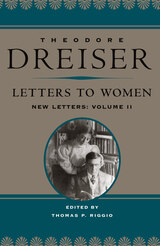
Theodore Dreiser led a long and controversial life, almost always pursuing some serious question, and not rarely pursuing women. This collection, the second volume of Dreiser correspondence to be published by the University of Illinois Press, gathers previously unpublished letters Dreiser wrote to women between 1893 and 1945, many of them showing personal feelings Dreiser revealed nowhere else. Here he both preens and mocks himself, natters and scolds, relates his jaunts with Mencken and his skirmishes with editors and publishers. He admits his worries, bemoans his longings, and self-consciously embarks on love letters that are unafraid to smolder and flame. To one reader he sends “Kisses, Kisses, Kisses, for your sweety mouth” and urges his needy requests: “Write me a love-letter Honey girl.” Alongside such amorous play, he often expressed his deepest feelings on philosophical, religious, and social issues that characterize his public writing.
Chronologically arranged and meticulously edited by Thomas P. Riggio, these letters reveal how wide and deep Dreiser’s needs were. Dreiser often discussed his writing in his letters to women friends, telling them what he wanted to do, where he thought he succeeded and failed, and seeking approval or criticism. By turns seductive, candid, coy, and informative, these letters provide an intimate view of a master writer who knew exactly what he was after.

Exploring human nature, society, and destiny through the lens of American naturalism.
In Notes on Life, Theodore Dreiser—best known for his landmark novels Sister Carrie and An American Tragedy—reveals himself as an incisive thinker grappling with the forces that shape human existence. This compelling collection of essays brings together Dreiser’s reflections on society, ambition, morality, and the often-unseen pressures that guide individual lives. Written during a period of rapid cultural and industrial transformation in the United States, these essays offer a deeply engaged response to the uncertainties and contradictions of modern life.
At the heart of Notes on Life lies Dreiser’s enduring commitment to the principles of literary naturalism: the belief that human behavior is influenced—if not determined—by environment, heredity, and social conditions. Yet these essays go beyond literary theory. They present a searching, often personal inquiry into what it means to live meaningfully in a world shaped by inequality, chance, and desire. Dreiser examines the tension between individual aspiration and societal constraint, probing the psychological and moral dimensions of success, failure, and identity.
What distinguishes this collection is its accessibility and range. Dreiser writes with a directness that invites readers into complex philosophical questions without sacrificing intellectual depth. Whether considering the nature of happiness, the role of material success, or the ethical dilemmas of modern society, he offers insights that remain strikingly relevant. His voice—by turns analytical, reflective, and quietly provocative—bridges the gap between literature and philosophy, making these essays as engaging for general readers as they are valuable for students and scholars.
For those interested in American literature, Notes on Life provides essential context for understanding Dreiser’s fiction and the broader movement of realism and naturalism in the early twentieth century. For contemporary readers, it offers a timeless meditation on the forces that continue to shape human experience: ambition, circumstance, and the search for meaning in an ever-changing world.
Both a work of literary significance and a volume of enduring philosophical reflection, Notes on Life stands as a testament to Dreiser’s intellectual breadth and his unwavering commitment to exploring the complexities of human life.
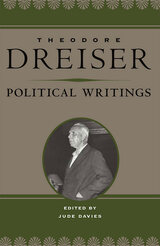

Theodore Dreiser - American Writers 102 was first published in 1972. Minnesota Archive Editions uses digital technology to make long-unavailable books once again accessible, and are published unaltered from the original University of Minnesota Press editions.
READERS
Browse our collection.
PUBLISHERS
See BiblioVault's publisher services.
STUDENT SERVICES
Files for college accessibility offices.
RECENTLY PUBLISHED





UChicago Accessibility Resources
home | accessibility | search | about | contact us
BiblioVault ® 2001 - 2026
The University of Chicago Press