
 A SCHOLARLY BOOK REPOSITORY
43 start with A start with A
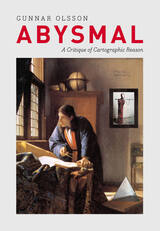
People rely on reason to think about and navigate the abstract world of human relations in much the same way they rely on maps to study and traverse the physical world. Starting from that simple observation, renowned geographer Gunnar Olsson offers in Abysmal an astonishingly erudite critique of the way human thought and action have become deeply immersed in the rhetoric of cartography and how this cartographic reasoning allows the powerful to map out other people’s lives.
A spectacular reading of Western philosophy, religion, and mythology that draws on early maps and atlases, Plato, Kant, and Wittgenstein, Thomas Pynchon, Gilgamesh, and Marcel Duchamp, Abysmal is itself a minimalist guide to the terrain of Western culture. Olsson roams widely but always returns to the problems inherent in reason, to question the outdated assumptions and fixed ideas that thinking cartographically entails. A work of ambition, scope, and sharp wit, Abysmal will appeal to an eclectic audience—to geographers and cartographers, but also to anyone interested in the history of ideas, culture, and art.
"A first-rate book...Brock's lucid and illuminating analysis offers much of value to both intellectual historians and theologians, as well as philosophers."—Theological Studies"Brock's treatment of Aquinas's account of action exhibits a rare combination of rigor and learning. It is, no doubt, the best we have."—The Thomist
Kervégan begins with Hegel’s term “objective spirit,” the public manifestation of our deepest commitments, the binding norms that shape our existence as subjects and agents. He examines objective spirit in three realms: the notion of right, the theory of society, and the state. In conversation with Tocqueville and other theorists of democracy, whether in the Anglophone world or in Europe, Kervégan shows how Hegel—often associated with grand metaphysical ideas—actually had a specific conception of civil society and the state. In Hegel’s view, public institutions represent the fulfillment of deep subjective needs—and in that sense, demonstrate that the real is the rational, because what surrounds us is the product of our collective mindedness. This groundbreaking analysis will guide the study of Hegel and nineteenth-century political thought for years to come.
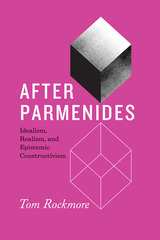
In After Parmenides, Tom Rockmore takes us all the way back to the beginning of Western philosophy, when Parmenides asserted that thought and being are the same. This idea created a division between what the mind constructs as knowable entities and the idea that there is also a mind-independent real, which we can know or fail to know. Rockmore argues that we need to give up on the idea of knowing the real as it is, and instead focus on the objects of cognition that our mind constructs. Though we cannot know mind-independent objects as they “really” are, we can and do know objects as they appear to us.
After Parmenides charts the continual engagement with these ideas of the real and the knowable throughout philosophical history from Plato and Aristotle to Descartes, Kant, Fichte, Hegel, Schopenhauer, Marx, and others. This ambitious book shows how new connections can be made in the history of philosophy when it is reread through a new lens.

From Kant to Kierkegaard, from Hegel to Heidegger, continental philosophers have indelibly shaped the trajectory of Western thought since the eighteenth century. Although much has been written about these monumental thinkers, students and scholars lack a definitive guide to the entire scope of the continental tradition. The most comprehensive reference work to date, this eight-volume History of Continental Philosophy will both encapsulate the subject and reorient our understanding of it. Beginning with an overview of Kant’s philosophy and its initial reception, the History traces the evolution of continental philosophy through major figures as well as movements such as existentialism, phenomenology, hermeneutics, and poststructuralism. The final volume outlines the current state of the field, bringing the work of both historical and modern thinkers to bear on such contemporary topics as feminism, globalization, and the environment. Throughout, the volumes examine important philosophical figures and developments in their historical, political, and cultural contexts.
The first reference of its kind, A History of Continental Philosophy has been written and edited by internationally recognized experts with a commitment to explaining complex thinkers, texts, and movements in rigorous yet jargon-free essays suitable for both undergraduates and seasoned specialists. These volumes also elucidate ongoing debates about the nature of continental and analytic philosophy, surveying the distinctive, sometimes overlapping characteristics and approaches of each tradition. Featuring helpful overviews of major topics and plotting road maps to their underlying contexts, A History of Continental Philosophy is destined to be the resource of first and last resort for students and scholars alike.
Recounts Kojève’s key role in the pivotal exchange of ideas between Eastern and Western European intellectuals in the early twentieth century
This book shines critical new light on the story of Alexandre Kojève’s intellectual origins and his role in the emigration of Russian philosophy into the West in the early twentieth century. Trevor Wilson illustrates how Kojève, at once adversarial to the insular communities of émigré philosophy and yet dependent on their networks and ideas for professional success, navigated the specters of the Russian tradition in pursuit of an autonomous self-definition as a philosopher and intellectual.
Alexandre Kojève and the Specters of Russian Philosophy analyzes the philosopher’s complicated relationship to the interwar diaspora and the complex role played by the Russian tradition in his intellectual formation. Wilson examines Kojève’s early writings in the émigré press on Russian religious philosophy, Soviet politics, and Eurasianism and argues for their enduring relevance for understanding Kojève in his mature period. Crucially, he contextualizes Kojève’s famed seminars on Hegel and examines how Kojève’s thought became embedded in the politics of the Cold War. Based on newly transcribed and translated archival material, he highlights a previously unacknowledged, transnational exchange of ideas between Eastern and Western European intellectuals and shows how it played a pivotal role in twentieth-century intellectual history—and its legacy in the twenty-first.
Beginning with a survey of Islamic philosophy and a discussion of its historical background, Mahdi considers the interrelated spheres of philosophy, political thought, theology, and jurisprudence of the time. He then turns to Alfarabi's concept of "the virtuous city," and concludes with an in-depth analysis of the trilogy, Philosophy of Plato and Aristotle.
This philosophical engagement with the writings of and about Alfarabi will be essential reading for anyone interested in medieval political philosophy.
The first complete English-language edition of Moderation in Belief, this new annotated translation by Aladdin M. Yaqub draws on the most esteemed critical editions of the Arabic texts and offers detailed commentary that analyzes and reconstructs the arguments found in the work’s four treatises. Explanations of the historical and intellectual background of the texts also enable readers with a limited knowledge of classical Arabic to fully explore al-Ghazali and this foundational text for the first time.
With the recent resurgence of interest in Islamic philosophy and the conflict between philosophy and religion, this new translation will be a welcome addition to the scholarship.
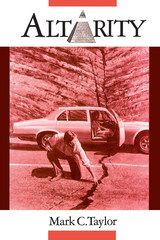
In Altarity, Taylor develops a genealogy of otherness and difference that is based on the principle of creative juxtaposition. Rather than relying on a historical or chronological survey of crucial moments in modern philosophical thinking, he explores the complex question of difference through the strategies of contrast, resonance, and design. Taylor brings together the work of thinkers as diverse as Hegel, Heidegger, Merleau-Ponty, Lacan, Bataille, Kristeva, Levinas, Blanchot, Derrida, and Kierkegaard to fashion a broad intellectual scheme.
Situated in an interdisciplinary discourse, Altarity signifies a harnessing of continental and American habits of intellectual thought and illustrates the singularity that emerges from such a configuration. As such, the book functions as a mirror of our intellectual moment and offers the academy a rigorous way of acknowledging the limitations of its own interpretive practices.
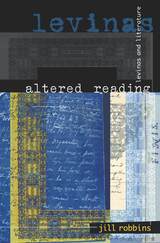
With an attitude at once respectful and interrogative, closely attentive to Levinas's texts while in dialogue with readings by Derrida, Blanchot, and Bataille, Altered Reading shows how the thread of the literary leads directly to the internal tensions of Levinas's ethical discourse. Jill Robbins provides a comprehensive critical account of Levinas's early and mature philosophy as well as later key transitional essays. In an invaluable appendix, she includes her own translation of an important, previously untranslated essay by Bataille on Levinas.
Altered Reading will interest philosophers, literary critics, scholars of religion, and others drawn to Levinas's work.
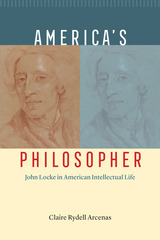
The influence of polymath philosopher John Locke (1632–1704) can still be found in a dizzying range of fields, as his writings touch on issues of identity, republicanism, and the nature of knowledge itself. Claire Rydell Arcenas’s new book tells the story of Americans’ longstanding yet ever-mutable obsession with this English thinker’s ideas, a saga whose most recent manifestations have found the so-called Father of Liberalism held up as a right-wing icon.
The first book to detail Locke’s trans-Atlantic influence from the eighteenth century until today, America’s Philosopher shows how and why interpretations of his ideas have captivated Americans in ways few other philosophers—from any nation—ever have. As Arcenas makes clear, each generation has essentially remade Locke in its own image, taking inspiration and transmuting his ideas to suit the needs of the particular historical moment. Drawing from a host of vernacular sources to illuminate Locke’s often contradictory impact on American daily and intellectual life from before the Revolutionary War to the present, Arcenas delivers a pathbreaking work in the history of ideas.
This is an auto-narrated audiobook edition of this book.
America’s Philosopher examines how John Locke has been interpreted, reinterpreted, and misinterpreted over three centuries of American history.
The influence of polymath philosopher John Locke (1632–1704) can still be found in a dizzying range of fields, as his writings touch on issues of identity, republicanism, and the nature of knowledge itself. Claire Rydell Arcenas’s new book tells the story of Americans’ longstanding yet ever-mutable obsession with this English thinker’s ideas, a saga whose most recent manifestations have found the so-called Father of Liberalism held up as a right-wing icon.
The first book to detail Locke’s trans-Atlantic influence from the eighteenth century until today, America’s Philosopher shows how and why interpretations of his ideas have captivated Americans in ways few other philosophers—from any nation—ever have. As Arcenas makes clear, each generation has essentially remade Locke in its own image, taking inspiration and transmuting his ideas to suit the needs of the particular historical moment. Drawing from a host of vernacular sources to illuminate Locke’s often contradictory impact on American daily and intellectual life from before the Revolutionary War to the present, Arcenas delivers a pathbreaking work in the history of ideas.
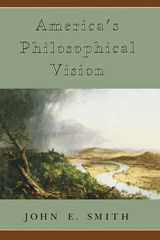
American philosophers like Peirce, James, Royce, and
Dewey have forged a unique philosophical tradition—one
that is rich and complex enough to represent a genuine
alternative to the analytic, phenomenological, and
hermeneutical traditions which have originated in Britain
or Europe.
"In my judgment, John Smith has no equal today in
combining two scholarly qualities: the analysis of
philosophical texts with penetration and rigor, and the
discernment of what it is in these texts that matters.
These qualities are in evidence throughout the essays in
America's Philosophical Vision. Whether he is
evaluating Rorty's view of Dewey; the pragmatic theory of
experience and truth; theories of freedom, creativity,
and the self; Royce's conception of community; or
synoptic philosophic visions, Smith always succeeds in
uniting a comprehensive understanding of philosophic
writings with a sure grasp of their import for human
culture and aspiration. It is a great benefit to
students of American thought that these papers have now
been collected into one volume."—James Gouinlock, Emory
University
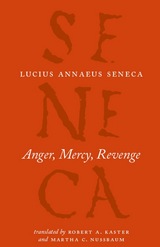
Lucius Annaeus Seneca (4 BCE–65 CE) was a Roman Stoic philosopher, dramatist, statesman, and adviser to the emperor Nero, all during the Silver Age of Latin literature. The Complete Works of Lucius Annaeus Seneca is a fresh and compelling series of new English-language translations of his works in seven accessible volumes. Edited by world-renowned classicists Elizabeth Asmis, Shadi Bartsch, and Martha C. Nussbaum, this engaging collection restores Seneca—whose works have been highly praised by modern authors from Desiderius Erasmus to Ralph Waldo Emerson—to his rightful place among the classical writers most widely studied in the humanities.
Anger, Mercy, Revenge comprises three key writings: the moral essays On Anger and On Clemency—which were penned as advice for the then young emperor, Nero—and the Apocolocyntosis, a brilliant satire lampooning the end of the reign of Claudius. Friend and tutor, as well as philosopher, Seneca welcomed the age of Nero in tones alternately serious, poetic, and comic—making Anger, Mercy, Revenge a work just as complicated, astute, and ambitious as its author.
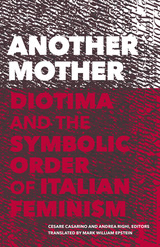
A groundbreaking volume introduces the unique feminist thought of the longstanding Italian group known as Diotima
Introducing Anglophone readers to a potent strain of Italian feminism known to French, Spanish, and German audiences but as yet unavailable in English, Another Mother argues that the question of the mother is essential to comprehend the matrix of contemporary culture and society and to pursue feminist political projects.
Focusing on Diotima, a community of women philosophers deeply involved in feminist politics since the 1960s, this volume provides a multifaceted panorama of its engagement with currents of thought including structuralism, psychoanalysis, linguistics, and Marxism. Starting from the simple insight that the mother is the one who gives us both life and language, these thinkers develop concepts of the mother and sexual difference in contemporary society that differ in crucial ways from both French and U.S. feminisms.
Arguing that Diotima anticipates many of the themes in contemporary philosophical discourses of biopolitics—exemplified by thinkers such as Giorgio Agamben, Antonio Negri, and Roberto Esposito—Another Mother opens an important space for reflections on the past history of feminism and on feminism’s future.
Contributors: Anne Emmanuelle Berger, Paris 8 U–Vincennes Saint-Denis; Ida Dominijanni; Luisa Muraro; Diana Sartori, U of Verona; Chiara Zamboni, U of Verona.
In his first book to be translated into English, Vioulac radicalizes Heidegger’s understanding of truth as disclosure through the notion of truth as apocalypse. This “apocalypse of truth” works as an unveiling that reveals both the finitude and mystery of truth, allowing a full confrontation with truth-as-absence. Engaging with Heidegger, Marx, and St. Paul, as well as contemporary figures including Giorgio Agamben, Alain Badiou, and Slavoj Žižek, Vioulac’s book presents a subtle, masterful exposition of his analysis before culminating in a powerful vision of “the abyss of the deity.” Here, Vioulac articulates a portrait of Christianity as a religion of mourning, waiting for a god who has already passed by, a form of ever-present eschatology whose end has always already taken place. With a preface by Jean-Luc Marion, Apocalypse of Truth presents a major contemporary French thinker to English-speaking audiences for the first time.

Not much escapes the intellect and imagination of the Angelic Doctor, St. Thomas Aquinas. Whether it be love, children, education, moral reasoning, happiness or the proper dispositions for human existence, St. Thomas seems an expert in all of it. Crime and criminal conduct are no exceptions to this general tendency with him. Not only does he have much to say about it, what he relates is perpetually fresh and surely the bedrock of what is now taken for granted. In this short treatise, the focus targets St. Thomas’s criminal codification – his law of crimes.
Indeed the magnanimity of his crimes code is a subject matter not yet treated in any detail in the scholarly literature. While parts and pieces are covered in many quarters, the literature has yet to develop a systematic, codified examination of Thomistic criminal law. The essence of the endeavor is threefold: first, how does St. Thomas factor the nature of the human person into the concept of criminal culpability and personal responsibility; second, what types of criminal conduct does St. Thomas specifically delineate and define; and lastly, what is Thomas’s view of mitigation and defense, as well as the corresponding punishment meted out for criminal conduct? This short commentary zeroes in on Thomistic Criminal Law – a project which will illuminate the root, the heritage and the foundation of modern criminal codification.
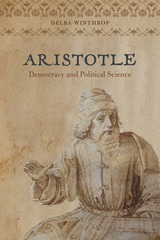
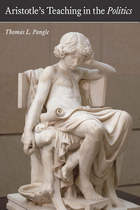
Today, democracy is seen as the best or even the only legitimate form of government. With this book, Delba Winthrop punctures this complacency and takes up the challenge of justifying democracy through Aristotle’s political science. In Aristotle’s time and in ours, democrats want inclusiveness; they want above all to include everyone as a part of a whole. But what makes a whole? This is a question for both politics and philosophy, and Winthrop shows that Aristotle pursues the answer in the Politics. She uncovers in his political science the insights philosophy brings to politics and, especially, the insights politics brings to philosophy. Through her appreciation of this dual purpose and her skilled execution of her argument, Winthrop makes profound discoveries. Central to politics, she maintains, is the quality of assertiveness—the kind of speech that demands to be heard. Aristotle, she shows for the first time, carries assertive speech into philosophy, where human reason claims its due as a contribution to the universe. Political science has the high role of teaching ordinary folk about democracy and what sustains it.
This posthumous publication is more than an honor to Delba Winthrop’s memory. It is a gift to partisans of democracy, advocates of justice, and students of Aristotle.
“Sorabji has produced a first-class book on an important topic. All Aristotelians, and anyone with an interest in any aspect of memory, will be in his debt.”—Jonathan Barnes, Isis
“Anyone concerned with Aristotle’s psychology, theory of mind, or rhetoric, anyone interested in mnemonic systems, and anyone trying to work out for himself a theory of memory, should read Aristotle’s treatise On Memory, with the comments by Richard Sorabji.”—International Studies in Philosophy
“Sorabji’s book is a sample of care, intelligence, and subtlety that the Anglo-Saxon philosophers do not hesitate to invest in such enterprises. . . . The notes seem to leave no detail, no textual difficulty unilluminated.”—Revue de Métaphysique et de Morale
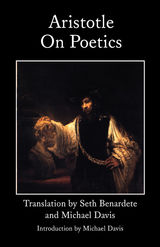
Aristotle’s much-translated On Poetics is the earliest and arguably the best treatment that we possess of tragedy as a literary form. The late Seth Benardete and Michael Davis have translated it anew with a view to rendering Aristotle’s text into English as precisely as possible. A literal translation has long been needed, for in order to excavate the argument of On Poetics one has to attend not simply to what is said on the surface but also to the various puzzles, questions, and peculiarities that emerge only on the level of how Aristotle says what he says and thereby leads one to revise and deepen one’s initial understanding of the intent of the argument. As On Poetics is about how tragedy ought to be composed, it should not be surprising that it turns out to be a rather artful piece of literature in its own right.
Benardete and Davis supplement their edition of On Poetics with extensive notes and appendices. They explain nuances of the original that elude translation, and they provide translations of passages found elsewhere in Aristotle’s works as well as in those of other ancient authors that prove useful in thinking through the argument of On Poetics both in terms of its treatment of tragedy and in terms of its broader concerns. By following the connections Aristotle plots between On Poetics and his other works, readers will be in a position to appreciate the centrality of this little book for his thought on the whole.
In an introduction that sketches the overall interpretation of On Poetics, Davis argues that, while On Poetics is certainly about tragedy, it has a further concern extending beyond poetry to the very structure of the human soul in its relation to what is, and that Aristotle reveals in the form of his argument the true character of human action.
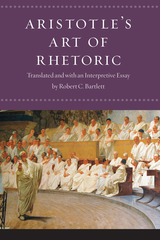
Here Robert C. Bartlett offers a literal, yet easily readable, new translation of Aristotle’s “Art of Rhetoric,” one that takes into account important alternatives in the manuscript and is fully annotated to explain historical, literary, and other allusions. Bartlett’s translation is also accompanied by an outline of the argument of each book; copious indexes, including subjects, proper names, and literary citations; a glossary of key terms; and a substantial interpretive essay.
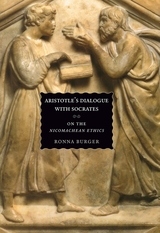
What is the good life for a human being? Aristotle’s exploration of this question in the Nicomachean Ethics has established it as a founding work of Western philosophy, though its teachings have long puzzled readers and provoked spirited discussion. Adopting a radically new point of view, Ronna Burger deciphers some of the most perplexing conundrums of this influential treatise by approaching it as Aristotle’s dialogue with the Platonic Socrates.
Tracing the argument of the Ethics as it emerges through that approach, Burger’s careful reading shows how Aristotle represents ethical virtue from the perspective of those devoted to it while standing back to examine its assumptions and implications.
“This is the best book I have read on Aristotle’s Nicomachean Ethics. It is so well crafted that reading it is like reading the Ethics itself, in that it provides an education in ethical matters that does justice to all sides of the issues.”—Mary P. Nichols, Baylor University
Aristotle may be the only thinker to propose a noncircular definition of change. With his landmark argument that change did, in fact, exist, Aristotle challenged established assumptions about what it is and developed a set of conceptual frameworks that continue to provide insight into the nature of reality. This groundbreaking work on change, however, has long been interpreted through a Platonist view of change as unreal. By offering a comprehensive reexamination of Aristotle’s pivotal arguments, and establishing his positive ontological conception of change, Sentesy makes a significant contribution to scholarship on Aristotle, ancient philosophy, the history and philosophy of science, and metaphysics.
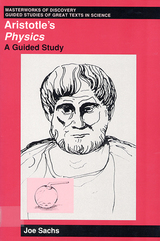
This is a new translation, with introduction, commentary, and an explanatory glossary.
"Sachs's translation and commentary rescue Aristotle's text from the rigid, pedantic, and misleading versions that have until now obscured his thought. Thanks to Sachs's superb guidance, the Physics comes alive as a profound dialectical inquiry whose insights into the enduring questions about nature, cause, change, time, and the 'infinite' are still pertinent today. Using such guided studies in class has been exhilarating both for myself and my students." ––Leon R. Kass, The Committee on Social Thought, University of Chicago
Aristotle’s Physics is the only complete and coherent book we have from the ancient world in which a thinker of the first rank seeks to say something about nature as a whole. For centuries, Aristotle’s inquiry into the causes and conditions of motion and rest dominated science and philosophy. To understand the intellectual assumptions of a powerful world view—and the roots of the Scientific Revolution—reading Aristotle is critical. Yet existing translations of Aristotle’s Physics have made it difficult to understand either Aristotle’s originality or the lasting value of his work.
In this volume in the Masterworks of Discovery series, Joe Sachs provides a new plain-spoken English translation of all of Aristotle’s classic treatise and accompanies it with a long interpretive introduction, a running explication of the text, and a helpful glossary. He succeeds brilliantly in fulfilling the aim of this innovative series: to give the general reader the tools to read and understand a masterwork of scientific discovery.
The core of the book is a fresh appraisal of Aristotle's view of tragic drama, in which Halliwell contends that at the heart of the Poetics lies a philosophical urge to instill a secularized understanding of Greek tragedy.
"Essential reading not only for all serious students of the Poetics . . . but also for those—the great majority—who have prudently fought shy of it altogether."—B. R. Rees, Classical Review
"A splendid work of scholarship and analysis . . . a brilliant interpretation."—Alexander Nehamas, Times Literary Supplement
Close examination of Aristotle’s treatise, Garver finds, reveals a significant, practical role for philosophy to play in politics. Philosophers present arguments about issues—such as the right and the good, justice and modes of governance, the relation between the good person and the good citizen, and the character of a good life—that politicians must then make appealing to their fellow citizens. Completing Garver’s trilogy on Aristotle’s unique vision, Aristotle’s Politics yields new ways of thinking about ethics and politics, ancient and modern.
READERS
Browse our collection.
PUBLISHERS
See BiblioVault's publisher services.
STUDENT SERVICES
Files for college accessibility offices.
RECENTLY PUBLISHED



UChicago Accessibility Resources
home | accessibility | search | about | contact us
BiblioVault ® 2001 - 2026
The University of Chicago Press