
 A SCHOLARLY BOOK REPOSITORY
Taking the Scottish Enlightenment philosopher David Hume as its subject, this book breaks new ground in focusing its lens on a little-studied aspect of Hume’s thinking: his understanding of money.
George Caffentzis makes both an intervention in the field of monetary philosophy and into Marxian conceptions of the relation between philosophy and capitalist development. He vividly charts the ways in which Hume’s philosophy directly informed the project of ‘civilizing’ the people of the Scottish Highlands and pacifying the English proletariat in response to the revolts of both groups at the heart of the empire.
Built on careful historical and philosophical detective work, Civilizing Money offers a stimulating and radical political reading of the ways in which Hume’s fundamental philosophical claims performed concrete political functions.
A clarifying examination of Gilles Deleuze’s first book shows how he would later transform the problem of immanence into the problem of difference
Despite the wide reception Gilles Deleuze has received across the humanities, research on his early work has remained scant. Experience and Empiricism remedies that gap with a detailed study of Deleuze’s first book, Empiricism and Subjectivity, which is devoted to the philosophical project of David Hume. Russell Ford argues that this work is poorly understood when read simply as a stand-alone study on Hume. Its significance only becomes apparent within the context of a larger problematic that dominated, and continues to inform, modern European philosophy: the conceptual constitution of a purely immanent account of existence. While the importance of this debate is recognized in contemporary scholarship, its genealogy—including Deleuze’s place within it—has been underappreciated. This book shows how Deleuze directly engages in an ongoing debate between his teachers Jean Wahl and Jean Hyppolite over experience and empiricism, an intervention that restages the famous encounter between rationalism and empiricism that yielded Kant’s critical philosophy. What, Deleuze effectively asks, might have happened had Hume been the one roused from his empirical dogmatic slumber by the rationalist challenge of Kant?

The eighteenth-century Scottish empiricist David Hume has been regarded as a notorious enemy of religion. Still, his discussion of religion is systematic, sophisticated, and sustained. Focusing mainly on two of Hume’s works, the relatively neglected Natural History of Religion and the more widely read Dialogues Concerning Natural Religion, Keith Yandell analyzes Hume’s treatment of a subject that he described as "a riddle, an enigma, an inexplicable mystery." In so doing, he explores the relationships between Hume’s philosophy of religion and his general philosophy.
Hume’s "evidentialism," applied to religion, can be summed up by saying that it is unreasonable to accept a religious belief unless one has evidence for it. Since it is also Hume’s view that there is no evidence for any religious belief, he concludes that no one is ever reasonable in accepting a religious belief. Yandell examines the explanations that Hume gave for such acceptance in Natural History of Religion. Addressing the Dialogues Concerning Natural Religion, he compares Hume’s views to those of such authors as Herbert of Cherbury and Bishop Joseph Butler, traces changes in Hume’s theory of meaning, and discusses the ontological and cosmological arguments and Hume’s treatment of the problem of evil. Yandell then considers other lesser known writings by Hume that are relevant to his philosophy of religion.
Although David Hume’s contributions to philosophy are firmly established, his economics has been largely overlooked. A Philosopher’s Economist offers the definitive account of Hume’s “worldly philosophy” and argues that economics was a central preoccupation of his life and work. Margaret Schabas and Carl Wennerlind show that Hume made important contributions to the science of economics, notably on money, trade, and public finance. Hume’s astute understanding of human behavior provided an important foundation for his economics and proved essential to his analysis of the ethical and political dimensions of capitalism. Hume also linked his economic theory with policy recommendations and sought to influence people in power. While in favor of the modern commercial world, believing that it had and would continue to raise standards of living, promote peaceful relations, and foster moral refinement, Hume was not an unqualified enthusiast. He recognized many of the underlying injustices of capitalism, its tendencies to promote avarice and inequality, as well as its potential for political instability and absolutism.
Hume’s imprint on modern economics is profound and far-reaching, whether through his close friend Adam Smith or later admirers such as John Maynard Keynes and Friedrich Hayek. Schabas and Wennerlind’s book compels us to reconsider the centrality and legacy of Hume’s economic thought—for both his time and ours—and thus serves as an important springboard for reflections on the philosophical underpinnings of economics.
By demonstrating how a philosophical method can be used to expose the political motivations behind intellectual positions, historical events, and their subsequent interpretations, Livingston revitalizes Hume's thought and reveals its relevance for contemporary dicussions of politics, nationalism, and ideology for the first time.
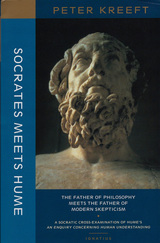
Kreeft invites the reader to take part in the process of refuting Hume’s skeptical arguments, with the great insights of Socrates. Based on an imagination dialogue between Socrates and Hume that takes place in the afterlife, this profound and witty book makes an entertaining and informative exploration of modern philosophy.
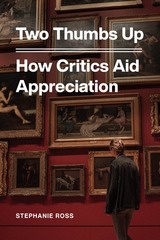
In Two Thumbs Up, philosopher Stephanie Ross tackles these questions, revealing the ways that critics influence our decisions, and why that’s a good thing. Starting from David Hume’s conception of ideal critics, Ross refines his position and makes the case that review-based journalistic or consumer reporting criticism proves the best model for helping us find and appreciate quality. She addresses and critiques several other positions and, in the process, she demonstrates how aesthetic and philosophical concerns permeate our lives, choices, and culture. Ultimately, whether we’re searching for the right wine or the best concert, Ross encourages us all to find and follow critics whose taste we share.
READERS
Browse our collection.
PUBLISHERS
See BiblioVault's publisher services.
STUDENT SERVICES
Files for college accessibility offices.
RECENTLY PUBLISHED





UChicago Accessibility Resources
home | accessibility | search | about | contact us
BiblioVault ® 2001 - 2026
The University of Chicago Press