
 A SCHOLARLY BOOK REPOSITORY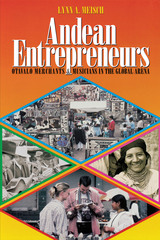
Native to a high valley in the Andes of Ecuador, the Otavalos are an indigenous people whose handcrafted textiles and traditional music are now sold in countries around the globe. Known as weavers and merchants since pre-Inca times, Otavalos today live and work in over thirty countries on six continents, while hosting more than 145,000 tourists annually at their Saturday market.
In this ethnography of the globalization process, Lynn A. Meisch looks at how participation in the global economy has affected Otavalo identity and culture since the 1970s. Drawing on nearly thirty years of fieldwork, she covers many areas of Otavalo life, including the development of weaving and music as business enterprises, the increase in tourism to Otavalo, the diaspora of Otavalo merchants and musicians around the world, changing social relations at home, the growth of indigenous political power, and current debates within the Otavalo community over preserving cultural identity in the face of globalization and transnational migration. Refuting the belief that contact with the wider world inevitably destroys indigenous societies, Meisch demonstrates that Otavalos are preserving many features of their culture while adopting and adapting modern technologies and practices they find useful.

This is the global supply chain, and, if the chain is broken, capitalism grinds to a halt. This book looks at case studies across the world to uncover a network of resistance by these workers who, despite their importance, often face vast exploitation and economic violence.
Experiencing first hand wildcat strikes, organised blockades and boycotts, the authors explore a diverse range of case studies, from South China dockworkers to the transformation of the port of Piraeus in Greece, and from the Southern California logistics sector, to dock and logistical workers in Chile and unions in Turkey.
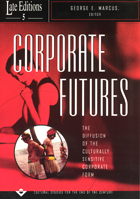
Late Editions 5, Corporate Futures, questions this idea of a "cultural landscape" by focusing on the the marked investment of corporations in the concept of culture, long the purview of anthropologists and, more recently, those involved in the humanistic disciplines. Emerging in the discourse of the workplace—and traveling beyond it to traditionally alternative associations—is the idea of a "corporate culture" with its own organization, management policies and practices, and ethos. How can we understand this culture of corporations, and to what extent does it reflect self-contained communities or fragmented human existence in groups under conditions of postmodernity? Corporate Futures tackles these issues and questions through conversations with managers, financial and risk analysts, and other participants in national and international organizations.
The results—engaging, intriguing, speculative, current—continue the work begun in earlier volumes to map the terrain of the present and navigate the uncertain future.
Praise for Late Editions: "If the succeeding volumes are as compassionate and informed as the first, this series could become an essential postmodern guidebook to the world's changing cultural terrain. I plan on letting it ease me into the next century."—Catherine Gysin, Utne Reader

"Elegantly written and sharply argued, Nick Robins' gripping account of the rise and fall of the English East India Company brings to life a crucial episode in the history of globalization."—Sankar Muthu, University of Chicago
The English East India Company was the mother of the modern multinational. Its trading empire encircled the globe, importing Asian luxuries such as spices, textiles, and teas. But it also conquered much of India with its private army and broke open China's markets with opium. The Company's practices shocked its contemporaries and still reverberate today, offering lessons about unfettered capitalism, corporate responsibility, and the legacy of colonialism.
The Corporation That Changed the World is the first book to reveal the Company's enduring legacy as a corporation. This expanded edition explores how the four forces of scale, technology, finance, and regulation drove its spectacular rise and fall. For decades, the Company was simply too big to fail, and stock market bubbles, famines, drug-running, and even duels between rival executives are to be found in this new account.
Table of Contents:
Introduction
Chronology
1 The Hidden Wound
2 The Imperious Company
3 Out of the Shadows
4 The Bengal Revolution
5 The Great East Indian Crash
6 Regulating the Company
7 Justice Will Be Done
8 The Toxic Exchange
10 The Unfettered Business
Epilogue
For Robins, the Company's story provides vital lessons on both the role of corporations in world history and the steps required to make global business accountable today.
In an attempt to quantify the effect of tax policy on international investment choices, this volume presents in-depth analyses of the interaction of international tax rules and the investment decisions of multinational enterprises. Ten papers assess the role played by multinational firms and their investment in the U.S. economy and the design of international tax rules for multinational investment; analyze channels through which international tax rules affect the costs of international business activities; and examine ways in which international tax rules affect financing decisions of multinational firms. As a group, the papers demonstrate that international tax rules have significant effects on firms' investment and other financing decisions.

Chapters cover such topics as theoretical accounts of FDI patterns, the growth of multinational enterprises, and the FDI experiences of Japan, the United States, and selected developing countries. This volume will interest economists, government officials, and business people concerned with FDI today.
Global Corporate Citizenship looks at issues of corporate responsibility globally, not just at multinational corporations operating worldwide, but at companies in developing countries facing important challenges within their own countries.
Featuring impressive original field research by Kellogg School of Management graduate students in the Global Initiatives in Management program, individual sections of the book are dedicated to issues of corporate citizenship in a wide range of countries including China, Vietnam, Thailand, Argentina, and South Africa. An introduction by Kellogg professor Daniel Diermeier sets the book in context as corporations come to terms with the complex issues facing the significance and limits of global corporate citizenship.
The beautiful Caribbean basin is fertile ground for a study of capitalism past and present. Transnational corporations move money and labor around the region, as national regulations are reworked to promote conditions benefiting private capital. Globalizing the Caribbean offers a probing account of the region’s experience of economic globalization while considering gendered and racialized social relations and the frequent exploitation of workers.
Jeb Sprague focuses on the social and material nature of this new era in the history of world capitalism. He combines an historical overview of capitalism in the region with theoretical analysis backed by case studies. Sprague elaborates upon the role of class formation and the restructuring of local states. He considers both U.S. hegemony, and how various upsurges from below and crises occur. He examines the globalization of the cruise ship and mining businesses, looks at the growth of migrant labor and reverse flow of remittances, and describes the evolving role of export processing and supranational associations. In doing so, Sprague shows how transnationally oriented elites have come to rule the Caribbean, and how capitalist globalization in the region occurs alongside shifting political, institutional, and organizational dynamics.
In this intriguing ethnography, Ellen Fuller investigates how issues of gender and identity as they relate to authority are addressed in a globalizing corporate culture. Going Global goes behind the office politics, turf wars and day-to-day workings of a transnational American company in Japan in the late 1990s as employees try to establish a comfortable place within the company.
Fuller looks at how relationships among Asians and between Asians and Americans are tested as individuals are promoted to positions of power and authority. Is there pressure for the Japanese to be more “American” to get ahead in business? Do female employees have to subscribe to certain stereotypes to be promoted or respected? How these American and Japanese workers assess one another raises important questions about international business management and human resources.

Popular anger against the financial system has never been higher, yet the practical workings of the system remain opaque to many people. The Heretic's Guide to Global Finance aims to bridge the gap between protest slogans and practical proposals for reform.
Brett Scott is a campaigner and former derivatives broker who has a unique understanding of life inside and outside the financial sector. He builds up a framework for approaching it based on the three principles of 'Exploring', 'Jamming' and 'Building', offering a practical guide for those who wish to deepen their understanding of, and access to, the inner workings of financial institutions.
Scott covers aspects frequently overlooked, such as the cultural dimensions of the financial system, and considers major issues such as agricultural speculation, carbon markets and tar-sands financing. Crucially, it also showcases the growing alternative finance movement, showing how everyday people can get involved in building a new, democratic, financial system.
In recent years, globalization and the expansion of information technologies have reshaped managerial practices, forcing multinational firms to adjust business practices to different environments and domestic companies to adjust to their foreign competitors. In International Differences in the Business Practices and Productivity of Firms, a distinguished group of contributors examines the phenomenon of widespread differences in managerial practices across firms, establishments within firms, and countries.
This volume brings together eight studies that combine qualitative and quantitative insider analysis of business practices such as the use of teams, incentive pay, lean manufacturing, and quality control, revealing the elements that determine which practices are adopted and why. International Differences in the Business Practices and Productivity of Firms offers a much-needed model for measuring the productivity and performance of international firms in a fast-paced global economy.
Transnational corporations straddle the globe, largely unseen by the public. Cargill, with its headquarters in the US, is the largest private corporation in North America, and possibly in the world. Cargill trades in food commodities and produces a great many of them: grains, flour, malt, corn, cotton, salt, vegetable oils, fruit juices, animal feeds, and meat. Among its most profitable activities is its trade in the global financial markets. There are few national economies unaffected by Cargill's activities, and few eaters in the north whose food does not pass through Cargill's hands at some point. Yet Cargill remains largely invisible to most people and accountable to no one outside the company.
This is the second edition of an explosive book that breaks the silence on the true extent of Cargill's power and influence worldwide -- its ability to shape national policies, and the implications of these strategies for all of us. Thoroughly revised and updated, Kneen's new book offers shocking new evidence of Cargill's activities since the book was first published in 1995. He examines how it has succeeded in eliminating competition by undertaking joint ventures with virtually all of its suppossed competitors. He shows how this massive corporation continues to aquire and divest, extending its grip even further in what amounts to almost total control of the global food system.

Prior to the millennium, economists and policy makers argued that free trade between the United States and Mexico would benefit both Americans and Mexicans. They believed that NAFTA would be a “win-win” proposition that would offer U.S. companies new markets for their products and Mexicans the hope of living in a more developed country with the modern conveniences of wealthier nations. Blending rigorous economic and statistical analysis with concern for the people affected, Mexican Women in American Factories offers the first assessment of whether NAFTA has fulfilled these expectations by examining its socioeconomic impact on workers in a Mexican border town.
Carolyn Tuttle led a group that interviewed 620 women maquila workers in Nogales, Sonora, Mexico. The responses from this representative sample refute many of the hopeful predictions made by scholars before NAFTA and reveal instead that little has improved for maquila workers. The women’s stories make it plain that free trade has created more low-paying jobs in sweatshops where workers are exploited. Families of maquila workers live in one- or two-room houses with no running water, no drainage, and no heat. The multinational companies who operate the maquilas consistently break Mexican labor laws by requiring women to work more than nine hours a day, six days a week, without medical benefits, while the minimum wage they pay workers is insufficient to feed their families. These findings will make a crucial contribution to debates over free trade, CAFTA-DR, and the impact of globalization.

In the wake of globalization, national governments are becoming increasingly interdependent, and knowledge is arguably becoming the most valuable form of capital. Helmut Willke’s Smart Governance offers a new perspective on global governance from the vantage point of a global knowledge society.
Employing a case study of the global financial system and an analysis of several governance regimes, Willke contends that markets, legal systems, and morality must evolve to cope with uncertainty, build capacities, and achieve resilience. Smart Governance will change the way economists, historians, and political scientists view international cooperation.
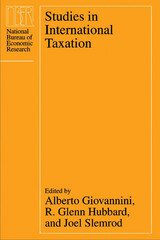
The contributors examine the effects of taxation on decisions about international financial management, business investment, and international income shifting. They consider the influence of tax rules on dividend policy decisions within multinationals; the extent to which tax incentives affect the level and location of research and development across countries; and the fact that foreign-controlled companies operating in the United States pay lower taxes than do domestically controlled companies.
The contributors to this volume are Rosanne Altshuler, Alan J. Auerbach, Neil Bruce, Timothy Goodspeed, Roger H. Gordon, Harry Grubert, Bronwyn H. Hall, David Harris, Kevin Hassett, James R. Hines Jr., Roy D. Hogg, Joosung Jun, Jeffrey K. Mackie-Mason, Jack M. Mintz, Randall Morck, John Mutti, T. Scott Newlon, James M. Poterba, Joel Slemrod, Deborah Swenson, G. Peter Wilson, and Bernard Yeung.
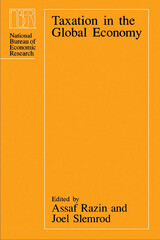
Assaf Razin and Joel Slemrod gathered experts from two traditionally distinct specialties, taxation and international economics, to lay the groundwork for understanding these issues, which will require the attention of scholars and policymakers for years to come.
Contributors describe the basic provisions of the U.S. tax code with respect to international transactions, highlighting the changes contained in the U.S. Tax Reform Act of 1986; explore the ways that tax systems influence the decisions of multinationals; examine the effect of taxation on trade patterns and capital flows; and discuss the implications of the opening world economy for the design of optimal international tax policy. The papers will prove valuable not only to scholars and students, but to government economists and international tax lawyers as well.
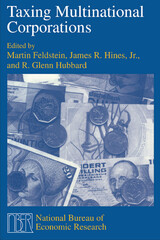
In ten succinct chapters, the book documents the channels through which tax policy in the United States and abroad affects plant and equipment investments, spending on research and development, the cost of debt and equity finance, and dividend repatriations by United States subsidiaries. It also discusses the impact of U.S. firms' outbound foreign investment on domestic and foreign economies. Especially useful to nonspecialists is an appendix that summarizes current United States rules for taxing international income.
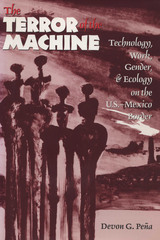
Born of thirteen years of field research, this interdisciplinary work explores the complex intersections of technology, class, gender, and ecology in the transnational milieu of Mexico's maquiladoras, foreign-owned assembly plants located along the U.S. border.
Devon Peña examines workplace and community struggles from the perspective of the women who work in the maquiladoras. He describes the workers' struggles for workplace democracy, social justice, and sustainable development. He also observes the circulation of struggle from the factory to the community, highlighting the efforts to establish worker-owned cooperatives in the border region during the 1970s and 1980s.
Female maquila workers are typically portrayed as passive, apolitical, and easily exploited. This book, however, presents an opposing view, investigating the "subaltern life of the shop floor"—the workers' informal methods of resistance to hazardous conditions, sexual harassment, and managerial tyranny. Using survey research, oral history, discourse analysis, and site ethnography, the author develops a cogent critique of labor-process theory, a critique grounded on his extensive study of actual workplace politics in the maquiladoras.
The Terror of the Machine is a trenchant analysis of the political, cultural, and environmental effects of maquila industrialization and an eloquent and persuasive call for alternatives in the direction of ecologically sustainable and culturally appropriate modes of development.
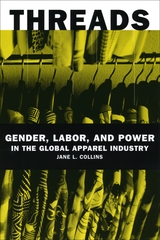
To dispel these misunderstandings, Jane L. Collins visited two very different apparel firms and their factories in the United States and Mexico. Moving from corporate headquarters to factory floors, her study traces the diverse ties that link First and Third World workers and managers, producers and consumers. Collins examines how the transnational economics of the apparel industry allow firms to relocate or subcontract their work anywhere in the world, making it much harder for garment workers in the United States or any other country to demand fair pay and humane working conditions.
Putting a human face on globalization, Threads shows not only how international trade affects local communities but also how workers can organize in this new environment to more effectively demand better treatment from their distant corporate employers.
READERS
Browse our collection.
PUBLISHERS
See BiblioVault's publisher services.
STUDENT SERVICES
Files for college accessibility offices.
RECENTLY PUBLISHED






UChicago Accessibility Resources
home | accessibility | search | about | contact us
BiblioVault ® 2001 - 2026
The University of Chicago Press