
 A SCHOLARLY BOOK REPOSITORY
24 start with A start with A
2015 ISHS Superior Achievement Award
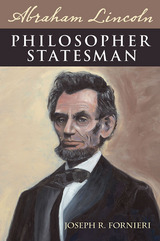
What constitutes Lincoln’s political greatness as a statesman? As a great leader, he saved the Union, presided over the end of slavery, and helped to pave the way for an interracial democracy. His great speeches provide enduring wisdom about human equality, democracy, free labor, and free society. Joseph R. Fornieri contends that Lincoln’s political genius is best understood in terms of a philosophical statesmanship that united greatness of thought and action, one that combined theory and practice. This philosophical statesmanship, Fornieri argues, can best be understood in terms of six dimensions of political leadership: wisdom, prudence, duty, magnanimity, rhetoric, and patriotism. Drawing on insights from history, politics, and philosophy, Fornieri tackles the question of how Lincoln’s statesmanship displayed each of these crucial elements.
Providing an accessible framework for understanding Lincoln’s statesmanship, this thoughtful study examines the sixteenth president’s political leadership in terms of the traditional moral vision of statecraft as understood by epic political philosophers such as Aristotle and St. Thomas Aquinas. Fornieri contends that Lincoln’s character is best understood in terms of Aquinas’s understanding of magnanimity or greatness of soul, the crowning virtue of statesmanship. True political greatness, as embodied by Lincoln, involves both humility and sacrificial service for the common good. The enduring wisdom and timeless teachings of these great thinkers, Fornieri shows, can lead to a deeper appreciation of statesmanship and of its embodiment in Abraham Lincoln.
With the great philosophers and books of western civilization as his guide, Fornieri demonstrates the important contribution of normative political philosophy to an understanding of our sixteenth president. Informed by political theory that draws on the classics in revealing the timelessness of Lincoln’s example, his interdisciplinary study offers profound insights for anyone interested in the nature of leadership, statesmanship, political philosophy, political ethics, political history, and constitutional law.
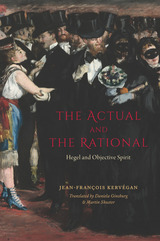
Kervégan begins with Hegel’s term “objective spirit,” the public manifestation of our deepest commitments, the binding norms that shape our existence as subjects and agents. He examines objective spirit in three realms: the notion of right, the theory of society, and the state. In conversation with Tocqueville and other theorists of democracy, whether in the Anglophone world or in Europe, Kervégan shows how Hegel—often associated with grand metaphysical ideas—actually had a specific conception of civil society and the state. In Hegel’s view, public institutions represent the fulfillment of deep subjective needs—and in that sense, demonstrate that the real is the rational, because what surrounds us is the product of our collective mindedness. This groundbreaking analysis will guide the study of Hegel and nineteenth-century political thought for years to come.
While African American political thought is inextricable from the historical movement of American political thought, this volume stresses the individuality of Black thinkers, the transnational and diasporic consciousness, and how individual speakers and writers draw on various traditions simultaneously to broaden our conception of African American political ideas. This landmark volume gives us the opportunity to tap into the myriad and nuanced political theories central to Black life. In doing so, African American Political Thought: A Collected History transforms how we understand the past and future of political thinking in the West.
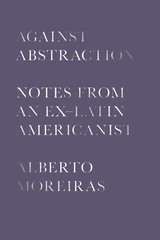
In 2015, members of the philosophy department at the University of Madrid conducted an interview with Alberto Moreiras for the university’s digital archive. The resulting dialogues and the Spanish edition of this work, Marranismo e inscripción, o el abandono de la conciencia desdichada, are the basis for Against Abstraction, supplemented with an interview conducted for the Chilean journal Papel máquina. In these landmark conversations, Moreiras describes how, though he was initially committed to Latin American literary studies, he eventually transitioned to become an eminent scholar of critical theory, existential philosophy, and ultimately infrapolitics and posthegemony.
Blending intellectual autobiography with a survey of Hispanism as practiced in universities in the United States (including the schisms in Latin American subaltern studies that eventually led to Moreiras’s departure from Duke University), these narratives read like a picaresque and a polemic on the symbolic power of scholars. Drawing on the concept of marranism (originally a term for Iberian Jews and Muslims forced to convert to Christianity during the Middle Ages) to consider the situations and allegiances he has navigated over the years, Moreiras has produced a multifaceted self-portrait that will surely spark further discourse.

Considering Levinas’s critique of French liberalism and Nazi racial politics, and the links between them, Maldonado-Torres identifies a “master morality” of dominion and control at the heart of western modernity. This master morality constitutes the center of a warring paradigm that inspires and legitimizes racial policies, imperial projects, and wars of invasion. Maldonado-Torres refines the description of modernity’s war paradigm and the Levinasian critique through Fanon’s phenomenology of the colonized and racial self and the politics of decolonization, which he reinterprets in light of the Levinasian conception of ethics. Drawing on Dussel’s genealogy of the modern imperial and warring self, Maldonado-Torres theorizes race as the naturalization of war’s death ethic. He offers decolonial ethics and politics as an antidote to modernity’s master morality and the paradigm of war. Against War advances the de-colonial turn, showing how theory and ethics cannot be conceived without politics, and how they all need to be oriented by the imperative of decolonization in the modern/colonial and postmodern world.
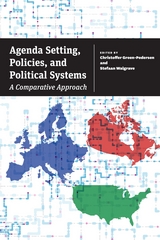
Agenda Setting and Political Attention brings together essays on eleven countries and two broad themes. Contributors to the first section analyze the extent to which party and electoral changes and shifts in the partisan composition of government have led—or not led—to policy changes in the United States, the United Kingdom, the Netherlands, Denmark, Switzerland, and France. The second section turns the focus on changing institutional structures in Germany, Italy, Belgium, Spain, and Canada, including the German reunification and the collapse of the Italian party system. Together, the essays make clear the efficacy of the agenda-setting approach for understanding not only how policies evolve, but also how political systems function.
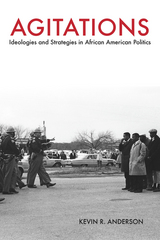
Though the activities of the National Association for the Advancement of Colored People (NAACP), the Southern Christian Leadership Conference (SCLC), and the Student Nonviolent Coordinating Committee (SNCC) were unified in their common idea of resistance to oppression, these groups fought their battles on multiple fronts. The NAACP filed lawsuits and aggressively lobbied Congress and state legislatures, while Martin Luther King Jr. and SCLC challenged the racial status quo through nonviolent mass action, and the SNCC focused on community empowerment activities. In Agitations, Kevin Anderson studies these various activities in order to trace the ideological foundations of these groups and to understand how diversity among African Americans created multiple political strategies.
Agitations goes beyond the traditionally acknowledged divide between integrationist and accommodationist wings of African American politics to explore the diverse fundamental ideologies and strategic outcomes among African American activists that still define, influence, and complicate political life today.
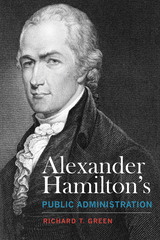
American public administration inherited from Alexander Hamilton a distinct republican framework through which we derive many of our modern governing standards and practices. His administrative theory flowed from his republican vision, prescribing not only the how of administration but also what should be done and why. Administration and policy merged seamlessly in his mind, each conditioning the other. His Anti-Federalist detractors clearly saw this and fought his vision tooth and nail.
That conflict endures to this day because Americans still have not settled on just one vision of the American republic. That is why, Richard Green argues, Hamilton is a pivotal figure in our current reckoning. If we want to more fully understand ourselves and our ways of governing today, we must start by understanding Hamilton, and we cannot do that without exploring his administrative theory and practice in depth.
Alexander Hamilton’s Public Administration considers Hamilton both as a founder of the American republic, steeped in the currents of political philosophy and science of his day, and as its chief administrative theorist and craftsman, deeply involved in establishing the early institutions and policies that would bring his interpretation of the written Constitution to life. Accordingly, this book addresses the complex mix of classical and modern ideas that informed his vision of a modern commercial and administrative republic; the administrative ideas, institutions, and practices that flowed from that vision; and the substantive policies he deemed essential to its realization. Green’s analysis grows out of an immersion in Hamilton’s extant papers, including reports, letters, pamphlets, and essays. Readers will find a comprehensive explanation of his theoretical contributions and a richly detailed account of his ideas and practices in historical context.
Beginning with a survey of Islamic philosophy and a discussion of its historical background, Mahdi considers the interrelated spheres of philosophy, political thought, theology, and jurisprudence of the time. He then turns to Alfarabi's concept of "the virtuous city," and concludes with an in-depth analysis of the trilogy, Philosophy of Plato and Aristotle.
This philosophical engagement with the writings of and about Alfarabi will be essential reading for anyone interested in medieval political philosophy.

This one-volume edition presents the essence of the other side of that crucial dialogue. It can be read as a genuine counterpart to the Federalist Papers; as an original source companion to Storing's brilliant essay What the Anti-Federalists Were For (volume I of The Complete Anti-Federalist, available as a separate paperback); or as a guide to exploring the full range of Anti-Federalist writing. The Anti-Federalist makes a fundamental source of our political heritage accessible to everyone.
Offering a new perspective on Sophocles’s Antigone as a model for reimagining humanity’s future—and its end
Why read Antigone today? The premise of this accessible, essayistic work is that humanity finds itself at a crossroads, where it must reinvent itself or perish—a condition similar to Antigone’s own. Rereading Antigone via Hegel’s engagement with the text can help us understand what it means for a human age to come to an end: that is, to think of our age as an episode whose collapse is also an engine of historical change.
Gregor Moder argues that the task of humanity today may not be to defend the minimal remnants of our civilization but to say farewell to it—to give it a proper burial. As Moder explicates, the central problem of this foundational tragedy lies in the positions of brother and sister, man and woman, representing human and divine law and the institutions of the state and the family. Through a fresh reading of both Sophocles’s play and Hegel’s productive reworking of the Greek myth, Moder’s analysis shows that sometimes the only way through deep social contradictions is in unraveling the framework that has constructed them.
A nuanced extrapolation of Hannah Arendt’s theory of judgment through her highly provocative reading of Immanuel Kant
More than a half century after it was first published, Hannah Arendt’s Origins of Totalitarianism rose to the top of best-seller lists as readers grappled with the triumph of Trumpism. Arendt, Kant, and the Enigma of Judgment directs our attention to her later thought, the posthumously published and highly provocative Lectures on Kant’s Political Philosophy. Martin Blumenthal-Barby puts this work in dialogue with Arendt’s other writings, including her notes on Kant’s Critique of Judgment, to outline her own theory of judgment for the twentieth century. In an era of post-truths and artificial intelligence, the idea that authentic judgment—for example, the ability to distinguish right from wrong—is incommensurable with abstract, automated processes lies at the center of Arendt’s late work and at the fore of our collective reckoning.
Rather than presenting us with a fixed account, Blumenthal-Barby suggests, Arendt’s drawing and redrawing of conceptual distinctions is itself an enactment of judgment, a process that challenges and complicates what she says at every turn. In so doing, Arendt, in thoroughly Kantian fashion, establishes judgment as a performative category that can never be taught but only demonstrated. As sharp as it is timely, this incisive book reminds us why a shared reality matters in a time of intense political polarization and why the democratic project, vulnerable as it may appear today, crucially depends on it.
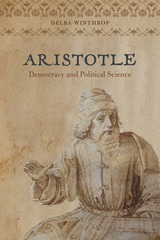
Today, democracy is seen as the best or even the only legitimate form of government. With this book, Delba Winthrop punctures this complacency and takes up the challenge of justifying democracy through Aristotle’s political science. In Aristotle’s time and in ours, democrats want inclusiveness; they want above all to include everyone as a part of a whole. But what makes a whole? This is a question for both politics and philosophy, and Winthrop shows that Aristotle pursues the answer in the Politics. She uncovers in his political science the insights philosophy brings to politics and, especially, the insights politics brings to philosophy. Through her appreciation of this dual purpose and her skilled execution of her argument, Winthrop makes profound discoveries. Central to politics, she maintains, is the quality of assertiveness—the kind of speech that demands to be heard. Aristotle, she shows for the first time, carries assertive speech into philosophy, where human reason claims its due as a contribution to the universe. Political science has the high role of teaching ordinary folk about democracy and what sustains it.
This posthumous publication is more than an honor to Delba Winthrop’s memory. It is a gift to partisans of democracy, advocates of justice, and students of Aristotle.
Close examination of Aristotle’s treatise, Garver finds, reveals a significant, practical role for philosophy to play in politics. Philosophers present arguments about issues—such as the right and the good, justice and modes of governance, the relation between the good person and the good citizen, and the character of a good life—that politicians must then make appealing to their fellow citizens. Completing Garver’s trilogy on Aristotle’s unique vision, Aristotle’s Politics yields new ways of thinking about ethics and politics, ancient and modern.

"[O]ne leaves this book feeling enriched and challenged. Pitkin prompts us to rethink our understanding of Arendt and to demythologize the pervasive sense of political helplessness Arendt herself sought so hard to articulate. . . . [A] cause for celebration."—Peter Baehr, Times Literary Supplement
"[Arendt] is certainly among the most original and outstanding political theorists of the twentieth century. . . . It is difficult to imagine a hostile critic examining more effectively than Pitkin . . . Arendt's concept of the social, for hostility would inhibit the acquisition of the mastery of Arendt's texts that Pitkin displays at every turn."—Peter Berkowitz, New Republic
READERS
Browse our collection.
PUBLISHERS
See BiblioVault's publisher services.
STUDENT SERVICES
Files for college accessibility offices.
RECENTLY PUBLISHED





UChicago Accessibility Resources
home | accessibility | search | about | contact us
BiblioVault ® 2001 - 2026
The University of Chicago Press