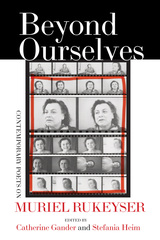
front cover of Beyond Ourselves
Beyond Ourselves
Contemporary Poets on Muriel Rukeyser
Catherine Gander
West Virginia University Press, 2026

Muriel Rukeyser has many faces: poet, biographer, theorist, playwright, novelist, story-writer, filmmaker, translator, ethnographer, and innovator of social, documentary poetics; feminist, queer, Jewish, single mother, and social justice activist. Yet above all, she was a poet. Threaded through her work, politics, and life was the conviction that poetry is an animating force that connects people and disciplines. Recent years have seen a surge of renewed interest in Rukeyser’s work, bringing her back into public consciousness as a crucial voice on the relations between poetry and social life in America and beyond. 

Beyond Ourselves is the first volume of its kind to comprehensively consider the continued urgency and lasting legacy of Rukeyser’s work as a key source and inspiration for poets working today. Volume editors Catherine Gander and Stefania Heim—both scholars and poets—have gathered critical and creative contributions from some of the most innovative, exciting, and socially engaged poets writing today. In lyric and braided essays, scholarly critique, hybrid investigations, documentary collages, and collaborative poetry, these poets dive deeply into Muriel Rukeyser’s work and life to interrogate, explore, and challenge the models she provides for thinking and writing in our own social, political, and poetic moment. These essays address a range of themes, from the transhistorical politics of motherhood and contemporary relational and feminist poetics of war to communal history via documentary film and the possibilities of coalition-building beyond borders. As in Rukeyser’s own work, the forms of these texts animate their inquiries.

Beyond Ourselves is a volume at the intersections of creative and critical thought, reflecting on how Rukeyser’s expansive body of work offers a vision for, as she writes, “a kind of imagination with which to meet the world.”

Contributors: Daniel Borzutzky, Susan Briante, Catherine Gander, Stacy Hardy, Stefania Heim, Erika Meitner, Philip Metres, Jena Osman, Deborah Paredez, Khadijah Queen, Solmaz Sharif, and Nomi Stone.
[more]

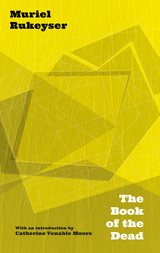
front cover of The Book of the Dead
The Book of the Dead
Muriel Rukeyser
West Virginia University Press, 2018
Written in response to the Hawk’s Nest Tunnel disaster of 1931 in Gauley Bridge, West Virginia, The Book of the Dead is an important part of West Virginia’s cultural heritage and a powerful account of one of the worst industrial catastrophes in American history. The poems collected here investigate the roots of a tragedy that killed hundreds of workers, most of them African American. They are a rare engagement with the overlap between race and environment in Appalachia.
Published for the first time alongside photographs by Nancy Naumburg, who accompanied Rukeyser to Gauley Bridge in 1936, this edition of The Book of the Dead includes an introduction by Catherine Venable Moore, whose writing on the topic has been anthologized in Best American Essays.
 
[more]

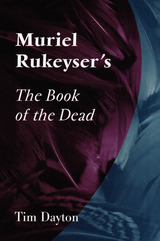
front cover of Muriel Rukeyser's the Book of the Dead
Muriel Rukeyser's the Book of the Dead
Tim Dayton
University of Missouri Press, 2003
The Book of the Dead by Muriel Rukeyser was published as part of her 1938 volume U.S. 1. The poem, which is probably the most ambitious and least understood work of Depression-era American verse, commemorates the worst industrial accident in U.S. history, the Gauley Tunnel tragedy. In this terrible disaster, an undetermined number of men—likely somewhere between 700 and 800—died of acute silicosis, a lung disorder caused by prolonged inhalation of silica dust, after working on a tunnel project in Fayette County, West Virginia, in the early 1930s.
After many years of relative neglect, The Book of the Dead has recently returned to print and has become the subject of critical attention. In Muriel Rukeyser’s “The Book of the Dead,” Tim Dayton continues that study by characterizing the literary and political world of Rukeyser at the time she wrote The Book of the Dead
Rukeyser’s poem clearly emerges from 1930s radicalism, as well as from Rukeyser’s deeply felt calling to poetry. After describing the world from which the poem emerged, Dayton sets up the fundamental factual matters with which the poem is concerned, detailing the circumstances of the Gauley Tunnel tragedy, and establishes a framework derived from the classical tripartite division of the genres—epic, lyric, and dramatic. Through this framework, he sees Rukeyser presenting a multifaceted reflection upon the significance, particularly the historical significance, of the Gauley Tunnel tragedy. For Rukeyser, that disaster was the emblem of a history in which those who do the work of the world are denied control of the vast powers they bring into being.
Dayton also studies the critical reception of The Book of the Dead and determines that while the contemporary response was mixed, most reviewers felt that Rukeyser had certainly attempted something of value and significance. He pays particular attention to John Wheelwright’s critical review and to the defenses of Rukeyser launched in the 1980s and 1990s by Louise Kertesz and Walter Kalaidjian. The author also examines the relationship between Marxism as a theory of history governing The Book of the Dead and the poem itself, which presents a vision of history.
Based upon primary scholarship in Rukeyser’s papers, a close reading of the poem, and Marxist theory, Muriel Rukeyser’sThe Book of the Dead” offers a comprehensive and compelling analysis of The Book of the Dead and will likely remain the definitive work on this poem.
[more]

front cover of Out of Silence
Out of Silence
Selected Poems
Muriel Rukeyser
Northwestern University Press, 1992
Out of Silence is a poetry book encompassing the contradictions of twentieth-century America. 
[more]


Send via email Share on Facebook Share on Twitter