
 A SCHOLARLY BOOK REPOSITORY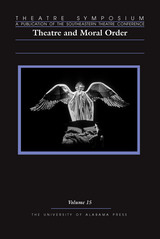
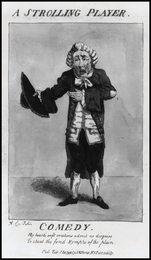
The essays gathered in Volume 16 of the annual journal Theatre Symposium illustrate well the range of material that falls under the heading "comedy" as it is played on stage.
Stanley Longman's essay on "The Commedia dell'Arte as the Quintessence of Comedy" introduces us to the inhabitants of "Commediatown," character types who are descendents of the Greeks and ancestors, it seems, of almost everyone who came after. Boris Senker, an eyewitness to Croatia's evolution from communism to democracy, reports on the all-too-real "Commedia" stereotypes that have found their way onto the stage in his homeland.
Other essays address the improvisational nature of "Commedia"; the roots of laughter and the expectations inherent in presenting "old schtick" to a new generation; comedic technique, verbal and physical, in Molière; the use of the macabre to create humor in the "Théâtre du Grand Guignol"; the story of Henry Fielding, the theatre practitioner most responsible for the British government's crackdown on subversive material, via the Licensing Act of 1737; Beckett's theatrical connections to the comedy theory of Henri Bergson; and do-it-yourself (DIY) comedy—happenings, situations, gatherings—as practiced in British stand-up comedy.
Volume 16 provides just a glimpse into the possibilities for comedy on the stage. If the past examples allow for extrapolation into the future, the position of comedy as a means of communicating problems and solutions for society's woes is remarkably sound.
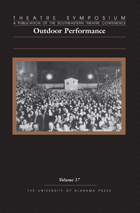
Among other subjects, these essays explore the rise of "airdomes" as performance spaces in the American Midwest in the first half of the 20th century; the civic-religious pageants staged by certain Mormon congregations; Wheels-A-Rolling, and other railroad themed pageants; first-hand accounts of the innovative Hunter Hills theatre program in Tennessee; the role of traditional outdoor historical drama, particularly the long-running performances of Paul Green's The Lost Colony; and the rise of the part dance, part sport, part performance phenomenon "parkour"-- the improvised traversal of obstacles found in both urban and rural landscapes.
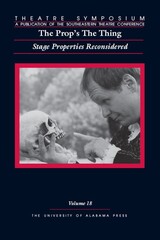
The contributors illuminate many aspects of this largely ignored yet crucial part of the theatre. Kyna Hamill looks at props as a means to mark social status. Christine Woodworth addresses the challenges presented by using blood onstage, while Andrew Sofer discusses the use of prop corpses on the Shakespearean stage. Andrew Kimbrough moves from an examination of actors’ use of props to a consideration of audience response to performance. Other essays investigate specific objects or productions, and introduce provocative and original perspectives to the growing discussion about stage properties.
transvestite theatre, Annie Oakley and the disruption of Victorian audiences, and historical attempts to create ideal audiences. Edited by E. Bert Wallace, this latest publication from the largest regional theatre organization in the United States collects the most current scholarship on theatre history and theory.
Contributors To Volume 20
Susan Bennett / Jane Barnette / Becky Becker / Lisa Bernd / Evan
Bridenstine / Michael Jaros / Robert I. Lublin / Paulette Marty
Whether or not theatre arose from ritual and/or religion, from prehistory to the present there have been clear and vital connections among the three. Ritual, Religion, and Theatre, volume 21 of the annual journal Theatre Symposium, presents a series of essays that explore the intricate and vital relationships that exist, historically and today, between these various modes of expression and performance.
The essays in this volume discuss the stage presence of the spiritual meme; ritual performance and spirituality in The Living Theatre; theatricality, themes, and theology in James Weldon Johnson’s God’s Trombones; Jordan Harrison’s Act a Lady and the ritual of queerness; Gerpla and national identity in Iceland; confession in Hamlet and Measure for Measure; Christian liturgical drama; Muslim theatre and performance; cave rituals and the Brain’s Theatre; and other, more general issues.
Edited by E. Bert Wallace, this latest publication by the largest regional theatre organization in the United States collects the most current scholarship on theatre history and theory.
CONTRIBUTORS
Cohen Ambrose / David Callaghan / Gregory S. Carr
Matt DiCintio / William Doan / Tom F. Driver / Steve Earnest
Jennifer Flaherty / Charles A. Gillespie / Thomas L. King
Justin Kosec / Mark Pizzato / Kate Stratton
The eleven contributors to this fascinating collection illuminate many aspects of commercial theatre and how best to examine it. George Pate analyzes the high-stakes implication of a melodramatic legal battle. Christine Woodworth recounts the difficulties encountered by British actresses near the turn of the twentieth century, while Boone J. Hopkins considers newly found images of Margo Jones along with the commercial appeal they represent.
The volume continues with articles that follow developments with ties to commercial theatre, such as the interplay between Broadway companies and regional theatres, musical productions in communist Poland, and the influence of Korean popular culture on theatre and the unique production arrangements that have resulted. Other essays investigate alternative concepts related to commercial themes with regard to audience interaction and the burgeoning world of geek theatre.
Edited by David S. Thompson, this latest publication by the largest regional theatre organization in the United States collects the most current scholarship on theatre history and theory.
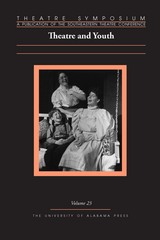
The first set of essays draws from robustly diverse sources: the work of Frank Wedekind in nineteenth-century Germany, Peter Pan’s several stage incarnations, Evgeny Shvarts’s antitotalitarian plays in Soviet Russia, and Christopher Marlowe’s Dido, Queen of Carthage, whose depictions of childhood comment on both the classical period as well as Marlowe’s own Elizabethan age.
The second part of the collection explores and illustrates how youth participate in theatre, the cognitive benefits youth reap from theatre practice, and the ameliorating power of theatre to help at-risk youth. These essays show fascinating and valuable case studies of, for example, theatre employed in geography curricula to strengthen spatial thinking, theatre as an antidote to youth delinquency, and theatre teaching Latinos in the south strategies for coping in a multilingual world.
Rounding out this exemplary collection are a pair of essays that survey the state of the art, the significance of theatre-for-youth programming choices, and the shifting attitudes young Americans are bringing to the discipline. Eclectic and vital, this expertly curated collection will be of interest to educators and theatre professionals alike.
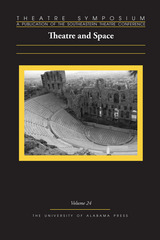
Exploring the dynamic intersections of performance and place.
At a time when so many options exist for access to theatrical entertainments, it is no surprise that theatre practitioners and scholars are often preoccupied with the role of the audience. While space undoubtedly impacts the rehearsal and production processes, its greater significance seems to rest in the impact a specific location has on the audience.
This volume provides diverse viewpoints on theatre and space, as well as its relationship to the audience. Sebastian Trainor and Samuel T. Shanks offer contemporary perspectives on two ancient theatre spaces, while Lisa Marie Bowler describes the Globe Theatre, a replica of the original, as embodying a kind of absence despite its rich link to the past. Focusing on distinctly different periods and settings, both Andrew Gibb and Christine Woodworth describe a politics of space in which specific players gain prestige and power. Chase Bringardner identifies the audience as playing an important role in creating a space for parody in a historic Nashville venue, while Arnab Banerji describes an exhausting process for members of the Bengali group theatre who must continually move from space to space. Finally, Alicia Corts discusses virtual performance spaces and the degree to which participants are able to control their online identities within virtual performances. Bookending these eight essays are Marvin Carlson’s keynote presentation “Whose Space Is It Anyway?” and his closing remarks for the symposium, both of which allude to, and richly explicate, the ultimate arbiters of theatrical space: the audience.
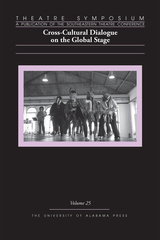
Globalization may strike many as a phenomenon of our own historical moment, but it is truly as old as civilization: we need only look to the ancient Silk Road linking the Far East to the Mediterranean in order to find some of the earliest recorded impacts of people and goods crossing borders. Yet, in the current cultural moment, tensions are high due to increased migration, economic unpredictability, complicated acts of local and global terror, and heightened political divisions all over the world.
Thus globalization seems new and a threat to our ways of life, to our nations, and to our cultures. In what ways have theatre practitioners, educators, and scholars worked to support cross-cultural dialogue historically? And in what ways might theatre embrace the complexities and contradictions inherent in any meaningful exchange? The essays in Theatre Symposium, Volume 25 reflect on these questions.
Featured in Theatre Symposium, Volume 25
- “Theatre as Cultural Exchange: Stages and Studios of Learning” by Anita Gonzalez
- “Certain Kinds of Dances Used among Them: An Initial Inquiry into Colonial Spanish Encounters with the Areytos of the Taíno in Puerto Rico” by E. Bert Wallace
- “Gertrude Hoffmann’s Lawful Piracy: ‘A Vision of Salome’ and the Russian Season as Transatlantic Production Impersonations” by Sunny Stalter-Pace
- “Greasing the Global: Princess Lotus Blossom and the Fabrication of the ‘Orient’ to Pitch Products in the American Medicine Show” by Chase Bringardner
- “Dismembering Tennessee Williams: The Global Context of Lee Breuer’s A Streetcar Named Desire” by Daniel Ciba
- “Transformative Cross-Cultural Dialogue in Prague: Americans Creating Czech History Plays” by Karen Berman
- “Finding Common Ground: Lessac Training across Cultures” by Erica Tobolski and Deborah A. Kinghorn
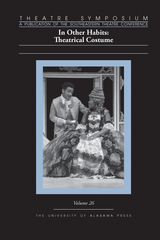
Stage costumes reveal character. They tell audiences who the character is or how a character functions within the world of the play, among other things. Theatrical costuming, however, along with other forms of theatre design, has often been considered merely a craft, rather than part of the deeply systemic creation of meaning onstage. In what ways do our clothes shape and reveal our habits of behavior? How do stage costumes work to reveal one kind of habit via the manipulation of another? How might theatre practitioners learn to most effectively exploit this dynamic? Theatre Symposium, Volume 26 analyzes the ways in which meaning is conveyed through costuming for the stage and explores the underlying assumptions embedded in theatrical practice and costume production.
THEATRE SYMPOSIUM, VOLUME 26
MICHELE MAJER
Plus que Reine: The Napoleonic Revival in Belle Epoque Theatre and Fashion
CAITLIN QUINN
Creating a Realistic Rendering Pedagogy: The Fashion Illustration Problem
ALY RENEE AMIDEI
Where'd I Put My Character?: The Costume Character Body and Essential Costuming for the Ensemble Actor
KYLA KAZUSCHYK
Embracing the Chaos: Creating Costumes for Devised Work
DAVID S. THOMPSON
Dressing the Image: Costumes in Printed Theatrical Advertising
LEAH LOWE
Costuming the Audience: Gentility, Consumption, and the Lady’s Theatre Hat in Gilded Age America
JORGE SANDOVAL
The RuPaul Effect: The Exploration of the Costuming Rituals of Drag Culture in Social Media and the Theatrical Performativity of the Male Body in the Ambit of the Everyday
GREGORY S. CARR
A Brand New Day on Broadway: The Genius of Geoffrey Holder’s Artistry and His Intentional Evocation of the African Diaspora
ANDREW GIBB
On the [Historical] Sublime: J. R. Planché’s King John and the Romantic Ideal of the Past
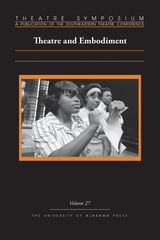
Theatre is inescapably about bodies. By definition, theatre requires the live bodies of performers in the same space and at the same time as the live bodies of an audience. And, yet, it’s hard to talk about bodies. We talk about characters; we talk about actors; we talk about costume and movement. But we often approach these as identities or processes layered onto bodies, rather than as inescapably entwined with them. Bodies on the theatrical stage hold the power of transformation. Theatre practitioners, scholars, and educators must think about what bodies go where onstage and what stories which bodies to tell.
The essays in Theatre Symposium, Volume 27 explore a broad range of issues related to embodiment. The volume begins with Rhonda Blair’s keynote essay, in which she provides an overview of the current cognitive science underpinning our understanding of what it means to be “embodied” and to talk about “embodiment.” She also provides a set of goals and cautions for theatre artists engaging with the available science on embodiment, while issuing a call for the absolute necessity for that engagement, given the primacy of the body to the theatrical act.
The following three essays provide examinations of historical bodies in performance. Timothy Pyles works to shift the common textual focus of Racinian scholarship to a more embodied understanding through his examination of the performances of the young female students of the Saint-Cyr academy in two of Racine’s Biblical plays. Shifting forward in time by three centuries, Travis Stern’s exploration of the auratic celebrity of baseball player Mike Kelly uncovers the ways in which bodies may retain the ghosts of their former selves long after physical ability and wealth are gone. Laurence D. Smith’s investigation of actress Manda Björling’s performances in Miss Julie provides a model for how cognitive science, in this case theories of cognitive blending, can be integrated with archival theatrical research and scholarship.
From scholarship grounded in analysis of historical bodies and embodiment, the volume shifts to pedagogical concerns. Kaja Amado Dunn’s essay on the ways in which careless selection of working texts can inflict embodied harm on students of color issues an imperative call for careful and intentional classroom practice in theatre training programs. Cohen Ambrose’s theorization of pedagogical cognitive ecologies, in which subjects usually taught disparately (acting, theatre history, costume design, for example) could be approached collaboratively and through embodiment, speaks to ways in which this call might be answered.
Tessa Carr’s essay on "The Integration of Tuskegee High School" brings together ideas of historical bodies and embodiment in the academic theatrical context through an examination of the process of creating a documentary theatre production. The final piece in the volume, Bridget Sundin’s exchange with the ghost of Marlene Dietrich, is an imaginative exploration of how it is possible to open the archive, to create new spaces for performance scholarship, via an interaction with the body.
The scholarly conference from which this publication emerged was circulated in the waning months of 2018, following a summer of urgent and emotional debate surrounding new US immigration policies regarding immigrant family separations, arguments fueled on one side by fears about the loss of social cohesion, and on the other by photographs of incarcerated children. Given the then-prevailing political atmosphere, editor Andrew Gibb anticipated that a good number of submissions might draw connections between the patterns, policies, and histories of immigration on the one hand, and theatrical or otherwise performance-centered expressions of citizenship, whether inclusive or exclusionary, on the other. In retrospect, what could have been foreseen is that theatre scholars, educators, and professionals would interpret recent events against a wider and more complex backdrop. The ultimate result of that initial call is this volume, a collection of essays whose authors reach beyond simple definitions of citizenship as determined by documents and legal rights, and who engage in larger conversations about what citizenship can mean, and how such meanings are expressed through theatre and performance.
Interestingly, while none of the authors published herein take up immigration as a central issue, they all make use of some combination of three particular analytical frameworks, all of which happen to be pertinent to the current immigrant experience and attempts to regulate it: bodies, institutions, and technologies.
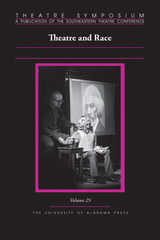
A few weeks prior to the submission deadline for this volume of Theatre Symposium, the murder of George Floyd by officers of the Minneapolis Police Department sparked a movement for racial justice that reverberated at every level of US society. At predominantly and historically white academic institutions (including Theatre Symposium and its parent organization, the Southeastern Theatre Conference) leaders were compelled, as perhaps never before, to account for the role of systematic racism in the foundation and perpetuation of their organizations. While the present volume’s theme of “Theatre and Race” was announced in the waning days of 2019, the composition and editing of the issue’s essays were undertaken almost entirely within the transformed cultural and professional landscape of 2020. Throughout its twenty-nine years of publication, Theatre Symposium’s pages have included many excellent essays whose authors have deployed theories of race as an analytical framework, and (less often) treated BIPOC-centered art and artists as subject. The intent of the current editors in conceiving this issue was to center such subjects and theorizations, a goal that has since taken on a more widely recognized urgency.
Taken together, these twelve essays represent a wide range of scholarly responses to the theme of “theatre and race.” The fact that there is so much to say on the topic, from so many different perspectives, is a sign of how profoundly theatre practices have been—and continue to be—shaped by racial discourses and their material manifestations.
Exploring the many voices of the dramaturg—and the evolving artistry of shaping theatre from within.
As both a verb and a noun, the word voice has many meanings and functions on multiple levels, a phenomenon that is remarkably analogous to the practice of dramaturgy. Thus, the topic title Voice of the Dramaturg allows for the requisite flexibility and provides a unifying theme for the third volume of Theatre Symposium. This volume of the proceedings from the June 1994 joint meeting of the Southeastern Theatre Conference and the Literary Managers and Dramaturgs in Atlanta, Georgia, addresses the question, What is Dramaturgy? Part I includes the contributions of the six symposium participants and concludes with the roundtable discussion by panelists. Part II is composed of refereed papers. These papers range from the highly theoretical to the practical and pedagogical. They reflect the diversity of what dramaturgy means in contemporary theatre.
Illustrates how theatre’s engagement with politics changes over time
For the thirtieth volume of Theatre Symposium, the editors return to a topic first proposed over twenty years ago in volume 9 (theatre and politics in the twentieth century), reimaged for a broader, more comprehensive time frame. In this volume on theater and politics, scholars explore what constitutes the political, how the political is performed, and how theatre engages with politics over time, drawing on the following framing questions: What is the historical and ongoing role of theatre in framing our ideas and conversations about politics? How do politics and theatre engage one another in an increasingly mediated landscape? From theatrical analysis of the political arena to political analysis of the theatrical stage, discussions of theatre and politics can challenge ethical, theoretical, and artistic considerations of our world.
The current moment presents a compelling opportunity to revisit, revise, and reengage. Certainly, in the twenty-one volumes since volume 9, the political landscape both nationally and internationally has shifted dramatically. The past two years specifically have seen an increase in the already prevalent presence of the political in our daily discourse. The COVID-19 global pandemic and ongoing racial reckonings have further unmoored many systems and structures, requiring action and change. Rather than a moment of pause or passivity, pandemic times have seen an increase in political activity and political discourse on the local, national, and global levels. Within the theatre and performance communities, these calls to action have resulted in movements like #weseeyouWAT and other calls to break down old systems and create new ones, to privilege access for those of the global majority, and to explicitly demand advocacy and activism. Organizations like the Southeastern Theatre Conference (SETC) itself crafted new ethos statements and engaged in the necessary work of boldly foregrounding equity, diversity, inclusion, and accessibility at the center of all its efforts.
The editors and contributors to this volume respond to the immediacy of this moment and the clarion call for change. From Shakespeare to new productions like Alabama Love Stories, presented at Auburn University, contributors grapple with a range of examples, contemporary and historical, and argue with renewed urgency for the importance of intentionally interrogating the interplay of performance and politics. The essays in this volume demonstrate that theatre and performance cannot rise to this moment or even begin to address it without doing that substantial work to clean its own house and create accessible new spaces.
Contributors
Chase Bringardner / Tessa Carr / Lily Climenhaga / Abena Foreman-Trice / Emma Givens / TK Manwill / Boomie Pederson / Royal Shirée / Teresa Simone / Tony Tambasco / Jonathon W. Taylor / Justice von Maur / Patricia Ybarra
A new issue of the longstanding theatre journal, documenting conversations that traverse disciplinary boundaries
The essays in the thirty-first volume of Theatre Symposium traverse disciplinary boundaries to explore what constitutes the “popular” in theater and performance in an increasingly frenetic and mediated landscape. Amid the current resurgence of populist discourse and the enduring impact of popular culture, this volume explores what is considered popular, how that determination gets made, and who makes it. The answers to these questions shape the structures and systems of performance in an interaction that is reciprocal, intricate, and multifaceted. Productions often succeed or fail based on their ability to align with what is popular—sometimes productively, sometimes clumsily, sometimes brazenly, and sometimes tragically.
In our current moment, what constitutes the popular profoundly affects the real world politically, economically, and socially. Controversies about the electoral college system hinge on the primacy of the “popular” vote. Streaming services daily update lists of their most popular content and base future decisions on opaque measures of popularity. Social media platforms broadcast popular content across the globe, triggering new products, social activism, and political revolutions.
The contributors to this volume engage with a range of contemporary and historical examples and argue with clarity and acuity the interplay of performance and the popular. Theatre and performance deeply engage with the popular at every level—from audience response to box office revenue. The variety of methodologies and sites of inquiry showcased in this volume demonstrates the breadth and depth of the popular and the importance of such work to understanding our present moment onstage and off.
CONTRIBUTORS
Mysia Anderson / Chase Bringardner / Elizabeth M. Cizmar / Chelsea Curto / Janet M. Davis / Tom Fish / Kyla Kazuschyk / Sarah McCarroll / Eleanor Owicki / Sunny Stalter-Pace / Chelsea Taylor / Chris Woodworth

A new volume of the longstanding theatre journal, documenting conversations that traverse disciplinary boundaries
Theater Symposium, Volume 32 delves into the collaborative dynamics and ritualistic exchanges within performance during the collective resurgence into a hopeful post-COVID world. This volume’s contributors embark on a journey through the vibrant realm of material performance, with puppetry at the forefront, guiding readers into an expansive landscape of object performance styles and structures. As they navigate this terrain, they pose critical questions that unravel the complexities of object performance analysis and its impact on audiences. Bringing together perspectives from designers, creators, and performers, this volume explores how object performances serve as a medium to engage with the world, fostering synchrony and positive outcomes across a diverse array of artistic practices. Theater Symposium, Volume 32 invites readers to expand their understanding of collaborative practices and the object world, whether it be through the lens of labor or entertainment.
Contributors
Ashley Bellet / Francesca Marie Chilcote / Elisabeth Hostetter / Rebecca Johnson / Kyla Kazuschyk / Keith Byron Kirk / Jesse Njus / Claudia Orenstein / Paulette Richards / Dory Sibley / Echo Sunyata Sibley / Skye Strauss
This collection of essays explores how drama can teach political principles and entertain at the same time.
Political commentary is possible through "variety" theatre, this volume contends. Compiled from the April 2000 Theatre Symposium held on the campus of the University of Tennessee-Knoxville, this collection of essays presents a compelling mix of theoretical and practical viewpoints from a broad diversity of scholars from around the country.
What remains to be learned about the political objectives of Brecht's Lehrstriucke? What political power is resident in the satirical humor of Dario Fo's drama? What can we learn from Mordecai Gorelik's political/artistic philosophy that might inform contemporary practice? What was the impact of political theatre on Broadway between the wars? Is Thornton Wilder's Our Town the play we've always imagined it to be, or does it challenge the politics of its time? What is the role of theatre activism in raising consciousness about gender politics? These are only some of the questions addressed by this lively, informative discussion.
READERS
Browse our collection.
PUBLISHERS
See BiblioVault's publisher services.
STUDENT SERVICES
Files for college accessibility offices.
RECENTLY PUBLISHED




UChicago Accessibility Resources
home | accessibility | search | about | contact us
BiblioVault ® 2001 - 2026
The University of Chicago Press