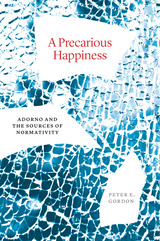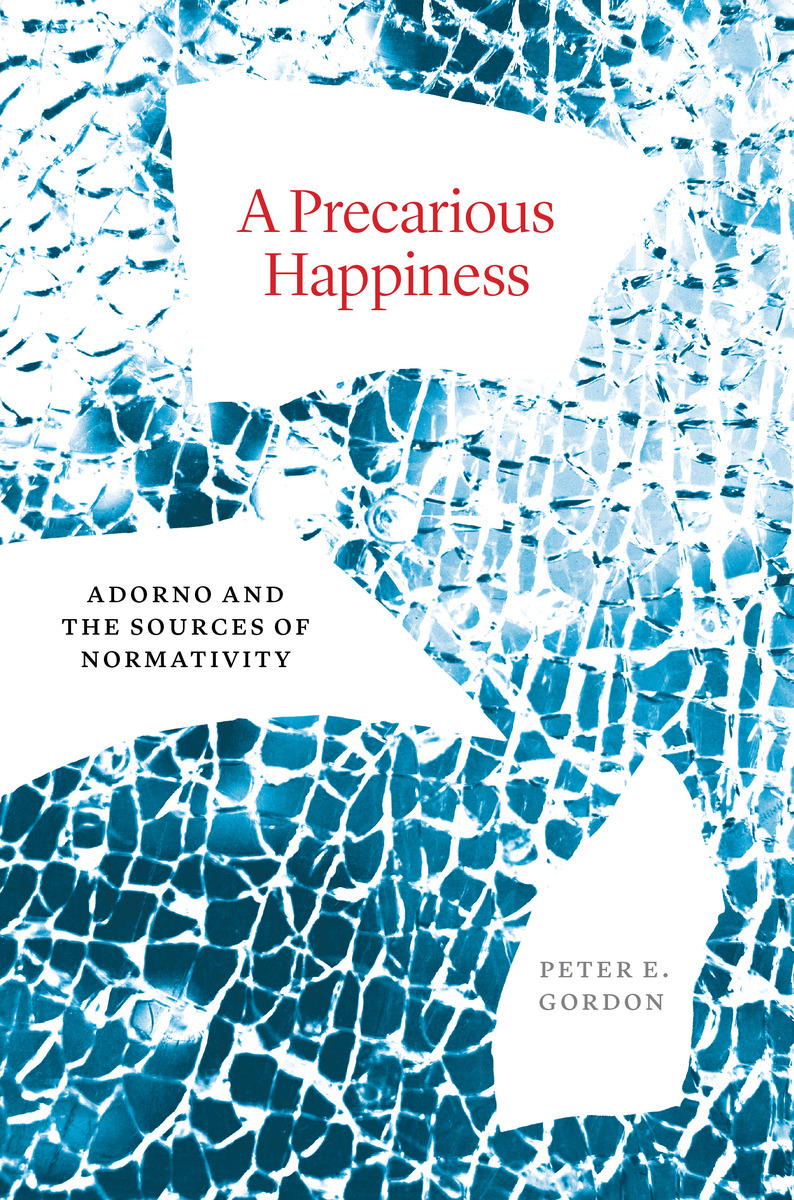
A Precarious Happiness: Adorno and the Sources of Normativity
University of Chicago Press, 2023
Cloth: 978-0-226-82857-2 | eISBN: 978-0-226-82919-7
Library of Congress Classification B3199.A34G675 2024
Dewey Decimal Classification 193
Cloth: 978-0-226-82857-2 | eISBN: 978-0-226-82919-7
Library of Congress Classification B3199.A34G675 2024
Dewey Decimal Classification 193
ABOUT THIS BOOK | AUTHOR BIOGRAPHY | REVIEWS | TOC | REQUEST ACCESSIBLE FILE
ABOUT THIS BOOK
A strikingly original account of Theodor Adorno’s work as a critique animated by happiness.
"Gordon’s confidently gripping and persistently subtle interpretation brings a new tone to the debate about Adorno’s negativism."—Jürgen Habermas
Theodor Adorno is often portrayed as a totalizing negativist, a scowling contrarian who looked upon modern society with despair. Peter E. Gordon thinks we have this wrong: if Adorno is uncompromising in his critique, it is because he sees in modernity an unfulfilled possibility of human flourishing. In a damaged world, Gordon argues, all happiness is likewise damaged but not wholly absent. Through a comprehensive rereading of Adorno’s work, A Precarious Happiness recovers Adorno’s commitment to traces of happiness—fragments of the good amid the bad. Ultimately, Gordon argues that social criticism, while exposing falsehoods, must also cast a vision for an unrealized better world.
"Gordon’s confidently gripping and persistently subtle interpretation brings a new tone to the debate about Adorno’s negativism."—Jürgen Habermas
Theodor Adorno is often portrayed as a totalizing negativist, a scowling contrarian who looked upon modern society with despair. Peter E. Gordon thinks we have this wrong: if Adorno is uncompromising in his critique, it is because he sees in modernity an unfulfilled possibility of human flourishing. In a damaged world, Gordon argues, all happiness is likewise damaged but not wholly absent. Through a comprehensive rereading of Adorno’s work, A Precarious Happiness recovers Adorno’s commitment to traces of happiness—fragments of the good amid the bad. Ultimately, Gordon argues that social criticism, while exposing falsehoods, must also cast a vision for an unrealized better world.
See other books on: 1903-1969 | Adorno | Adorno, Theodor W. | Critical theory | Normativity (Ethics)
See other titles from University of Chicago Press