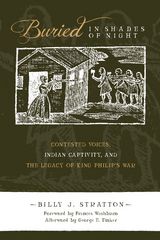
Buried in Shades of Night: Contested Voices, Indian Captivity, and the Legacy of King Philip's War
University of Arizona Press, 2013
Cloth: 978-0-8165-3028-1 | Paper: 978-0-8165-3138-7 | eISBN: 978-0-8165-9903-5 (standard)
Library of Congress Classification E87.R8S77 2013
Dewey Decimal Classification 973.24
Cloth: 978-0-8165-3028-1 | Paper: 978-0-8165-3138-7 | eISBN: 978-0-8165-9903-5 (standard)
Library of Congress Classification E87.R8S77 2013
Dewey Decimal Classification 973.24
ABOUT THIS BOOK | AUTHOR BIOGRAPHY | REVIEWS | TOC
ABOUT THIS BOOK
The captivity narrative of Mary Rowlandson, The Soveraignty and Goodness of God, published in 1682, is often considered the first “best seller” to be published in North America. Since then, it has long been read as a first-person account of the trials of Indian captivity. After an attack on the Puritan town of Lancaster, Massachusetts, in February 1676, Rowlandson was held prisoner for more than eleven weeks before eventually being ransomed. The account of her experiences, published six years later, soon took its place as an exemplar of the captivity narrative genre and a popular focal point of scholarly attention in the three hundred years since.
In this groundbreaking new book, Billy J. Stratton offers a critical examination of the narrative of Mary Rowlandson. Although it has long been thought that the book’s preface was written by the influential Puritan minister Increase Mather, Stratton’s research suggests that Mather was also deeply involved in the production of the narrative itself, which bears strong traces of a literary form that was already well established in Europe. As Stratton notes, the portrayal of Indian people as animalistic “savages” and of Rowlandson’s solace in Biblical exegesis served as a convenient alibi for the colonial aspirations of the Puritan leadership.
Stratton calls into question much that has been accepted as fact by scholars and historians over the last century, and re-centers the focus on the marginalized perspective of Native American people, including those whose land had been occupied by the Puritan settlers. In doing so, Stratton demands a careful reconsideration of the role that the captivity narrative—which was instrumental in shaping conceptions of “frontier warfare”—has played in the development of both American literary history and national identity.
See other books on: Indian captivities | Indians in literature | King Philip's War, 1675-1676 | Night | Shades
See other titles from University of Arizona Press