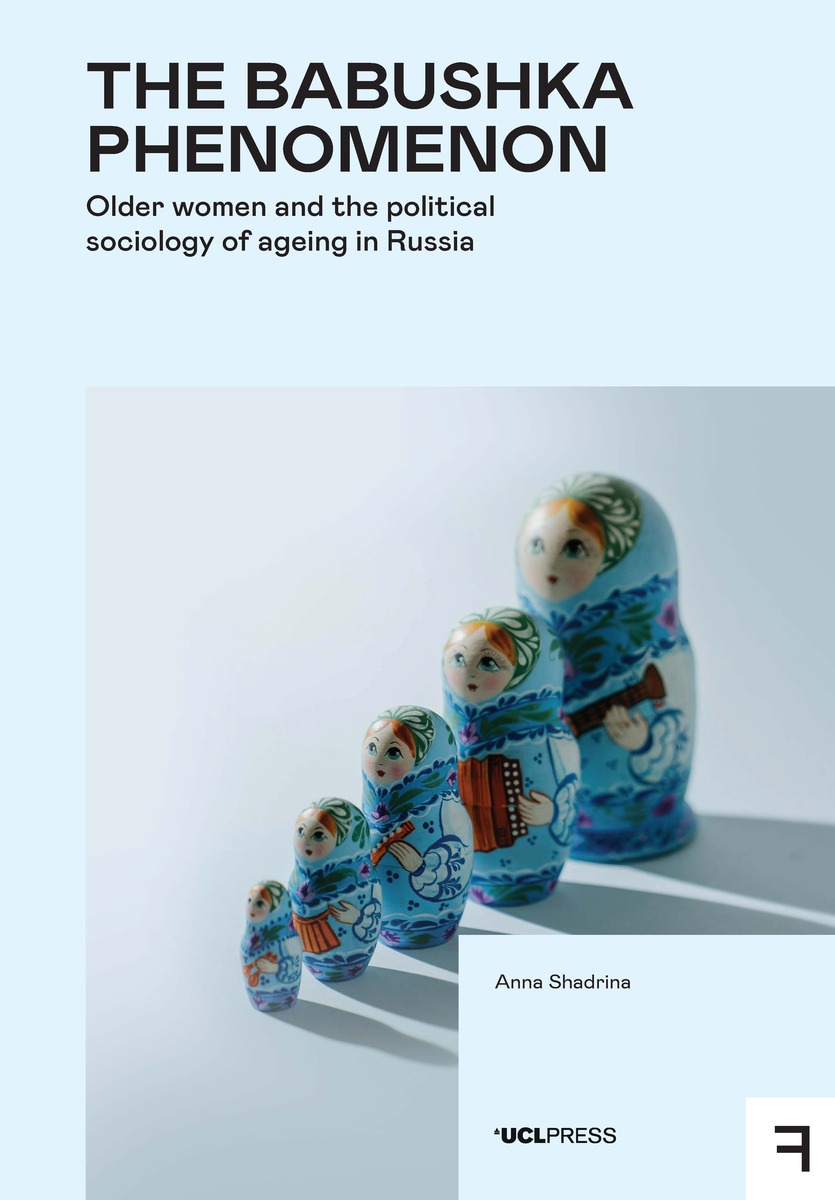
The Babushka Phenomenon: Older Women and the Political Sociology of Ageing in Russia
University College London, 2025
Cloth: 978-1-80008-907-5 | Paper: 978-1-80008-908-2
See other books on: Ageing | Marriage & Family | Older Women | Political Sociology | Russian & Soviet
See other titles from University College London
Cloth: 978-1-80008-907-5 | Paper: 978-1-80008-908-2
ABOUT THIS BOOK | AUTHOR BIOGRAPHY | TOC
ABOUT THIS BOOK
A unique sociological perspective on how “babushkas” have been pushed to the margins of post-Soviet society.
The word “babushka” literally means “grandmother,” but it has come to represent much more since the Soviet era, not least the family caregiver. In her new study, Anna Shadrina explores the marginalization of older women in post-Soviet Russia, shedding light on the complex image of the babushka as both the cornerstone of the family unit and a passive recipient of social benefits. The author argues that this image has been shaped in no small part by welfare cutbacks that shifted the responsibility of family care from the state to individual women, as well as the increasing frustration of working-age people with the post-socialist economic system. Ultimately, she shows that despite being ostracized from society for defying age- and gender-specific social expectations, older women occupy a crucial position as active contributors to the economy.
The word “babushka” literally means “grandmother,” but it has come to represent much more since the Soviet era, not least the family caregiver. In her new study, Anna Shadrina explores the marginalization of older women in post-Soviet Russia, shedding light on the complex image of the babushka as both the cornerstone of the family unit and a passive recipient of social benefits. The author argues that this image has been shaped in no small part by welfare cutbacks that shifted the responsibility of family care from the state to individual women, as well as the increasing frustration of working-age people with the post-socialist economic system. Ultimately, she shows that despite being ostracized from society for defying age- and gender-specific social expectations, older women occupy a crucial position as active contributors to the economy.
See other books on: Ageing | Marriage & Family | Older Women | Political Sociology | Russian & Soviet
See other titles from University College London