ABOUT THIS BOOK
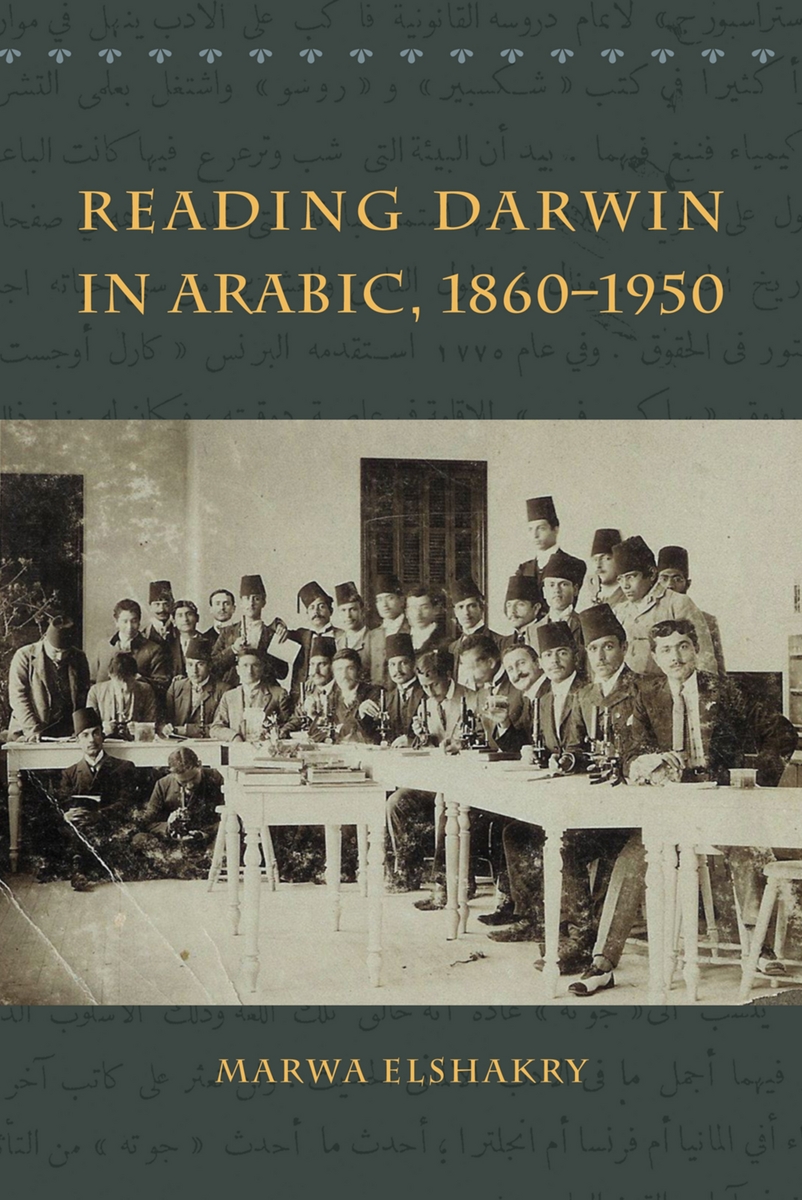
In Reading Darwin in Arabic, Marwa Elshakry questions current ideas about Islam, science, and secularism by exploring the ways in which Darwin was read in Arabic from the late 1860s to the mid-twentieth century. Borrowing from translation and reading studies and weaving together the history of science with intellectual history, she explores Darwin’s global appeal from the perspective of several generations of Arabic readers and shows how Darwin’s writings helped alter the social and epistemological landscape of the Arab learned classes.
Providing a close textual, political, and institutional analysis of the tremendous interest in Darwin’s ideas and other works on evolution, Elshakry shows how, in an age of massive regional and international political upheaval, these readings were suffused with the anxieties of empire and civilizational decline. The politics of evolution infiltrated Arabic discussions of pedagogy, progress, and the very sense of history. They also led to a literary and conceptual transformation of notions of science and religion themselves. Darwin thus became a vehicle for discussing scriptural exegesis, the conditions of belief, and cosmological views more broadly. The book also acquaints readers with Muslim and Christian intellectuals, bureaucrats, and theologians, and concludes by exploring Darwin’s waning influence on public and intellectual life in the Arab world after World War I.
Reading Darwin in Arabic is an engaging and powerfully argued reconceptualization of the intellectual and political history of the Middle East.
REVIEWS
“Thoroughly researched. . . . [A] densely argued and fascinating book [that] gives extensive coverage to such matters as missionary ambitions and strategies in the Middle East, Muhammad Abduh’s attempts to reform al-Azhar as a teaching institution, the rise of Pharaonism as a cultural movement, the growing sense of an Islamic civilization with a history, the eleventh-century Sufi al-Ghazali’s overweening presence in philosophical debates, and Arab interest in Atatürk’s reforms.”
— Robert Irwin, Times Literary Supplement
“Elshakry’s book is a remarkable feat of scholarship that builds on an impressive base of sources. . . . I believe Reading Darwin in Arabic will serve as a beacon of insight and inspiration for scholars of the Middle East and historians of modern science.”
— Harun Küçük, Max Planck Institute for the History of Science, Science
“This pathbreaking book opens up a new world of understanding about the encounters of science in an era of imperial rivalries and nationalist ambitions. Following networks of travel, print, and translation across the Arabic-speaking world, Marwa Elshakry not only brings to life a vibrant intellectual culture too little known in the West but also illuminates contemporary global debates about tradition, faith, and evolutionary science.”
— James A. Secord, University of Cambridge
“A tour de force, this book moves on a spectacular trajectory from Darwin’s original texts to their translation, interpretation, and contestation in zones that remain terra incognita to most scholars today. Elshakry shows for the first time how science-and-religion issues that still agitate Americans were first brought to Ottoman Syria and Egypt by Americans themselves—and, tellingly, she points up multiple ironies in the creative and often unexpected ways in which evolutionary ideas were appropriated by Muslims and Christians alike. To an age obsessed by ‘the clash of civilizations,’ Reading Darwin in Arabic will be revelatory.”
— James Moore, coauthor of Darwin and Darwin’s Sacred Cause
“A novel and important contribution to our understanding of the globalization of science in the nineteenth century. Marwa Elshakry’s study will appeal not only to scholars of the modern intellectual and political history of the Middle East but also to an audience in the history of science, especially those working on imperial and colonial histories of science.”
— Timothy Mitchell, author of Colonising Egypt
"A fresh perspective on the reception of Darwinism. While the title of her book suggests a focus on the impact of Darwin’s Origins of Species on Arabic readers, it is, in fact, a work relevant to anyone interested in the reception of scientific ideas on a global scale. . . . A solid contribution to knowledge, and one that will remain a cornerstone of the intellectual history of the Arabic reading world."
— Andrew Bednarski, Gonville and Caius College, Studies in History and Philosophy of Biological and Biomedical Sciences
"Elshakry’s wonderfully rich book adds a great deal to our knowledge concerning the reception of modern science by Arab and Muslim intellectuals."
— John Kelsay, Florida State University, Quarterly Review of Biology
"Even as Christian apologists combed scripture for Biblical refutations of Darwin, Islamic scholars as high up the intellectual ladder as Egypt’s grand mufti, Muhammad 'Abduh, 'had little difficulty reconciling modern principles of evolution with revelation,' Elshakry observes in this thorough study of the question of the compatibility of Darwin’s ideas with Islamic thinking."
— Tom Verde, AramcoWorld
"With the limited scholarship focusing on science translation between the Global North and the Global South, Elshakry’s Reading Darwin in Arabic is a much welcome contribution to the existing literature on the globalization, translation and popularization of science, especially in colonial and postcolonial contexts. Reading Darwin is an invaluable resource for historians of science and intellectual historians of the Middle East. It is also a crucial contribution to science-and-religion studies."
— Soha Bayoumi, Harvard University, Endeavour
"Rewarding. . . . Reading Darwin in Arabic is about more than its title suggests. It describes the intellectual ferment in Egypt as the country grappled both with Darwinism and colonial rule, and an Islamic liberalism shone briefly before being all but extinguished by the brutal ideologies of the twentieth century."
— Christopher de Bellaigue, New York Review of Books
"Elshakry’s Reading Darwin in Arabic is a tour-de-force. Without question, Elshakry has made an invaluable contribution to the global and cultural histories of decolonization."Maurice Jr. M. Labelle (University of Saskatchewan)
— Maurice Jr. M. Labelle, University of Saskatchewan, H-Net
"Elshakry has written a wonderful book on the interaction between the Islamic world and Western scientific thought in the late nineteenth and early twentieth centuries. This book should be of interest to anyone teaching about the impact of Darwinism, since it greatly extends the range of our information about how different cultures respond to evolutionary ideas."
— Science and Education
TABLE OF CONTENTS
Introduction - Marwa Elshakry
DOI: 10.7208/chicago/9780226001449.003.0001
This chapter is available at:
https://academic.oup.com/chica...
The Gospel of Science - Marwa Elshakry
DOI: 10.7208/chicago/9780226001449.003.0002
[Evangelism, Missionaries, Conversion, Arabic Press, Education, Human descent, Creationism, Ottoman Syria, Beirut]
This chapter looks at the role of American missionaries in nineteenth century Ottoman Syria and their promotion of modern science pedagogy and popularization on the path to salvation. Through the extensive use of mission archives and through close readings of the contemporary Arabic press, it examines the missionaries’ role in the founding of the Syrian Protestant College in Beirut in 1866 and the encouragement and exemplar they provided for two of their college tutors’, Ya‘qub Sarruf’s and Farris Nimr’s founding of the scientific and literary journal Al-Muqtataf in 1876. This would prove to be one of the most important organs for the popularization of the modern sciences in Arabic, and in particular for the dissemination and discussion of Darwin’s ideas. Despite the missionaries’ initial enthusiasm for this journal, a controversy over Darwin in 1882 (known as the “Lewis affair,” after the furor caused by college professor Edwin Lewis in publicly praising Darwin) turned them against their acolytes’ enterprise, and brought to the surface the ambiguities of the American evangelical promotion of science in the Syrian lands. (pages 25 - 72)
This chapter is available at:
https://academic.oup.com/chica...
Evolution and the Eastern Question - Marwa Elshakry
DOI: 10.7208/chicago/9780226001449.003.0003
[Popularization, Social Evolution, Civilization, Progress, Race, British imperialism, Anti-colonialism, Egypt, Sudan]
Following Al-Muqtataf’s move to Cairo after the British occupation in 1882-83, this chapter examines how the journal focused increasingly on discussions of social evolutionary thought and on questions of civilizational rise and fall, universal progress and social development. Turning ever more to a cosmic vision of evolution and universal natural laws, they were particularly inspired by the writings of Herbert Spencer. Their concern with social progress and civilizational decline also led them toward a new engagement with issues of race, particularly around the time of the newly declared Anglo-Egyptian Condominium with Sudan, as well as to a new concern with examples of “Eastern progress,” especially in the wake of Japan’s victory during the Russo-Japanese War of 1904-05. This was also reflected in the works of their former Syrian Protestant College and co-collaborator (later the editor of another major literary and scientific journal in its own right), Jurji Zaydan. Yet their engagement with these issues, their close relations with the British and their founding, with British backing, of a daily newspaper, Al-Muqattam, in 1899 soon led them to be attacked by Arab nationalists and anti-colonial critics. (pages 73 - 98)
This chapter is available at:
https://academic.oup.com/chica...
Materialism and Its Critics - Marwa Elshakry
DOI: 10.7208/chicago/9780226001449.003.0004
[Materialism, Naturalism, Heresy, Spontaneous generation, Jamal al-Din al-Afghani, Evolution of religion]
This chapter examines one of the earliest and most controversial Arab evolutionary materialists, Shibli Shumayil. A Syrian Protestant College graduate and close colleague of the Muqtataf group, Shumayyil wrote tirelessly in defence of materialism, an inherently ambiguous and multivalent term in Arabic that led him to pen his own neologism. His promotion of spontaneous generation (or abiogenesis in particular) as well as his frequent writings on the evolution of religion attracted sharp criticism from Arab Christians and Muslims. Indeed, his translation of Ludwig Büchner’s commentaries on Darwin (from a French translation of the original German) spawned dozens of refutations. Foremost among them were the writings of the Syrian Protestant College tutor, Ibrahim al-Hurani, who promoted an evangelical anti-evolutionary perspective under the auspices of the college. Yet far more effective was the refutation of materialism published by the pan-Islamist revolutionary, Jamal al-Din al-Afghani. This was originally published in Urdu and inspired by the “naturalist” movement of the Indian theologian Sayyid Ahmad Khan. It was later translated into Arabic by Muhammad ‘Abduh, who clearly had Shumayyil in mind, and thanks to the popularity of its anti-materialist message, it helped cast a shadow on Arabic readings of evolution for generations to come. (pages 99 - 130)
This chapter is available at:
https://academic.oup.com/chica...
Theologies of Nature - Marwa Elshakry
DOI: 10.7208/chicago/9780226001449.003.0005
[Natural theology, Chain of Being, Providentialism, ‘ilm al-kalam, theology, Natural law, Ottoman Reform]
Perhaps another feature of the backlash against evolutionary materialism was the rise of a contemporary natural theological discourse in Arabic, which forms the focus of this chapter. Examining the broader intellectual milieu that formed around the rejection of materialism in Beirut in particular, and revolving around the work of the Sufi theologian Husayn al-Jisr, it shows how writings on evolution in Arabic helped spur renewed interest in older theological debates, particularly around the tradition of Muslim scholastic theology, or ‘ilm al-kalam. This revitalization of theology also shows how Arabic readings of Darwin necessarily drew in older textual traditions and debates. These readings were critically shaped by contemporary debates on Ottoman educational and institutional reform. Indeed, al-Jisr himself spent time at the Sultan’s court in Istanbul, and was commissioned to write a treatise on the contemporary natural sciences from a Muslim theological perspective. (pages 131 - 160)
This chapter is available at:
https://academic.oup.com/chica...
Darwin and the Mufti - Marwa Elshakry
DOI: 10.7208/chicago/9780226001449.003.0006
[Scriptural hermeneutics, Tafsir, Qur’an, Muhammad ‘Abduh, Azhar, Pedagogy, Reform, “Islamic modernism”]
This chapter examines the career of one of the best-known Muslim intellectuals of colonial Egypt, Muhammad ‘Abduh. It looks in particular at his efforts at the curricular reform of al-Azhar. Following his discussion of the need to revitalize the Muslim sciences, it explores his understanding of “new subjects” of study or the “new sciences” (al-‘ulum al-haditha). For much of his life, ‘Abduh was at odds with the Azhari rank and file: his reformism was one reason why he was often denounced as a “Wahhabi.” His lectures on scriptural hermeneutics, or tafsir also gathered much criticism at the time; yet in other circles, these helped him acquire the label of one of the founding “Islamic modernists.” It was in these lectures that ‘Abduh would make passing references to evolution and to Darwin. An avid fan of Herbert Spencer, ‘Abduh’s engagement with contemporary evolutionary thought was nowhere as extensive as al-Jisr’s. Nevertheless, it provided further fodder for his critics who were as wary of ‘Abduh’s reform efforts as they were of his close relations with British advocates in Egypt. This chapter thus explores the politics of evolution alongside educational and religious reform through the experience of Egypt’s Grand Mufti. (pages 161 - 218)
This chapter is available at:
https://academic.oup.com/chica...
Evolutionary Socialism - Marwa Elshakry
DOI: 10.7208/chicago/9780226001449.003.0007
[Socialism, Bolshevism, Fabian Society, Collectivism, Individualism, Cooperation, Altruism, Mutual aid, Eugenics]
This chapter explores the rise of a new evolutionary discourse in Arabic during the early twentieth century: evolutionary socialism. Looking at the rise of Arab evolutionists who rejected the individualist, utilitarian and laissez-faire view of social evolution that was promoted earlier, it examines the new emphasis on collectivism, altruism and mutual aid. Examining the works of such early figures as Shibli Shumayyil and Farah Antun and later ones like Salama Musa, it considers how Darwin helped shape the sensibilities of many early Arab socialists long before Marx. Against the background of ever-growing anti-colonial nationalist foment, it looks at how the implications of Bolshevism often helped radicalise these figures, despite their continued emphasis on reform over revolution. The focus was still on social evolution and progress, and eugenics entered the discussion for the first time, yet the overall discourse remained gradualist, reformist and technocratic (as it had for previous thinkers). But the appeal of evolutionary socialism was bound up with the standing of the effendiya. The growing decline of this class marked the beginning of Darwin’s retreat from Arab intellectual life. (pages 219 - 260)
This chapter is available at:
https://academic.oup.com/chica...
Darwin in Translation - Marwa Elshakry
DOI: 10.7208/chicago/9780226001449.003.0008
[Translation, Positivism, Transcendentalism, Arab Golden Age, Warfare of science and theology, Easternism, Arabic Academy of Language, Language reform]
Despite the extensive discussion of Darwin in the Arabic press since at least the early 1870s, his Origin of Species was not translated until well into the twentieth century. This chapter examines the works of Isma‘il Mazhar, one of the last of the major Arab evolutionists and science popularizers. It focuses on his work on translation and his efforts at language reform in general, for Mazhar was an avid translator, and he spent a considerable amount of time deliberating on the literary, stylistic and conceptual implications of translation. (Later he would also go on to participate in one of Egypt’s first Arabic Language Academies, where he worked specifically on the problem of modern scientific translation.) In particular, the chapter considers his readings of Darwin in the face of growing suspicions of evolution’s entrenched materialism. In the 1920s and 1930s, Mazhar campaigned tirelessly against this perspective, and his own stance was as neo-positivist as it was transcendentalist. Nevertheless, the very subject of his work was quickly losing favour with Arabic readers, and his ideas on evolution and social progress, alongside his views on religion, language and politics, gained him few followers. (pages 261 - 306)
This chapter is available at:
https://academic.oup.com/chica...
Afterword - Marwa Elshakry
DOI: 10.7208/chicago/9780226001449.003.0009
[Publics, Counter-Publics, Anti-evolutionism, Intelligent design, Effendiya, Gradualism, Middle East]
The afterword reflects briefly on the reasons for the continued decline of Darwin’s appeal among Arabic readers after the second World War. Explaining this in terms of broad social, political and cultural changes, notably the rise of new kinds of reading publics and counter-publics, it considers some of the factors behind the rise of anti-evolutionism and the rejection of the gradualist, reformist and positivist vision of so many of the Arab evolutionists examined in this book. (pages 307 - 318)
This chapter is available at:
https://academic.oup.com/chica...