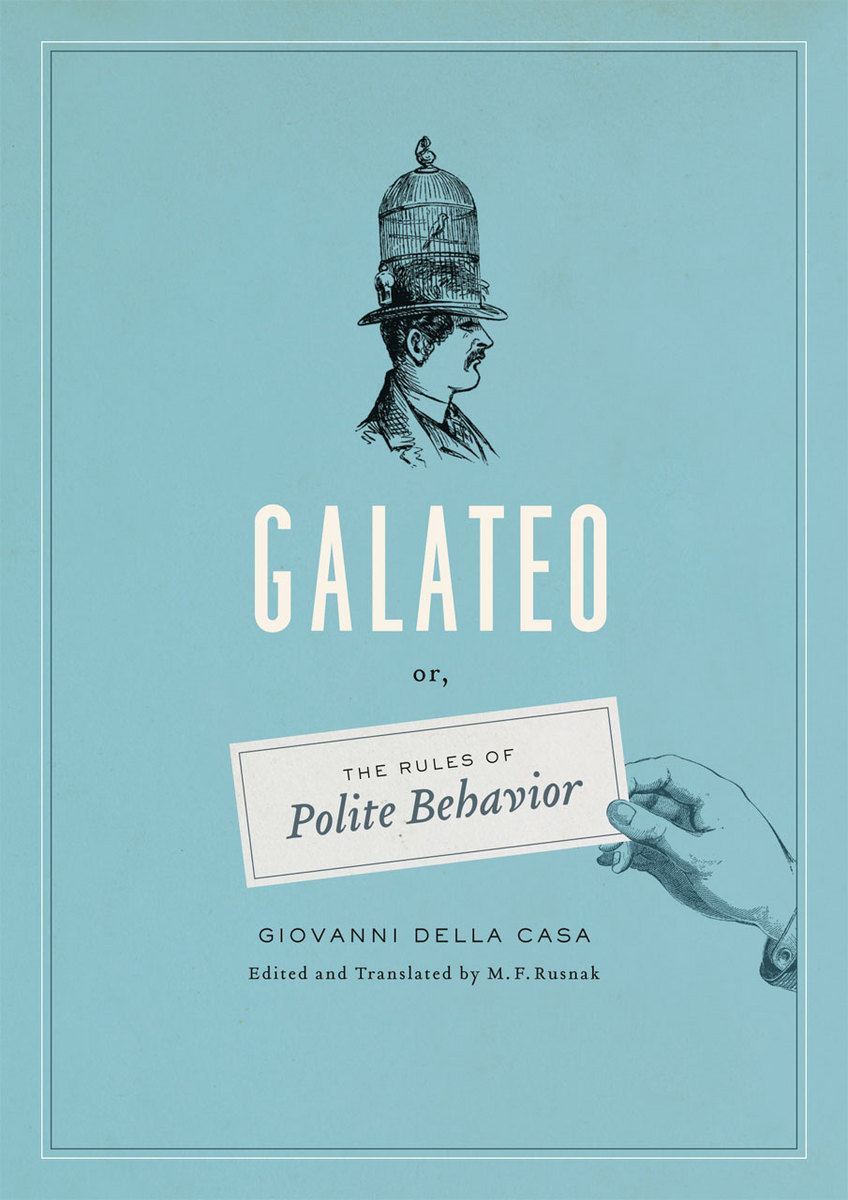
Galateo
Or, The Rules of Polite Behavior
by Giovanni Della Casa, edited by M. F. Rusnak, translated by M. F. Rusnak
University of Chicago Press, 2013
Cloth: 978-0-226-01097-7 | Paper: 978-0-226-21219-7 | Electronic: 978-0-226-01102-8
DOI: 10.7208/chicago/9780226011028.001.0001
ABOUT THIS BOOKAUTHOR BIOGRAPHYREVIEWSTABLE OF CONTENTS
ABOUT THIS BOOK
“Since it is the case that you are now just beginning that journey that I have for the most part as you see completed, that is, the one through mortal life, and loving you so very much as I do, I have proposed to myself—as one who has been many places—to show you those places in life where, walking through them, I fear you could easily either fall or take the wrong direction.”
So begins Galateo, a treatise on polite behavior written by Giovanni Della Casa (1503–56) for the benefit of his nephew, a young Florentine destined for greatness.
In the voice of a cranky yet genial old uncle, Della Casa offers the distillation of what he has learned over a lifetime of public service as diplomat and papal nuncio. As relevant today as it was in Renaissance Italy, Galateo deals with subjects as varied as dress codes, charming conversation and off-color jokes, eating habits and hairstyles, and literary language. In its time, Galateo circulated as widely as Machiavelli’s Prince and Castiglione’s Book of the Courtier. Mirroring what Machiavelli did for promoting political behavior, and what Castiglione did for behavior at court, Della Casa here creates a picture of the refined man caught in a world in which embarrassment and vulgarity prevail. Less a treatise promoting courtly values or a manual of savoir faire, it is rather a meditation on conformity and the law, on perfection and rules, but also an exasperated—often theatrical—reaction to the diverse ways in which people make fools of themselves in everyday social situations.
With renewed interest in etiquette and polite behavior growing both inside and outside the academy, the time is right for a new, definitive edition of this book. More than a mere etiquette book, this restored edition will be entertaining (and even useful) for anyone making their way in modern civilized and polite society, and a subtle gift for the rude neighbor, the thoughtless dinner guest, or the friend or relative in need of a refresher on proper behavior.
AUTHOR BIOGRAPHY
Giovanni Della Casa (1503–56) was a celebrated Italian writer and diplomat whose works in Latin and Italian spread across a stunning range of poetic and prose genres. M. F. Rusnak is a translator, professor, and writer. He lives in Princeton, New Jersey, and Florence, Italy.
REVIEWS
“Galateo holds an important place in the long and rich history of etiquette books.”
— Judith Martin, New York Times Book Review
“Throughout, the book reveals a sophisticated understanding of human sensitivity, of our deep-rooted hunger for respect. . . . In its brevity, Galateo can almost be viewed as a kind of Renaissance Elements of Style, with the understanding that ‘style’ here means courteous behavior. Rusnak’s introductory essay, copious notes, and bibliography usefully fill out some of the book’s historical context. But the counsel itself remains timeless.”
— Michael Dirda, Washington Post
“Della Casa’s advice is consistently delightful and pointed.”
— Boston Globe Brainiac Blog
“A delightful new translation.”
— Stephen Greenblatt, New York Review of Books
“[Galateo] mixes sagacity with delicious asperity. Modern foodists would be aghast (and perhaps fall blessedly silent) at the advice on how to behave at a dinner party: ‘You must not do anything to proclaim how greatly you are enjoying the food and wine, for this habit is for tavern keepers.’ Della Casa is wonderfully irritated by people who interrupt constantly (they ‘surely make the other person eager to punch or smack them’), and people who describe their dreams in excruciating detail. It is somehow reassuring to know that idiots and bores are the same throughout the ages.”
— Guardian
“Recommended.”
— D. Stewart, Ohio University, Choice
TABLE OF CONTENTS
Introduction
1. Long-winded opening—good manners, compared with more weighty virtues, and why they are no less useful to a gentleman
2. Annoying behavior defined simply interms of sensual suffering
3. Disgusting things offend the senses—and even the imagination and desire
4. Galateo and Count Ricciardo—ananecdote on the importance of politeness
5. Returning to the subject of offensive and gauche habits
6. Ways we enjoy one another, and irk one another, especially in conversation
7. Dressing for success
8. Petulant and pompous and self-serving people
9. How to spoil a conversation
10. On those prim and lady like men
11. The don’ts of conversation
12. Keep your dreams to yourself
13. Liars and braggarts and the falsely modest
14. Ceremonies, especially empty compliments, discussed
15. Three kinds of compliments—why not to extend them
16. Compliments done for vanity and out of duty, and a warning about adulation
17. Why imported Spanish affectation is particularly vapid
18. Other spoken sources of annoyance: slander, contradiction, reprimanding, etc
19. The risks of mockery and ridicule and vituperative wit
20. Comic talent: those who are funny and those who try to be
21. Some practical tips on storytelling
22. Eloquence and the choice of language
23. More on the fine art of conversation
24. The verbose, the interrupters, the taciturn
25. Anecdote of the sculptor, The Rule, and a lady named Reason
26. The aesthetics of human language and human actions
27. Why hurting my senses hurts my mind
28. Grace, decorum, and restraint—and a special word on fashion sense
29. Bad table manners and getting knee-walking drunk
30. The myriad ways to be rude—and an abrupt conclusion
Notes
Bibliography