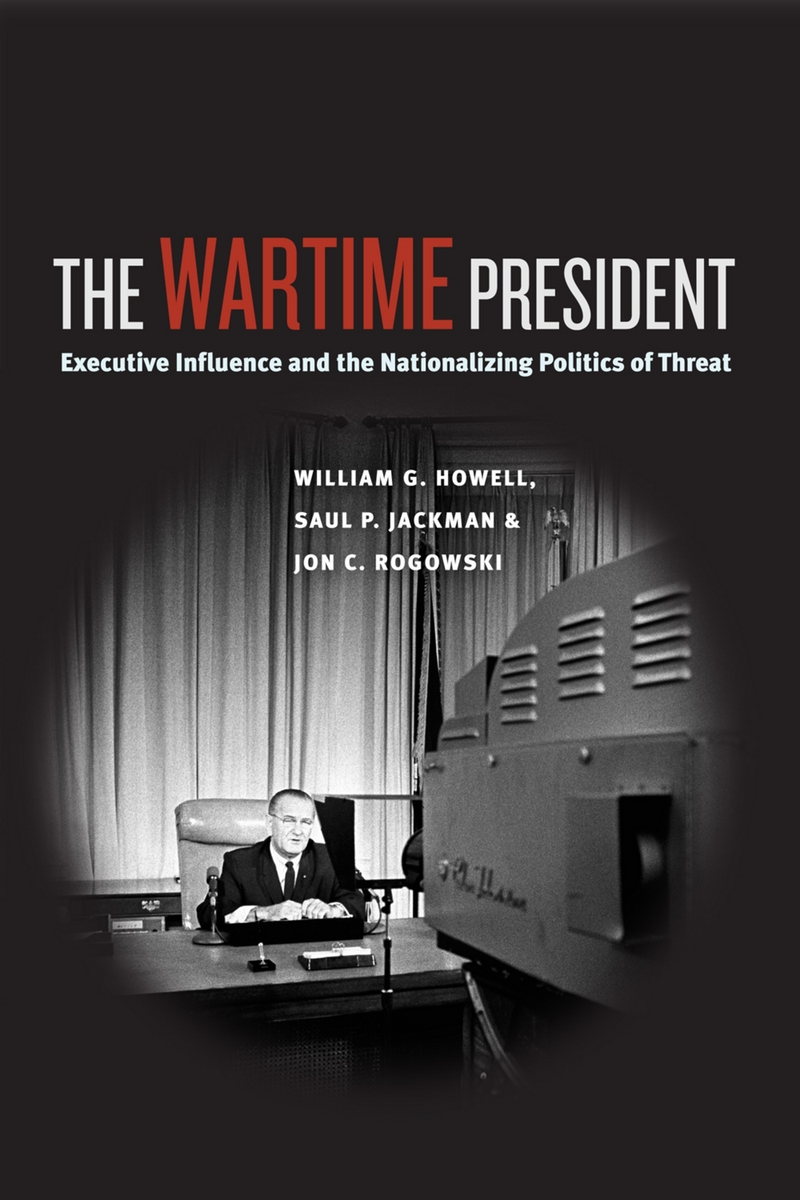
The Wartime President
Executive Influence and the Nationalizing Politics of Threat
University of Chicago Press, 2013
Cloth: 978-0-226-04825-3 | Paper: 978-0-226-04839-0 | Electronic: 978-0-226-04842-0
DOI: 10.7208/chicago/9780226048420.001.0001
Cloth: 978-0-226-04825-3 | Paper: 978-0-226-04839-0 | Electronic: 978-0-226-04842-0
DOI: 10.7208/chicago/9780226048420.001.0001
AVAILABLE FROM
University of Chicago Press (paper, ebook)Brytewave (CafeScribe-Follett Higher Ed)
Chegg Inc
DeGruyter Multi-User Ebook Program
ebrary
EBSCO eBooks (formerly NetLibrary)
OverDrive
University Press Scholarship Online (UPSO)
ABOUT THIS BOOKAUTHOR BIOGRAPHYREVIEWSTABLE OF CONTENTS
ABOUT THIS BOOK
“It is the nature of war to increase the executive at the expense of the legislative authority,” wrote Alexander Hamilton in the Federalist Papers. The balance of power between Congress and the president has been a powerful thread throughout American political thought since the time of the Founding Fathers. And yet, for all that has been written on the topic, we still lack a solid empirical or theoretical justification for Hamilton’s proposition.
For the first time, William G. Howell, Saul P. Jackman, and Jon C. Rogowski systematically analyze the question. Congress, they show, is more likely to defer to the president’s policy preferences when political debates center on national rather than local considerations. Thus, World War II and the post-9/11 wars in Afghanistan and Iraq significantly augmented presidential power, allowing the president to enact foreign and domestic policies that would have been unattainable in times of peace. But, contrary to popular belief, there are also times when war has little effect on a president’s influence in Congress. The Vietnam and Gulf Wars, for instance, did not nationalize our politics nearly so much, and presidential influence expanded only moderately.
Built on groundbreaking research, The Wartime President offers one of the most significant works ever written on the wartime powers presidents wield at home.
AUTHOR BIOGRAPHY
William G. Howell is the Sydney Stein Professor in American Politics at the Harris School of Public Policy Studies and professor of political science in the College at the University of Chicago. He is the author or coauthor of several books, including, most recently, Thinking about the Presidency: The Primacy of Power and While Dangers Gather: Congressional Checks on Presidential War Powers. Saul P. Jackman is a fellow at the Brookings Institution in Washington, DC. Jon C. Rogowski is assistant professor in the Department of Political Science at Washington University in St. Louis.
REVIEWS
“William G. Howell, Saul P. Jackman, and Jon C. Rogowski continue the valuable and highly regarded line of presidency research that integrates modern analytical techniques with deep substantive knowledge. No question in American politics is of greater importance—or more timely—than the power of the president and his relationship with Congress, and The Wartime President makes a clearly written and cutting-edge contribution that is sure to spur further research.”
— Steven Callander, Stanford University“The Wartime President offers a compelling, original theory of how war affects presidential power. By demonstrating through rigorous empirical analysis that war empowers the president when it leads the public and members of Congress to focus on national concerns rather than local priorities, William G. Howell, Saul P. Jackman, and Jon C. Rogowski dramatically advance our understanding of the presidency and of our separation of powers system.”
— Eric Schickler, University of California, Berkeley
“The Wartime President offers an interesting window into a central question in American politics: how does war shape the balance between Congress and the executive branch in lawmaking?”
— David Mayhew, Yale University"The Wartime President tackles an important and understudied question: Do US presidents have greater influence over domestic policy during war than during peacetime? In the first systematic and quantitative study of this question, William G. Howell, Saul P. Jackman, and Jon C. Rogowski show that—in contrast with decades-old accepted wisdom—foreign conflict does not, in and of itself, secure Congressional deference to the president’s policy goals. Rather—as predicted by Howell, Jackman, and Rogowski’s Policy Priority Model—presidential policy goals tend to receive greater deference from Congress when members of Congress view the proposal as furthering a national policy priority, as opposed to being more closely tied to local issues. The broad and deep empirical analysis indicates that members of Congress are more likely to view the president’s policy goals as being tied to national interests during wartime and, provocatively, this perception effect is larger in realms of domestic policy than in those of foreign affairs. Accessible and engaging, The Wartime President is strongly recommended for anyone interested in political institutions or public policy."
— John W. Patty, Center for New Institutional Social Sciences, Washington University in Saint Louis“A meaty and complex analysis of the presidency during war. . . . The writing is clear and the case studies presented enrich the analysis. What we learn is that presidents benefit from war in their domestic agenda. As members of congress shift to focusing on national concerns, rather than local, they more closely adhere to the preferences of the president. This pattern isn’t without exceptions, and Howell, Jackman, and Rogowski show interesting cases where the model doesn’t predict outcomes as well.”
— New Books in Political Science“The claim that war increases executive political power ranks among political science’s most axiomatic propositions. However, when political scientists seek to answer why and how precisely war increases executive power, the discipline reverts back to its usual state of disagreement. Howell, Jackman, and Rogowski not only address these questions, but also ask whether, and in what respect, executive power is amplified by war. Their scholarship is impressive. . . . Highly recommended.”
— Choice“In fleshing out not only that war matters, but how it matters, The Wartime President makes a thoughtful theoretical and empirical contribution to a literature that will only grow in importance as our own war-made state continues to evolve.”
— Presidential Studies Quarterly“[The Wartime President] offers a genuinely novel way to think about the wartime presidency. . . . The book is likely to become an important reference point for those working on interbranch bargaining in the US political system.”
— Perspectives on Politics“When the public has soured on one political party, the conventional wisdom is for the other party to ‘nationalize’ the election. Presidents might take away a similar lesson from the empirically grounded and fascinating The Wartime President by William G. Howell, Saul P. Jackman, and Jon C. Rogowski.”
— Journal of American History“The idea that presidents can exercise power in war that they cannot in peace is deeply rooted in our understanding of the presidency and based in the idea that the public rallies around its leader during a time of crisis. It is the ambition of the authors of the Wartime President to replace this conventional wisdom with a more nuanced, rigorous, and theoretically grounded understanding of presidential power. Their book is a welcome addition to scholarship of the presidency. . . . It is rigorous, theoretically grounded, and a significant step forward in our understanding of presidential power in wartime.”
— Journal of Politics“Howell, Jackman, and Rogowski’s analysis goes far to explain why the commander in chief can so successfully pursue domestic policy during wartime. Their intelligent use of statistical tests is compelling. . . . [The book’s] academic orientation and empirical rigor make it well suited to graduate courses on the presidency, public policy, or American military history.”
— Michigan War Studies Review“At least since Alexander Hamilton made the observation, participants in and pundits of American politics have largely agreed that ‘[i]t is the nature of war to increase the executive at the expense of the legislative authority.' But like many bits of conventional wisdom, this was accepted rather than examined closely. In this new work, Howell, Jackman, and Rogowski subject to rigorous theoretical and comprehensive empirical analysis what had before received at best episodic attention. Over the course of this impressive work, the authors not only provide empirical evidence to support (generally) Hamilton’s observation, but also develop a theoretically compelling explanation to account for the general relationship and the variations we see across cases.”
— Journal of Legislative StudiesTABLE OF CONTENTS
War and the American Presidency - William G. Howell, Saul P. Jackman, Jon C. Rogowski
The Policy Priority Model - William G. Howell, Saul P. Jackman, Jon C. Rogowski
The Model's Predictions about Modern U.S. Wars - William G. Howell, Saul P. Jackman, Jon C. Rogowski
Spending in War and in Peace - William G. Howell, Saul P. Jackman, Jon C. Rogowski
Voting in War and in Peace - William G. Howell, Saul P. Jackman, Jon C. Rogowski
Case Studies I: Illustrations - William G. Howell, Saul P. Jackman, Jon C. Rogowski
Case Studies II: Challenges - William G. Howell, Saul P. Jackman, Jon C. Rogowski
Summaries, Speculations, and Extensions - William G. Howell, Saul P. Jackman, Jon C. Rogowski