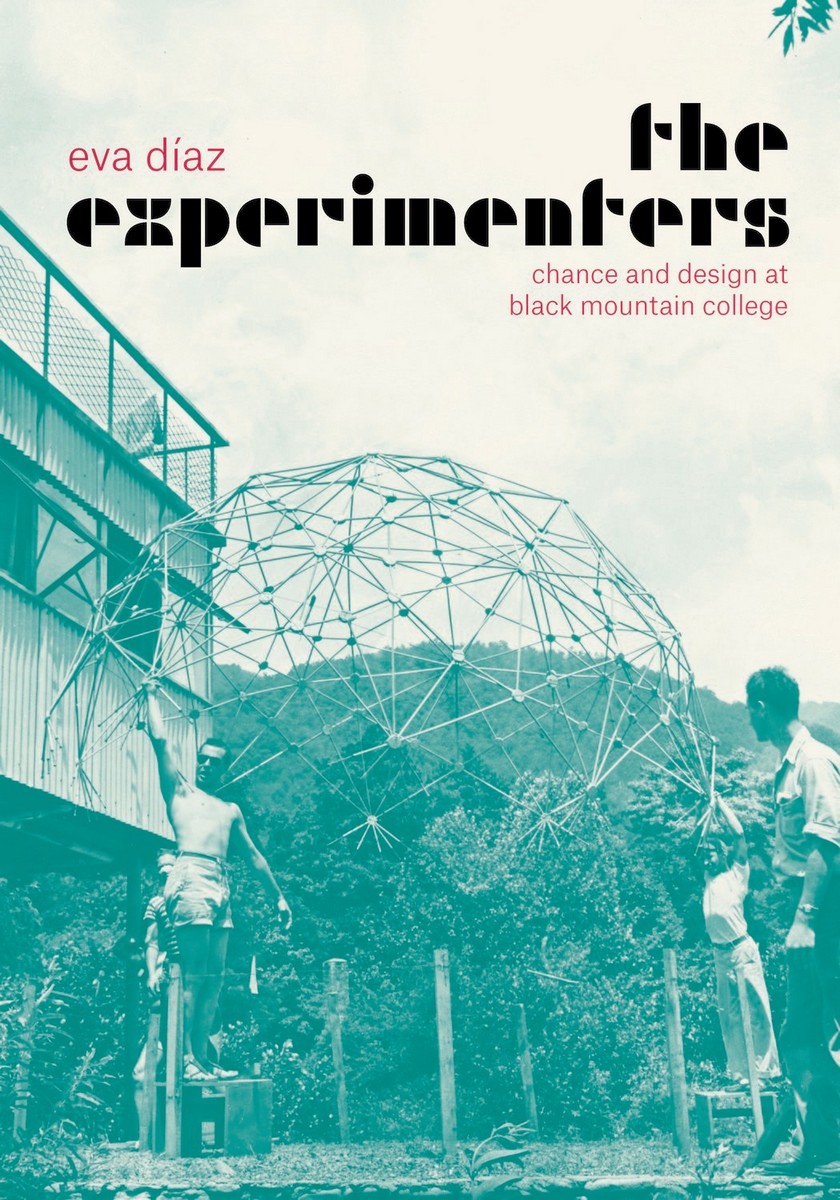
The Experimenters
Chance and Design at Black Mountain College
University of Chicago Press, 2014
Cloth: 978-0-226-06798-8 | Electronic: 978-0-226-06803-9
DOI: 10.7208/chicago/9780226068039.001.0001
Cloth: 978-0-226-06798-8 | Electronic: 978-0-226-06803-9
DOI: 10.7208/chicago/9780226068039.001.0001
AVAILABLE FROM
University of Chicago Press (cloth, ebook)Chegg Inc
ebrary
EBSCO eBooks (formerly NetLibrary)
Kno
OverDrive
ABOUT THIS BOOKAUTHOR BIOGRAPHYREVIEWSTABLE OF CONTENTS
ABOUT THIS BOOK
In the years immediately following World War II, Black Mountain College, an unaccredited school in rural Appalachia, became a vital hub of cultural innovation. Practically every major artistic figure of the mid-twentieth century spent some time there: Merce Cunningham, Ray Johnson, Franz Kline, Willem and Elaine de Kooning, Robert Motherwell, Robert Rauschenberg, Dorothea Rockburne, Aaron Siskind, Cy Twombly—the list goes on and on. Yet scholars have tended to view these artists’ time at the College as little more than prologue, a step on their way to greatness. With The Experimenters, Eva Díaz reveals the importance of Black Mountain College—and especially of three key teachers, Josef Albers, John Cage, and R. Buckminster Fuller—to be much greater than that.
Díaz’s focus is on experimentation. Albers, Cage, and Fuller, she shows, taught new models of art making that favored testing procedures rather than personal expression. These methodologies represented incipient directions for postwar art practice, elements of which would be sampled, and often wholly adopted, by Black Mountain students and subsequent practitioners. The resulting works, which interrelate art and life in a way that imbues these projects with crucial relevance, not only reconfigured the relationships among chance, order, and design—they helped redefine what artistic practice was, and could be, for future generations.
Offering a bold, compelling new angle on some of the most widely studied creative figures of modern times, The Experimenters does nothing less than rewrite the story of art in the mid-twentieth century.
Díaz’s focus is on experimentation. Albers, Cage, and Fuller, she shows, taught new models of art making that favored testing procedures rather than personal expression. These methodologies represented incipient directions for postwar art practice, elements of which would be sampled, and often wholly adopted, by Black Mountain students and subsequent practitioners. The resulting works, which interrelate art and life in a way that imbues these projects with crucial relevance, not only reconfigured the relationships among chance, order, and design—they helped redefine what artistic practice was, and could be, for future generations.
Offering a bold, compelling new angle on some of the most widely studied creative figures of modern times, The Experimenters does nothing less than rewrite the story of art in the mid-twentieth century.
AUTHOR BIOGRAPHY
Eva Díaz is assistant professor of art history at the Pratt Institute.
REVIEWS
“In this highly evocative and well-executed study, Díaz explores the innovative pedagogical practices that were developed at Black Mountain College in its heyday. Respectful of the distinct teaching methods of the College’s most notable faculty, Diaz nonetheless finds a common experimental basis to the artworks and inventions produced by their students in the late 1940s and early 1950s. The Experimenters is nuanced, erudite, and intellectually wide-ranging. It will be essential reading for anyone interested in the development of mid-twentieth-century art in the United States.”
— Alexander Alberro, author of Conceptual Art and the Politics of Publicity“By parsing three different versions of experimentation—performed by Josef Albers, John Cage, and Buckminster Fuller—Díaz shows us how their individual efforts were part of a shared commitment to art’s capacity to reinvent the world, to alter how we see, experience, and shape it in our own image. In the name of experimentation each of the artists suspended, if only for a moment, the metrics of failure and success, and replaced them instead with the values of intellectual pleasure, expanded sensory experiences, and aesthetic innovation. While the book is undoubtedly a historical account of a particular time and place, it is also a road map for many paths that, while not taken, still remain open.”
— Helen Molesworth, Museum of Contemporary Art, Los Angeles“Terrific. Black Mountain College has long been a lodestone for those interested in alternative educational models and in artistic innovation. Nevertheless, the major historical literature on the College still rests on largely anecdotal histories, with a tendency to jaunty optimism in lieu of criticality. There is nothing quite like The Experimenters out there—not on Black Mountain College, not on art making, and not on pedagogy.”
— Judith Rodenbeck, Sarah Lawrence College“What links systems theorist and architect R. Buckminster Fuller with artistic innovators such as Josef Albers and John Cage? The answer is Black Mountain College, North Carolina. . . . As art historian Eva Díaz reveals in this engrossing study, their explorations in materials, form, chance, and indeterminacy were never less than electrifying. Her sympathetic portrait of Fuller as a utopian saving the world through geodesic geometry is particularly assured.”
— Nature“Provides readers with clarity and elucidation about a college, three of its professors and an outside-the-mainstream educational experience. . . . Engaging.”
— New York-Pennsylvania Collector“Insightful. . . . What distinguishes this book is Díaz’s lucid, comprehensive explanations of the ways in which Albers, Cage, and Fuller employed experimentation, or chance, and even failure as agents to advance perception in art specifically and, more broadly, to improve society and the body politic. . . . Highly recommended.”
— Choice“With well-developed prose and a good narrative, Díaz excels at providing context and content for an important story of experimentation on this campus and in subsequent locations inspired or directly impacted by the Black Mountain College approach to education.”
— Journal of Southern History“Highly enjoyable and even inspirational for anyone interested in art practice or simply the power of challenging accepted ways of thinking. . . . Reminds us that the restless spirit of experimentation is often best fostered in environments that expose the rules governing life and art before pushing us, in a collective effort, to break them.”
— MAKE Literary MagazineTABLE OF CONTENTS
Acknowledgments
Introduction: Black Mountain College between Chance and Design
Chapter 1: Josef Albers and the Ethics of Perception
Chapter 2: John Cage's Chance Protocols
Chapter 3: R. Buckminster Fuller's Design Revolution
Epilogue: Legacies of Black Mountain College
Notes
Bibliography
Index