Cloth: 978-0-226-07887-8 | Paper: 978-0-226-07888-5 | Electronic: 978-0-226-07891-5
DOI: 10.7208/chicago/9780226078915.001.0001
AVAILABLE FROM
University of Chicago Press (paper, ebook)Barnes & Noble Nook
Brytewave (CafeScribe-Follett Higher Ed)
DeGruyter Multi-User Ebook Program
ebrary
EBSCO eBooks (formerly NetLibrary)
Google Play
ABOUT THIS BOOK
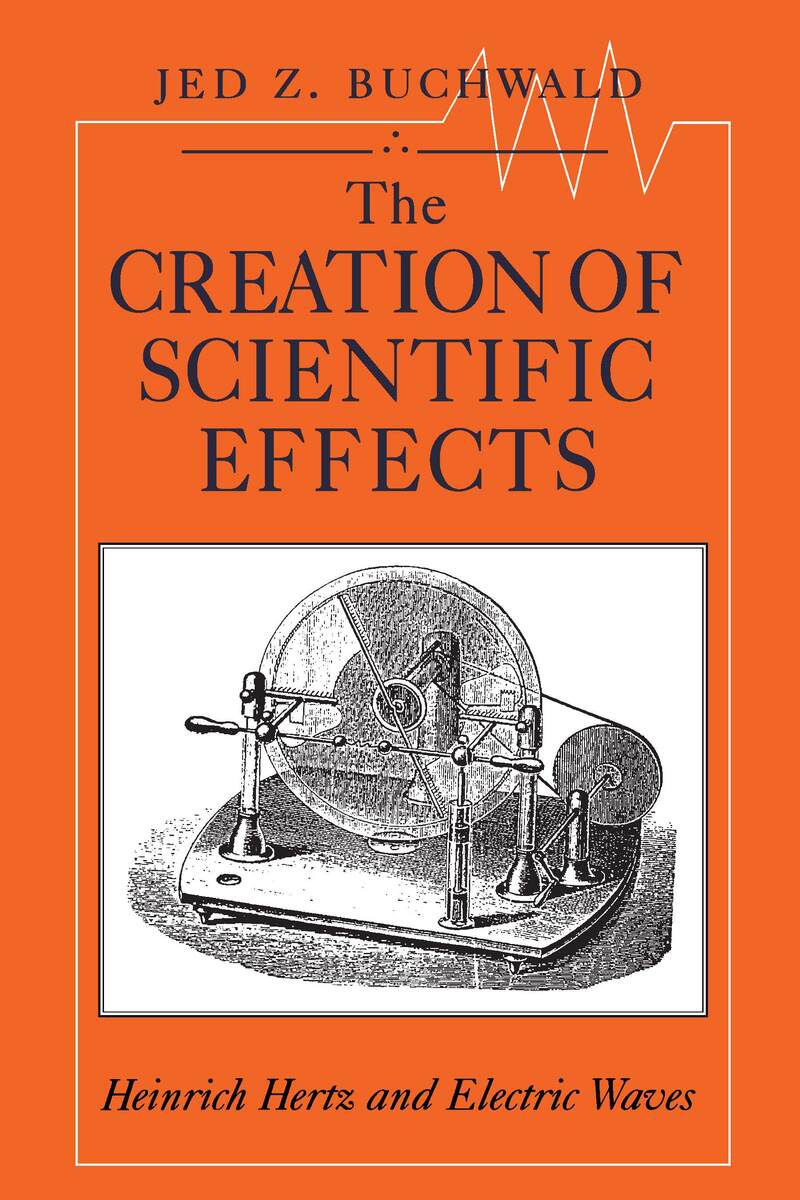
Drawing on the lab notes, published papers, and unpublished manuscripts of Heinrich Hertz, Buchwald recreates Hertz's 1887 invention of a device that produced electromagnetic waves in wires. The invention itself was serendipitous and the device was quickly transformed, but Hertz's early experiments led to major innovations in electrodynamics. Buchwald explores the difficulty Hertz had in reconciling the theories of other physicists, including Hermann von Helmholtz and James Clerk Maxwell, and he considers the complex and often problematic connections between theory and experiment.
In this first detailed scientific biography of Hertz and his scientific community, Buchwald demonstrates that tacit knowledge can be recovered so that we can begin to identify the unspoken rules that govern scientific practice.
TABLE OF CONTENTS
List of Figures
List of Tables
Preface
One: Introduction: Heinrich Hertz, Maker of Effects
Part One: In Helmholtz's Laboratory
Two: Forms of Electrodynamics
Three: Realizing Potentials in the Laboratory
Part Two: Information Direct from Nature
Four: A Budding Career
Five: Devices for Induction
Six: Hertz's Early Exploration of Helmholtz's Concepts
Part Three: Berlin's Golden Boy
Seven: Rotating Spheres
Eight: Elastic Interactions
Nine: Specific Powers in the Laboratory
Ten: The Cathode Ray as a Vehicle for Success
Part Four: Studying Books
Eleven: Frustration
Twelve: Hertz's Argument
Thirteen: Assumption X
Part Five: Electric Waves
Fourteen: A Novel Device
Fifteen: How the Resonator Became an Electric Probe
Sixteen: Electric Propagation Produced
Seventeen: Electric Waves Manipulated
Eighteen: Conclusion: Restraint and Reconstruction
Appendixes
1. Waveguides and Radiators in Maxwellian Electrodynamics
2. Helmholtz's Derivation of the Forces from a Potential
3. Helmholtz's Energy Argument
4. Polarization Currents and Experiment
5. Convection in Helmholtz's Electrodynamics
6. Instability in the Fechner-Weber Theory
7. Hertz's First Use of the General Helmholtz Equations
8. Hertz on the Induction of Polarization by Motion
9. Hertz on Relatively Moving, Charged Conductors
10. Elastic Bodies Pressed Together
11. Evaporation's Theoretical Limits
12. Hertz's Model for Geissler-Tube Discharge
13. Propagation in Helmholtz's Electrodynamics
14. Forces in Hertz's Early Experiments
15. Hertz's Quasi Field Theory for Narrow Cylindrical Wires
16. Considerations regarding the Possible Background to Helmholtz's New Physics
17. Poincaré and Bertrand
18. Difficulties with Charge and Polarization
Notes
Bibliography
Index