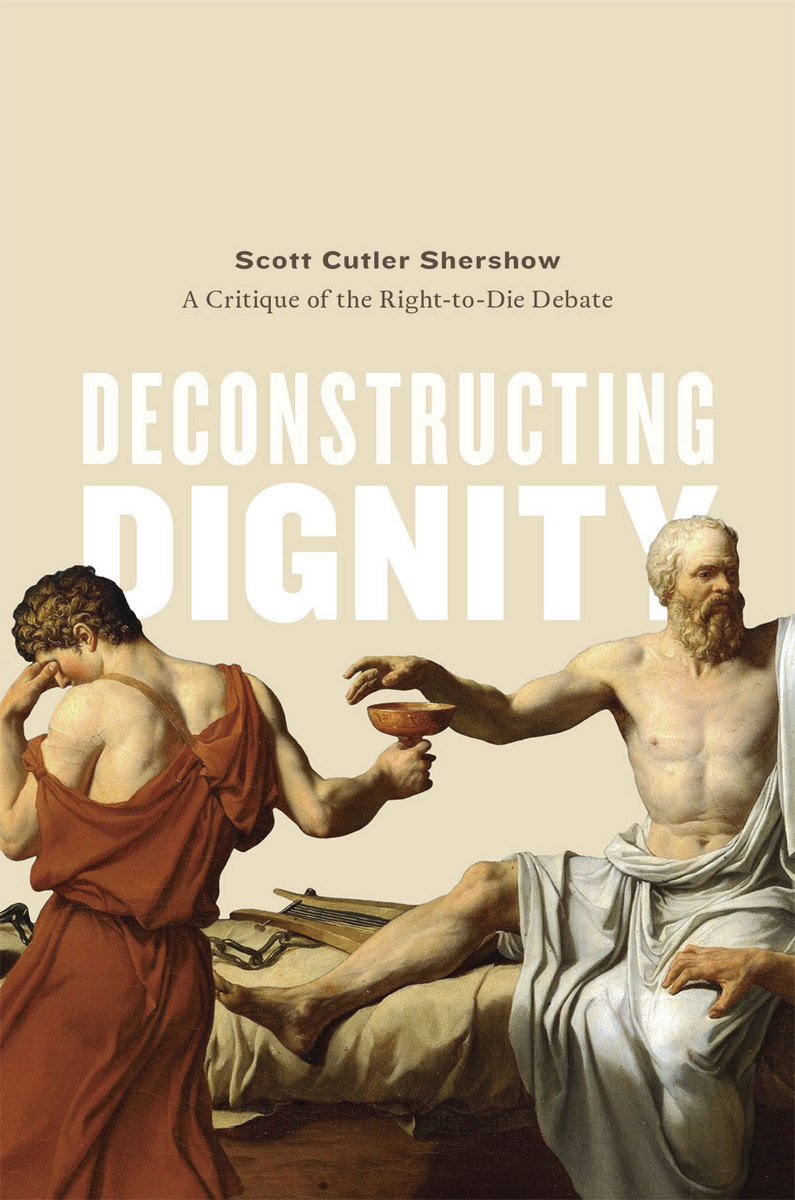
Deconstructing Dignity A Critique of the Right-to-Die Debate
by Scott Cutler Shershow
University of Chicago Press, 2013
Cloth: 978-0-226-08812-9 | Electronic: 978-0-226-08826-6
DOI: 10.7208/chicago/9780226088266.001.0001
ABOUT THIS BOOKAUTHOR BIOGRAPHYREVIEWSTABLE OF CONTENTS

ABOUT THIS BOOK

The right-to-die debate has gone on for centuries, playing out most recently as a spectacle of protest surrounding figures such as Terry Schiavo. In Deconstructing Dignity, Scott Cutler Shershow offers a powerful new way of thinking about it philosophically. Focusing on the concepts of human dignity and the sanctity of life, he employs Derridean deconstruction to uncover self-contradictory and damaging assumptions that underlie both sides of the debate.

Shershow examines texts from Cicero’s De Officiis to Kant’s Groundwork of the Metaphysics of Morals to court decisions and religious declarations. Through them he reveals how arguments both supporting and denying the right to die undermine their own unconditional concepts of human dignity and the sanctity of life with a hidden conditional logic, one often tied to practical economic concerns and the scarcity or unequal distribution of medical resources. He goes on to examine the exceptional case of self-sacrifice, closing with a vision of a society—one whose conditions we are far from meeting—in which the debate can finally be resolved. A sophisticated analysis of a heated topic, Deconstructing Dignity is also a masterful example of deconstructionist methods at work. 

AUTHOR BIOGRAPHY

Scott Cutler Shershow is professor of English at the University of California, Davis. He is the author of Puppets and ‘Popular’ Culture and The Work and the Gift, the latter published by the University of Chicago Press, and is also coeditor of Marxist Shakespeares. He lives in Davis, CA. 

REVIEWS

“Although, as Shershow says at the outset, he ‘for the most part refrain[s] from taking sides,’ he offers many incisive criticisms of ethical arguments. His approach gives rise to many new insights, and bioethicists can certainly learn a lot from this book.”
 
— Sigrid Sterckx, Times Higher Education

“Scott Cutler Shershow is engaged here in practical deconstruction of the highest order and most compelling kind. He argues, with terrific clarity, that the whole discourse we’ve inherited in the right-to-die debate has sought to divide reason between calculation and incalculability. This is the opposition that comes apart in Deconstructing Dignity. Through hyperacute readings from the tradition up to Ronald Dworkin and the contemporary debate, Shershow traces a fault line running beneath this whole discursive field. It’s thrilling to follow as he pries it apart, setting off innumerable tremblings and even earthquakes. This book does not just shift the debate; it turns it to face an utterly new, unknown direction, the only direction from which a future can come.”
— Peggy Kamuf, coeditor of the Seminars of Jacques Derrida series

Deconstructing Dignity is an excellent book. It is well conceived and wonderfully executed. It not only intervenes in this particular debate on the right to die but takes up important and long-standing concepts and problems in the history of philosophy and culture; it dismantles vapid truisms and opens onto the possibility of a thought of life—and death—that is not always already lost within life’s supposed dignity and sanctity.”
— David E. Johnson, University at Buffalo, SUNY

“In his moving final interview, Jacques Derrida worried that he and deconstruction itself would, upon his death, immediately begin to be forgotten by cultural memory and relegated to the archival dustbins of history. Scott Cutler Shershow’s rigorous deconstructive rereading of the right-to-die debate and the many competing philosophical, cultural, and legal discourses it has sponsored, demonstrates that, on the contrary, the legacy of Derridean deconstruction today continues to be inherited, extended, and reworked in the most urgent and creative forms imaginable. Deconstructing Dignity, like all of Shershow’s books, is a model of argumentative scrupulousness, critical vigilance, and circumspect erudition.”
— Gerhard Richter, Brown University

TABLE OF CONTENTS

- Scott Cutler Shershow
DOI: 10.7208/chicago/9780226088266.003.0001
[Jacques Derrida, Deconstruction, Sovereignty, Walter Benjamin, Justice]
This chapter surveys the texts of Jacques Derrida to outline a kind of deconstructive “method.” Deconstruction, which is fundamentally a thought of time and mortality, and a commitment to the endless interrogation of philosophic axioms and norms, is as such uniquely qualified as a way to approach both ancient and modern debates about a right to die. Deconstruction follows an “adventurous strategy,” a kind of protocol that does not, however, precede the discourse it governs, in order to reveal how philosophic debates are constituted in terms of a “violent hierarchy” of two opposed terms. Deconstructive thought first inverts these terms, and then shows how such inversion displaces the original hierarchy, allowing for the irruptive emergence of a new quasi-concept — and a way to think otherwise about the question at issue. (pages 1 - 28)
This chapter is available at:
    https://academic.oup.com/chica...

- Scott Cutler Shershow
DOI: 10.7208/chicago/9780226088266.003.0002
[Dignity, Death with Dignity, Sanctity of Life, Leon R. Kass]
This chapter considers the semantic structure of two abstractions, dignity and sanctity, both individually and in terms of their relation and potential opposition. In the contemporary debate about a right to die, one side claims to uphold an ideal of “death with dignity,” the other an ideal of “the sanctity of life.” Yet it proves to be impossible either to distinguish rigorously between dignity and sanctity or to force them into simple identity. Dignity appears in contemporary parlance to convey a triangle of meanings that are related but potentially distinct: worth or value, status or rank, and bearing or comportment. The idea of “the sanctity of life” similarly contains inherent contradictions and inconsistencies, not least because such a concept remains obviously at the command of a sovereign “right to death.” Partisans on both sides of the debate about a right to die are thus constantly forced to reclaim and redefine one or the other (or both) of these principles. (pages 29 - 40)
This chapter is available at:
    https://academic.oup.com/chica...

- Scott Cutler Shershow
DOI: 10.7208/chicago/9780226088266.003.0003
[Dignity, Sovereignty, Human rights]
Across the modern discourse of human rights, “human dignity” serves as the rubric for an ideal of individual freedom in its potential or actual antagonism with sovereign power. Yet the history and genealogy of both “dignity” and “sovereignty” shows that the two terms are intimately linked, both semantically and conceptually. A hypothetical individual “right to die” is thus finally inseparable from a sovereign “right to death.” Via a close analysis of a few classical and scriptural passages, the chapter observes how the concept of dignity appears always in need of a kind of supplement. For example, in contemporary parlance, especially in the discourse of human rights, the word “dignity” is almost always paired with “worth,” as though the word dignity is either not quite sufficient to state the value and status of humanity, or refers to a value that is more or different than simple worth. (pages 41 - 52)
This chapter is available at:
    https://academic.oup.com/chica...

- Scott Cutler Shershow
DOI: 10.7208/chicago/9780226088266.003.0004
[Human Dignity, Cicero, Aquinas, Pico de Mirandola, Shakespeare, Francis Bacon, Kant]
This chapter provides a selective genealogy of the concept of human dignity from its first appearance in Cicero’s De Officiis. Via brief consideration of texts by Boethius, Aquinas, Chaucer, Pico de Mirandola, Shakespeare, Francis Bacon and Kant, the chapter argues that dignity, throughout its long history, has always been a concept at once universal and exclusive, conditional and unconditional, and characterized by a strange relation of calculation and incalculability. (pages 53 - 84)
This chapter is available at:
    https://academic.oup.com/chica...

- Scott Cutler Shershow
DOI: 10.7208/chicago/9780226088266.003.0005
[Right to die, Euthanasia, Autonomy, Freedom of Choice, Assisted-Suicide, Death with Dignity, Leon R. Kass, Wesley J. Smith, Brian Clark, Whose Life Is it Anyway?, Paul Ramsey]
This chapter argues that the arguments on both sides of the debate about a right to die are characterized by unacknowledged contradictions, and in particular by a tension between the claims of calculation and incalculability. Those in favor of a right to die argue above all that such a right is the supreme expression of individual autonomy, freedom, and reasoned choice. They also, however, implicitly undermine this argument by also suggesting that the establishment of such a right would also conserve scarce medical resources. Those opposed to a right to die, similarly, argue above all for an unconditional principle of “always care, never kill.” But they also implicitly qualify this absolute principle by eschewing all possibility of reasoned choice, and arguing that even though some cases seem to justify a right to die, to allow even these will put on us on a “slippery slope” towards a “culture of death.” This side also undermines the principle of unconditional care even more fatally by yoking it to an ethics of the marketplace by which, in practice, such care would be distributed according to the vagaries of birth, employment and fortune. (pages 85 - 98)
This chapter is available at:
    https://academic.oup.com/chica...

- Scott Cutler Shershow
DOI: 10.7208/chicago/9780226088266.003.0006
[Suicide, Sacrifice, Plato, Phaedo, Durkheim, Locke, Kant, Doctrine of Double Effect]
This chapter further contextualizes the contemporary debate about a right to die by considering a few highlights of the philosophic approach to the question of suicide in general. Although nearly all major western philosophers argue that suicide is ethically impermissible, they commonly also allow a single exception: self-sacrifice. Thus an otherwise unconditional prohibition of suicide is commonly qualified by the possibility that some deaths may be recuperated as sacrificial value. The chapter elaborates this point via brief remarks on the modern sociological approach to suicide that begins with Durkheim, and then by considering Plato’s Phaedo, and texts by Locke and Kant. (pages 99 - 120)
This chapter is available at:
    https://academic.oup.com/chica...

- Scott Cutler Shershow
DOI: 10.7208/chicago/9780226088266.003.0007
[Samuel D. Williams, Binding and Hoche, Euthanasia, Doctrine of Double Effect, Cruzan v. Director, Ronald Dworkin, Robert P. George, Terry Schiavo, Karen Quinlan, John Protevi]
Building on previous chapters, this chapter argues that the whole debate about a right to die is pervaded, on both sides, by a logic of sacrificial calculation. This point is elaborated by consideration of a wide variety of texts: Samuel D. Williams’ “Euthanasia” (1870), Karl Binding and Alfred Hoche’s infamous Permitting the Destruction of Unworthy Life (1920), the “Declaration on Euthanasia” of the Catholic Church (1980), the U.S. Supreme Court’s decision in Cruzan v. Director, Missouri Department of Health (1990), Ronald Dworkin’s Life’s Dominion (1993), and several others. Among other points, arguments about euthanasia and its practical details prove to be inseparable from difficult questions of time and self-presence. (pages 121 - 162)
This chapter is available at:
    https://academic.oup.com/chica...

- Scott Cutler Shershow
DOI: 10.7208/chicago/9780226088266.003.0008
[Jacques Derrida, Deconstruction, Cloning, Georges Bataille, Death with Dignity, Assisted Suicide, euthanasia]
This chapter restates in a different way the relation of unconditional principle and rational calculation that the book has shown to be always central in debates about a right to die. As a preliminary example, the chapter considers Derrida’s remarks about cloning from Rogues. It goes on to argue that the calculation necessarily involved in choosing death would be something like what Bataille called the “restricted economy” of singular beings, who are necessarily bound to economic scarcity. The unconditioned principle to which such calculation finally opens would correspondingly be something like Bataille’s “general economy” of expenditure without return: the joyous affirmation with which one might embrace death as absolute negativity. The irruptive new quasi-concept that emerges from the deconstruction of the relation of calculation and the incalculable at the heart of this debate can thus be called a just care. Only by ensuring that all necessary medical attention is absolutely guaranteed to all, can one bring a practical rationality to the principle of “always care,” and make it possible to choose death in the radical absence of any other conditions. (pages 163 - 176)
This chapter is available at:
    https://academic.oup.com/chica...