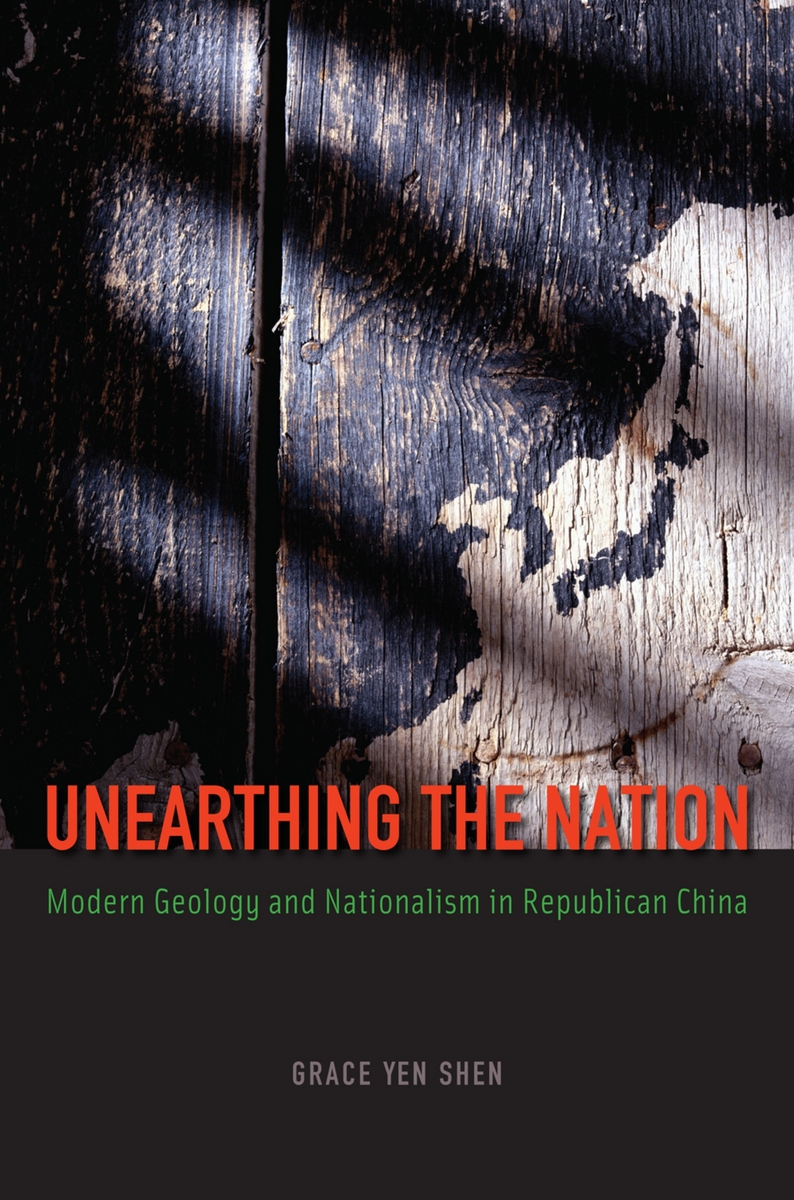
Unearthing the Nation
Modern Geology and Nationalism in Republican China
University of Chicago Press, 2014
Cloth: 978-0-226-09040-5 | Electronic: 978-0-226-09054-2
DOI: 10.7208/chicago/9780226090542.001.0001
Cloth: 978-0-226-09040-5 | Electronic: 978-0-226-09054-2
DOI: 10.7208/chicago/9780226090542.001.0001
AVAILABLE FROM
University of Chicago Press (cloth, ebook)Amazon Kindle
Apple Books
Barnes & Noble Nook
Brytewave (CafeScribe-Follett Higher Ed)
Chegg Inc
Copia Interactive
DeGruyter Multi-User Ebook Program
ebrary
EBSCO eBooks (formerly NetLibrary)
Google Play
Kno
University Press Scholarship Online (UPSO)
ABOUT THIS BOOKAUTHOR BIOGRAPHYREVIEWSTABLE OF CONTENTS
ABOUT THIS BOOK
Questions of national identity have long dominated China’s political, social, and cultural horizons. So in the early 1900s, when diverse groups in China began to covet foreign science in the name of new technology and modernization, questions of nationhood came to the fore. In Unearthing the Nation, Grace Yen Shen uses the development of modern geology to explore this complex relationship between science and nationalism in Republican China.
Shen shows that Chinese geologists—in battling growing Western and Japanese encroachment of Chinese sovereignty—faced two ongoing challenges: how to develop objective, internationally recognized scientific authority without effacing native identity, and how to serve China when China was still searching for a stable national form. Shen argues that Chinese geologists overcame these obstacles by experimenting with different ways to associate the subjects of their scientific study, the land and its features, with the object of their political and cultural loyalties. This, in turn, led them to link national survival with the establishment of scientific authority in Chinese society.
The first major history of modern Chinese geology, Unearthing the Nation introduces the key figures in the rise of the field, as well as several key organizations, such as the Geological Society of China, and explains how they helped bring Chinese geology onto the world stage.
The first major history of modern Chinese geology, Unearthing the Nation introduces the key figures in the rise of the field, as well as several key organizations, such as the Geological Society of China, and explains how they helped bring Chinese geology onto the world stage.
AUTHOR BIOGRAPHY
Grace Yen Shen is assistant professor of Chinese history at Fordham University.
REVIEWS
“Unearthing the Nation is more than a scientific history. Shen’s in-depth analysis reveals that national, political, and cultural loyalties had a key role in the development of Chinese geology, and she seamlessly integrates this into her narrative on the discoveries and evolution of the field. . . . [T]his is an important book: it presents a comprehensive history of Chinese geology while demonstrating the discipline’s unique pattern of development.”
— Xu Xing, Nature“If you want a nice, short, well-written book that explains the birth of a modern science in China and why it matters, this is a good choice.”
— Alan Baumler, Indiana University of Pennsylvania, Frog in a Well“A groundbreaking study, Unearthing the Nation examines the development of the field of modern geology in early twentieth-century China. It deftly shows how Chinese geologists explored new relationships between man and land, navigated the shifting terrain of early twentieth-century politics, and delved into the unexpected opportunities of wartime China when military exigencies opened up the hinterland for exploration. Like the physical land that China’s modern geographers encountered in their fieldwork, the book is a fascinating read and exposes readers to the ever-changing landscape of modern Chinese science, its relationship with global geography, and Republican era politics.”
— Eugenia Lean, Columbia University
“Grace Yen Shen’s Unearthing the Nation is a rich, innovative, and finely crafted historical study of Chinese geology and society during the Republican period. It creatively combines political history, cultural analyses, and the history of science in tracing the development of the Chinese geoscientific community and related institutions, with special attention to the transnational dimensions of the enterprise. It will be recognized as a major contribution not only to the history of Chinese geology but also to modern Chinese history and the history of modern science in general.”
— Zuoyue Wang, California State Polytechnic University, Pomona“A lucid and original account of geology that gainsays the long-standing view of science in China as passive and inert. Instead, Grace Yen Shen grants early Chinese geologists the intellectual acumen to grasp the implications of their work in scientific, political, and social terms. They not only forged a new field of geology but also created a new scientific community of geologists, which envisioned a new China below the earth that was worth saving.”
— Benjamin A. Elman, author of A Cultural History of Modern Science in China
“In charting the evolution of geology and the geological community in China, Unearthing the Nation offers a portrait of modern China in miniature and a provocative interpretation of the interplay between science, nationalism, and modernity. The book is an engaging read—rich, nuanced, and elegantly written. It also bristles with insights and ideas. An excellent and long overdue study of the most important scientific discipline in early twentieth-century China.”
— Fa-ti Fan, Binghamton University
"This book provides a context and narrative for the main players, journals, and associations for geology in Republican China. The research is copious and Shen has made a genuine contribution by linking key players with narrative facility."
— Journal of East Asian StudiesTABLE OF CONTENTS
Introduction - Grace Yen Shen
The Lay of the Land: Territoriality, Foreign Exploration, and Modern Geology in Qing China - Grace Yen Shen
Shaping the Field: Fieldwork and the Creation of the Modern Chinese Geologist - Grace Yen Shen
A Host of Nations: Cosmopolitanism and the Geological Society of China - Grace Yen Shen
The Nanjing Decade: Geological Expansion and the State - Grace Yen Shen
Resistance and Reconstruction: Emergence of a Domestic Community - Grace Yen Shen
Conclusion - Grace Yen Shen