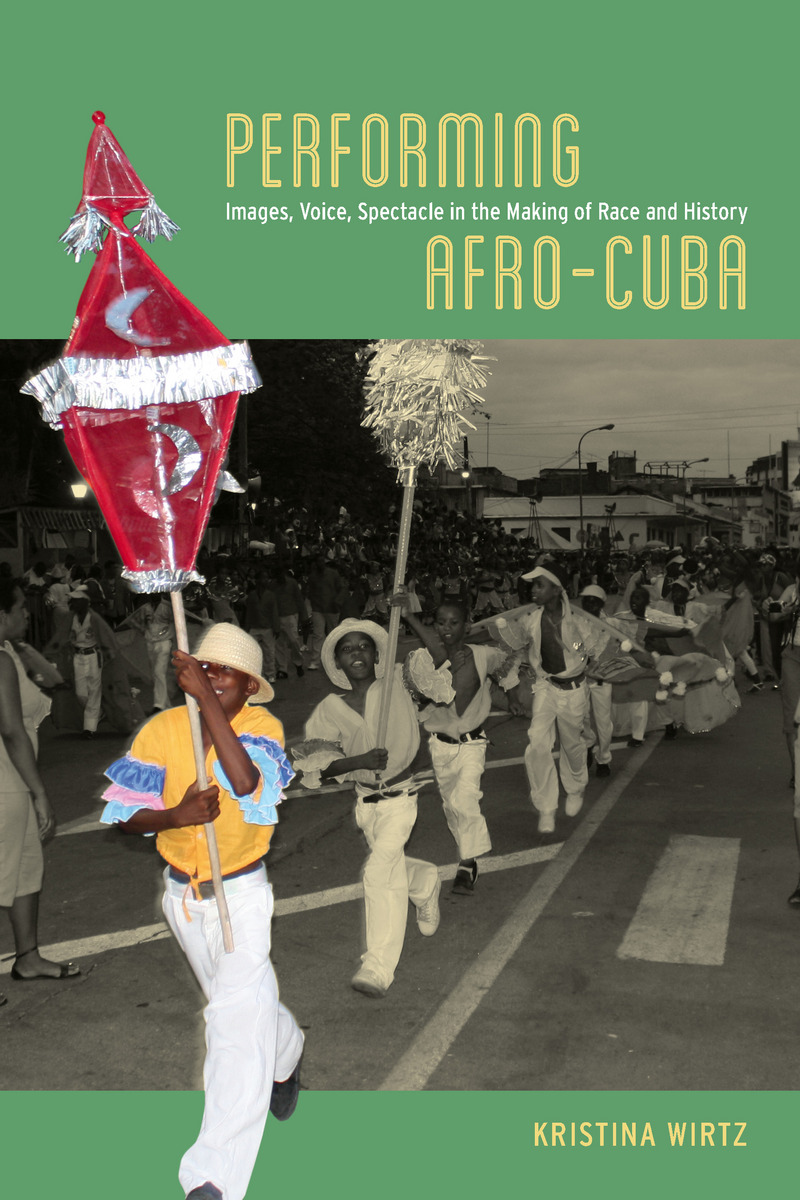
Performing Afro-Cuba
Image, Voice, Spectacle in the Making of Race and History
University of Chicago Press, 2014
Cloth: 978-0-226-11886-4 | Paper: 978-0-226-11905-2 | Electronic: 978-0-226-11919-9
DOI: 10.7208/chicago/9780226119199.001.0001
Cloth: 978-0-226-11886-4 | Paper: 978-0-226-11905-2 | Electronic: 978-0-226-11919-9
DOI: 10.7208/chicago/9780226119199.001.0001
AVAILABLE FROM
University of Chicago Press (cloth, paper, ebook)Amazon Kindle
Barnes & Noble Nook
Brytewave (CafeScribe-Follett Higher Ed)
Chegg Inc
Copia Interactive
ebrary
EBSCO eBooks (formerly NetLibrary)
Google Play
Kno
Kobo
ABOUT THIS BOOKAUTHOR BIOGRAPHYREVIEWSTABLE OF CONTENTS
ABOUT THIS BOOK
Visitors to Cuba will notice that Afro-Cuban figures and references are everywhere: in popular music and folklore shows, paintings and dolls of Santería saints in airport shops, and even restaurants with plantation themes. In Performing Afro-Cuba, Kristina Wirtz examines how the animation of Cuba’s colonial past and African heritage through such figures and performances not only reflects but also shapes the Cuban experience of Blackness. She also investigates how this process operates at different spatial and temporal scales—from the immediate present to the imagined past, from the barrio to the socialist state.
Wirtz analyzes a variety of performances and the ways they construct Cuban racial and historical imaginations. She offers a sophisticated view of performance as enacting diverse revolutionary ideals, religious notions, and racial identity politics, and she outlines how these concepts play out in the ongoing institutionalization of folklore as an official, even state-sponsored, category. Employing Bakhtin’s concept of “chronotopes”—the semiotic construction of space-time—she examines the roles of voice, temporality, embodiment, imagery, and memory in the racializing process. The result is a deftly balanced study that marries racial studies, performance studies, anthropology, and semiotics to explore the nature of race as a cultural sign, one that is always in process, always shifting.
Wirtz analyzes a variety of performances and the ways they construct Cuban racial and historical imaginations. She offers a sophisticated view of performance as enacting diverse revolutionary ideals, religious notions, and racial identity politics, and she outlines how these concepts play out in the ongoing institutionalization of folklore as an official, even state-sponsored, category. Employing Bakhtin’s concept of “chronotopes”—the semiotic construction of space-time—she examines the roles of voice, temporality, embodiment, imagery, and memory in the racializing process. The result is a deftly balanced study that marries racial studies, performance studies, anthropology, and semiotics to explore the nature of race as a cultural sign, one that is always in process, always shifting.
AUTHOR BIOGRAPHY
Kristina Wirtz is associate professor of anthropology at Western Michigan University. She is the author of Ritual, Discourse, and Community in Cuban Santería.
REVIEWS
“Performing Afro-Cuba is remarkable achievement. To put Wirtz’s argument in a nutshell would be to do a gross injustice to her sophisticated—and often quite elegant—exposition. She is simply the smartest and theoretically most sophisticated anthropologist doing research in Cuba these days. But aside from her contribution to the regionalist literature, the real value of her work is that it speaks to enduring anthropological questions, while raising a number of new ones that are relevant far beyond her specific field site. I enthusiastically recommend it.”
— Stephan Palmié, author of The Cooking of History: How Not to Study Afro-Cuban Religion“Performing Afro-Cuba is a careful and precise anthropology of history making, a study of the effortful cultural work and highly structured theater of relations out of which the Cuban racial order was and is still, perhaps more forcefully than ever, being made and remade. Compact, well-argued, it is utterly engrossing. It attacks a familiar issue in an original way, and it does so with a strong theoretical frame rendered in an approachable writing style.”
— Paul Christopher Johnson, University of Michigan“Performing Afro-Cuba is a masterful exploration of figurations of race and dialogues of racialization in Cuba. I learned a great deal from this challenging work, especially from Wirtz’s productive expansions of the notions of register and chronotope. The book is analytically powerful and richly engaged; Wirtz’s own voice is a sensitively reflexive part of the polyphonic dialogues she traces through Cuban history, social life, and cultural performance.”
— Richard Bauman, Indiana University“A thoughtful and timely study that locates race in Cuba through performance studies and ethnography. . . . It expands the boundaries of the anthropological study of religion by questioning the very paradigms of inquiry and temporality that locate the ethnographic subject. That is, Wirtz’s study moves us away from the exotic tropes that often create an ethnographic present and into a complexly situated racial terrain. Her focus on Santiago de Cuba is also a welcome gesture away from Havana-oriented studies of Cuban culture, religion, and society. Indeed, the book helps readers to negotiate Cuban pageantry within broader Caribbean and Atlantic traditions that perform race in multi-faceted ways. . . . Wirtz’s work should inspire further investigations of transnational, especially Caribbean and Atlantic, enactments of historical memory and race in carnival. These final considerations are a testament to Wirtz’s substantial achievement in Performing Afro-Cuba where she gets readers to consider race and performance in ways that are expansive, critical, and illuminating.”
— Journal of Folklore Research"Performing Afro-Cuba offers an important read on the semiotic contours of race and folkloric spectacle in eastern Cuba and marks an important contribution to broader folklore studies."
— American AnthropologistTABLE OF CONTENTS
Agradecimientos
List of Illustrations
1. Semiotics of Race and History
2. Image-inations of Blackness
3. Bodies in Motion: Routes of Blackness in the Carnivalesque
4. Voices: Chronotopic Registers and Historical Imagination in Cuban Folk Religious Rituals
5. Pride: Singing Black History in the Carabalí Cabildos
6. Performance: State-Sponsored Folklore Spectacles of Blackness as History
7. Brutology: The Enregisterment of Bozal, from “Blackface” Theater to Spirit Possession
Notes
References Cited
Index