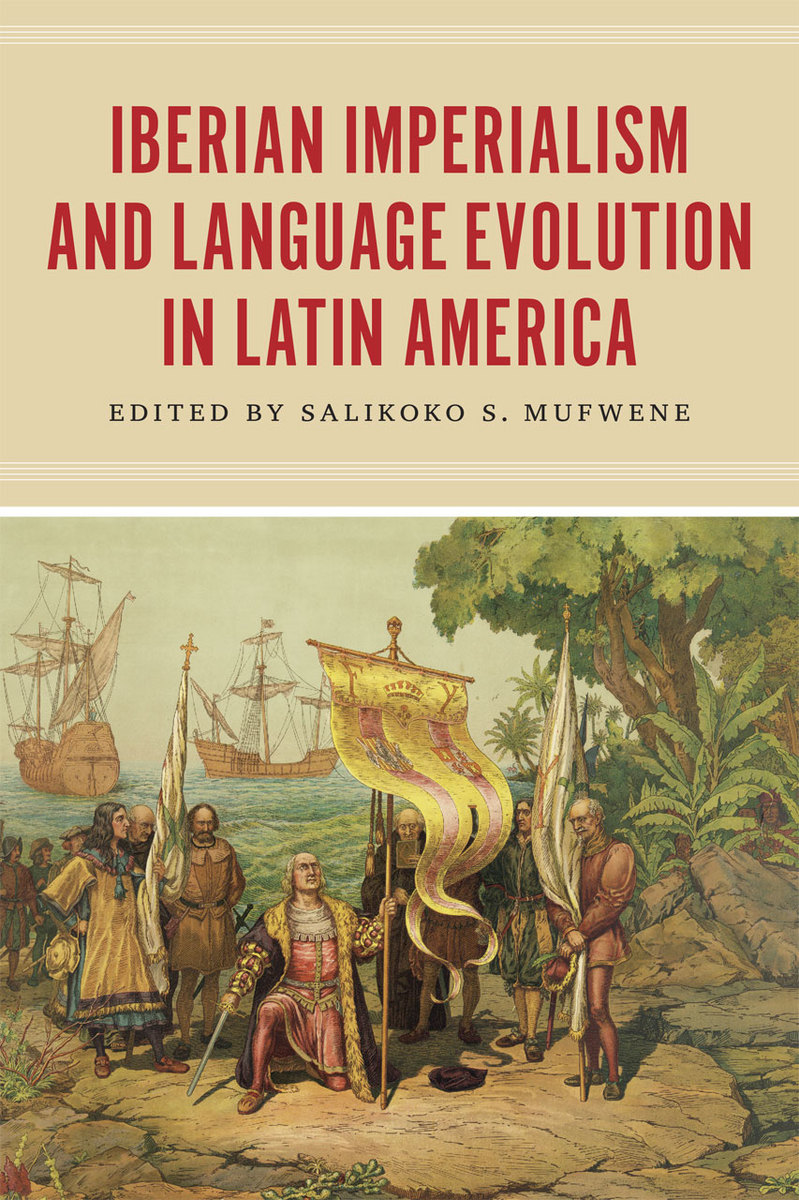
TABLE OF CONTENTS
Latin America: A Linguistic Curiosity from the Point of View of Colonization and the Ensuing Language Contacts - Salikoko S. Mufwene
DOI: 10.7208/chicago/9780226125671.003.0001
[Colonization, slaves, sugar, gold, creoles, pidgins, language endangerment, language evolution, speciation, autonomization]
Portugal and Spain engaged in the effective colonization of the New World at least 100 years before England, France, and Holland did. The Portuguese started producing sugar on the industrial scale in Brazil also way before the English, the French, and their Dutch did in their tropical colonies. Brazil imported more slaves than all the other colonies combined; and, along with Cuba and the Dominican Republic, it abolished slavery only in the late 19th century. Yet, Iberian Latin America has produced no creole other than the Spanish-based Palenquero, which emerged indisputably among Maroon slaves, and the largely Portuguese-based Papiamentu, which is associated with the Netherlands Antilles. What can Latin America teach us, even if only negatively, about the ecological conditions that produce creoles? What can it also teach us about the survival of indigenous languages after the colonists contributed to the attrition of Native Americans both by miscegenation and by the genocides committed especially by the Spaniards during the early stages of colonization? From a language evolution perspective, what are the critical differences between the colonization of the New World by the Iberians and by the other European nations? (pages 1 - 37)
This chapter is available at:
https://academic.oup.com/chica...
The Many Facets of Spanish Dialect Diversification in Latin America - John M. Lipski
DOI: 10.7208/chicago/9780226125671.003.0002
[Spanish dialectology, language contact, urban sociolinguistics]
This study examines the factors that are primarily responsible for Spanish American dialect diversification over the past five centuries. Three main forces shaped the evolution of Latin American Spanish: regional Peninsular dialect traits brought by Spanish settlers, contact with other languages (indigenous as well as voluntary and involuntary immigrant languages), and emergent dialect features catalyzed by the rise of urban nuclei in colonial Spanish America. The role of Spanish Peninsular dialects is weighed in terms of the “founder principle” that attributes to the first settlers a long-lasting influence on subsequent linguistic evolution. A chronological comparison of changes occurring in Spain and Spanish America effectively brackets possible founder effects, while an examination of the demographic growth of colonial cities is correlated with the emergence of uniquely Latin American Spanish features. Language contact and the persistence of interlanguage varieties produced such phenomena as double possessives, object clitic doubling, cryto-evidential marking through the use of Spanish verb tenses, and unique intonational configurations. (pages 38 - 75)
This chapter is available at:
https://academic.oup.com/chica...
Amerindian Language Islands in Brazil - Hildo Honório do Couto
DOI: 10.7208/chicago/9780226125671.003.0003
[Ecolinguistics, language islands, Língua Geral, language death, colonization]
Using ecolinguistics as a framework for language contact, this essay begins by showing that the arrival of the Europeans in the territory of present-day Brazil pushed the autochthonous peoples to the condition of small enclaves, forming what in German dialectology is called “language islands.” First, a brief history and definition of this term is given. Second, there is an overview of the linguistic situation before the arrival of the Portuguese. Third, from their arrival on, two varieties of a Tupi-based lingua franca called Língua Geral ‘general language’ emerged which served as a means of communication between Europeans and Natives speaking diverse mutually unintelligible languages, as well as between the Natives themselves. Fourth, we see that around 1000 languages out of the roughly 1200 that existed before the European invasion died out in about 500 years, i.e., two languages per year. The almost 200 remaining ones are obsolescent or moribund, even those that were enclosed in reservations, not counting a few small groups that may still be spoken in the interior of the Amazon jungle. The general conclusion is that the colonization of Brazil by Europeans was devastating for native peoples and their respective languages. (pages 76 - 107)
This chapter is available at:
https://academic.oup.com/chica...
Historical Development of Nheengatu (Língua Geral Amazônica) - Denny Moore
DOI: 10.7208/chicago/9780226125671.003.0004
[Nheengatu, Língua Geral Amazônica, Brasílica, Tupinambá, language contact, substratum effects, linguistic borrowing]
The indigenous Tupian language spoken on the east coast of Brazil by the Tupinambá and other tribes at the time of contact by Europeans spread through the early colony of Brazil, becoming known as the Brasílica. This language was an instrument in the conquest of Amazonia by Jesuits, colonial officials, and colonists, beginning in the 17th century. Its evolution over centuries was driven by economics, politics, religious expansionism, demography, geography, and technological change. Its adoption by speakers of other indigenous languages, including tribes that were ‘descended’ into captivity or semi-captivity, resulted in very rapid change in the language due to substratum effects. Lexical and grammatical borrowings from Portuguese increased in the last 120 years of the history of the language, by then known as Nheengatu or Língua Geral Amazônica. There was some model replication and structural diffusion from Portuguese occurring over the centuries. A brief sketch of the modern language is presented, with attention to the language contact effects exhibited in its structure. Aside from the Nheengatu dialect of the Upper Rio Negro, there are other dialects of the language and these are a priority for documentation. (pages 108 - 142)
This chapter is available at:
https://academic.oup.com/chica...
Language and Conquest: Tupi-Guarani Expansion in the European Colonization of Brazil and Amazonia - M. Kittiya Lee
DOI: 10.7208/chicago/9780226125671.003.0005
[lingua franca, inter-ethnic relations, Língua Geral, Tupi-Guarani, colonial history, colonization]
This chapter provides the historical context for understanding the early development of the language known to colonial writers and observers as the Brasílica and referenced in linguistic and historical scholarship as the Língua Geral of Brazil. It examines the colonial-era relations between Tupi-Guarani Indians and the Portuguese and other Europeans in Brazil and Amazonia. It begins with an ethnohistorical analysis of a 1519 vocabulary in order to illustrate the nature and linguistic range of initial inter-ethnic communication. The characteristics evident in this early encounter are then viewed over the longue durée of three centuries (1500-1800) to suggest that the language family shaped inter-ethnic affairs – including linguistic communication – because of a distinct Tupi-Guarani ethos of engagement with European and non-Tupi-Guarani indigenous outsiders. (pages 143 - 167)
This chapter is available at:
https://academic.oup.com/chica...
African Descendants’ Rural Vernacular Portuguese and Its Contribution to Understanding the Development of Brazilian Portuguese - Heliana Mello
DOI: 10.7208/chicago/9780226125671.003.0006
[Vernacular Brazilian Portuguese, contact, diversity, Quilombos]
This chapter discusses sociohistorical and linguistic factors that might have contributed to shaping vernacular Brazilian Portuguese. Data from an Afro-Brazilian community are analysed, taking into consideration divergent features in relation to standard Brazilian Portuguese which lead to the conclusion that vernacular BP is made up of a continuum of varieties, in which none can be named a creole. (pages 168 - 185)
This chapter is available at:
https://academic.oup.com/chica...
Brazilian Portuguese and the Ecology of (Post-)Colonial Brazil - J. Clancy Clements
DOI: 10.7208/chicago/9780226125671.003.0007
[Vernacular Brazilian Portuguese (VBP), VBP traits, Brazilian population distribution, sugar plantations, Africans in Brazil, homesteads, slaves, mining census data]
Vernacular Brazilian Portuguese (VBP) can be characterized by a variety of phonological and morpho-syntactic traits (13 are identified) that are rare to non-existent in Vernacular European Portuguese, or are only found in certain dialects in Portugal. This study accounts for the innovations in VBP by invoking the distribution of African and European populations in Brazil. From the 16th to the end of the 18th century, a vast number of slaves were transported to Brazil. In the late 19th and early 20th centuries, Blacks and Pardos made up well over half of the total population, and the Norte, Nordeste, and Leste regions had an especially dominant presence of Blacks and Pardos. Consequently, African-language features were arguably more strongly represented and there were additional innovations triggered by large-scale second language learning. Although the restructuring processes undergone by VBP have been admittedly complex, one key aspect of the propagation of the innovations in VBP has arguably been the presence of a diverse and heterogeneous linguistic feature pool, which is due to the strong presence in Brazil of Africans and their descendants over the last three and a half centuries. (pages 186 - 204)
This chapter is available at:
https://academic.oup.com/chica...
Maya and Spanish in Yucatán: An Example of Continuity and Change - Barbara Pfeiler
DOI: 10.7208/chicago/9780226125671.003.0008
[Maya, Yucatan, bilingualism, borrowing, socioeconomic ecology, migration, linguistic centrism]
This chapter addresses the question of language coexistence and change in the Mexican state of Yucatan, where the highest proportion of bilingualism of an indigenous language and Spanish has been registered. The efforts to spread Spanish in Yucatan started only after the 19th century, allowing a continuous use of the Maya language but also mutual borrowings into the structures of both languages. While Maya has contributed to making the local/regional variety of Spanish singular in comparison to other Mexican Spanish varieties, the extent of the influence of Spanish onto the Mayan language can be correlated with the duration and intensity of contact with Spanish. Although Maya has survived the competition of Spanish to date, new socioeconomic ecologies, migration, and linguistic centralism account for the spread of Spanish as a vernacular language across the peninsula of Yucatan, which encourages Mayan parents to transmit Spanish as a mother tongue, instead of Maya. (pages 205 - 224)
This chapter is available at:
https://academic.oup.com/chica...
Standard Colonial Quechua - Alan Durston
DOI: 10.7208/chicago/9780226125671.003.0009
[Quechua, Andes, Spanish colonialism, standardization, language shift]
This chapter examines how Spanish rule in Andes affected the Quechua language family, especially via the rise and spread of new, colonial varieties. In particular, it examines the history of Standard Colonial Quechua, a written standard developed by the Peruvian church as a pastoral medium. Although widely used, it was restricted to specific contexts and cannot be considered a lingua franca in the usual sense. (pages 225 - 243)
This chapter is available at:
https://academic.oup.com/chica...
Linguistic Subjectivity in Ecologies of Amazonian Language Change - Christopher Ball
DOI: 10.7208/chicago/9780226125671.003.0010
[subjectivity, language ideology, Vaupés, Upper Xingu]
Variability in cultural ideologies of subjectivity is linked to language, specifically to the ways in which ethnolinguistic differences are socially mobilized and territorialized. I compare different indigenous ideologies of linguistic subjectivity within Amazonia through an examination of two multilingual language and culture areas: the Vaupés or Upper Rio Negro and the Upper Xingu. I show that their populations harbor differing cultural assumptions. Those in the Vaupés value the benefits of plurilingualism, whereas those in the Upper Xingu adhere to monolingualism. I argue that these differences in ideological understandings of the speaking subject have affected the development of these speech communities in divergent ways. Such processes are entwined in the ecology of language evolution. (pages 244 - 273)
This chapter is available at:
https://academic.oup.com/chica...
The Ecology of Language Evolution in Latin America: A Haitian Postscript toward a Postcolonial Sequel - Michel Degraff
DOI: 10.7208/chicago/9780226125671.003.0011
[Creole Exceptionalism, Creole languages, Haiti, Haitian Creole, Indigenous languages, education for all, language change, language contact, language endangerment, social justice]
How can studies of language change in Iberian America help us better understand related phenomena in the Caribbean, and vice-versa? I raise some fundamental issues about language contact and its linguistic, cultural and socio-political consequences in Latin America, alongside challenging questions regarding the relationship between power and the production of knowledge in and about Latin America. These issues conjure up the foundations and politics of Creole studies and of education in Haiti. Here, Haiti serves as a spectacular case study to probe the effects of (neo-)colonialism on language diversification, vitality and endangerment throughout Latin America. Rejecting Creole Exceptionalism (i.e., the dogma that Creole languages are exceptional languages on either developmental or structural grounds), I compare Haitian Creole with its counterparts in continental Latin America, particularly Amerindian languages. This exercise sheds new light on the common socio-historical roots of various myths about Creole and Indigenous languages. I then consider how the past can help us analyze, then deconstruct, some of the racially- and ethnically-based hierarchies in Latin America. I conclude with a plea for a North-South collaboration among linguists and, also, between the latter and educators—collaboration toward social justice through quality education for all in Latin America and beyond. (pages 274 - 328)
This chapter is available at:
https://academic.oup.com/chica...