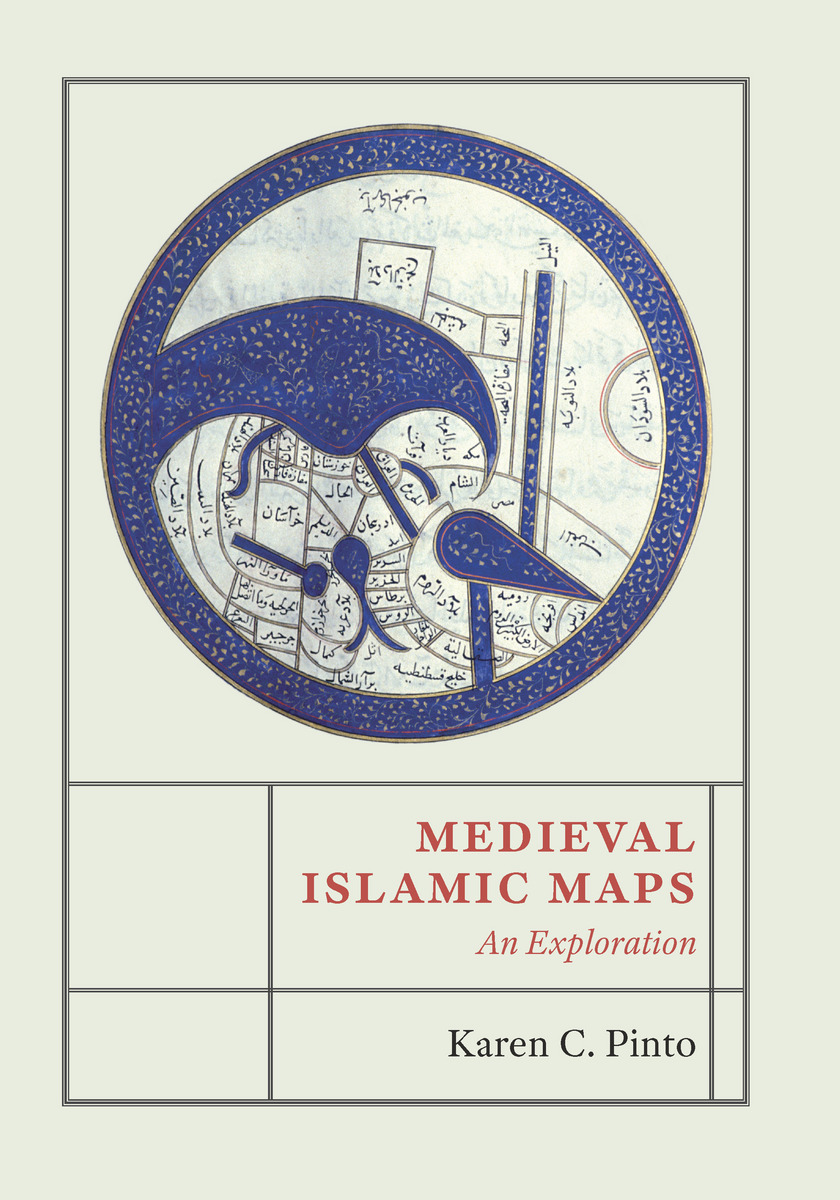
Medieval Islamic Maps
An Exploration
University of Chicago Press, 2016
Cloth: 978-0-226-12696-8 | Electronic: 978-0-226-12701-9
DOI: 10.7208/chicago/9780226127019.001.0001
Cloth: 978-0-226-12696-8 | Electronic: 978-0-226-12701-9
DOI: 10.7208/chicago/9780226127019.001.0001
AVAILABLE FROM
University of Chicago Press (cloth, ebook)DeGruyter Multi-User Ebook Program
EBSCO eBooks (formerly NetLibrary)
University Press Scholarship Online (UPSO)
ABOUT THIS BOOKAUTHOR BIOGRAPHYREVIEWSTABLE OF CONTENTS
ABOUT THIS BOOK
Hundreds of exceptional cartographic images are scattered throughout medieval and early modern Arabic, Persian, and Turkish manuscript collections. The plethora of copies created around the Islamic world over the course of eight centuries testifies to the enduring importance of these medieval visions for the Muslim cartographic imagination. With Medieval Islamic Maps, historian Karen C. Pinto brings us the first in-depth exploration of medieval Islamic cartography from the mid-tenth to the nineteenth century.
Pinto focuses on the distinct tradition of maps known collectively as the Book of Roads and Kingdoms (Kitab al-Masalik wa al-Mamalik, or KMMS), examining them from three distinct angles—iconography, context, and patronage. She untangles the history of the KMMS maps, traces their inception and evolution, and analyzes them to reveal the identities of their creators, painters, and patrons, as well as the vivid realities of the social and physical world they depicted. In doing so, Pinto develops innovative techniques for approaching the visual record of Islamic history, explores how medieval Muslims perceived themselves and their world, and brings Middle Eastern maps into the forefront of the study of the history of cartography.
Pinto focuses on the distinct tradition of maps known collectively as the Book of Roads and Kingdoms (Kitab al-Masalik wa al-Mamalik, or KMMS), examining them from three distinct angles—iconography, context, and patronage. She untangles the history of the KMMS maps, traces their inception and evolution, and analyzes them to reveal the identities of their creators, painters, and patrons, as well as the vivid realities of the social and physical world they depicted. In doing so, Pinto develops innovative techniques for approaching the visual record of Islamic history, explores how medieval Muslims perceived themselves and their world, and brings Middle Eastern maps into the forefront of the study of the history of cartography.
AUTHOR BIOGRAPHY
Karen C. Pinto is assistant professor of Islamic and Middle Eastern history at Boise State University.
REVIEWS
“Medieval Islamic Maps is a project of great value and importance: it uses maps as documents of political and cultural history and relates them to changes in other arts. Pinto displays profound knowledge of her sources, excellent contextual awareness, indefatigable scholarship, a keen eye for evidence, suppleness in thought, and fluency in expression. She situates her maps against intercultural influences, political circumstances, and agendas of mapmakers and patrons. Her approach is markedly original compared with existing works, which tend to focus on the technical aspects of cartography. Reading Medieval Islamic Maps is a rich and rewarding experience, and any scholar interested in Islam, cartography, or historiography should take notice of this fine work.”
— Felipe Fernández-Armesto, University of Notre Dame“Written with a clear and compelling voice, Medieval Islamic Maps illuminates the history and significance of centuries of medieval Islamic cartography. Pinto includes an abundance of fascinating maps throughout, coaxing the reader into a thorough understanding of them through her use of a Google Earth distortion. One of the most fascinating themes of the book, which shows both depth and breadth, is Pinto’s demonstration of how the KMMS mapping tradition—the most widely circulating and longest living cartographic template—became more stylized and less representative over the centuries to finally emerge as an objet d’art. She does this while simultaneously tracing how it intersected with the Western cartographic tradition in one of its afterlives. With a gradual development of her arguments in short, concise chapters, Pinto offers an absorbing—and much-needed—exploration of Middle Eastern cartography that will be an essential addition in the next textbook on Islamic history.”
— Dana Sajdi, Boston College“In Medieval Islamic Maps, Pinto makes an underappreciated and misunderstood genre of historical source very accessible and understandable. Drawing impressively on Arabic, Ottoman, and Persian sources, she guides the reader through key issues relating to their interpretation, and situates them in their cultural, historical, and geographical contexts. It is a work of great originality and importance.”
— Brian Catlos, University of Colorado Boulder"Through excellent research in multilingual (Arabic, Persian, and Turkish) primary and secondary resources, Pinto provides a significantly original, detailed, and compelling in-depth assessment of medieval Islamic cartography from the mid-10th to the 19th century. The author focuses on a ninth-century tradition of maps known collectively as the Kitab al-Masalik wa al-Mamalik, or Book of Roads and Kingdoms, by the Persian geographer Ibn Khordadbeh, and Greek history (notably Ptolemy) from the perspectives of iconography, context, and patronage. In 13 chapters augmented by 150 superb (mostly color) illustrations, 741 scholarly notes, and 686 bibliographic references, she examines these Muslim maps as documents of political and cultural history from a broad humanities context and demonstrates the intersection with Western cartography. Tracing the inception and evolution of these maps, Pinto analyzes them to uncover the identities of their creators, painters, and patrons. Incredibly valuable for research in cartography, historiography, and Islamic studies.This unique compendium is a 'must acquisition for scholars and major libraries. Essential."
— Choice"Pinto's book is well-researched and provides a number of excellently reproduced, beautiful illustrations. One must be grateful for her extensive library research and the photographs she has made of rare world maps that are normally hard to see. The University of Chicago Press has done a magnificent job with the illustrations."
— Imago Mundi"Books on Islamic maps can be counted on the fingers of one hand, and this volume is a very important addition to a fledgling field."
— Journal of Historical Geography"Pinto’s analysis shows how KMMS maps can be used as alternate gateways into the Islamic history of cartography. It is stimulating to see how this corpus of maps, until now largely neglected—unlike Ptolemaic cartography and its later developments—and considered of little significance to the study of the history of science, is now considered as relevant material for cartographic and historical studies."
— Speculum"The book is lavishly illustrated; most maps are reproduced in high-quality color copy, many photographed by the author. Some maps are made available in print for the first time....Pinto is painstaking with regard to visual details of map ideography and decoration, while expressing hope that art historians will turn their attention to illustrations in scientific manuscripts (248). Her work is both meticulous and imaginative – truly an exploration."
— Peregrinations: Journal of Medieval Art and Architecture"The book is well written and easy to folow. The research is excellent ...What really stands out in her volume are the illustrations... I certainly recommend this work and believe it is a strong entry into a history of medieval maps.
— Terrae Incognitae"[Pinto] traces the development of Islamic mapping traditions alongside the cosmographic and cartographic descriptions of the cultures, including Hindu, Buddhist and Jain, that influenced those styles...This volume explores maps as gateways into Islamic history offering insights that can be appreciated by both scholars and general readers."
— Aramco World"This is a necessary book for research libraries and, as noted, a good supplementary read for instructors covering geographies of the Middle East through time."
— Kyle T. Evered, Michigan State University, Historical GeographyTABLE OF CONTENTS
Note on Transliteration
1 / Introduction: Ways of Seeing Islamic Maps - Karen C. Pinto
2 / A Look Back - Karen C. Pinto
3 / A Sketch of the Islamic Mapping Tradition - Karen C. Pinto
4 / KMMS World Maps Primer - Karen C. Pinto
5 / Iconography of the Encircling Ocean - Karen C. Pinto
6 / Classical and Medieval Encircling Oceans - Karen C. Pinto
7 / The Muslim Baḥr al-Muḥīṭ - Karen C. Pinto
8 / The Beja in Time and Space - Karen C. Pinto
9 / How the Beja Capture Imagination - Karen C. Pinto
10 / Meḥmed II and Map Patronage - Karen C. Pinto
11 / The KMMS Ottoman Cluster - Karen C. Pinto
12 / Source of the Ottoman Cluster
13 / Conclusion: Mundus est immundus - Karen C. Pinto
Acknowledgments
Notes
Bibliography
Index