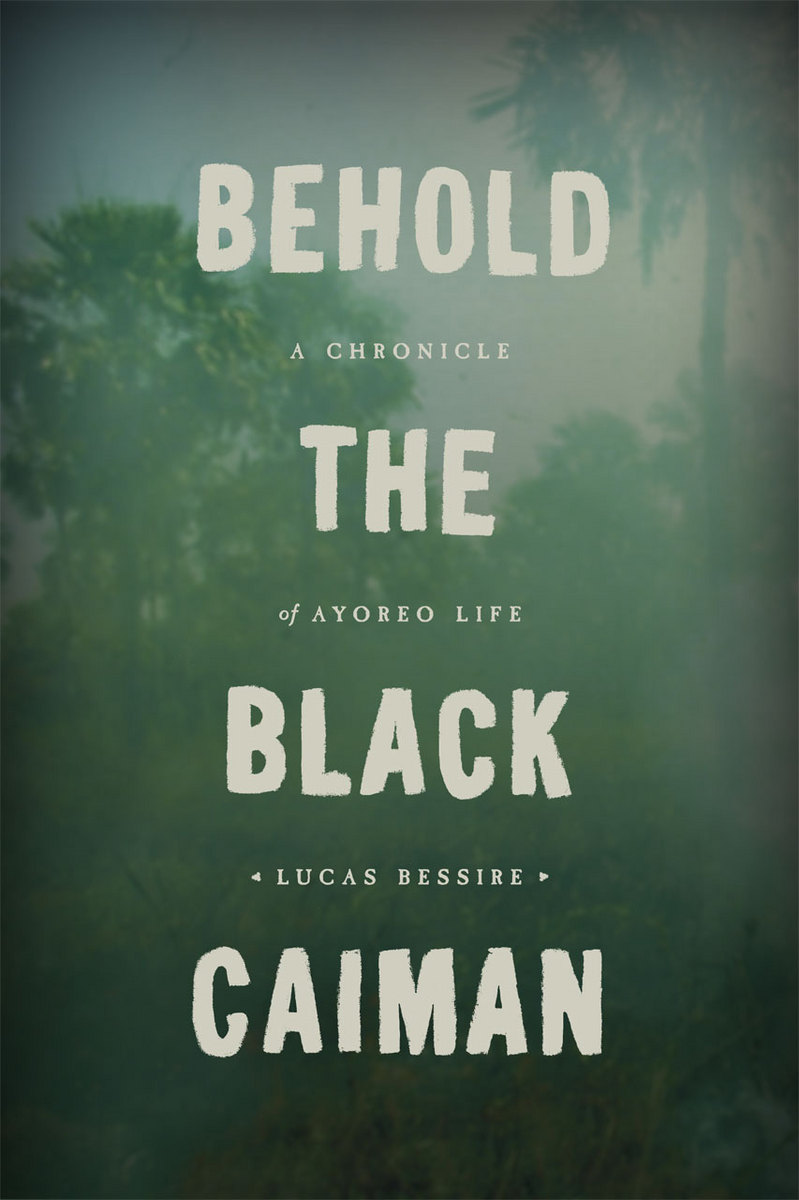
Behold the Black Caiman
A Chronicle of Ayoreo Life
University of Chicago Press, 2014
Cloth: 978-0-226-14089-6 | Paper: 978-0-226-17557-7 | Electronic: 978-0-226-17560-7
DOI: 10.7208/chicago/9780226175607.001.0001
Cloth: 978-0-226-14089-6 | Paper: 978-0-226-17557-7 | Electronic: 978-0-226-17560-7
DOI: 10.7208/chicago/9780226175607.001.0001
AVAILABLE FROM
University of Chicago Press (cloth, paper, ebook)Brytewave (CafeScribe-Follett Higher Ed)
Chegg Inc
ebrary
EBSCO eBooks (formerly NetLibrary)
Kno
ABOUT THIS BOOKAUTHOR BIOGRAPHYREVIEWSTABLE OF CONTENTS
ABOUT THIS BOOK
In 2004, one of the world’s last bands of voluntarily isolated nomads left behind their ancestral life in the dwindling thorn forests of northern Paraguay, fleeing ranchers’ bulldozers. Behold the Black Caiman is Lucas Bessire’s intimate chronicle of the journey of this small group of Ayoreo people, the terrifying new world they now face, and the precarious lives they are piecing together against the backdrop of soul-collecting missionaries, humanitarian NGOs, late liberal economic policies, and the highest deforestation rate in the world.
Drawing on ten years of fieldwork, Bessire highlights the stark disconnect between the desperate conditions of Ayoreo life for those out of the forest and the well-funded global efforts to preserve those Ayoreo still living in it. By showing how this disconnect reverberates within Ayoreo bodies and minds, his reflexive account takes aim at the devastating consequences of our society’s continued obsession with the primitive and raises important questions about anthropology’s potent capacity to further or impede indigenous struggles for sovereignty. The result is a timely update to the classic literary ethnographies of South America, a sustained critique of the so-called ontological turn—one of anthropology’s hottest trends—and, above all, an urgent call for scholars and activists alike to rethink their notions of difference.
Drawing on ten years of fieldwork, Bessire highlights the stark disconnect between the desperate conditions of Ayoreo life for those out of the forest and the well-funded global efforts to preserve those Ayoreo still living in it. By showing how this disconnect reverberates within Ayoreo bodies and minds, his reflexive account takes aim at the devastating consequences of our society’s continued obsession with the primitive and raises important questions about anthropology’s potent capacity to further or impede indigenous struggles for sovereignty. The result is a timely update to the classic literary ethnographies of South America, a sustained critique of the so-called ontological turn—one of anthropology’s hottest trends—and, above all, an urgent call for scholars and activists alike to rethink their notions of difference.
AUTHOR BIOGRAPHY
Lucas Bessire is assistant professor of anthropology at the University of Oklahoma. He is the producer and director of the documentary film From Honey to Ashes.
REVIEWS
“This is an exceptional book whose compelling narrative fully immerses the reader in the social and spatial geography of the northern Gran Chaco. The book’s greatest strength is Bessire’s careful conceptual and ethnographic decomposition of the terms that have long been used to dehumanize the Ayoreo people in popular and scholarly imaginings. Original and unsettling, this ethnography shows that the anthropological deconstructions of conventional notions of ‘culture’ and ‘indigeneity’ haven’t gone too far—in fact, they haven’t gone far enough.”
— Gastón Gordillo, author of Rubble: The Afterlife of Destruction“Wonderfully sensitive to its own presuppositions about anthropology no less than the giddy claims made for ‘Amerindian cosmology’ and the so-called ontological turn, Bessire’s chronicle of the Ayoreo of Paraguay and Bolivia is breathtaking in its power and delicacy. His chronicle takes us into the depths of suffering, not to resurrect the primitive or the travail of genocide, but so as to more honestly address what he sees as deep-seated ‘zones of intense translation’ that override the hoopla of Western attachment to the indigene as bound to tradition. A profoundly iconoclastic book that will become one of the great classics of social thought, it leaves the reader in a remarkably new place for rethinking modern history, no less than thinking itself.”
— Michael Taussig, Columbia University“In a time when anthropologists proclaim an ‘ontological turn’ based on the study of cosmologies and mythologies, proposing a representation of Amerindians as radical others living in ahistorical temporality, Bessire resists what he calls the ‘fetishization of tradition’ by offering a beautifully written ethnography of the pauperized and marginalized Ayoreo people, who are caught between the forest and the bulldozers that destroy it, between the proselytism of millenarian religions and the benevolence of humanitarian organizations. Behold the Black Caiman is an important and courageous book, which will be a source of inspiration for all social scientists interested in the contradictions of the contemporary world.”
— Didier Fassin, Institute for Advanced Study“Bessire presents the reader with a plethora of unruly images and evocative vignettes of Ayoreo life which never surrender to a single, univocal narrative. His account is purposefully complex. In a world where sensationalized images of the “last contacted Indians” are regularly consumed to satiate our hunger for otherness, and in an academy where indigenous ways of life are increasingly emphasized as the only true political alternative to our world, Bessire’s book is a much-needed different voice.”
— Times Literary Supplement"Behold the Black Caiman wrestles with the complexity of life and the ways in which it can be both dehumanized and endured. The book’s innovative, elegiac style is not merely an aesthetic device, but rather a provocation. Bessire is asking us, as readers, to think with him."
— Cultural AnthropologyTABLE OF CONTENTS
List of Illustrations
Prefatory Note
Chapter 1. The Devil and the Fetishization of Tradition
Chapter 2. The Lost Center of the World
Chapter 4. Mediating the New Human
Chapter 5. Apocalypse and the Limits of Transformation
Chapter 6. Shame and the Limits of the Subject
Chapter 7. Affliction and the Limits of Becoming
Chapter 8. The Politics of Isolation
Conclusion: Behold the Black Caiman
Acknowledgments
Notes
Bibliography
Index