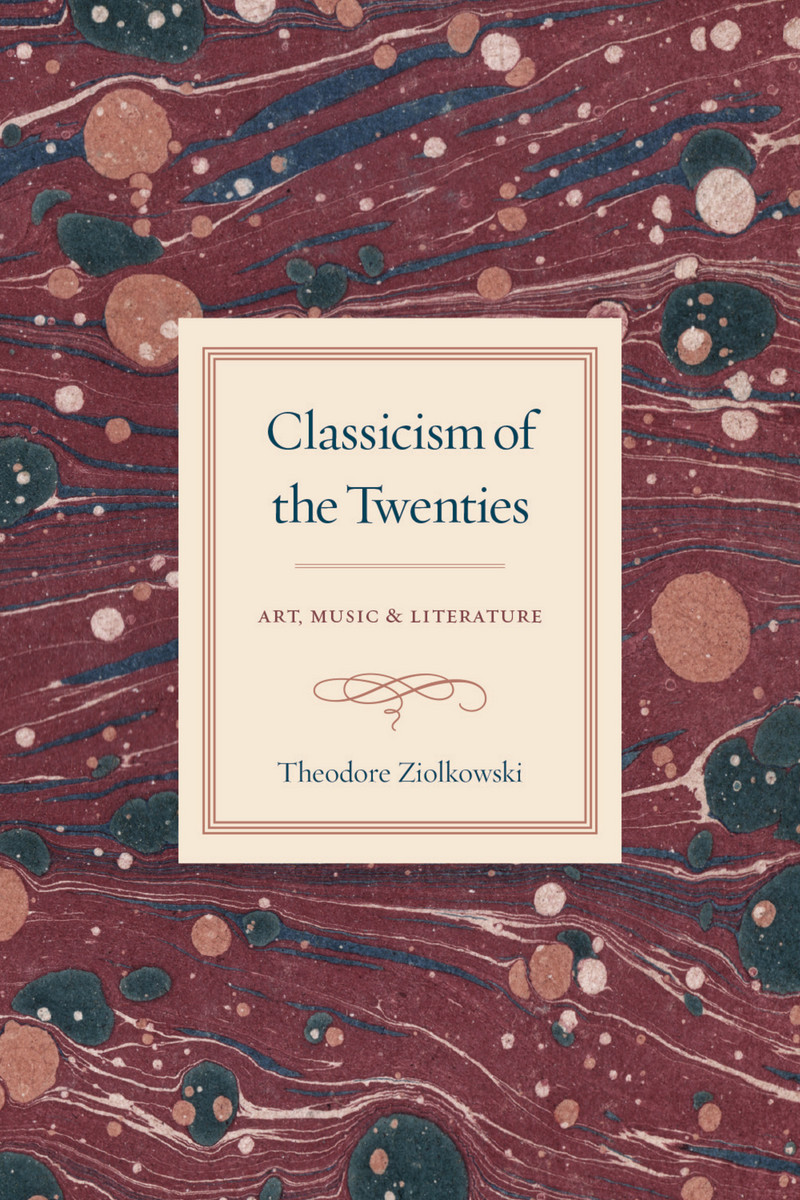
Classicism of the Twenties
Art, Music, and Literature
University of Chicago Press, 2014
Cloth: 978-0-226-18398-5 | Electronic: 978-0-226-18403-6
DOI: 10.7208/chicago/9780226184036.001.0001
Cloth: 978-0-226-18398-5 | Electronic: 978-0-226-18403-6
DOI: 10.7208/chicago/9780226184036.001.0001
AVAILABLE FROM
University of Chicago Press (cloth, ebook)Brytewave (CafeScribe-Follett Higher Ed)
Chegg Inc
DeGruyter Multi-User Ebook Program
ebrary
EBSCO eBooks (formerly NetLibrary)
University Press Scholarship Online (UPSO)
ABOUT THIS BOOKAUTHOR BIOGRAPHYREVIEWSTABLE OF CONTENTS
ABOUT THIS BOOK
The triumph of avant-gardes in the 1920s tends to dominate our discussions of the music, art, and literature of the period. But the broader current of modernism encompassed many movements, and one of the most distinct and influential was a turn to classicism.
In Classicism of the Twenties, Theodore Ziolkowski offers a compelling account of that movement. Giving equal attention to music, art, and literature, and focusing in particular on the works of Stravinsky, Picasso, and T. S. Eliot, he shows how the turn to classicism manifested itself. In reaction both to the excesses of neoromanticism and early modernism and to the horrors of World War I—and with respectful detachment—artists, writers, and composers adapted themes and forms from the past and tried to imbue their own works with the values of simplicity and order that epitomized earlier classicisms.
By identifying elements common to all three arts, and carefully situating classicism within the broader sweep of modernist movements, Ziolkowski presents a refreshingly original view of the cultural life of the 1920s.
In Classicism of the Twenties, Theodore Ziolkowski offers a compelling account of that movement. Giving equal attention to music, art, and literature, and focusing in particular on the works of Stravinsky, Picasso, and T. S. Eliot, he shows how the turn to classicism manifested itself. In reaction both to the excesses of neoromanticism and early modernism and to the horrors of World War I—and with respectful detachment—artists, writers, and composers adapted themes and forms from the past and tried to imbue their own works with the values of simplicity and order that epitomized earlier classicisms.
By identifying elements common to all three arts, and carefully situating classicism within the broader sweep of modernist movements, Ziolkowski presents a refreshingly original view of the cultural life of the 1920s.
AUTHOR BIOGRAPHY
Theodore Ziolkowski is professor emeritus of German and comparative literature at Princeton University. He is the author of Modes of Faith: Secular Surrogates for Lost Religious Belief, also published by the University of Chicago Press.
REVIEWS
“Ziolkowski presents a remarkable array of writers, artists, and composers, all of whom were keen to take art in new directions after the Great War finally put an end to the long nineteenth century. He usefully defines ‘classicism of the twenties’ as a telling meld of historical appropriation and ironic distance motivated by a war-battered need for order and clarity. This book will serve both as an enticing introduction for the uninitiated and a newly configured map for more experienced travelers.”
— Scott Burnham, Princeton University“Ziolkowski convincingly explains how and why classical forms and values persisted obstinately—sometimes flamboyantly—in the very midst of cultural innovation and experiment. At the same time, his erudition and ability to combine concepts create before our eyes the most pleasing and intriguing imagery: colorful, filmlike, even kaleidoscopic. This book will delight and fascinate.”
— Virgil Nemoianu, Catholic University of America“‘Classicism’ in the earlier twentieth century has been extensively discussed in reference to individual writers, artists, and musicians, but Ziolkowski, dealing with individual cases from an overarching interdisciplinary and international perspective, has brilliantly expanded its multicultural horizons.”
— Burton Pike, City University of New York“Presents a closely and elegantly argued interdisciplinary recuperation of the inter-war response to romantic sensibilities and modernist aesthetics espoused by a core group of artists—composers, painters, and writers—that took the form of a return of classical forms and themes in reaction to the psychic and moral devastation of World War I.”
— Key Reporter“Highly readable, unforcedly polemical, expository rather than theoretical, and historically informative. . . . [Ziolkowski] has the space to let his examples speak for themselves, and he can point out, with admirable clarity and erudition, the common features that emerge from them.”
— Modern Language ReviewTABLE OF CONTENTS
List of Figures
Preface
Part 1: The Theory
1. Prewar Classicism - Theodore Ziolkowski
2. Classicism of the Twenties - Theodore Ziolkowski
Part 2: The Practice
3. Three Exemplary Figures - Theodore Ziolkowski
Part 3: Test Cases
4. The Writers - Theodore Ziolkowski
5. The Artists - Theodore Ziolkowski
6. The Composers - Theodore Ziolkowski
Part 4: Conclusions
7. Classicism of the Twenties? - Theodore Ziolkowski
Notes
Index