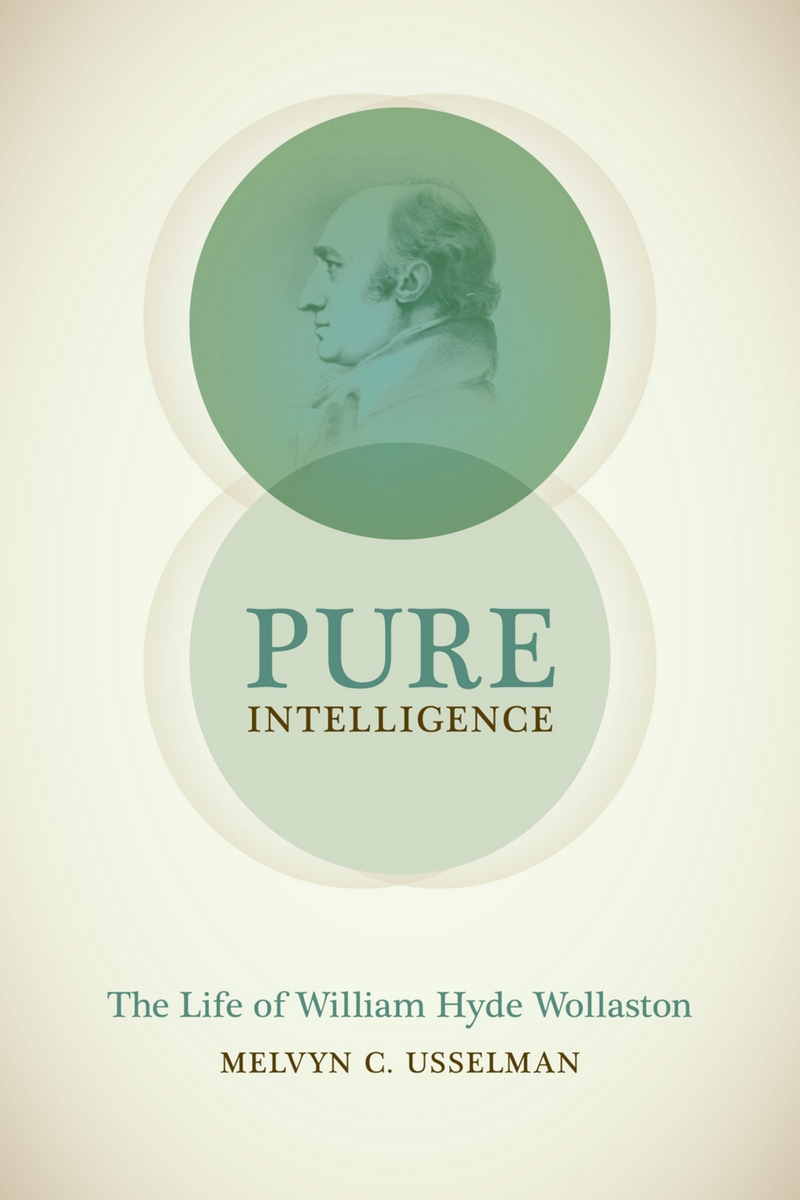
REVIEWS
"Portraying the extraordinary polymath Wollaston both in detail and in the round, this elegantly written work is a major contribution to understanding early nineteenth-century British science. Usselman exhibits quiet mastery of the diverse fields in which Wollaston labored, fitting his subject into the science, the technology, and the political and economic life of his day. His work says much about themes of great current historical interest, including the relationships of science to artisanal crafts, invention, and enterprise. Pure Intelligence is both an intellectual tour de force and a pleasure to read."
— Alan Rocke, Case Western Reserve University
"During the first thirty years of the nineteenth century William Hyde Wollaston’s contemporaries considered him Britain’s greatest natural philosopher, yet today he is almost a forgotten figure. After two centuries of obscurity Wollaston is vividly brought to life in Usselman’s long-awaited and aptly titled biography. Based upon a thirty-year study of Wollaston’s extraordinary wide range of publications, laboratory notebooks, letters and business records, Usselman tells the story of a polymath physician who entered a secret partnership to manufacture platinum metals and organic chemicals and found himself in an embarrassing but fascinating ethical dilemma; a brilliant analytical chemist who played a crucial role in the development of crystallography and the atomic theory; a physicist whose contributions to optics and instrument-making were fundamental; and a man who was at the cultural center of British science. This is a brilliant study of a neglected genius."
— William Brock, University of Leicester
"Usselman has written the first major biography of William Hyde Wollaston, and it is magisterial. Wollaston was reserved in public, warm and devoted in private. Here we have Wollaston brought to life in the round, with the full range of his laboratory work incisively examined, his public service, his inventiveness, and his commercial acumen; science, society, politics, and finance are all in play, and Usselman not only teaches us about Wollaston, restoring him to the eminence that his contemporaries recognized, but also sheds new and important light on the multiple contexts in which he lived and worked. This, after two hundred years, is the definitive biography."
— Trevor H. Levere, University of Toronto
"Somehow no biography of William Hyde Wollaston materialised during or just after his life, and over time he became little more than a name, sometimes regarded as a recluse. Now after a lifetime’s devotion, Usselman has magnificently filled the gap with a book that brings this great man to life and puts him in his context of Regency Britain and its ‘Second Scientific Revolution,’ in which science became specialised and professional. Anyone with interests in the history of science generally as well as in chemistry specifically will want to read and enjoy this biography, and I am happy to commend it most warmly."
— David Knight, Durham University
"He was crucial to the development of crystallography, and discovered the amino acid cystine and the elements palladium and rhodium. Yet scientific polymath William Hyde Wollaston (1766–1828) is largely forgotten. This meticulous biography, the life's work of late chemist Melvyn Usselman, reveals a man of indefatigable curiosity and methodological genius. As we see Wollaston crafting analytical instruments for Arctic expeditions, stargazing, or showing scientific writer Mary Somerville the uses of a goniometer, we can only concur with Usselman that this was a 'man worth knowing.'"
— Nature
"In William Wollaston, Usselman has found a long-neglected but vastly interesting subject and presented us with a gem of a book. . . . Wollaston (1766-1828) made contributions to organic, inorganic, physical and analytical chemistry, optics, crystallography, mineralogy, physiology, electricity, instrument design and manufacture, physiology and kinematics. . . . Usselman’s book paints a picture of the full breadth of Wollaston’s professional life that is close up and detailed."
— Richard Joyner, Times Higher Education
“Pure Intelligence: The Life of William Hyde Wollaston is a biography two centuries overdue: but well worth the wait….In this volume you will read fascinating accounts of Wollaston’s discoveries….Professor Usselman has covered Wollaston’s scientific achievements in their entirety at a level of scholarship that can only be described as magnificent.”
— Brain: A Journal of Neurology
"Usselman’s approach is classically internalist, and reading his detailed unpacking of the scientific reasoning revealed by Wollaston’s laboratory notebooks reminded me of the way musicologists write the history of music, making their argument both in prose and in musical notation. Usselman’s reconstruction and demonstration of Wollaston’s design of sequences of reagents in order to progressively refine his metals, uses both prose descriptions and chemical notation-both modern and late eighteenth century-in tandem to show what a great technician Wollaston was."
— Studies in History and Philosophy of Biological and Biomedical Sciences
TABLE OF CONTENTS
Acknowledgments
Note to Reader
List of Abbreviations
Prologue - Melvyn C. Usselman
DOI: 10.7208/chicago/9780226245874.003.0016
[William Hyde Wollaston, powder metallurgy, malleable platinum, eureka moments, presentism, scientific discovery, historiography]
This Prologue presents a brief, slightly dramatized account of William Hyde Wollaston’s first successful consolidation of powdered platinum into a malleable solid in April, 1801. The preparation of one small ingot of platinum is a milestone in the history of powder metallurgy, and marks the beginning of the modern platinum industry. The description of the laboratory procedure is based on notebook and published accounts, together with the author’s best guess of what unknown circumstances might have prevailed. The imagined drama of the event is then used as a springboard to discuss an historian’s need to separate speculation from fact, to place such ‘eureka moments’ into appropriate perspective, to distinguish interpretations based on presentism from those situated in contemporary beliefs, to avoid over-simplification and to provide a credible explanation of the value placed on noteworthy scientific discoveries. Wollaston’s life and science allow one to explore all these issues. (pages 1 - 7)
This chapter is available at:
https://academic.oup.com/chica...
1. The Making of a Physician: 1766–1795 - Melvyn C. Usselman
DOI: 10.7208/chicago/9780226245874.003.0001
[William Hyde Wollaston, Francis Wollaston, Charterhouse, Caius College, medical education, teaching hospital, country physician, Smithson Tennant]
This chapter describes the life and education of W. H. Wollaston from his birth in 1766 to his years as a country physician the 1790s. Growing up in a large family steeped in religion and natural philosophy, Wollaston was guided by his father Francis through preliminary schooling at Charterhouse to medical studies and a fellowship at Caius College, Cambridge. Following a program of studies recommended by his uncle William Heberden, Wollaston obtained his Bachelor of Medicine degree in 1788, and spent the next five years acquiring valuable medical skills at the teaching hospitals of London. Details are given of his MD degree of 1793 and four years of doctoring in Bury St. Edmunds, together with accounts of his election to the Royal Society in 1793 and the Royal College of Physicians in 1794. Wollaston’s exposure to chemistry and the chemist Smithson Tennant at Cambridge is also described. (pages 8 - 29)
This chapter is available at:
https://academic.oup.com/chica...
2. Early Medical and Scientific Interests: 1792–1800 - Melvyn C. Usselman
DOI: 10.7208/chicago/9780226245874.003.0002
[William Hyde Wollaston, micro scale analysis, crystallography, fairy rings, human calculi, cystine, Royal College of Physicians, smallpox vaccination, atmospheric refraction, Smithson Tennant]
This chapter describes W. H. Wollaston’s scientific interests in the 1790s, including chemical analysis on a micro scale and substance identification by crystallographic properties. Wollaston’s studies of fairy rings, human calculi and the discovery of cystine are discussed, as are his services to the Royal College of Physicians as censor, madhouse commissioner and smallpox vaccination advisor. His influential study of atmospheric refraction is described and the reasons for his abandonment of medicine are presented. The chapter also discusses the formation of his secret partnership with Smithson Tennant to produce value-added chemical products from inexpensive raw materials. (pages 30 - 52)
This chapter is available at:
https://academic.oup.com/chica...
3. Early Years as a Natural Philosopher: 1800–1802 - Melvyn C. Usselman
DOI: 10.7208/chicago/9780226245874.003.0003
[William Hyde Wollaston, Humphry Davy, Thomas Young, observation, theory, galvanism, refractometer, solar dark lines, ultraviolet light, optical instruments]
This chapter describes W. H. Wollaston’s introduction to the Royal Society and its dining club, together with his association with Humphry Davy and Thomas Young. Wollaston’s intellectual emphasis on the primacy of observation, and his distrust of overhasty theory formation, is explained with reference to his debate with Young on the vibratory theory of light. Wollaston’s pioneering studies of galvanism, including descriptions of his miniature devices for water electrolysis and electrical incandescence, are described. There is also an analysis of his groundbreaking paper on the refraction and dispersion of light, which included the invention of a refractometer based on total internal reflection, and the first observation of dark lines in the solar spectrum as well as the existence of ultraviolet light. A description is also given of his study of the double refraction of Iceland spar and invention of three optical instruments for naval navigation. (pages 53 - 82)
This chapter is available at:
https://academic.oup.com/chica...
4. Malleable Platinum: 1800–1801 - Melvyn C. Usselman
DOI: 10.7208/chicago/9780226245874.003.0004
[William Hyde Wollaston, alluvial platina, aqua regia, spongy platinum, malleable platinum, commercial secrets]
This chapter describes the difficulties 18th century chemists encountered trying to produce commercially-useful platinum from the alluvial deposits of crude platina found in the rivers of New Granada in South America. Based on experimental data from his research notebooks, a description is given of Wollaston’s improved multi-step purification procedure which yielded platinum of high purity. Success was due primarily to careful control over the amounts and relative quantities of nitric and muriatic acids in the aqua regia solvent. In April, 1801, Wollaston was able for the first time to compress spongy platinum powder into a malleable ingot. He soon perfected the process and began to prepare thousands of ounces of the metal for later sale, although he kept his process secret and did not market the metal because he suspected that there were one or more new elements to be discovered in the crude ore. (pages 83 - 108)
This chapter is available at:
https://academic.oup.com/chica...
5. Palladium and Rhodium: 1801–1825 - Melvyn C. Usselman
DOI: 10.7208/chicago/9780226245874.003.0005
[William Hyde Wollaston, platinum processing, palladium, rhodium, business secrecy, chemical discovery, Richard Chenevix, scientific fraud, rhodium pen tips]
This chapter describes W. H. Wollaston’s batch processes for the production of malleable platinum and his efforts to make the process as economically efficient as possible. Recovery of dissolved platinum by treatment of residual aqua regia with iron generated metallic residues from which he isolated palladium in 1802 and rhodium in 1804. Wollaston’s desire to keep all details of his platinum business secret prompted him to announce the discovery of palladium by the anonymous sale of small ribbons of the metal. The controversy prompted by the claims of fraud issued by Richard Chenevix over the nature of palladium is described, and the damage to Wollaston’s reputation by those who believed chemical discoveries should be freely disseminated is examined. The limited markets for palladium in astronomical instruments and rhodium in pen tips is discussed (pages 109 - 134)
This chapter is available at:
https://academic.oup.com/chica...
6. Optical Devices and Social Networks: 1804–1809 - Melvyn C. Usselman
DOI: 10.7208/chicago/9780226245874.003.0006
[William Hyde Wollaston, meniscus lenses, periscopic spectacles, camera lucida, Francis Chantrey, bodies in motion, work potential, energy, Chemistry Club, Geological Society]
This chapter describes how W. H. Wollaston’s expertise in linear optics led him to design and patent in 1804 meniscus lenses for improved eye glasses which he called periscopic spectacles. He also suggested improvements to the camera lucida and microscopes that took advantage of curved lenses. He designed and patented in 1806 a novel and compact drawing aid he named a camera lucida, which was used by the sculptor Francis Chantrey to make preliminary drawings of his subjects. The device remained in wide use for sketching until well into the 20th century. The chapter also discusses Wollaston’s1805 paper on the forces of moving bodies in which he placed emphasis on the work potential of a body supplying energy to another over a finite distance. Wollaston’s move into new social and scientific networks in London, such as the Chemistry Club and the Geological Society, is described. (pages 135 - 162)
This chapter is available at:
https://academic.oup.com/chica...
7. Commercial Platinum: 1805–1820 - Melvyn C. Usselman
DOI: 10.7208/chicago/9780226245874.003.0007
[William Hyde Wollaston, commercial platinum, William Cary, firearm touch-holes, sulfuric acid boilers, platinum crucibles, chemical business, John Johnson, entrepreneurs]
This chapter presents details of W. H. Wollaston’s and S. Tennant’s platinum business, which made malleable platinum available for commercial use for the first time. The finished metal was sold by the instrument maker William Cary and the major industrial application was for the touch-holes of firearms, which consumed about two-thirds of all platinum sold. The other significant application was for boilers used for the concentration of sulfuric acid. The purest platinum was reserved for the most demanding applications, such as laboratory crucibles. Most of the platina ore purchased after 1805 was bought from the London assayer John Johnson, who obtained it from traders in Kingston, Jamaica. The chemicals business of the two entrepreneurs became quite profitable after 1809, and Wollaston negotiated a larger share of the profits as a reward for his total superintendence of the production process. (pages 163 - 189)
This chapter is available at:
https://academic.oup.com/chica...
8. Organic Chemicals and Multiple Combining Proportions: 1802–1815 - Melvyn C. Usselman
DOI: 10.7208/chicago/9780226245874.003.0008
[William Hyde Wollaston, Smithson Tennant, organic chemicals, tartaric acid, oxalic acid, multiple combining proportions, Thomas Thomson, John Dalton, atomic theory]
This chapter describes the organic chemicals business of W. H. Wollaston and S. Tennant, and Wollaston’s discovery of multiple combining proportions in the salts of organic acids. Wollaston extracted tartaric acid from the sediments of wine fermentation and converted large amounts of it to salts of oxalic acid, which were sold to textile manufacturers in Manchester. The organic chemicals business was not greatly profitable because of decreasing profit margins, so it was terminated about 1811. A scientific bonus of the commercial process was Wollaston’s discovery in 1803 and 1804 of multiple proportions in the potash salts of tartaric and oxalic acids. After learning of Thomas Thomson’s report of multiple proportions in two salts of oxalic acid in 1807, and the significance of the observation for atomic theory, Wollaston published several examples of integral combining proportions in 1808. Many believed that the paper provided strong empirical support for John Dalton’s atomic theory. (pages 190 - 219)
This chapter is available at:
https://academic.oup.com/chica...
9. Crystals and Atoms: 1803–1818 - Melvyn C. Usselman
DOI: 10.7208/chicago/9780226245874.003.0009
[William Hyde Wollaston, mineralogy, crystallography, reflective goniometer, René Just Haüy, particulate crystal structure, Eilhard Mitscherlich, isomorphism]
This chapter describes Wollaston’s broadening interests after the chemical business had moved to profitability. He began to move in wider social circles and deepen his expertise in mineralogy and crystallography. He initiated a more quantitative phase of mineralogical studies by the invention of the reflective goniometer, which allowed the measurement of crystal angles to an accuracy of one-tenth of a degree. Wollaston used his goniometer to refute some of the idealized crystal angles accepted by René Just Haüy and went on to propose a theory of crystal structure based on the close packing of spherical and spheroidal particles. In 1818, Wollaston verified and extended François Beudant’s discovery of crystallographic similarities in metallic sulfates, but was unable to anticipate the principles of isomorphism later proposed by Eilhard Mitscherlich. (pages 220 - 239)
This chapter is available at:
https://academic.oup.com/chica...
10. More Practical and Conceptual Innovation: 1809–1822 - Melvyn C. Usselman
DOI: 10.7208/chicago/9780226245874.003.0010
[William Hyde Wollaston, muscle contraction, cryophorus, Wollaston wires, chemical equivalents, combining proportions, indestructible atoms, finite atmosphere]
This chapter describes some examples of Wollaston’s innovative thinking, both practical and conceptual. In 1809 he reported a measurement of the frequency of muscle fiber contractions of 20-30 beats per second and, a few years later he devised a precursor of a heat pipe which he named a cryophorus. In 1813 he published his method of making platinum wires, known today as Wollaston wires, with diameters as narrow as 1/50,000 of an inch. In 1814 he published details of the sliding scale of chemical equivalents, which allowed chemists to calculate easily the relative proportions, or equivalents, of substances present in compound substances. For many, discussion of chemical combination in terms of equivalents was seen as an epistemological improvement over atomistic explanation. In 1822, Wollaston sought to provide proof for the existence of indestructible atoms by an argument based on the finite extent of a planet’s atmosphere. (pages 240 - 261)
This chapter is available at:
https://academic.oup.com/chica...
11. Changing Priorities: 1809–1815 - Melvyn C. Usselman
DOI: 10.7208/chicago/9780226245874.003.0011
[William Hyde Wollaston, physiological chemistry, blood sugar, John Sebright, Paris visit, Smithson Tennant]
This chapter discusses some of Wollaston’s physiological studies, such as the transfer of chemicals through a biological membrane in the presence of an electrical field, and his failed attempts to detect sugar in the blood of diabetics. The contemporary respect for Wollaston’s abilities is revealed by personal comment and social engagements, and several examples are given of Wollaston’s sporting visits to the country estates of wealthy acquaintances such as John Sebright. Wollaston’s trip to Paris in 1814 after the abdication of Napoleon is recounted, and the changes to his life brought on by the death of his father and Smithson Tennant in 1815 are described. (pages 262 - 280)
This chapter is available at:
https://academic.oup.com/chica...
12. Service to Government and the Royal Society: 1803–1820 - Melvyn C. Usselman
DOI: 10.7208/chicago/9780226245874.003.0012
[William Hyde Wollaston, Excise taxes, alcoholometry, Sikes’ hydrometer, weights and measures, Smithson Tennant, Davy lamp, Humphry Davy, Board of Longitude, President of the Royal Society]
This chapter describes several of Wollaston’s contributions to government committees and the Royal Society. In 1803 he was appointed to a committee that was to recommend to the Excise Office the best means of quantifying the alcohol content of spirits, and Wollaston superintended the introduction of the Sikes’ hydrometer as the official measuring instrument. He also made recommendations to a Committee on Weights and Measures which resulted in the Imperial units adopted in 1824. Experiments with Smithson Tennant that demonstrated that flame could not pass through narrow tubes preceded Humphry Davy’s discoveries that led to the invention of the Davy lamp for miners. In 1818 he began a decade-long term as a resident commissioner of the Board of Longitude. In 1820 Wollaston served as interim President of the Royal Society, but elected not to oppose Davy for a longer term, despite support from the reform-minded members of the Society. (pages 281 - 302)
This chapter is available at:
https://academic.oup.com/chica...
13. A Diversity of Interests: 1815–1824 - Melvyn C. Usselman
DOI: 10.7208/chicago/9780226245874.003.0013
[William Hyde Wollaston, Julia Hankey, Jane Marcet, Mary Somerville, Maria Edgeworth, electromagnetic rotation, high frequency hearing loss, hemianopsia, fortification spectra, migraine]
This chapter discusses Wollaston’s friendship with Julia Hankey and his trip with her family through continental Europe in 1816, as well as a description of his interactions with three prominent female authors, Jane Marcet, Mary Somerville and Maria Edgeworth. Mention is also made of the closing of the platinum business in 1820 due to the loss of platina supply. Wollaston’s role in the discovery of electromagnetic rotation by Michael Faraday is described, as is the resulting unpleasantness surrounding Faraday’s election to the Royal Society. The chapter also discusses Wollaston’s study of the sharp onset of high frequency hearing loss and his own incidences of half-field vision loss known as hemianopsia and fortification spectra, which were likely connected with unrecognized migraine attacks. (pages 303 - 329)
This chapter is available at:
https://academic.oup.com/chica...
14. The Last Years: 1824–1828 - Melvyn C. Usselman
DOI: 10.7208/chicago/9780226245874.003.0014
[William Hyde Wollaston, optical glass, brightness of stars, Wollaston doublet, paralysis, donations to science societies]
This chapter describes the last few years of Wollaston’s life, during which he more frequently engaged in outdoor pursuits such as fishing and shooting expeditions. He donated some of the last platinum in his possession to Faraday’s researches on optical glass and published papers on the brightness of stars, a two-fluid barometer and a double lens setup for microscopes that became known as a Wollaston doublet. In late 1827, Wollaston began to suffer from intermittent paralysis in his left arm and in late 1828 his worsening condition confined him to his home. In preparation for death, he bequeathed his belongings to family, made donations to the Royal, the Geological and the Astronomical Societies, and prepared personal gifts to many friends, which were distributed just prior to his death on Dec. 22, 1828. The chapter also gives examples of his mental acuteness just prior to death. (pages 330 - 350)
This chapter is available at:
https://academic.oup.com/chica...
15. Post Mortem and Legacy: 1828–Present - Melvyn C. Usselman
DOI: 10.7208/chicago/9780226245874.003.0015
[William Hyde Wollaston, brain tumor, legacy, Henry Warburton, observation, theory]
This chapter gives details of the post mortem examination which confirmed that Wollaston died of a brain tumor. Several extracts from reminiscences of contemporaries give insight into the many scientific accomplishments of Wollaston, together with mention both of his public aloofness and personal warmth and generosity. The author gives reasons for Wollaston’s relative anonymity relative to contemporaries of lesser or equal talents, chief among them being the century-long loss of the materials assembled by Henry Warburton. The claim is also advanced that Wollaston’s reluctance to extend his remarkable observational skills into theoretical explanations has reduced his visibility to modern scientists and historians. (pages 351 - 360)
This chapter is available at:
https://academic.oup.com/chica...
Notes
Bibliography
Index