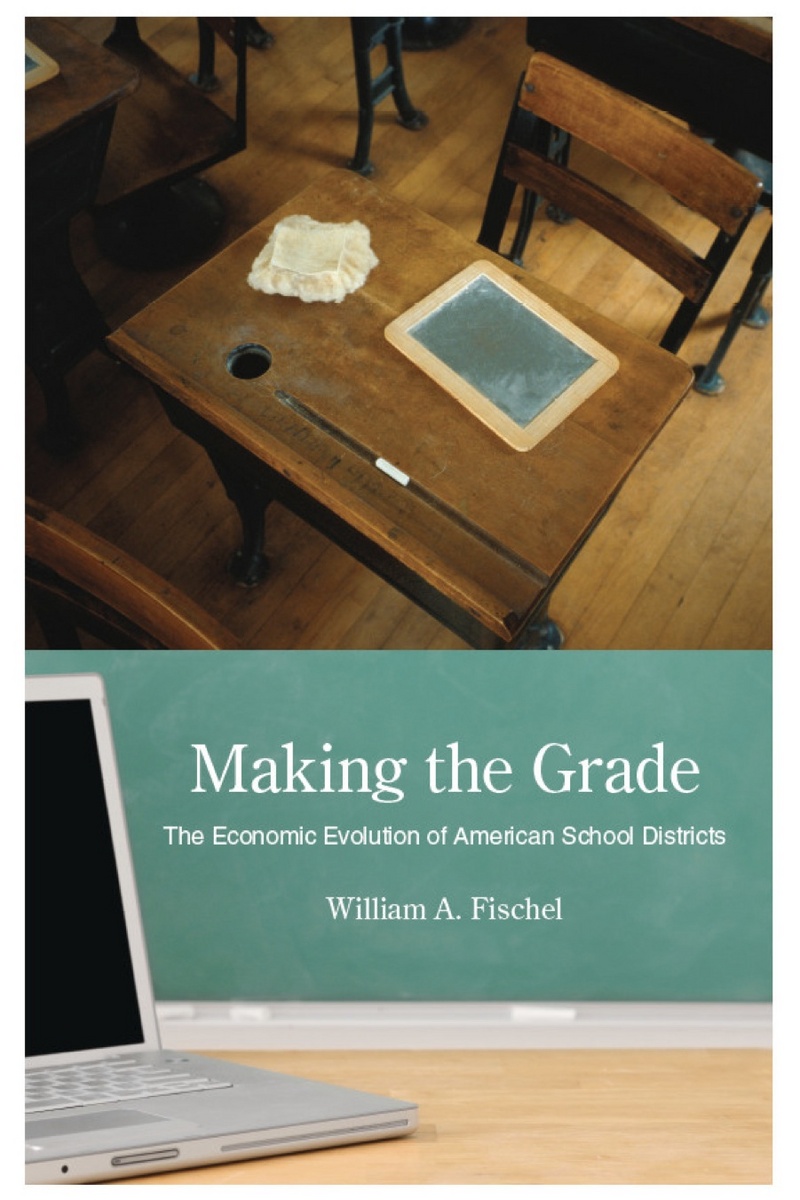
REVIEWS
“Making the Grade is an important contribution to the study of the political economy of public education, drawing on an eclectic body of evidence ranging from anecdotes to survey data to maps from Google Earth. Fischel has an unusually engaging prose style, and I am confident that the book will be widely read and discussed by economists and political scientists with an interest in education policy.”
— Martin West, Harvard Graduate School of Education
“The American standard of living owes much to the early development of public schools. In this provocative and important new book, master economist William Fischel persuasively argues that many of the distinctive institutional features of American education—the proverbial one room school house, summer vacations, age-grading, school consolidation, and the geography of school districts—were ‘bottom-up’ demand-driven choices of parents and taxpayers seeking efficiency and maximal land values rather than ‘top-down’ decisions imposed by the educational bureaucracy. Just like politics schools, Fischel implores, are all local—and it’s a good thing, too. The lessons for latter day educational reformers are nothing short of profound.”
— Robert A. Margo, author of Race and Schooling in the South, 1880–1950: An Economic History
“Bill Fischel has done it again. He has taken a set of commonly accepted views about schools and turned them upside down—shattering our simplistic explanations for age-grading in schools, for the September to May school calendar, and for voter disapproval of voucher referenda. His clear and logical development of the interests of citizens and their impact on the geography and organization of schools is compelling. This fascinating book demonstrates the power of some simple economic ideas for organizing our interpretation of the world around us.”
— Eric Hanushek, Hoover Institution, Stanford University
“At a time in which K-12 education has increasingly become a focus of state and federal governments, William Fischel offers a refreshingly different perspective. His is a story of how school districts emerged from the concerns of local communities and adapted as those communities evolved. For those who are becoming weary of No Child Left Behind, standardized testing, and other top-down measures to improve our public schools, this book is a reminder of what we may be losing.”
— Jon Sonstelie, University of California, Santa Barbara
"How Americans managed to achieve the feat of mass education and convince those without children to finance the education of other people’s children is the subject of William Fischel’s engaging and highly informative volume. . . . Making the Grade should be read by any historian or student of education who wants to learn about the evolution and functions of the school district. These mundane governmental units are a key to the initial success of the U.S. educational system. The book is also entertaining. Read it to learn why teaching became a female occupation, why summer vacations, standardized calendars, and age grading are ubiquitous, why property taxes pay for schools, why vouchers have gained adherents more in cities than in rural areas, and why teachers in many developing nations today, but not U.S. teachers in the nineteenth century, are frequently absent."
— Claudia Goldin, EH.net
"Through detailed research into topics from the content of the Northwest Ordinance and the politics of Jim Crow segregation to recent home prices and climate conditions, Mr. Fischel tells his own story, making the case that school districts are efficient and enjoy popular support. . . . Fischel's apology for school districts is compelling."
— Washington Times
"Highly readable. . . . The conventional 'top-down' history of American education is at best incomplete. Instead, Fischel offers a 'bottom-up' history that, with a few parsimonious concepts, explains quite a lot about the development of the American school system."
— Education Next
"This accessible, thoughtful book examines the sources of political support for American local school districts, from the late 1700s through today with charter schools and vouchers. . . . Fischel draws interesting, sometimes surprising, conclusions from the scattered historical materials."
— Choice
TABLE OF CONTENTS
Preface
Introduction: Mobility, Property, and Community - William A. Fischel
DOI: 10.7208/chicago/9780226251318.003.0001
[public education, educational reforms, school districts, human mobility]
This book focuses on public education and educational reforms. It has two connotations for school districts. The more obvious and contemporary is the demand for public schools to conform to high standards of accomplishment. The less obvious connotation of this book's title is the historical transformation of school districts. It also explains how the tutorial-recitation method was supplanted by the age-graded method. The themes that cut across the chapters of this book can be summarized as mobility, property, and community. The book concludes with a suggestion that a robust system of locally governed—and at least partly locally financed—school districts may be essential for the future of education. The challenge is the decline in the proportion of the population that has children in schools. (pages 1 - 12)
This chapter is available at:
https://academic.oup.com/chica...
Early American Land Policies and the Marvelously Efficient One-Room School - William A. Fischel
DOI: 10.7208/chicago/9780226251318.003.0002
[land policies, one-room schools, America, rural environments, economic conditions]
This chapter offers historical evidence that the provision of American schools was motivated by a concern for property values. It advances the idea that the one-room school was an efficient response to the pattern of settlement and economic conditions of nineteenth-century America. The important features of this system were obscured at times by nostalgic antiquarianism and contemptuous modernism. The latter part of the chapter addresses the evolutionary question of why the one-room school was so successful that it persisted long after multigrade schooling had been first established. It is argued that the system sought by most reformers—an age-graded system with professional instructors, multiroom schools, and centralized finance—would have been much less satisfactory in rural America. (pages 13 - 66)
This chapter is available at:
https://academic.oup.com/chica...
Explaining the School District Consolidation Movement - William A. Fischel
DOI: 10.7208/chicago/9780226251318.003.0003
[school districts, land values, economic change, education norms, America, rural voters]
This chapter uses land-value concerns and economic and technical change to explain the dramatic decline in the number of school districts between 1910 and 1970. Almost all the decline in district numbers to 1970 can be accounted for by the consolidation of rural, one-room school districts into larger districts that had multiroom buildings in which children were put on an age-graded track that led to high school. The twentieth-century decline in rural population, better roads and motor vehicles, and the demand for high school education contributed to the transformation of American education norms. As education moved toward age grading, it became important to coordinate the school experience from one place to another. This coordination came without much central direction. The political success of the age-graded model was because of the recognition by rural voters that their property values would be lowered if they did not get with the age-graded program. One-room, rural schools by 1900 attempted to adopt an age-graded system. This system did not work well in the one-room setting. One-room schools thus became obsolete. Attendance began to shrink because of declining rural population and because parents of ambitious students moved to age-graded districts. It accounted for almost all the decline in school district numbers from 1910 to 1970. (pages 67 - 118)
This chapter is available at:
https://academic.oup.com/chica...
“Will I See You in September?” Labor Mobility and the Standard School Calendar - William A. Fischel
DOI: 10.7208/chicago/9780226251318.003.0004
[labor mobility, standard school calendar, pedagogy, public schooling, education]
This chapter offers indirect evidence that school districts were able to evolve from one-room pedagogy to an age-graded system without a conscious, top-down organizer. The chapter offers evidence that the system of public schooling that evolved in the twentieth century was responsive to migration. A specific example of nearly spontaneous order is the coordination of school calendars, which is a marker for coordination of other aspects of school curricula. It turns out that the modern school year, which starts near the end of summer and ends at the beginning of the next summer, is a worldwide standard. Its purpose is to allow teachers and families with children to end school in one place, use a cost-minimizing season to move to another place, and begin the school year along with the preexisting students and teachers in their new home. The transition from irregular calendars to the standard system was occasioned by the widespread adoption of age-graded schooling. Age-graded education has a grim logic to it that makes it difficult to undertake rapid reforms. As a result, efforts that work on either end of K-12 education—preschool and postsecondary education—are the more viable candidates for restoring American pre-eminence in education. (pages 119 - 156)
This chapter is available at:
https://academic.oup.com/chica...
The Economic Geography of School Districts - William A. Fischel
DOI: 10.7208/chicago/9780226251318.003.0005
[economic geography, school districts, race, metropolitan structure, rural conditions]
This chapter explains the differences in the geographic size of school districts by region of the country, especially why the South's school districts are so much larger in area. Race has a lot to do with it, but not always in ways that one would expect. The chapter examines the metropolitan structure of school districts to examine the parameters of “Tiebout competition,” in which households choose among different school districts to buy their homes. There is a lot of competition, but, more surprisingly, the variation in the competitive structure of urban districts is largely the product of previous rural conditions. Finally, the chapter presents the evidence that, despite their differing functions, legal status, and governance, school districts and municipal governments are not strangers to one another. The chapter has made a case for thinking about school districts in a national rather than a state-by-state context. The generalizations about school districts presented in the chapter are based primarily on political and population patterns that vary by region rather than by state. (pages 157 - 216)
This chapter is available at:
https://academic.oup.com/chica...
Education Reforms and Social Capital in School Districts - William A. Fischel
DOI: 10.7208/chicago/9780226251318.003.0006
[educational reforms, social capital, school districts, America, public schools]
This chapter looks at whether school districts are still relevant in American life. The chapter presents some broad empirical evidence in support of the social capital theory of public schools: states with smaller school districts appear to have more social capital; demographic data show that the long-term trends in social capital are closely tracked by the average number of school-age children per family; and contemporary surveys show that parents with more children seem to have more social capital. The chapter also touches on two contemporary trends that could undermine the relevance of school districts. The school-finance litigation movement has had considerable success in reallocating fiscal authority, but it has, contrary to expectations, done little to undermine public attachment to their local school districts. Charter schools have been most popular with voters and parents in the problematic, oversize school districts of large central cities. These schools offer central-city residents the benefits of participation in their schools and their governance. The chapter suggests that a robust system of locally governed school districts may be essential for the future of education. (pages 217 - 268)
This chapter is available at:
https://academic.oup.com/chica...
Reference List
Index