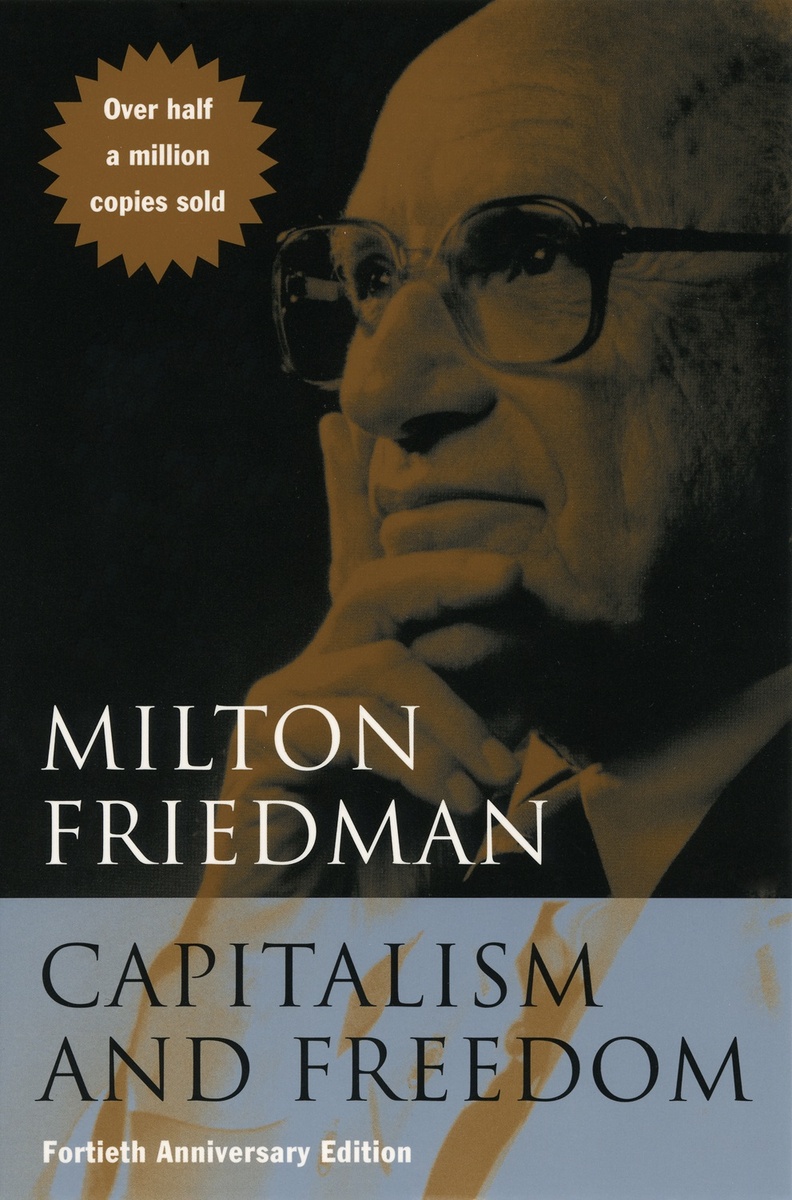
Capitalism and Freedom
Fortieth Anniversary Edition
University of Chicago Press, 2002
Cloth: 978-0-226-26420-2 | Paper: 978-0-226-26421-9 | Electronic: 978-0-226-26418-9
DOI: 10.7208/chicago/9780226264189.001.0001
Cloth: 978-0-226-26420-2 | Paper: 978-0-226-26421-9 | Electronic: 978-0-226-26418-9
DOI: 10.7208/chicago/9780226264189.001.0001
AVAILABLE FROM
This title is no longer available from this publisher at this time. To let the publisher know you are interested in the title, please email bv-help@uchicago.edu.
ABOUT THIS BOOKAUTHOR BIOGRAPHYTABLE OF CONTENTS
ABOUT THIS BOOK
Selected by the Times Literary Supplement as one of the "hundred most influential books since the war"
How can we benefit from the promise of government while avoiding the threat it poses to individual freedom? In this classic book, Milton Friedman provides the definitive statement of his immensely influential economic philosophy—one in which competitive capitalism serves as both a device for achieving economic freedom and a necessary condition for political freedom. The result is an accessible text that has sold well over half a million copies in English, has been translated into eighteen languages, and shows every sign of becoming more and more influential as time goes on.
How can we benefit from the promise of government while avoiding the threat it poses to individual freedom? In this classic book, Milton Friedman provides the definitive statement of his immensely influential economic philosophy—one in which competitive capitalism serves as both a device for achieving economic freedom and a necessary condition for political freedom. The result is an accessible text that has sold well over half a million copies in English, has been translated into eighteen languages, and shows every sign of becoming more and more influential as time goes on.
AUTHOR BIOGRAPHY
Milton Friedman is a senior research fellow at the Hoover Institution, Stanford University, and the Paul Snowden Distinguished Service Professor Emeritus of Economics at the University of Chicago. In 1976 he was awarded the Nobel Prize in economics. He has written a number of books, including two with his wife, Rose D. Friedman—the bestselling Free to Choose and Two Lucky People: Memoirs, the latter published by the University of Chicago Press.
TABLE OF CONTENTS
Preface, 2002
Preface, 1982
Preface
Introduction
I The Relation Between Economic and Political Freedom
II The Role of Government in a Free Society
III The Control of Money
IV International Financial and Trade Arrangements
V Fiscal Policy
VI The Role of Government in Education
VII Capitalism and Discrimination
VIII Monopoly and the Social Responsibility of Business and Labor
IX Occupational Licensure
X The Distribution of Income
XI Social Welfare Measures
XII Alleviation of Poverty
XIII Conclusion
Index