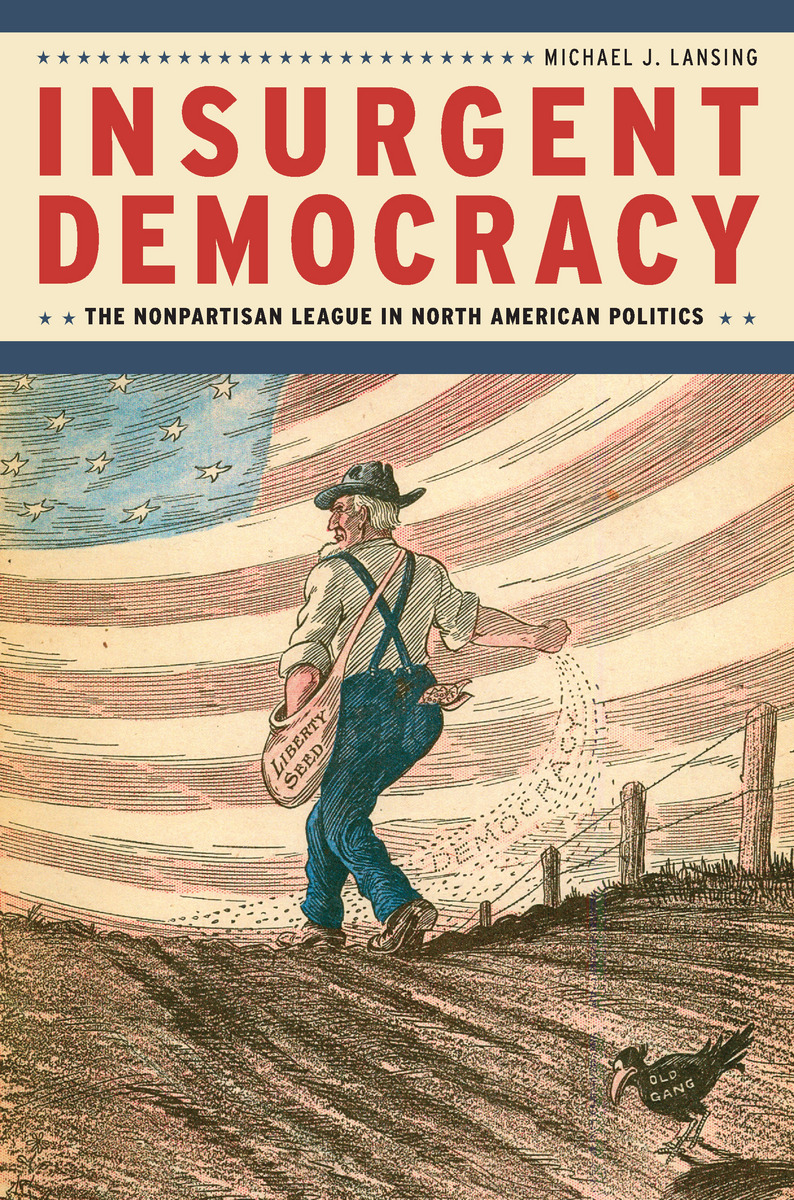
Insurgent Democracy
The Nonpartisan League in North American Politics
University of Chicago Press, 2015
Cloth: 978-0-226-28350-0 | Paper: 978-0-226-43477-3 | Electronic: 978-0-226-28364-7
DOI: 10.7208/chicago/9780226283647.001.0001
Cloth: 978-0-226-28350-0 | Paper: 978-0-226-43477-3 | Electronic: 978-0-226-28364-7
DOI: 10.7208/chicago/9780226283647.001.0001
AVAILABLE FROM
University of Chicago Press (cloth, paper, ebook)Brytewave (CafeScribe-Follett Higher Ed)
Chegg Inc
DeGruyter Multi-User Ebook Program
ebrary
EBSCO eBooks (formerly NetLibrary)
Kno
University Press Scholarship Online (UPSO)
ABOUT THIS BOOKAUTHOR BIOGRAPHYREVIEWSTABLE OF CONTENTS
ABOUT THIS BOOK
In 1915, western farmers mounted one of the most significant challenges to party politics America has seen: the Nonpartisan League, which sought to empower citizens and restrain corporate influence. Before its collapse in the 1920s, the League counted over 250,000 paying members, spread to thirteen states and two Canadian provinces, controlled North Dakota’s state government, and birthed new farmer-labor alliances. Yet today it is all but forgotten, neglected even by scholars.
Michael J. Lansing aims to change that. Insurgent Democracy offers a new look at the Nonpartisan League and a new way to understand its rise and fall in the United States and Canada. Lansing argues that, rather than a spasm of populist rage that inevitably burned itself out, the story of the League is in fact an instructive example of how popular movements can create lasting change. Depicting the League as a transnational response to economic inequity, Lansing not only resurrects its story of citizen activism, but also allows us to see its potential to inform contemporary movements.
Michael J. Lansing aims to change that. Insurgent Democracy offers a new look at the Nonpartisan League and a new way to understand its rise and fall in the United States and Canada. Lansing argues that, rather than a spasm of populist rage that inevitably burned itself out, the story of the League is in fact an instructive example of how popular movements can create lasting change. Depicting the League as a transnational response to economic inequity, Lansing not only resurrects its story of citizen activism, but also allows us to see its potential to inform contemporary movements.
AUTHOR BIOGRAPHY
Michael J. Lansing is associate professor of history at Augsburg College in Minneapolis.
REVIEWS
“Insurgent Democracy is beautifully written, deeply researched, and compellingly argued. Lansing’s graceful prose and flowing narrative will capture the attention and imagination of a wide variety of readers, including historians, political scientists, and activists. This book will be one of the most important rural, western, and American political histories to emerge for some time. At the same time, the book helps to redeem—in a proud but not uncritical manner—our nation’s rich legacy of agrarian radicalism.”
— Robert D. Johnston, author of The Radical Middle Class“The farmers of the Nonpartisan League unleashed an anti-corporate insurgency about which most of us know too little. Yet, their democratic experiments and their pursuit of alternative economic models offer invaluable insights. Lansing tells their remarkable story with the care and passion that it deserves.”
— Charles Postel, author of The Populist Vision“Lansing takes us back to a time when ordinary people fought to participate fully in democratic institutions and believed adamantly in a marketplace that would serve all people. They were engaged, imaginative, and courageous. Lansing also reminds us that it is not too late to demand the same.”
— Catherine McNicol Stock, author of Rural Radicals: Righteous Indignation in the American Grain“The history of agricultural radicalism in the US (or even the political history of farmers, for that matter) usually ends with the demise of the Populists in the 1890s. Lansing, however, provides a much-needed corrective in this book charting the history of the eponymous North Dakota-born farmers’ organization, formed in 1915, that spread across agricultural states from Wisconsin to Washington, and even into Canada. . . . This book should be in every academic library collection. Highly recommended.”
— Choice“The book is an excellent opportunity to take a new look at the impact of the Nonpartisan League not only in North Dakota, but nationally and in Canada. Lansing’s account of the League’s success and failure is also a study of the difficult but not impossible path of citizen action that can transform the political process, even from within the system.”
— North Dakota History“Written at a time when populisms of the right have decimated that liberalism, Lansing’s story invites fresh conversations about the current state of American politics.”
— Western Historical Quarterly“Lansing has produced a well-researched and elegantly written chronicle of the NPL and its short-lived period of operation (1915–1923), focusing his keen gaze on how the organization created a rural insurgency dedicated to the proposition of participatory democracy. Aiming his lens at contemporary American politics with its ideological divisions, rapacious capitalism, and growing economic inequality, Lansing’s book also serves as a platform for how such a politics might be achieved again.”
— Agricultural History“Lansing’s Insurgent Democracy is a product of different times and of recent developments in historical scholarship. Impressively researched, it ranges over a full catalog of concepts and issues of current academic interest, including transnationalism, women’s activism, historical memory, the radical middle class, movement culture, election laws, participatory democracy, citizen empowerment, and moral economy. . . . It provides important new perspectives on a remarkable movement and should stimulate further work.”
— Journal of American History“Meticulously researched, accurate and workmanlike, insightful, and smoothly written. For anyone wishing to learn about a little known chapter in early twentieth-century North American agrarian politics, this book is very good.”
— Labour/Le Travail“The strength of Insurgent Democracy comes from Lansing’s impressive use of primary sources to bring the NPL’s story back to life. His ability to connect American and Canadian history adds a dimension rarely achieved in other works. Insurgent Democracy’s thoughtful discussion helps restore the broader political imaginary of the NPL’s vision.”
— Nebraska History“Lansing casts a keen eye on a populist movement that briefly unsettled politics on the western plains, providing a blueprint for citizen agency in a corporate age. . . . Prodigiously researched and passionately argued, Insurgent Democracy could hardly be more relevant to the current political conversation. In a presidential election year in which populist messages have engaged millions of voters in both major parties, a turn to history offers both cautionary notes and inspiration, depending on one’s perspective. The way things are is not always the way things must be. Surely an idealist’s mantra, it may also offer a road map to something better.”
— American Historical Review“A thoughtfully conceived and carefully constructed example of how a study steeped in a particular regional context can also provide valuable insight on enduring questions, which include but also ultimately transcend that context.”
— Great Plains Studies“A fascinating read. . .Raises thought-provoking questions. . .The many microepisodes spread throughout Insurgent Democracy provide fodder for a scholar seeking to examine the challenges of fusing farmers and labor.”
— Kansas HistoryTABLE OF CONTENTS
Prologue
1. Birth - Michael J. Lansing
2. Expansion - Michael J. Lansing
3. Opposition - Michael J. Lansing
4. Power - Michael J. Lansing
5. Reverses - Michael J. Lansing
6. Legacies - Michael J. Lansing
Epilogue
Acknowledgments
Notes
Index