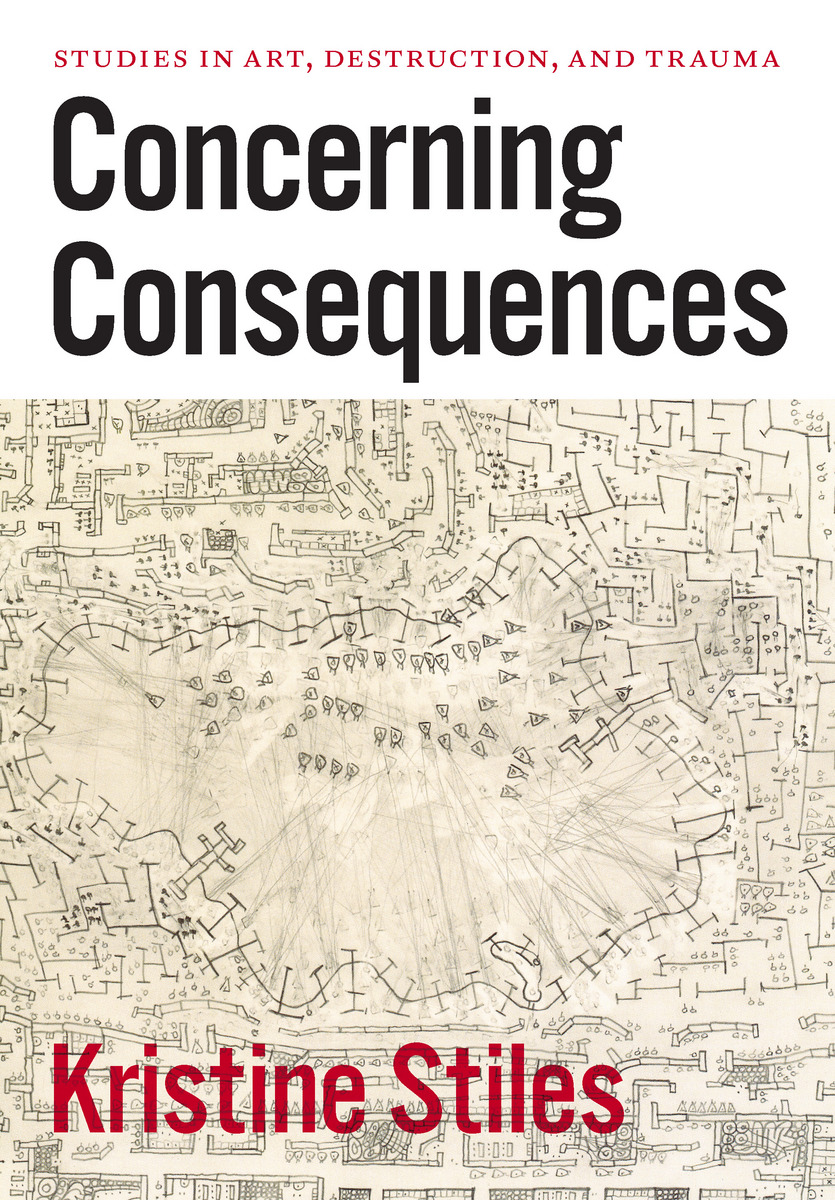
TABLE OF CONTENTS
Acknowledgments
Introduction - Kristine Stiles
DOI: 10.7208/chicago/9780226304403.003.0001
[art, trauma, cultures of trauma, dissociation, doubling, Shaft of the Dead Man, visual representations, trauma studies, art history, biography]
This book explores the ceremonial role of art in expressing the concerning consequences of traumatic events. The author, who introduced the phrase “cultures of trauma” in 1993 to describe the situation in Romania and other Eastern European countries following the Velvet Revolutions in 1989, discusses traumatic dissociation, doubling, and metaphors for dissociated personality in the work of five artists: Istvan Kantor, Franz West, Lynn Hershman Leeson, Larry Miller, and Yoko Ono. This introduction analyzes the Upper Paleolithic paintings in what is known as the Shaft of the Dead Man, a shaft located in the extensive underground cave at Lascaux in southwestern France, and situates the shaft scene's imagery as a cornerstone of visual representations of trauma that belong not to modernism but to deep time. Also considered is Ai Weiwei's Marble Chair (2008), trauma studies in art history, and the importance of biography in writing about trauma. (pages 1 - 26)
This chapter is available at:
https://academic.oup.com/chica...
I. Cultures of Trauma
Survival Ethos and Destruction Art - Kristine Stiles
DOI: 10.7208/chicago/9780226304403.003.0002
[destruction art, survivor, survival, survival art, visual arts, destruction, artists, Gustav Metzger, auto-destructive art, Destruction in Art Symposium]
This chapter argues that destruction art is the visual corollary to the discourse of the survivor: it bears witness to the tenuous conditionality of survival. It describes destruction art, which might just as appropriately be called “survival art,” as the only attempt in the visual arts to grapple seriously with both the technology of actual annihilation and the psychodynamics of virtual extinction. It suggests that destruction art is one of the few cultural practices to address the general absence of discussion about destruction in society in order to marshal human conscience into collective awareness and resistance. In this sense, the overriding values of the artists associated with destruction art are ethical. The chapter also examines Gustav Metzger's “auto-destructive art” and how he brought the various tendencies of destruction art together as a cohesive discourse and representation in the Destruction in Art Symposium in 1966. (pages 29 - 46)
This chapter is available at:
https://academic.oup.com/chica...
Shaved Heads and Marked Bodies: Representations from Cultures of Trauma - Kristine Stiles
DOI: 10.7208/chicago/9780226304403.003.0003
[cultures of trauma, shaved heads, marked bodies, visual arts, trauma, destruction, violence, visual memory, culture, skinheads]
This chapter examines two sites within the cultures of trauma: “shaved heads” and “marked bodies.” “Shaved heads” are a representation pertaining both to an image and to a style, resulting from a wide variety of social and political experiences outside of the context of the visual arts. “Marked bodies” are a representation that refers to the performative paradigm that developed within society and the visual arts, an aesthetic practice that is rooted deeply in cultures of trauma in accordance with larger political frames of destruction and violence. The chapter considers examples of shaved heads in history that inhabit the visual memory of culture, a memory of the history of war, domination, and colonization across whose pages bodies reach back to the Old and New Testaments and forward to the white power of skinheads. (pages 47 - 66)
This chapter is available at:
https://academic.oup.com/chica...
Remembering Invisibility: Documentary Photography of the Nuclear Age - Kristine Stiles
DOI: 10.7208/chicago/9780226304403.003.0004
[remembrance, atom bombs, nuclear age, nuclear weapons, nucleography, documentary photographs, nucleocide, documentary photography]
This chapter argues that photography can play a crucial role in the survival of the planet by enabling the visual knowledge necessary for remembrance, the prerequisite for agency. Photography was important to the precise targeting of the atom bombs that destroyed Hiroshima and Nagasaki. It can represent the micro and macro conditions of the nuclear age, depict the hidden places and conditions of nuclear weapons manufacture and storage, and display nuclear energy industries, as well as record humans, animals, and the environment damaged by radiation and fallout. The chapter proposes the terms “nucleography” for the unparalleled visual traces of the bomb's light, “nucleographic” for documentary photographs of the nuclear age, and “nucleocide” for that war that is its legacy. It also considers documentary photography as a branch of nucleography. (pages 67 - 84)
This chapter is available at:
https://academic.oup.com/chica...
II. Doubles
The Ideal Gifts and The Trinity Session of Istvan Kantor - Kristine Stiles
DOI: 10.7208/chicago/9780226304403.003.0005
[trauma, Istvan Kantor, The Trinity Session, empire, extreme experience, art, social calamity, ideal gifts]
This chapter analyzes the evidence of the role of trauma—cultural, political, and social—in the work of Istvan Kantor by focusing on his The Trinity Session. It first considers the proposition that the conditions of empire are enough to have already plunged entire world populations into states of rebellion, dissociated distraction, and numbness, all part of the etiology of trauma. It then discusses Kantor's reference to the many arrests he has provoked and endured as the result of his “ideal gifts” to art and society during the Austro-Hungarian Empire. It also examines The Trinity Session through the lens of extreme experience, arguing that its significance derives from the ontological depths to which he has pushed art in an effort to articulate and present truths about contemporary social calamity. (pages 87 - 99)
This chapter is available at:
https://academic.oup.com/chica...
Franz West’s Dialogic Paßstücke - Kristine Stiles
DOI: 10.7208/chicago/9780226304403.003.0006
[art, Franz West, Paßstücke, adaptives, Louis Lavelle, Paul Ricoeur, psyche, God, fetish, art objects]
This chapter examines Franz West's Paßstücke, a word that means “adaptives” in English. Paßstücke are odd objects that suggest both Louis Lavelle's philosophical considerations of the similarities between Narcissus and Pygmalion, and Paul Ricoeur's meditations. West began making the Paßstücke in 1973. The very enigmatic qualities of the Paßstücke emphasize personality traits not otherwise readily apparent in our use and manipulations of normal objects. Because of their special status as art objects, the Paßstücke can operate without reference to everyday objects. Their significance resides in how they visualize what we already know about the interrelationship between the psyche and its objects. This chapter addresses the psychological function of the Paßstücke as well as its relationship to the issue of God and to the fetish. (pages 100 - 108)
This chapter is available at:
https://academic.oup.com/chica...
1.1.78–2.2.78: Lynn Hershman’s Roberta Breitmore - Kristine Stiles
DOI: 10.7208/chicago/9780226304403.003.0007
[doubling, Lynn Hershman, Roberta Breitmore, psychotherapy, art, San Francisco, schizophrenia, madness]
This chapter talks about Lynn Hershman's fictional persona and alter ego called Roberta Breitmore, written between January 1, 1978 and February 2, 1978. Here the author mimes the two voices in Hershman's doubling as Roberta Breitmore and represents the odd double exigencies of someone who functioned in the role of both a scholar and an artist. Each voice is not quite what it wants to be: one has a scholarly tone, the other a not quite street slang. She describes Roberta Breitmore as an indistinct character existing on our perimeter, a vacant participant in psychotherapy, Art openings, EST, Zen Center, Weight Watchers, her own neighborhood. Since Roberta was exposed, she multiplied into Other look-alikes. She is an object contained both by the city of San Francisco's Space and the locale's time. Roberta calls her own doubling, Schizophrenia, a Representation that is pretty much the popularization of one version of Madness. (pages 109 - 120)
This chapter is available at:
https://academic.oup.com/chica...
Larry Miller’s Mom-Me - Kristine Stiles
DOI: 10.7208/chicago/9780226304403.003.0008
[art, Larry Miller, video installation, Mom-Me, violence, sexual abuse, mother, hypnosis, trauma, anomaly]
This chapter analyzes the various substrates of Larry Miller's 1973 video installation and performance called Mom-Me. Miller's dysfunctional family and the events of his childhood influenced his work; he lived in a violent environment in which the violence itself often took place in a sexualized context. Miller became hypervigilant in order to ward of and avoid his stepfather's violence, and he dissociated himself psychologically from the memories of his past; both behaviors are similar to the patterns of individuals who have experienced actual sexual abuse. Mom-Me consists of photographs, texts, and a ninety-minute video documenting Miller's attempt to inhabit his mother's psyche while under hypnosis. Yet Mom-Me is devoid of references to Miller's traumatic childhood. The chapter emphasizes Miller's attention to anomaly, suggesting that it represents not only an extraordinary attention to life, but also a will to live in and through art. (pages 121 - 133)
This chapter is available at:
https://academic.oup.com/chica...
Unbosoming Lennon: The Politics of Yoko Ono’s Experience - Kristine Stiles
DOI: 10.7208/chicago/9780226304403.003.0009
[art, Yoko Ono, avant-garde, LENONO, John Lennon, protofeminism, popular culture]
This chapter analyzes Yoko Ono's avant-garde performance work and how it helped nurture the architecture of LENONO, the neologism she and John Lennon coined for a record label. On the album Double Fantasy, recorded just before his murder in 1980, Lennon publicly avowed his difficulty in being able to “hardly express” that “woman...I'm forever in your debt.” In his unabashed and unembarrassed acknowledgment of woman, Lennon sang to Yoko Ono and in the process “unbosomed himself.” This chapter examines three aspects of LENONO: the biographical and artistic origins of Ono's art actions and her protofeminist concerns as they contributed to Lennon's entrance into the avant-garde; the ways in which the history of avant-garde performance helped Lennon to articulate his own male space for feminist practice; and the ways in which Ono and Lennon utilized live performed art to realize the activist potential of their union in popular culture beyond the insularity of the art world. (pages 134 - 156)
This chapter is available at:
https://academic.oup.com/chica...
III. Shooting Range
Burden of Light: Chris Burden - Kristine Stiles
DOI: 10.7208/chicago/9780226304403.003.0010
[light, Chris Burden, art, Shoot, White Light/White Heat, The Fist of Light, human nature, truth, lux, lumen]
This chapter examines how light figures in Chris Burden's art in a range of media, including Shoot (1971), White Light/White Heat (1975), and The Fist of Light (1993). Light pervades Burden's work, from the glint of a bullet to that light emitted by solar rays, fire, and electricity, and the refracted luminosity of materials such as glass, nickel, water, gold, and diamonds. His work with light can be sinister and foreboding, plunge viewers into pitch-blackness, expose the lethal and life-giving potentialities of light, and juxtapose visibility and invisibility. The chapter explains how Burden used light to contrast the spiritual with the dark side of human nature in the convergence of cultural and political affairs. Rather than producing art that is dependent upon sight for truth, Burden unites the conceptual illumination of lux to the empirical understanding of lumen. (pages 159 - 175)
This chapter is available at:
https://academic.oup.com/chica...
Teaching a Dead Hand to Draw: Kim Jones, War, and Art - Kristine Stiles
DOI: 10.7208/chicago/9780226304403.003.0011
[art, Kim Jones, Vietnam War, Teaching a Dead Hand to Draw, trauma, Khaki Marine Shirt, Rat Piece, Self Love]
This chapter examines Kim Jones's representation of the Vietnam War in his art, including Teaching a Dead Hand to Draw. Jones has had the temerity and exceptional force of temperament, personality, ingenuity, and originality to teach his hand to draw. Through that act, in all its aesthetic variety, he continually overcomes the grief and memories of experiences beyond comprehension that are the legacy of the Vietnam War. This chapter also considers the ways that Jones translated the language of war trauma into the languages of art by analyzing his other works such as Khaki Marine Shirt (2005), Rat Piece (1976), and Self Love (1986). (pages 176 - 193)
This chapter is available at:
https://academic.oup.com/chica...
Jean Toche: Impressions from the Rogue Bush Imperial Presidency - Kristine Stiles
DOI: 10.7208/chicago/9780226304403.003.0012
[documentary photography, Jean Toche, Impressions from the Rogue Bush Imperial Presidency, art, transformism, self-portraits, politics, exhibition, Bush administration]
This chapter examines Jean Toche's 2009 exhibition Impressions from the Rogue Bush Imperial Presidency, seen as an indictment of the deceitful, empire-building Bush administration and how it operated with criminal villainy. Documentary photography bears witness to moments in history, and art photography of the body depicts intimate life, including sexuality, identity, family relations, privacy, and one's association or disconnection to the self. These two truisms about photographic genres are related to questions regarding the purpose of photography to capture appearances or to transform the world in what Louis Ducos du Hauron called “transformism” in 1889. The chapter considers Toche's use of a Polaroid camera to shoot mocking self-portraits that express his resistance to every aspect of culture, politics, religions, and much more. (pages 194 - 208)
This chapter is available at:
https://academic.oup.com/chica...
IV. Corpora Vilia
Cloud with Its Shadow: Marina Abramović - Kristine Stiles
DOI: 10.7208/chicago/9780226304403.003.0013
[art, Marina Abramović, The Biography, body art, Yugoslavia, social body, Cleaning the House, Cleaning the Mirror I, sacred contact, Balkan Erotic Epic]
This chapter examines the art of Marina Abramović, beginning with excerpts from her The Biography (1993). Abramović belongs to a small number of artists throughout the world who pioneered body art and who established many of its aesthetic criteria. Her autobiography unmasks the foundations upon which she would practice art and suggests how she would eventually transform her life in order to live her art “in the here and now.” Abramovic's performances incriminate everyone in the former Yugoslavian nation, yoking intimate acts of purification onto the polluted social body to insinuate that the crimes of the state are also those of its citizens. The chapter considers Abramović's other works, including Cleaning the House (1996) and Cleaning the Mirror I (1995), both of which incorporate an element of “sacred contact,” and Balkan Erotic Epic (2005). (pages 211 - 243)
This chapter is available at:
https://academic.oup.com/chica...
Thunderbird Immolation: William Pope.L and Burning Racism - Kristine Stiles
DOI: 10.7208/chicago/9780226304403.003.0014
[black humor, William Pope.L, Thunderbird Immolation, racism, performance art, photography, painting, social realism]
This chapter examines William Pope.L's Thunderbird Immolation, a work of art that brings humor into the context of racism. Thunderbird Immolation (and other street works like Roach Motel, 1978) is socially aggressive and confrontational in the manner of Adrian Piper's early Catalysis pieces. While performance art is fundamentally a figurative practice deeply intertwined with the development of figurative painting, sculpture, and photography from history painting and various types of social realism to documentary, Pope.L's performative intervention in the spaces of the elite Soho commercial art market also realized a high level of conceptual abstraction. Pope.L expresses his fury in what is best known as “black humor”. (pages 244 - 250)
This chapter is available at:
https://academic.oup.com/chica...
Barbara Turner Smith’s Haunting - Kristine Stiles
DOI: 10.7208/chicago/9780226304403.003.0015
[haunting, Barbara Turner Smith, art, Xerox photocopy books, black paintings, performances, sexuality, death, traumatic memory, Piercing the Corporate Veil]
This chapter examines the haunted presence in Barbara Turner Smith's art and life. Haunting permeates and informs Smith's work. From her early Xerox photocopy books and black paintings to performances that celebrate sexuality, sacrifice, spiritual quests, growth, and giving, Smith's haunting signifies a pervasive yet generative consciousness of death that is the source of her deep sense of contingency and responsibility. Smith's awareness of the fragility of being—her inner gnawing and its link to interpersonal accountability—constitutes a self-regulating and self-reflexive aesthetic practice that entails both personal reflection and interdependent care. The chapter considers some of Smith's performances that deal with various structures of traumatic memory, including Piercing the Corporate Veil, Feed Me, The Way to Be, and The 21st Century Odyssey. (pages 251 - 262)
This chapter is available at:
https://academic.oup.com/chica...
The Aesthetics of the Misfit: The Case of Henry Flynt and David Tudor - Kristine Stiles
DOI: 10.7208/chicago/9780226304403.003.0016
[aesthetics, David Tudor, John Cage, Henry Flynt, self-expression, freedom, sense of self, creep personality]
This chapter examines the aesthetics of David Tudor as a performer and composer by situating his artistic aims within those of John Cage and Henry Flynt. As an interpreter-performer, Tudor trusted in and aspired to the moment when in following a score he could unexpectedly depart from it, reaching a point of independence and sovereignty in the creative act. Although Tudor was the consummate interpreter of Cage's work, his own aesthetic interests diverged considerably from Cage's rejection of self-expression, his pursuit of anonymity in the work, and his notions of freedom. Drawing on interviews with and statements by Tudor and other artists, the chapter discusses the aesthetics of the misfit found in the margins of work by artists like Flynt and Tudor. It also considers Tudor's views on freedom and expression as well as his sense of self, along with Flynt's theory of the creep personality. (pages 263 - 273)
This chapter is available at:
https://academic.oup.com/chica...
Notes on Rudolf Schwarzkogler’s Images of Healing, A Biographical Sketch - Kristine Stiles
DOI: 10.7208/chicago/9780226304403.003.0017
[healing, Rudolf Schwarzkogler, actions, photographs, regeneration, transformation, death, mortality, suffering, resurrection]
This chapter examines images of healing in the works of Rudolf Schwarzkogler. Schwarzkogler began what would be his short corpus of actions in the summer and fall of 1965. His first four actions took place in his friend Heinz Cibulka's apartment: Hochzeit (Wedding), 2nd Action, 4. Aktion, and 6. Aktion. He initially titled these four actions, made for the production of photographs, Aktion mit einem menschlichen Körper (Action with a Male Body). The chapter suggests how, in highly compacted arcane signifiers of regeneration and transformation, Schwarzkogler opposed death with the fragility of mortality, seeking to redefine fragmentation in terms of the contingency of suffering bodies in strange forms of resurrection that anticipated Jacques Derrida's observation: “Cruelty is consciousness, is exposed lucidity”. (pages 274 - 284)
This chapter is available at:
https://academic.oup.com/chica...
V. Terminal Culture
Rauschenberg’s “Gap” - Kristine Stiles
DOI: 10.7208/chicago/9780226304403.003.0018
[art, Robert Rauschenberg, life, painting, experimental art, imagery, photography, ethics, Litercy (Phantom), gap]
This chapter examines Robert Rauschenberg's attempt “to act” in “that gap” between art and life in his effort to avoid the incommensurability of what he called the “blinding fact” of both. In 1959, Rauschenberg declared: “Painting relates to both art and life. Neither can be made. (I try to act in that gap between the two.)” By 1977, Rauschenberg's “act in the gap” had become a maxim for experimental art. His appropriated imagery, combined with photography and painting, would soon also be recognized as the antecedent for visual aspects of postmodernism, especially neo-expressionist painting, in the 1980s. The chapter discusses Rauschenberg's notion of art and life as well as his views on ethics, along with his 1991 work of art Litercy (Phantom). (pages 287 - 308)
This chapter is available at:
https://academic.oup.com/chica...
Warhol’s “What?” - Kristine Stiles
DOI: 10.7208/chicago/9780226304403.003.0019
[capitalism, Andy Warhol, advertising, Rainer Crone, Steven Koch, Hal Foster, traumatic imagery, art, traumatic subjectivity, shadows]
This chapter examines Andy Warhol's foresight regarding the demise of cultural conventions, augmented by the ubiquity of capitalism, advertising, and technology. Many in the 1960s dismissed Warhol as a mere product of Madison Avenue advertising and capitalism. Rainer Crone attempted to right this perception, insisting that Warhol had “revolutionized traditional aesthetics” by uniting silkscreen, painting, and photography. By contrast, Steven Koch presented Warhol as the cruel and poignant icon in his 1973 book Stargazer: Andy Warhol's World and His Films. In 1996, Hal Foster published “Death in America,” which extended his reading of Warhol's traumatic imagery to a broader analysis of art. Beginning with his oft-repeated question “What?” the chapter analyzes Warhol's behavior and argues that it is not a “performance” but a performative manifestation of traumatic subjectivity. It also considers Warhol's views on Americans and the United States, along with his reproduction of shadows in his works. (pages 309 - 338)
This chapter is available at:
https://academic.oup.com/chica...
Maurice Benayoun’s “7:47 a.m.”
Wangechi Mutu’s Family Tree - Kristine Stiles
DOI: 10.7208/chicago/9780226304403.003.0021
[intersubjectivity, Wangechi Mutu, art, Family Tree, collage, contact zones, world culture, cultural agency, trauma, feminism]
This chapter examines the hybrid, cyborgian identity that Wangechi Mutu constantly reinvents in her art througth an analysis of Family Tree. Mutu's collage and installation work delivers visual creolization as the corollary of “contact zones.” She continually reforms the metaphorical “we” in images, objects, and actions, working in every medium to invent this hybrid. The chapter explores Mutu's visual analysis of world culture and its planetary rootedness in racial, sexual, economic, and national divides; war; and the violence of privilege. It places Mutu's work within the domain of a philosophical conversation on intersubjectivity and discusses her exacting reconstruction of shared states of collective subjectivity and cultural agency. It also considers the convergence of trauma and feminism in her work and the forensic aspect of her reconstruction of composite imagery. (pages 343 - 362)
This chapter is available at:
https://academic.oup.com/chica...
Notes
Index