Cloth: 978-0-226-33399-1 | Paper: 978-0-226-52793-2 | Electronic: 978-0-226-33404-2
DOI: 10.7208/chicago/9780226334042.001.0001
ABOUT THIS BOOK
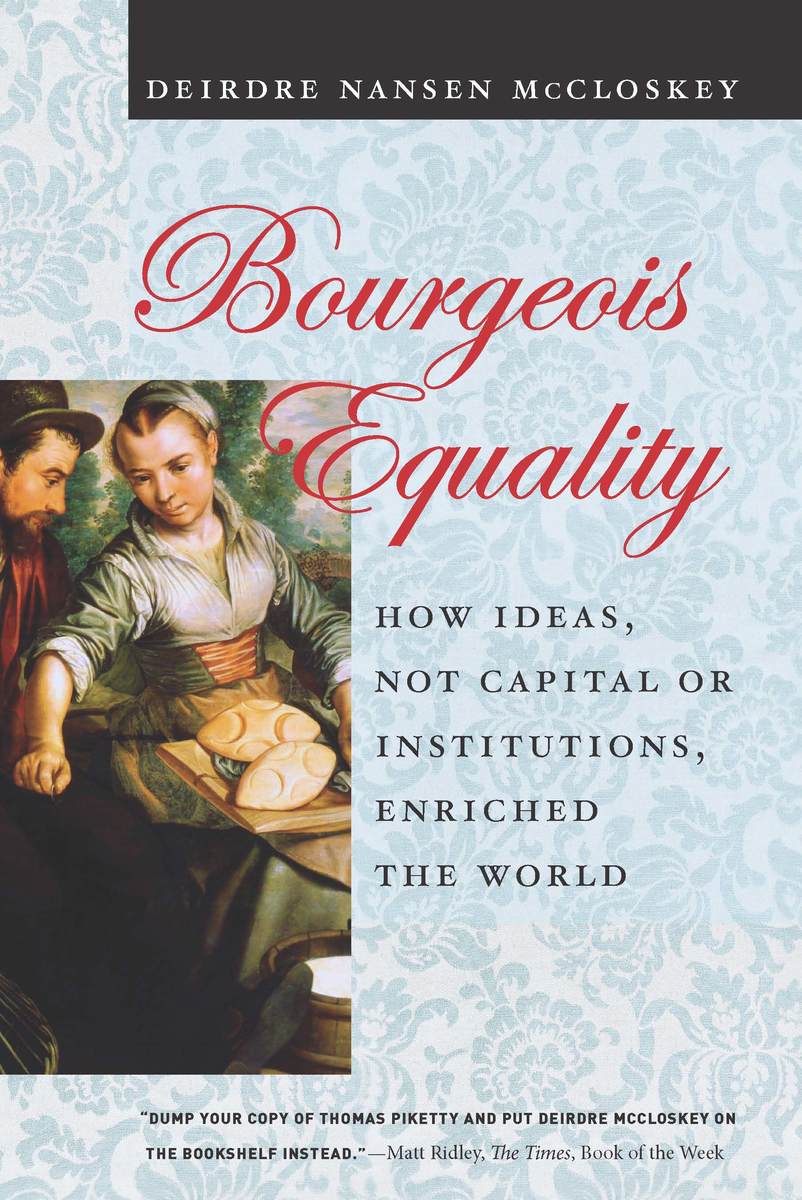
Why? Most economists—from Adam Smith and Karl Marx to Thomas Piketty—say the Great Enrichment since 1800 came from accumulated capital. McCloskey disagrees, fiercely. “Our riches,” she argues, “were made not by piling brick on brick, bank balance on bank balance, but by piling idea on idea.” Capital was necessary, but so was the presence of oxygen. It was ideas, not matter, that drove “trade-tested betterment.” Nor were institutions the drivers. The World Bank orthodoxy of “add institutions and stir” doesn’t work, and didn’t. McCloskey builds a powerful case for the initiating role of ideas—ideas for electric motors and free elections, of course, but more deeply the bizarre and liberal ideas of equal liberty and dignity for ordinary folk. Liberalism arose from theological and political revolutions in northwest Europe, yielding a unique respect for betterment and its practitioners, and upending ancient hierarchies. Commoners were encouraged to have a go, and the bourgeoisie took up the Bourgeois Deal, and we were all enriched.
Few economists or historians write like McCloskey—her ability to invest the facts of economic history with the urgency of a novel, or of a leading case at law, is unmatched. She summarizes modern economics and modern economic history with verve and lucidity, yet sees through to the really big scientific conclusion. Not matter, but ideas. Big books don’t come any more ambitious, or captivating, than Bourgeois Equality.
AUTHOR BIOGRAPHY
REVIEWS
TABLE OF CONTENTS
Exordium: The Three Volumes Show That We Are Rich Because of an Ethical and Rhetorical Change
Acknowledgments
First Question: What Is to Be Explained?
Part I. A Great Enrichment Happened, and Will Happen
1. The World Is Pretty Rich, but Once Was Poor
2. For Malthusian and Other Reasons, Very Poor
3. Then Many of Us Shot Up the Blade of a Hockey Stick
4. As Your Own Life Shows
5. The Poor Were Made Much Better Off
6. Inequality Is Not the Problem
7. Despite Doubts from the Left
8. Or from the Right and Middle
9. The Great International Divergence Can Be Overcome
Second Question: Why Not the Conventional Explanations?
Part II. Explanations from Left and Right Have Proven False
10. The Divergence Was Not Caused by Imperialism
11. Poverty Cannot Be Overcome from the Left by Overthrowing “Capitalism”
12. “Accumulate, Accumulate” Is Not What Happened in History
13. But Neither Can Poverty Be Overcome from the Right by Implanting “Institutions”
14. Because Ethics Matters, and Changes, More
15. And the Oomph of Institutional Change Is Far Too Small
16. Most Governmental Institutions Make Us Poorer
Third Question: What, Then, Explains the Enrichment?
Part III. Bourgeois Life Had Been Rhetorically Revalued Britain at the Onset of the Industrial Revolution
17. It Is a Truth Universally Acknowledged That Even Dr. Johnson and Jane Austen Exhibit the Revaluation
18. No Woman but a Blockhead Wrote for Anything but Money
19. Adam Smith Exhibits Bourgeois Theory at Its Ethical Best
20. Smith Was Not a Mr. Max U, but Rather the Last of the Former Virtue Ethicists
21. That Is, He Was No Reductionist, Economistic or Otherwise
22. And He Formulated the Bourgeois Deal
23. Ben Franklin Was Bourgeois, and He Embodied Betterment
24. By 1848 a Bourgeois Ideology Had Wholly Triumphed
Part IV. A Pro-Bourgeois Rhetoric Was Forming in England around 1700
25. The Word “Honest” Shows the Changing Attitude toward the Aristocracy and the Bourgeoisie
26. And So Does the Word “Eerlijk”
27. Defoe, Addison, and Steele Show It, Too
28. The Bourgeois Revaluation Becomes a Commonplace, as in The London Merchant
29. Bourgeois Europe, for Example, Loved Measurement
30. The Change Was in Social Habits of the Lip, Not in Psychology
31. And the Change Was Specifically British
Part V. Yet England Had Recently Lagg ed in Bourgeois Ideology, Compared with the Netherlands
32. Bourgeois Shakespeare Disdained Trade and the Bourgeoisie
33. As Did Elizabethan England Generally
34. Aristocratic England, for Example, Scorned Measurement
35. The Dutch Preached Bourgeois Virtue
36. And the Dutch Bourgeoisie Was Virtuous
37. For Instance, Bourgeois Holland Was Tolerant, and Not for Prudence Only
Part VI. R eformation, Revolt, Revolution, and Reading Increased the Liberty and Dignity of Ordinary Europeans
38. The Causes Were Local, Temporary, and Unpredictable
39. “Democratic” Church Governance Emboldened People
40. The Theology of Happiness Changed circa 1700
41. Printing and Reading and Fragmentation Sustained the Dignity of Commoners
42. Political Ideas Mattered for Equal Liberty and Dignity
43. Ideas Made for a Bourgeois Revaluation
44. The Rhetorical Change Was Necessary, and Maybe Sufficient
Part VII. Nowhere Before on a Large Scale Had Bourgeois or Other Commoners Been Honored
45. Talk Had Been Hostile to Betterment
46. The Hostility Was Ancient
47. Yet Some Christians Anticipated a Respected Bourgeoisie
48. And Betterment, Though Long Disdained, Developed Its Own Vested Interests
49. And Then Turned
50. On the Whole, However, the Bourgeoisies and Their Bettering Projects Have Been Precarious
Part VIII. Words and Ideas Ca used the Modern World
51. Sweet Talk Rules the Economy
52. And Its Rhetoric Can Change Quickly
53. It Was Not a Deep Cultural Change
54. Yes, It Was Ideas, Not Interests or Institutions, That Changed, Suddenly, in Northwestern Europe
55. Elsewhere Ideas about the Bourgeoisie Did Not Change
Fourth Question: What Are the Dangers?
Part IX. The History and Economics Have Been Misunderstood
56. The Change in Ideas Contradicts Many Ideas from the Political Middle, 1890–1980
57. And Many Polanyish Ideas from the Left
58. Yet Polanyi Was Right about Embeddedness
59. Trade-Tested Betterment Is Democratic in Consumption
60. And Liberating in Production
61. And Therefore Bourgeois Rhetoric Was Better for the Poor
Part X. That Is, Rhetoric Made Us, but Ca n Readily Unmake Us
62. After 1848 the Clerisy Converted to Antibetterment
63. The Clerisy Betrayed the Bourgeois Deal, and Approved the Bolshevik and Bismarckian Deals
64. Anticonsumerism and Pro-Bohemianism Were Fruits of the Antibetterment Reaction
65. Despite the Clerisy’s Doubts
66. What Matters Ethically Is Not Equality of Outcome, but the Condition of the Working Class
67. A Change in Rhetoric Made Modernity, and Can Spread It
Notes
Works Cited
Index