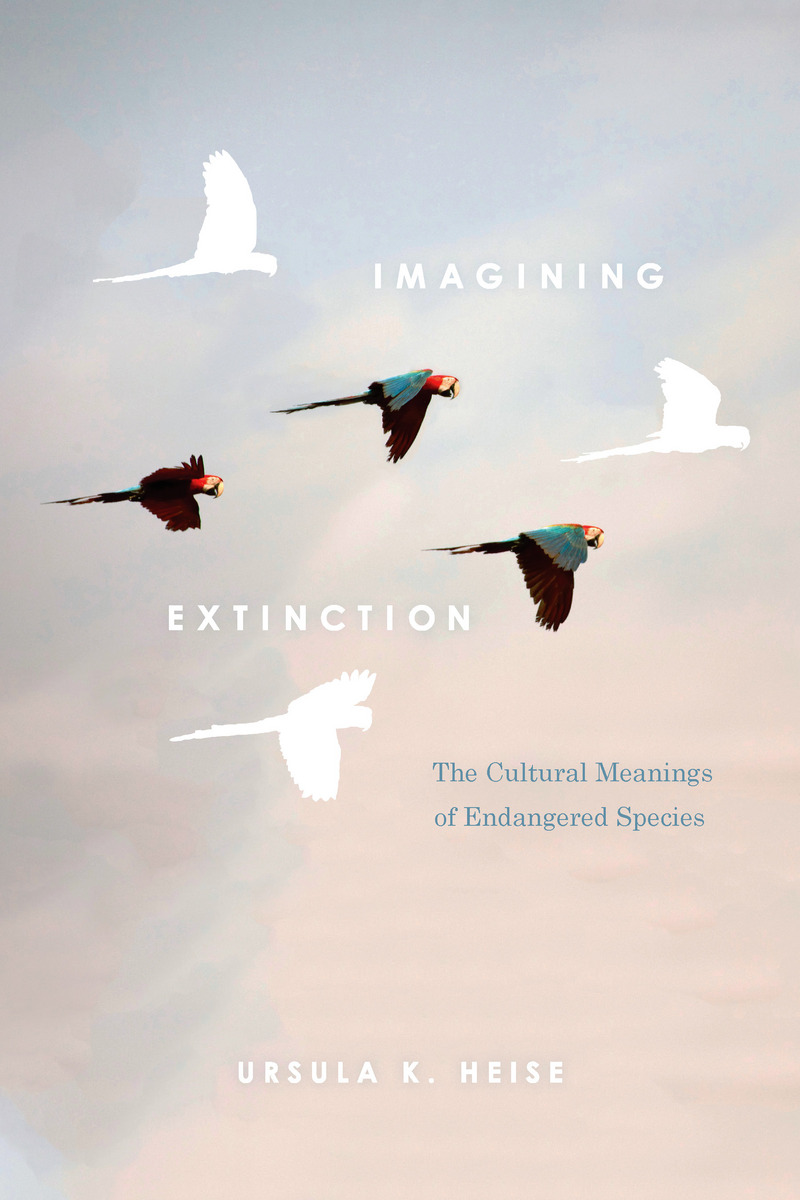
Imagining Extinction The Cultural Meanings of Endangered Species
by Ursula K. Heise
University of Chicago Press, 2016
Cloth: 978-0-226-35802-4 | Paper: 978-0-226-35816-1 | Electronic: 978-0-226-35833-8
DOI: 10.7208/chicago/9780226358338.001.0001
ABOUT THIS BOOKAUTHOR BIOGRAPHYREVIEWSTABLE OF CONTENTS

ABOUT THIS BOOK

We are currently facing the sixth mass extinction of species in the history of life on Earth, biologists claim—the first one caused by humans. Activists, filmmakers, writers, and artists are seeking to bring the crisis to the public’s attention through stories and images that use the strategies of elegy, tragedy, epic, and even comedy. Imagining Extinction is the first book to examine the cultural frameworks shaping these narratives and images.

Ursula K. Heise argues that understanding these stories and symbols is indispensable for any effective advocacy on behalf of endangered species. More than that, she shows how biodiversity conservation, even and especially in its scientific and legal dimensions, is shaped by cultural assumptions about what is valuable in nature and what is not. These assumptions are hardwired into even seemingly neutral tools such as biodiversity databases and laws for the protection of endangered species. Heise shows that the conflicts and convergences of biodiversity conservation with animal welfare advocacy, environmental justice, and discussions about the Anthropocene open up a new vision of multispecies justice. Ultimately, Imagining Extinction demonstrates that biodiversity, endangered species, and extinction are not only scientific questions but issues of histories, cultures, and values.

AUTHOR BIOGRAPHY

Ursula K. Heise is the Marcia H. Howard Chair in Literary Studies in the Department of English and the Institute of the Environment and Sustainability at the University of California, Los Angeles. Her books include Chronoschisms: Time, Narrative, and Postmodernism and Sense of Place and Sense of Planet: The Environmental Imagination of the Global.

REVIEWS

“[An] important, scholarly book. . . . Recommended.”
— Choice

“Heise is the leading ecocritic of her generation. Any serious-minded person with a concern for the longstanding but accelerating plight of endangered nonhuman species—and how to make sense of its history and possible futures as an urgent cultural predicament—is certain to profit from reading Imagining Extinction.”
— Lawrence Buell, Harvard University

“Imagining Extinction shows Heise working at the height of her powers, traversing a formidable range of charged ecological-cultural issues that include mass species extinctions and rapid loss of biodiversity; global climate change; narrative ‘templates’ that structure how cultures care about, and tell stories about, other species; the rise of biodiversity databases; biodiversity laws; and animal rights. This book is elegantly written, cogently organized, and comprehensively researched.”
— Nicole Shukin, University of Victoria

“Timely and nuanced.”
— ECOhUMANITIES

"Ursula Heise, who takes the time to unravel the philosophical contradictions that riddle the field with landmines. She’s very good at asking difficult questions. . . . Her book breaks interesting ground, examining the role of archives and databases as cultural mechanisms for establishing meaning as important as science fiction, ethnography, and theories of justice. All of these are woven together in the book, producing some refreshing new ways of thinking about our predicament."
 
— Nowtopian

"A nuanced re-visioning of extinction discourse, inflected powerfully by literary traditions ranging from elegy to epic. . . . Bound by temporal division, suggests Heise, only the human imagination can seemingly inspire the kind of social and political action championed by environmentalists and scientists alike. . . .  Imagining Extinction persuasively advocates for the centrality of the literary, the anthropological, the historical, and the psychological in coding and recoding our present considerations of extinction and the Anthropocene. Repeatedly, Heise draws our attention to 'the stories we tell about ourselves.' Perhaps this, after all, is the humanities’ calling. Writing and rewriting stories about who we are, where we are, why we are. And yet, in the same way that I do not want the humanities reduced to a single function, I would also not want to reduce Heise’s Imagining Extinction to a single application. Self-consciously, the text seems crafted in order to lend itself to alliances far beyond a single discourse or discipline. Extinction, after all, is by its present definition uncontained and uncontainable."
 
— Clint Wilson III, Cultures of Energy

"As a framework, multispecies justice attends to the ways in which cultural, socio-political, economic, and historical differences have shaped our thinking about human and non-human communities, as well as our relations to biological and ecological differences. The hope–as Heise’s work indicates--is that it may serve as a starting point for telling different stories and imagining a better future."
— Tranimacies

“This ambitious study covers extensive intellectual ground. The author’s goal is not to understand what endangered species and extinction mean biologically but to move toward understanding what they do (and perhaps to learn what they could eventually come to) mean culturally—or, in her words, ‘how they mean culturally.’ That distinction does not and should not be taken as an indication that this book does not represent relevant reading for biologists. It does, although it is equally relevant for anyone concerned about biodiversity and the environment.”
— The Quarterly Review of Biology

“The range of Heise’s analyses and the care with which she maintains her critical distance are remarkably impressive. . . . Imagining Extinction is a crisp, consistently intelligent study which helps us to think through extinction and the loss of biodiversity, but also how to negotiate and respect cultural difference, and how, practically, to extend that consideration to other living beings.”
 
— The British Society for Literature and Science

"In Imagining Extinction, Heise reads for extinction story templates across last-of-its-kind narratives, biodiversity databases, endangered species laws, and contemporary speculative fiction, along with other genres and media....Heise deftly lays pathways that environmental humanities scholars will tread for the foreseeable future. Her questions assume the primacy of narrative, but they also push literary and cultural scholars to deploy their skills of apprehension, discernment, analysis, and articulation across a wide range of disciplinary boundaries. They also offer incredibly useful anchors for teaching, in particular for helping students think about intersectional structures of oppression that encompass human and nonhuman creatures and their habitats."
— American Literary History

"Heise’s book sets itself apart from the basic premise of much of the extant literature on this topic. Rather than declaring it to be ‘imperative that we should care’, Heise asserts that the omnipresence of images of endangered and extinct species makes it abundantly clear that we do care, such that ‘why conservation matters and how it might be fostered’ are the issues at stake....Imagining Extinction is precise in the work that it does with individual ‘texts’ (broadly conceived). What is more, the demonstration that environmental narratives are first and foremost cultural rather than scientific across a very wide range of material blasts open new fields of enquiry for others to work in henceforth."
— European Journal of American Culture

TABLE OF CONTENTS

- Ursula K. Heise
DOI: 10.7208/chicago/9780226358338.003.0001
[declensionist narrative;decline narrative;Anthropocene;environmental narrative;endangered species;biodiversity conservation;species conservation]
The concern over endangered species and a possible mass extinction forms part of rapidly changing environmental discourses in the twenty-first century. Anthropologists, historians, and literary scholars have shown that the ecosystems that usually function as ground zero for restoration efforts—typically, landscapes before the arrival of European colonizers—had already been previously altered by indigenous peoples around the world for millennia. Climate change makes difficult the attempt to return to an earlier state of nature in many places. Faced with these challenges, environmentalist writer Bill McKibben proclaimed the “end of nature” in 1989, the vanishing of an ideal nature separate from humans. The lament over disappearing nature and the associated critique of modernity was countered by a more optimistic emphasis on modernization and technology in the 2000s, and has morphed over the last decade into discussions over the Anthropocene, domesticated nature, intervention ecology, and novel ecosystems. In this context of increasing controversy over the reasons and methods for conserving nature, biodiversity loss emerges as an issue that is closely associated with cultural anxieties and political critiques of modernization and colonization. Biodiversity and endangered species therefore need to be understood in terms of the cultural meanings they mobilize. (pages 1 - 18)
This chapter is available at:
    https://academic.oup.com/chica...

- Ursula K. Heise
DOI: 10.7208/chicago/9780226358338.003.0002
[environmental narrative;environmental elegy;environmental tragedy;environmental comedy;environmental rhetoric;modernization;biodiversity conservation;species conservation]
This chapter analyzes the interplay of science and culture in narratives about species loss. Scientific assessments of biodiversity are constrained by uncertainties that reach from the definition of "biodiversity" to appropriate ways of measuring it. In the scientific and public realms, arguments about biodiversity loss typically follow a narrative "proxy logic," whereby charismatic megafauna stand in for species at large, species for biodiversity, and biodiversity for what humans value about nature. This value attribution, as the cases of the dodo, the Honshu wolf, the ivory-billed woodpecker, the huia, and the thylacine show in works such as David Quammen's Song of the Dodo, Lee Hyla's Wilson's Ivory-Bill, Sally McIntyre's Huia Transcriptions, and Julia Leigh's The Hunter, are associated with narratives about modernization and colonization. Endangered or extinct animals typically feature in elegiac or tragic stories that highlight what was lost in such historical processes. Conservation, therefore, is primarily a political and cultural rather than a scientific issue, and should be approached through the study of narrative and culture. Comedies such as Douglas Adams’s Last Chance To See offer an alternative perspective on conservation that focuses on contingency and the present rather than on the past. (pages 19 - 54)
This chapter is available at:
    https://academic.oup.com/chica...

- Ursula K. Heise
DOI: 10.7208/chicago/9780226358338.003.0003
[database aesthetic;digital humanities;epic;inventory;catalog;biodiversity;species;biodiversity conservation;species conservation]
This chapter focuses on global biodiversity databases, Red Lists of endangered species, and works of literature and art that engage with species loss by way of a database aesthetic. Lydia Millet's novels How the Dead Dream and Maya Lin's website What Is Missing? exemplify an aesthetic approach to vanishing species by way of enumeration, so as to redirect the reader's attention from individual last specimens to biodiversity at large. Their species inventories resemble the global biodiversity databases that have been created over the last twenty years in response to the extinction crisis, especially Red lists that classify species by their risk. The IUCN Red List of Threatened Species, the most prominent global Red List, incorporates elements of elegy into its basic categories, but subordinates them to an epic and encyclopedic narrative logic that at certain moments even levels the difference between humans and other species. This epic approach is also visible in the photography and film database ARKive.org, as well as in the paintings of Isabella Kirkland and the photographs of Joel Sartore, which desentimentalize species elegies and tragedies by shifting to a perception of the numerical sublime of mass extinction and the epic narrative of planet Earth. (pages 55 - 86)
This chapter is available at:
    https://academic.oup.com/chica...

- Ursula K. Heise
DOI: 10.7208/chicago/9780226358338.003.0004
[biodiversity laws;endangered species laws;comparative legal studies;species;habitat;environmental justice;biodiversity conservation;species conservation]
This chapter compares laws for the protection of biodiversity in four sites (US, Germany, European Union, Bolivia) so as to highlight the divergent historical provenance and cultural framing of legal engagements with endangered species. The 1973 Endangered Species Act of the United States focuses on the protection of species at risk and on "critical habitat" as a way of preserving species. In Germany, where environmentalism since the late-nineteenth century has foregrounded the conservation of cultural landscapes, the current law protects biodiversity rather than endangered species, and subordinates the conservation of animal and plant species to the maintenance of historical and cultural landscapes. The European Union protects both species and habitats, adopting a largely scientific vocabulary to create a common language and concern for a shared heritage among its diverse member states. In Bolivia, the new constitution passed in 2009 and subsequent laws combine science and indigenous traditions so as to integrate biodiversity protection into a broader vision of "Buen Vivir," the just and good society. Assessing the performance of these laws is difficult without taking into account the cultural and political frameworks that make biodiversity conservation part of national or regional identity. (pages 87 - 126)
This chapter is available at:
    https://academic.oup.com/chica...

- Ursula K. Heise
DOI: 10.7208/chicago/9780226358338.003.0005
[animal welfare movement;animal rights movement;environmentalism;domestication;biodiversity conservation;species conservation;critical animal studies]
This chapter discusses intellectual and political tensions between biodiversity conservation and the animal welfare movement. Whereas both movements are centrally concerned with the welfare of nonhumans and react against the modern divide between humans and animals, they differ in their visions of the nonhuman Other. Animal welfare has conventionally focused on domestic nature and on individual animals that are used as pets, farming commodities, subjects of scientific experiments, and exhibits in zoos and circuses. It has invoked the animal's capabilities and, sometimes, rights, to justify its moral consideration. Environmental conservation has emphasized wild animals and plants, species rather than individuals, and has invoked functioning ecology as that which should be protected. A comparative reading of Jacques Derrida and Aldo Leopold shows that animal welfare typically seeks to make animals members of the human community, whereas environmentalism seeks to make humans citizens of the ecological community. In practical scenarios that involve introduced species, as T. C. Boyle demonstrates in his novel When the Killing's Done, neither movement can entirely live up to its principles. But as environmentalism, under the sign of the Anthropocene, envisions nature increasingly as domesticated, the perspective of animal welfare becomes newly relevant to conservation efforts. (pages 127 - 161)
This chapter is available at:
    https://academic.oup.com/chica...

- Ursula K. Heise
DOI: 10.7208/chicago/9780226358338.003.0006
[environmental justice;postcolonialism;postcolonial ecocriticism;multispecies ethnography;cultural anthropology;animal welfare;animal rights;biodiversity conservation;species conservation]
This chapter focuses on the political tensions between biodiversity conservation and environmental justice over the last thirty years, which have centered on the privileging of nonhuman species over the welfare of disenfranchised human communities. Through the analysis of three fictional texts that stage this confrontation, Mayra Montero's Tú, la oscuridad (In the Palm of Darkness), the Stanford Graphic Novel Project's Virunga, and Amitav Ghosh's The Hungry Tide, the chapter develops the notion of "multispecies justice." As a theoretical concept, multispecies justice draws on multispecies ethnography, studies of cosmopolitanism, critical animal studies, and Actor-Network-Theory to propose a model for combining justice for different human communities with justice for other species. It proposes that "the human" as a species category should not be assumed as a biological given, but assembled—in both the technical and the political senses of the word—from cultural differences. These differences will also inflect the parallel assembly of what justice means in particular contexts, especially in relation to the avoidable and unavoidable forms of violence that typically accompany encounters between different human communities and between species. (pages 162 - 201)
This chapter is available at:
    https://academic.oup.com/chica...

- Ursula K. Heise
DOI: 10.7208/chicago/9780226358338.003.0007
[Anthropocene;cosmopolitanism;environmental justice;multispecies ethnography;speculative fiction;science fiction;terraforming;species conservation;de-extinction;rewilding]
Recently, the concept of the Anthropocene has become increasingly important for environmentalism. For pessimists, it signals the enormous scope of negative human impact on the environment; for optimists, it means imagining the nature of the future as reshaped by humans. These discussions often draw (implicitly or explicitly) on tropes and narrative strategies from science fiction, especially the concept of terraforming, as do projects for "rewilding" and "de-extinction." Speculative fiction also resonates in other controversies around the Anthropocene: the question of whether it imposes the urgency of a new environmental cosmopolitanism, or glosses over continuing socio-economic divides, and whether it overemphasizes human agency, in tension with posthumanisms that have foregrounded nonhuman agents in social networks. But some of these posthumanisms, including the idea of multispecies justice, offer the possibility of extending cosmopolitan models of thought beyond the human sphere without relying on “flat ontologies” that weaken the emphasis on differences within and beyond species boundaries. Orson Scott Card's Ender tetralogy exemplifies in a fictional context the transition from human-caused extinction to multispecies justice, and thereby demonstrates how the planetary storytelling mode of speculative fiction provides a model for designing new narratives of biodiversity, conservation, survival, and multispecies justice. (pages 202 - 237)
This chapter is available at:
    https://academic.oup.com/chica...

- Ursula K. Heise
DOI: 10.7208/chicago/9780226358338.003.0008
[Anthropocene;climate change;polar bear;Inuit culture;species conservation;biodiversity conservation;Arctic]
The Coda analyzes the polar bear as a symbol of global, rather than culturally specific, crisis. Its endangerment has emerged as the most important icon of climate change as global warming begins to transform the Arctic, often the “last wilderness” in the imagination of Euroamerican publics. As a symbol of climate change, the polar bear comes home to a suburban commuter in a 2010 Nissan commercial for an all-electric vehicle. It comes home in a very different fashion in Zacharias Kunuk and Ian Mauro's 2010 documentary Qapirangajuq: Inuit Knowledge and Climate Change, in which Inuit interviewees interpret the increased presence of polar bears on land not as a consequence of climate change but of wildlife biologists' interference. Even an endangered species with a seemingly global meaning turns out to be culturally specific in this context, confirming that biodiversity is primarily a cultural and political issue and only secondarily a scientific issue. (pages 238 - 244)
This chapter is available at:
    https://academic.oup.com/chica...