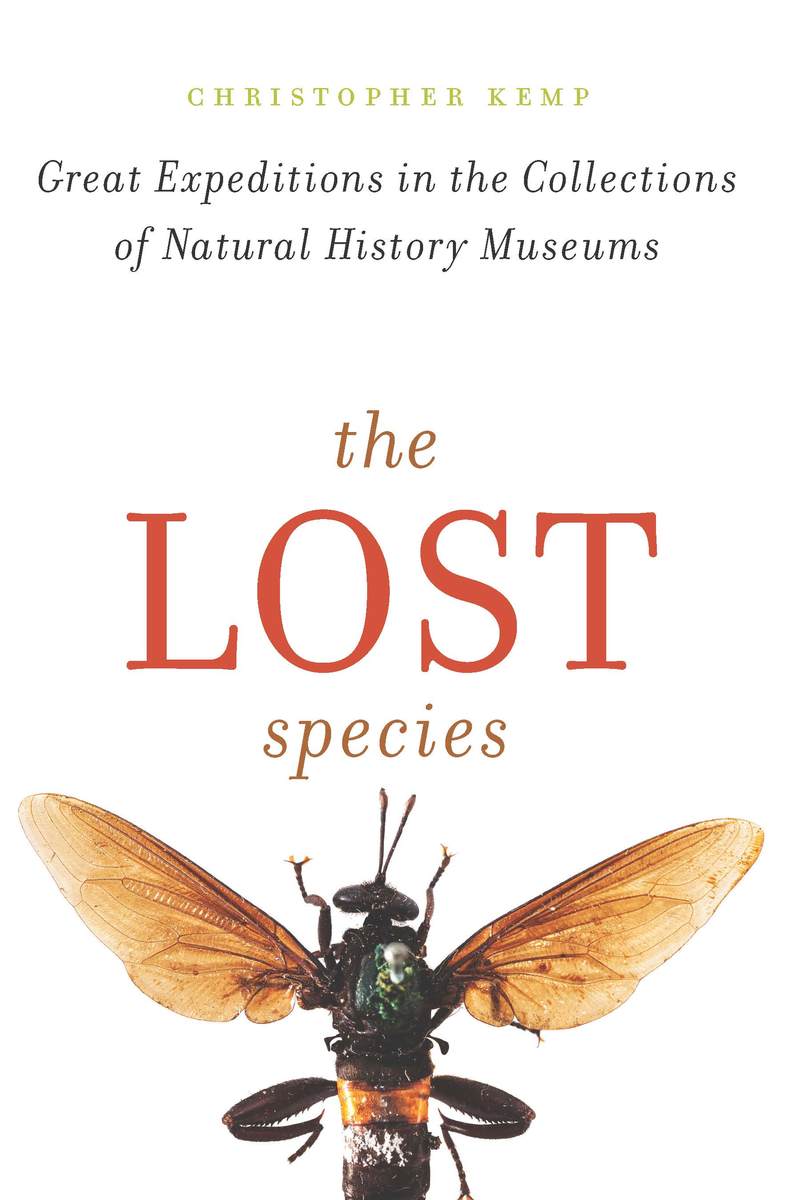
ABOUT THIS BOOK
The tiny, lungless Thorius salamander from southern Mexico, thinner than a match and smaller than a quarter. The lushly white-coated Saki, an arboreal monkey from the Brazilian rainforests. The olinguito, a native of the Andes, which looks part mongoose, part teddy bear. These fantastic species are all new to science—at least newly named and identified; but they weren’t discovered in the wild, instead, they were unearthed in the drawers and cavernous basements of natural history museums. As Christopher Kemp reveals in The Lost Species, hiding in the cabinets and storage units of natural history museums is a treasure trove of discovery waiting to happen.
With Kemp as our guide, we go spelunking into museum basements, dig through specimen trays, and inspect the drawers and jars of collections, scientific detectives on the hunt for new species. We discover king crabs from 1906, unidentified tarantulas, mislabeled Himalayan landsnails, an unknown rove beetle originally collected by Darwin, and an overlooked squeaker frog, among other curiosities. In each case, these specimens sat quietly for decades—sometimes longer than a century—within the collections of museums, before sharp-eyed scientists understood they were new. Each year, scientists continue to encounter new species in museum collections—a stark reminder that we have named only a fraction of the world’s biodiversity. Sadly, some specimens have waited so long to be named that they are gone from the wild before they were identified, victims of climate change and habitat loss. As Kemp shows, these stories showcase the enduring importance of these very collections.
The Lost Species vividly tells these stories of discovery—from the latest information on each creature to the people who collected them and the scientists who finally realized what they had unearthed—and will inspire many a museumgoer to want to peek behind the closed doors and rummage through the archives.
REVIEWS
“Natural history museums and their collections come alive with Kemp’s inside stories of new species formerly hidden away in museum drawers and jars. Anyone who appreciates discovery and has an interest in museums, history, and biodiversity will find plenty to enjoy in The Lost Species, an intriguing, engaging, and conversational read.”
— Marty Crump, author of Eye of Newt and Toe of Frog, Adder’s Fork and Lizard’s Leg: The Lore and Mythology of Amphibians and Reptiles
“The natural history museums of the world are full of surprises—undescribed species, from flying foxes to king crabs—sitting on their shelves waiting for someone to notice. Kemp vividly brings to life the stories of these specimens, and the people who collect and describe them. The Lost Species will delight any reader who cares about discovery, adventure, and the little-known planet that sustains us.”
— Richard Conniff, author of The Species Seekers: Heroes, Fools, and the Mad Pursuit of Life on Earth
"As part of the rising concern for global biodiversity, Christopher Kemp makes clear the value of preserved specimens in basic research. He successfully presents their study as part science, part history, and part adventure."
— Edward O. Wilson, University Research Professor, emeritus, Harvard University
"Major natural history museums of the world today collectively hold an enormous, irreplaceable collection of scientific objects numbering in the billions. Among this library of life and culture that has been assembled over several centuries, each piece has its own tale to tell. Christopher Kemp vividly brings several of these stories to life in The Lost Species. He chooses pieces ranging from a lowly nematode worm to the mighty dinosaur Apatosaurus (formerly known as Brontosaurus) to engage us. He presents these specimens to us not only as voucher specimens of Earth's biodiversity, but also as examples of human endeavor surrounding their discovery and eventual study. A great read for anyone interested in natural history museum collections, how they came to be, and what we can learn from them."
— Lance Grande, author of Curators
“An unexpectedly delightful and rewarding jaunt into once-cherished, now-decaying living history. Each chapter gives a quick sketch of a species or genus that was formally described from a museum specimen, often decades after it was collected. Most of the creatures—which include lightning cockroaches, squeaker frogs, pygmy bandicoots from New Guinea, ruby seadragons, and ‘atomic’ tarantulas caught at a nuclear test site in Nevada—have been identified in the past fifteen years or so.”
— Wall Street Journal
“At a time when funding for natural history collections is under siege, Kemp’s The Lost Species, which champions the irreplaceable value of these collections in the identification of new species, is a refreshing endorsement of both biodiversity and curatorial taxonomic expertise. . . . Kemp ably demonstrates the vital role that natural history collections and curators with taxonomic expertise play in the documentation of new species and ultimately in the preservation of biodiversity. These collections require maintenance to ensure the preservation of specimens and documentation for the next generation of taxonomists, who will discover more new species. It is my hope that The Lost Species will engender broader public interest and support for these efforts.”
— Bonnie Styles, Science
“Natural history collections are vast, backlogged, error-riddled, or incompletely described. Think of all those expeditions in the 1800s and 1900s. Imagine drawers with thousands of beetles and flies, countless jars of marine invertebrates. What other treasures could those collections still be holding? Well, biologist Kemp wondered about that, too. And he went on a quest to uncover the forgotten collections and chronicled his findings in a book, The Last Species—new species that were only found with the help of natural history museums. . . . Amazing story.”
— Ira Flatow, Science Friday
“As Kemp showcases these inspiring discoveries, you’ll find yourself wondering what undiscovered treasures can be found in your local natural history museum. Clearly there is plenty of unknown biodiversity: currently, only 2 million species have been named out of the estimated 10 million that are thought to be out there (some credible estimates go as high as 30 million unnamed species), but I was amazed to learn that as many as half of all museum specimens are misidentified. Yeow! Clearly, there’s a lot of taxonomic and systematic work to be done. This engaging book is a compelling argument for the overall value of natural history museums, and for the importance of studying these collections.”
— GrrlScientist, Forbes, "Best Biology Books of 2017"
"The Lost Species is a compelling, fascinating, accessible yet scientifically robust book that I can't recommend too highly."
— Mark Greener, Fortean Times
"Essential for anyone with even a passing interest in biology (crypto- or otherwise). . . . The Lost Species is a compelling, fascinating, accessible, yet scientifically robust book that I can’t recommend too highly."
— Fortean Times
TABLE OF CONTENTS
Introduction
DOI: 10.7208/chicago/9780226386355.003.0001
[taxonomy;shelf lives;species description;natural history]
Natural history collections worldwide are in jeopardy -- underfunded, understaffed and poorly maintained. But the collections contain many important mysteries waiting to be discovered. By some estimates, specimens of 75 percent of newly-discovered animal species are already part of a collection, where they have waited decades and sometimes much longer -- an interval known as the shelf life -- to be discovered. This book gathers narratives of some of these discoveries. Each new species discovered from archived museum specimens provides new insights into complex ecoystems and the processes that made them.
1. Pushed up a Mountain and into the Clouds: The Olinguito (Bassaricyon neblina)
DOI: 10.7208/chicago/9780226386355.003.0002
[Olinguito;Bassaricyon neblina;Field Museum;Mammal]
Kristofer Helgen discovers the olinguito (Bassaricyon neblina) in a drawer at the Field Museum of Natural History in Chicago.
2. Beneath a Color 83 Sky: The Ucucha Mouse (Thomasomys ucucha)
DOI: 10.7208/chicago/9780226386355.003.0003
[Ludovic Soderstrom;American Museum of Natural History;Ecuador;mammal;Taxonomy;Thomasomys Ucucha]
Robert Voss discovers the Ucucha mouse (Thomasomys ucucha) in Peru and then discovers it again at the American Museum of Natural History.
3. Going on a Tapir Hunt: The Little Black Tapir (Tapirus kabomani)
DOI: 10.7208/chicago/9780226386355.003.0004
[American Museum of Natural History;taxonomy;Theodore Roosevelt;Brazil;Amazon;Phylogenetics;International Commission on Zoological Nomenclature;Marc van Roosmalen;Tapirus kabomani]
Mario Cozzoul describes the pygmy black tapir (Tapirus kabomani) using a 1914 specimen collected by Theodore Roosevelt.
4. A Taxonomic Confusion: The Saki Monkeys (Pithecia genus)
DOI: 10.7208/chicago/9780226386355.003.0005
[Pithecia;Saki monkeys;Alfred Russel Wallace;Philip Hershkovitz;Georges Louis Leclerc Buffon;Carl Linnaeus]
Laura K. Marsh revises thePithecia genus of saki monkeys, naming several new species from museum specimens.
5. Scattered to the Corners of the World: The Arfak Pygmy Bandicoot (Microperoryctes aplini)
DOI: 10.7208/chicago/9780226386355.003.0006
[taxonomy;species description;Ernst Mayr;New Guinea;Bird's Head Peninsula;Microperoryctes aplini]
Kristofer Helgen names the Arfak pygmy bandicoot (Microperoryctes aplini) from four known specimens, which are stored in museum collections on four different continents.
6. The One That Got Away for 160 Years: Wallace’s Pike Cichlid (Crenicichla monicae)
DOI: 10.7208/chicago/9780226386355.003.0007
[taxonomy;Crenicichla monicae;Alfred Russel Wallace;Rio Negro;Douglas Melin]
Sven Kullander describes Crenicichla monicae, a species of Amazonian pike cichlid first collected in 1852 by Alfred Russel Wallace who then lost the specimen at sea.
7. Here Be Dragons: The Ruby Seadragon (Phyllopteryx dewysea)
DOI: 10.7208/chicago/9780226386355.003.0008
[Taxonomy;Phyllopteryx dewysea;Ruby seadragon;Western Australian Museum;Nerida Wilson;Greg Rouse;Scripps Institution of Oceanography]
Josefin Stiller describes a new, and third, species of seadragon -- the ruby seadragon (Phyllopteryx dewysea) -- later discovering a specimen that had been in a collection since 1919.
8. A Century in a Jar: The Thorius Salamanders
DOI: 10.7208/chicago/9780226386355.003.0009
[Taxonomy;Thorius salamander;David Wake;Harvard Museum of Comparative Zoology;Hans Gadow]
In the course of forty years of research, Jim Hanken has described more than fifteen new species of Thorius salamanders, naming many of them from decades-old archived material.
9. From a Green Bowl: The Overlooked Squeaker Frog (Arthroleptis kutogundua)
DOI: 10.7208/chicago/9780226386355.003.0010
[Squeaker frogs;Morphology;Amphibians;Arthur Loveridge;Ngozi crater;Tanzania;Batrachochytrium dendrobatidis;Chytrid fungus]
David Blackburn describes the overlooked squeaker frog (Arthroleptis kutogundua) from a single specimen collected in 1930.
10. A Body and a Disembodied Tail: Smith’s Hidden Gecko (Cyrtodactylus celatus)
DOI: 10.7208/chicago/9780226386355.003.0011
[Gecko;Taxonomy;Museum of Natural History in London, United Kingdom;Timor;Malcolm Smith]
Hinrich Kaiser discovers a novel species of Timorese gecko that was collected in 1924.
11. Treasure in the By-Catch: The Gall Wasps (Cynipoidea species)
DOI: 10.7208/chicago/9780226386355.003.0012
[Taxonomy;Gall wasps;Cynipoid wasps;The USDA bee research facility;Logan, Utah]
Matthew Buffington discovers thousands of neglected specimens of gall wasps in Logan, Utah.
12. The Biomimic: The Lightning Cockroach (Lucihormetica luckae)
DOI: 10.7208/chicago/9780226386355.003.0013
[Blattodea;Taxonomy;National Museum of Natural History;Smithsonian Institution;biomimic;bioluminescence;Ecuador;Banos]
Collected in 1939, the lightning cockroach waited more than 70 years to be discovered.
13. Sunk beneath the Surface in a Sea of Beetles: Darwin’s Rove Beetle (Darwinilus sedarisi)
DOI: 10.7208/chicago/9780226386355.003.0014
[Coleoptera;rove beetle;Charles Darwin;HMS Beagle;Bahia Blanca;Staphylinidae;J.D. Hooker;Natural History Museum, London, United Kingdom]
Stelios Chatzimanolis describes Darwinilus sedarisi, a rove beetle collected in Argentina in 1832 by Charles Darwin during the first voyage of the Beagle.
14. The Spoils of a Distant War: The Congo Duskhawker Dragonfly (Gynacantha congolica)
DOI: 10.7208/chicago/9780226386355.003.0015
[Odonata;Taxonomy;King Leopold;Belgium;Congo River;Tervuren]
In a single 2015 publication, K.D. Dijkstra named sixty new species of African dragonflies, many of them described using century-old museum specimens.
15. A Specimen in Two Halves: Muir’s Wedge-Shaped Beetle (Rhipidocyrtus muiri)
DOI: 10.7208/chicago/9780226386355.003.0016
[Taxonomy;Coleoptera;National Museum of Natural History, Washington DC;Borneo;sugarcane borer;Frederick Muir;Hawaii]
Zach Falin describes a species of wedge beetle from Borneo (Rhipidocyrtus muiri), from a single specimen collected in 1906 and stored at the National Museum of Natural History in Washington DC.
16. Mary Kingsley’s Longhorn Beetle (Pseudictator kingsleyae)
DOI: 10.7208/chicago/9780226386355.003.0017
[Taxonomy;Coleoptera;Mary Kingsley;Ghana;Gold Coast;Max Barclay;longhorn beetle;Stanley Livingstone]
Max Barclay discovers an unnamed species of African longhorn beetle at the Natural History Museum in London, United Kingdom, collected in 1896 by Mary Kingsley.
17. The Giant Flies (Gauromydas papavero and Gauromydas mateus)
DOI: 10.7208/chicago/9780226386355.003.0018
[Julia Calhau;Torsten Dikow;Mydinae;Gauromydas;Diptera;tarantula hawk wasps;Brazilian savanna;Nelson Papavero]
The discovery of several species of Gauromydas giant flies, which mimic tarantula hawk wasps and had waited almost eighty years since their collection to be discovered.
18. It Came from Area 51: The Atomic Tarantula Spider (Aphonopelma atomicum)
DOI: 10.7208/chicago/9780226386355.003.0019
[Aphonopelma;tarantulas;United States;Nevada Test Site;Willis Gertsch;American Museum of Natural History, New York, USA;Nomina dubia;Andrew Smith]
While writing a revision of the United States species of Aphonopelma tarantulas, Chris Hamilton describes numerous new species, including A. atomicum, collected in 1961.
19. The Host with the Most: The Nematode Worm (Ohbayashinema aspeira)
DOI: 10.7208/chicago/9780226386355.003.0020
[Nemata;Olaus Murie;Teton range;Helminth worms;National Parasite Collection;Nathan Augustus Cobb;Eric Hoberg]
Hidden within a 1930 sample of a known nematode worm species collected in Wyoming, nematologist Eric Hoberg discovers another specimen: Ohbayashinema aspeira.
20. From a Time Machine on Cromwell Road: Ablett’s Land Snail (Pseudopomatias abletti)
DOI: 10.7208/chicago/9780226386355.003.0021
[Taxonomy;Himalayas;land snails;William Thomas Blanford;Henry Haversham Godwin-Austen;William Henry Benson;Jon Ablett;Natural History Museum, London, United Kingdom]
Hungarian malacologist Barna Pall-Gergely has named and described numerous species of Asian land snails from archived material in museum collections.
21. In Sight of Land: Payden’s Isopod (Exosphaeroma paydenae)
DOI: 10.7208/chicago/9780226386355.003.0022
[Isopoda;Natural History Museum of Los Angeles County;William Stimpson;William Healey Dall;Aleutian islands;Exosphaeroma amplicauda;Exosphaeroma paydenae;Adam Wall;Crustacea]
For more than a century, all marine isopods collected from the Pacific coastline were identified as belonging to one species. But they don't. Museum collections house numerous unnamed species, some dating back to the 1870s.
22. A Ball of Spines: Makarov’s King Crab (Paralomis makarovi)
DOI: 10.7208/chicago/9780226386355.003.0023
[Crustacea;Taxonomy;Rafael Lemaitre;Lithodidae;Paralomis makarovi;Bowers Bank;National Museum of Natural History, Washington DC]
At the National Museum of Natural History in Washington DC, graduate student Sally Snow discovered a jar filled with specimens of an unnamed species of king crab from 1906.
23. In an Ikea Bag: The Custard Apple Family (Monanthotaxis Genus)
DOI: 10.7208/chicago/9780226386355.003.0024
[Thomas Couvreur;Cameroon;Monanthotaxis;botany;Paul Hoekstra;Annonaceae;custard apple family;Naturalis Biodiversity Center, Leiden, Netherlands;Georg August Zenker]
Paul Hoekstra revises the Monanthotaxis genus of plants and names nine new species in the process, later finding archived specimens of all of them in natural history collections, some dating to 1907.
24. Waiting with Their Jackets On: The Fossils (Paleontology Specimens Collected by Elmer Riggs)
DOI: 10.7208/chicago/9780226386355.003.0025
[Taxonomy;fossils;field jackets;Apatosaurus;Elmer Riggs;Edward Drinker Cope;Othniel Charles Marsh]
At the Field Museum of Natural History in Chicago, Bill Simpson oversees the oversized fossil collection, which includes fossils still in their field jackets collected more than a century ago.
25. The First Art: The Earliest Hominin Engraving (a 500,000-Year-Old Shell)
DOI: 10.7208/chicago/9780226386355.003.0026
[Eugène Dubois;Homo erectus;Trinil;Java;Hominim;Pseudodon]
In a 2015 paper, Josephine Joordens describes markings made on a fossilized shell that date back 500,000 years. The shell had been part of the Naturalis Biodiversity Center in Leiden, Netherlands since around 1891, but no one had noticed the markings before.
Epilogue
DOI: 10.7208/chicago/9780226386355.003.0027
[taxonomy;funding;species discovery]
Despite the threats to natural history collections, the work continues. Every year hundreds of new species are named from specimens that have waited decades and centuries to be discovered.