TABLE OF CONTENTS
Introduction: Fantasies of Total Description - James Q. Davies, Ellen Lockhart
DOI: 10.7208/chicago/9780226402109.003.0001
[London;science;music;auditory culture;spectacle;performance;history of the senses;aural culture;sound culture;accumulation]
The authors introduce the volume by critiquing Marxist-inflected notions of "aural culture," "auditory culture," or "sound culture." They insist upon the audiovisuality of both musical and scientific practice, stating their intention to explore overlooked confluences between the disciplines of music and science. "The differences between ‘optical’ and ‘auditory’ inquiry, between what counted as ‘musical performance’ and what counted as ‘scientific performance,'" they explain, "were often difficult to define." The authors continue by amassing evidence in support of the claim that institutional spaces for scientific inquiry were often indistinguishable from those for musical study. The city itself is configured in this description as a vast repository, a warehouse for the acquisition, exhibition, sale, and ordering of “research.” London is distanced from its reputation as the capital of das Land ohne Musik; the purview extends from Charles Burney’s General History of Music, a four-volume study of music “from the earliest ages to the present period” (completed in 1789) to the Great Exhibition of 1851, where musical instruments were assembled alongside the technologies of science and industry. The accumulated contents of these framing repositories set the stage for a new picture of modern disciplinarity belying the purported division of aural from visual knowledge. (pages 1 - 26)
This chapter is available at:
University of Chicago Press
https://academic.oup.com/chica...
1. Music as an Object of Natural History - Emily I. Dolan
DOI: 10.7208/chicago/9780226402109.003.0002
[Charles Burney;music and science;travel literature;experimental philosophy;musical instruments;scientific instruments;history of sound;aesthetics;music history]
Dolan argues that Burney’s History of Music (1776-89) marked a major epistemological shift: a change in the kind of “object of knowledge” music was understood to be, bringing along with it new methodologies for its study and classification. While on his tours, Charles Burney was an enthusiastic witness to the demonstration not just of musical technologies, but scientific ones as well. In his travel diaries, instruments like C. P. E. Bach’s Silbermann clavichord in Hamburg bump up against Philip Matthäus Hahn’s orrery in Ludwigsburg, and Padre Boscovich’s Stet Sol in Milan. The chapter postulates that Burney sought to create a comprehensive account of music not by means mathematics-based theory (as in Padre Martini’s Storia della musica of 1757-81) or biography (as in Giorgio Vasari’s 1568 Lives of the Most Excellent Painters, Sculptors and Architects), but rather through first-hand experience of musical performance and observation of its instruments. Dolan suggests an affinity between Burney’s History of Music and contemporaneous endeavors in the natural sciences, including his own writings on astronomy, and the taxonomies of his friends Joseph Banks and William Herschel. The chapter explains how, for Burney, music came to be experienced as an object of natural history. (pages 27 - 46)
This chapter is available at:
University of Chicago Press
https://academic.oup.com/chica...
2. Celestial Mechanisms: Adam Walker’s Eidouranion, Celestina, and the Advancement of Knowledge - Deirdre Loughridge
DOI: 10.7208/chicago/9780226402109.003.0003
[Adam Walker;eidouranion;orrery;experimental philosophy;astronomy;music of the spheres;popular science;audiovisuality;celestina;musical instruments]
Loughridge considers the career of Adam Walker, a self-taught practitioner of “natural and experimental philosophy” from the north of England who gave public lectures and demonstrations on astronomy and the natural sciences. The chapter focuses on two of Walker’s inventions that often featured together: the celestina, a harpsichord-like keyboard instrument whose strings were sounded with a bow; and the Eidouranion (or “transparent orrery”), a vast astronomical machine that provided views of celestial phenomena, scaled to London’s largest theatres. Loughridge notes that while the celestina’s continuous, unearthly tone and rotating inner mechanisms derived from an older notion of celestial harmony, the instrument was also marketed domestically as a harpsichord stop, particularly suitable for the performance of slow movements. On the other hand was the Eidouranion – meaning image (or imitation) of the heavens. This “transparent orrery” was one of several Eido-entertainments appearing in London during the 1780s, one which, as Loughridge notes, was probably modeled on Philippe de Loutherbourg’s Eidophusikon, also exhibited with accompanying music. By the 1820s, Loughridge shows, these all-too-public musico-astronomical entertainments had taken on “an air of times gone by,” the “disenchantment of astronomical knowledge” perpetuated by a widening gap between the practices of popular and professional science. (pages 47 - 76)
This chapter is available at:
University of Chicago Press
https://academic.oup.com/chica...
3. Transparent Music and Sound-Light Analogy ca. 1800 - Ellen Lockhart
DOI: 10.7208/chicago/9780226402109.003.0004
[Nicola Sampieri;aesthetics;light-sound analogies;program music;descriptive music;Thomas Young;wave theory;harmonic slider;audiovisuality;bad music]
This chapter focuses on London composer Nicola Sampieri and his “Concert upon an Entire New Plan,” given at the Hanover Square Rooms and elsewhere from 1798. Sampieri’s “New Plan” employed “numerous and beautiful transparencies” to present natural scenes, both mundane and meteorological, with music composed expressly to represent these natural phenomena. Sampieri’s compositions for the fortepiano encouraged listeners to experience correspondences between what they saw and heard. Lockhart argues that Sampieri’s endeavors reflected renewed scientific interest in the analogy between tones and colors, as in the famed experiments of Thomas Young, which demonstrated that light and sound behaved according to a single principle of wave-based movement. Sampieri’s “Concert on a New Plan” provides a link between the pictorial entertainments of eighteenth-century London, and the familiar natural and cosmological imagery of nineteenth-century symphonic program music, such as Mendelssohn’s The Hebrides. Lockhart re-balances the long-held notion of ca. 1798 London as visual-centric, attesting instead to a broad interest in engaging the eyes and the ears together, and an investment in analogical thinking both within art and within science. (pages 77 - 100)
This chapter is available at:
University of Chicago Press
https://academic.oup.com/chica...
4. Charles Wheatstone: Musical Instrument Making, Natural Philosophy, and Acoustics in Early-Nineteenth-Century London - Myles W. Jackson
DOI: 10.7208/chicago/9780226402109.003.0005
[Charles Wheatstone;acoustics;musical instruments;experimental philosophy;popular science;light and sound;kaleidophone;acoucryptophone;speaking machines;wave theory]
This chapter argues that Wheatstone’s achievements in the fields of acoustics and long-distance communication were the direct result of his early education in musical instrument building. Jackson begins by considering the scientist’s early career in light of the particular culture of music- and scientific showmanship based on and around the Strand, where his father had a musical-instrument shop. Jackson takes us from “Charley Wheatstone’s Clever Tricks” through the Kaleidophone and other devices investigating sound-light analogies and the wave properties of sound. From there we move to Wheatstone’s early experiments in resonance, in which the violin bows, flutes, bassoon reeds and tuning forks strewn about Wheatstone’s musical instrument shop became quite literally instruments of science, generating new acoustic knowledge. Jackson concludes by considering Wheatstone’s work during the 1830s on reeds and reed-pipes, which resulted not only in an early speaking machine (observed with great interest by a young Alexander Graham Bell), but also in his most famous musical invention, the concertina. (pages 101 - 124)
This chapter is available at:
University of Chicago Press
https://academic.oup.com/chica...
5. Charles Wheatstone’s Enchanted Lyre and the Spectacle of Sound - Melisa Dickson
DOI: 10.7208/chicago/9780226402109.003.0006
[Charles Wheatstone;acoustics;musical instruments;acoucryptophone;enchanted lyre;history of sound;history of the senses;Chladni figure;telegraphy;Invisible Girl]
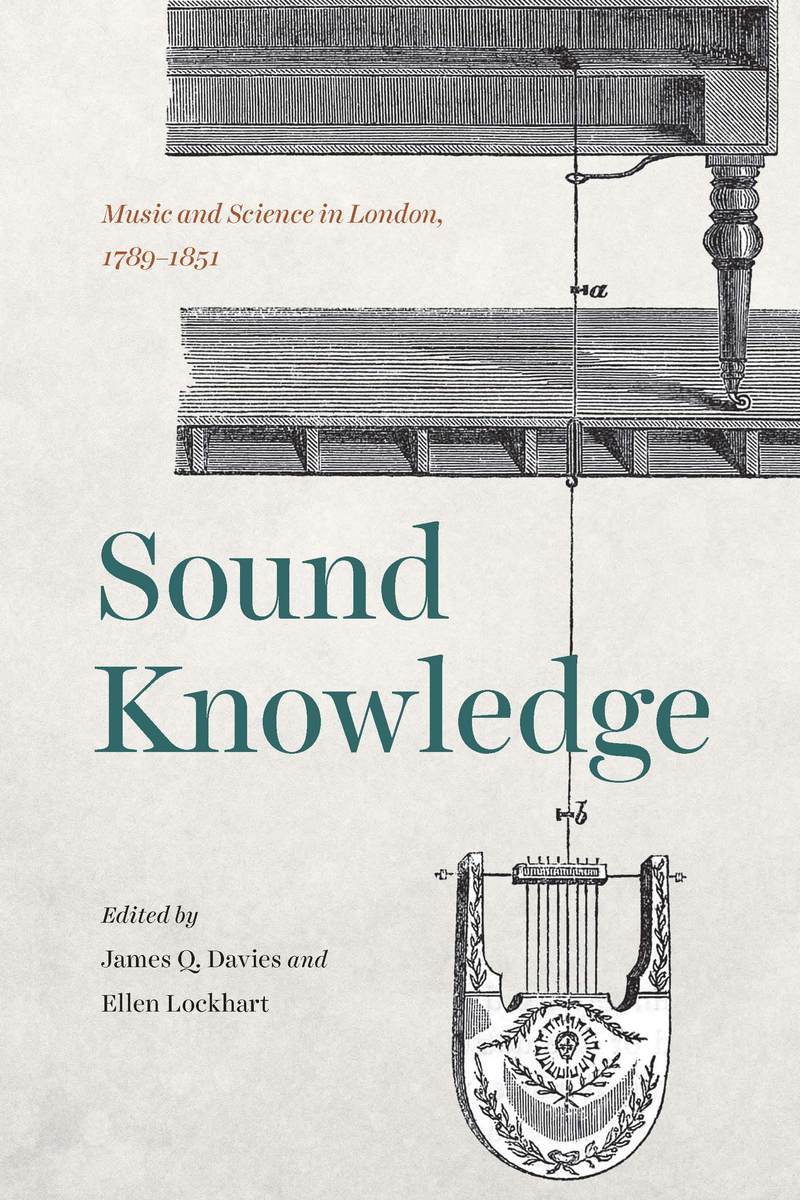
Dickson makes Wheatstone’s Enchanted Lyre or “Acoucryptophone” the point of departure for a study of fantasies about the materialisation and sight of sound. The Acoucryptophone was one device on display in the young Wheatstone’s “Musical Museum.” It consisted of a lyre suspended from the ceiling by a brass wire connected to other musical instruments in the room above; when these were played, their sounds would seem to emanate directly from the lyre. For acousticians, the apparatus demonstrated the principle that sound travelled more effectively through metal than through air. But the case of the Enchanted Lyre allows us to see how, in early nineteenth-century London, scientific demonstration could be elided with discourses of the supernatural, or marked with indices of the conjurer’s act. Dickson considers emerging telegraphic conceptions of “musical sound” as necessarily “abstract, intangible, and ethereal,” showing how such popular-scientific devices as the Enchanted Lyre and Invisible Girl rendered sound-waves visible while displacing the labor of performance. Ultimately, the Enchanted Lyre became both a tangible model of sound waves in action and the means by which to cultivate newly idealized notions of musical sound, sound being configured here as a matter beyond physical embodiment or sensory perception. (pages 125 - 144)
This chapter is available at:
University of Chicago Press
https://academic.oup.com/chica...
6. Instruments of Empire - James Q. Davies
DOI: 10.7208/chicago/9780226402109.003.0007
[telecommunications;imperialism;globalization;Charles Wheatstone;acoucryptophone;telegraphy;comparative philology;gamelan;Alexander Ellis;concertina]
This chapter links the island of Java with metropolitan London and rural South Africa. It invokes visions of a “global nineteenth century” in order to present a critical archeology of modern concepts of “sound” and of the “wired worlds” that so characterize global built environments today. The focus is on geographies of empire, and nineteenth-century musical instruments conceived to achieve that space, or to “annihilate distance,” particularly in the work of Charles Wheatstone. In Wheatstone’s work, sound was reconfigured as an enigmatic force for propagation: a way of collapsing space – extolled as an annihilator, or (more benignly) as a political force for cross-cultural communication and understanding. In the sixth of his popular 1835 “Lectures on Sound,” for example, Wheatstone laid before his audience a free-reed talking machine or vowel synthesizer, a Chinese sheng, Chladni figures, and an oversized Javanese gendèr, which Sir Thomas Raffles, former Lieutenant-General of Java, had recently brought back from the East. The paper draws connections between Wheatstone’s experiments on sound conductance, his telegraphic/telephonic fantasies, popular science, and the liberal-humanitarian search for a truly global instrument – one tuned to the so-called “scale of nature” and capable of “speaking” a supposedly universal musical language. (pages 145 - 174)
This chapter is available at:
University of Chicago Press
https://academic.oup.com/chica...
7. Good Vibrations: Frankenstein on the London Stage - Sarah Hibberd
DOI: 10.7208/chicago/9780226402109.003.0008
[Frankenstein;Mary Shelley;theatrical adaptation;melodrama;vitalism;animal electricity;galvanism;monstrosity;London;anatomy]
Hibberd considers two stage adaptations of Mary Shelley’s Frankenstein appearing in London in 1823: Richard Brinsley Peake’s Presumption; or, The Fate of Frankenstein, which played at the English Opera House near the Strand, and Henry Milner’s Frankenstein; or the Man and the Monster!, for the Coburg, a theatre for a primarily working-class audience, which was situated on the South Bank of the Thames. Both of these plays were melodramas, which meant that their dialogue was spoken but they also featured prominent mime, and the latter was generally accompanied by segments of descriptive music. In both, the monster was played by a mime. Hibberd situates Shelley’s novel and its adaptations in the context not only of contemporaneous developments in electrical medicine, but also of public scientific debates on animal electricity and vitalism, debates most prominently played out in the second half of the 1810s between two prominent members of London’s Royal College of Surgeons: John Abernethy and William Lawrence. Theatrical popularizations of the Frankenstein story, Hibberd argues, contributed in significant ways to these debates, most notably by configuring or staging music as a vital force, an electrical phenomenon imbued with the capacity to at once soothe, civilize, and shock. (pages 175 - 202)
This chapter is available at:
University of Chicago Press
https://academic.oup.com/chica...
8. Engine Noise and Artificial Intelligence: Babbage’s London - Gavin Williams
DOI: 10.7208/chicago/9780226402109.003.0009
[Charles Babbage;John Moulton;Difference Engine;London;artificial intelligence;street music;sound studies;history of listening;intellectual labor;noise]
Williams describes Charles Babbage as he neared the end of his life: living on Dorset Street in Marylebone alongside an old Difference Engine and an incomplete Analytical Machine, one working automated dancer (purchased from the remnants of Merlin’s Mechanical Exhibition, and restored), and – by Babbage’s own furious account – many hundreds of noisy and disruptive street performers. Williams posits a connection between what he calls “Babbage’s favored geriatric occupations”: continued work on the Difference Engine, and a campaign for increased legal restrictions on “foreign” street musicians. Drawing on early designs for the Difference Engine, which required its operator to count the pealing of multiple bells, but also upon Babbage’s pamphlet “On Street Nuisances” and his assertion that itinerant musicians had destroyed “one-fourth part of [his] working power,” Williams supplies a chapter in the history of listening that emphasizes the labor value of silent audition. The author examines governmental measures to regulate street music for the furtherance of an “industrious” political economy, and assesses the role of audile technique in the development of disciplinary notions of mental labor and artificial intelligence. (pages 203 - 226)
This chapter is available at:
University of Chicago Press
https://academic.oup.com/chica...
9. Hearing Things: Musical Objects at the 1851 Great Exhibition - Flora Willson
DOI: 10.7208/chicago/9780226402109.003.0010
[London;1851 Great Exhibition;Crystal Palace;musical instruments;object-oriented ontology;work concept;epistemology;organology;commodity form;industry]
Willson addresses music’s epistemological status: what kind of object of knowledge music was held to be, what material artifacts could speak for it, and in what kind of Museum. The occasion is the 1851 Great Exhibition of the Works of Industry of All Nations, which took place at London’s Crystal Palace. The organizers sought to represent “the Present” – ordered, classified, and ranked – as the culmination of historical narratives of progress. Music was represented by its instruments, and partook of their status as objects; the Exhibition featured pianos, organs, violins, and more, as well as internal mechanisms and other component parts, as representative works of industry. Its material traces were scattered throughout Machinery, General Hardware, the Fine Arts Court, and even Manufactures from Animal and Vegetable Substances. Instruments rather than musical masterpieces were “demonstrated." Music was an ever-elusive presence; it tended to recede into the buzz of the crowd, to vanish, half-unheard, into the towering domes of the steel-and-glass cathedral. Willson argues that the “musical work” was hardly an immortal artifact, ideal type, or regulative concept, but was manifested instead in a striking multiplicity of commodified ways at this “Great Exhibition of Things.” (pages 227 - 246)
This chapter is available at:
University of Chicago Press
https://academic.oup.com/chica...
Acknowledgments
Contributors
Index