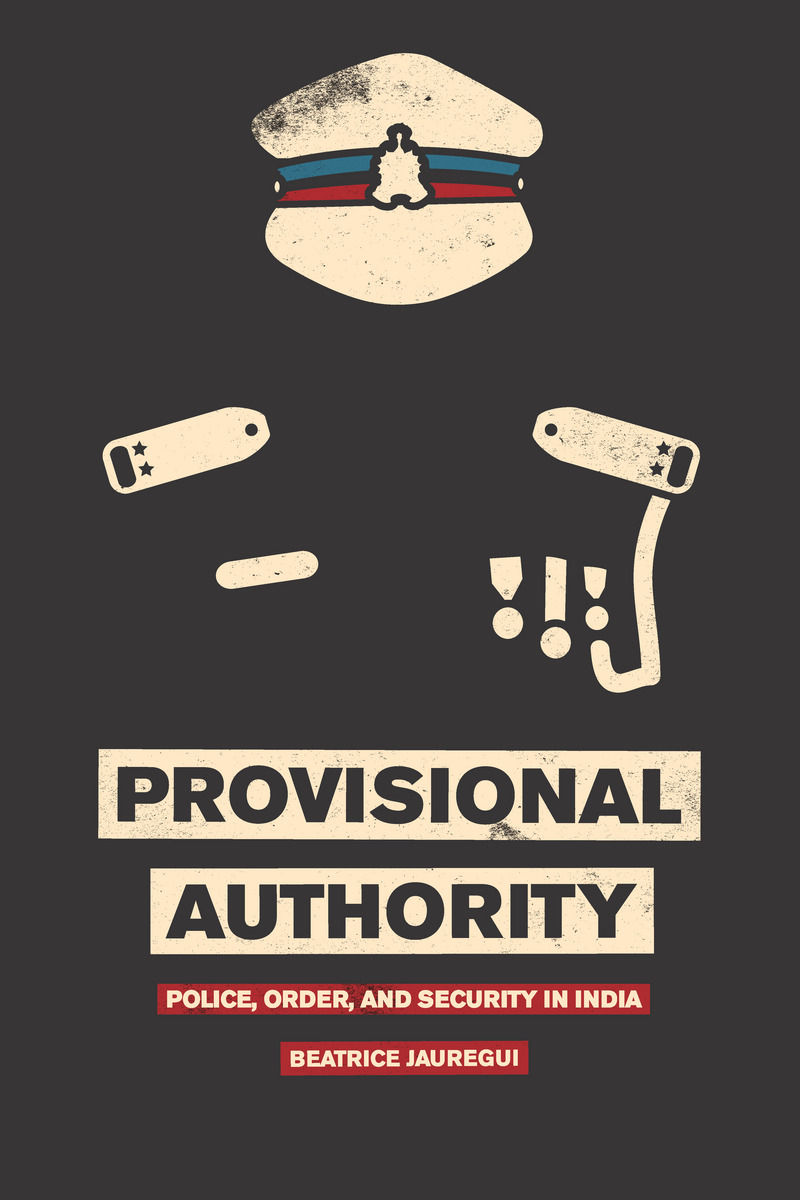
Provisional Authority Police, Order, and Security in India
by Beatrice Jauregui
University of Chicago Press, 2016
Cloth: 978-0-226-40367-0 | Paper: 978-0-226-40370-0 | Electronic: 978-0-226-40384-7
DOI: 10.7208/chicago/9780226403847.001.0001
ABOUT THIS BOOKAUTHOR BIOGRAPHYREVIEWSTABLE OF CONTENTS

ABOUT THIS BOOK

Policing as a global form is often fraught with excessive violence, corruption, and even criminalization. These sorts of problems are especially omnipresent in postcolonial nations such as India, where Beatrice Jauregui has spent several years studying the day-to-day lives of police officers in its most populous state, Uttar Pradesh. In this book, she offers an empirically rich and theoretically innovative look at the great puzzle of police authority in contemporary India and its relationship to social order, democratic governance, and security.
 
Jauregui explores the paradoxical demands placed on Indian police, who are at once routinely charged with abuses of authority at the same time that they are asked to extend that authority into any number of both official and unofficial tasks. Her ethnography of their everyday life and work demonstrates that police authority is provisional in several senses: shifting across time and space, subject to the availability and movement of resources, and dependent upon shared moral codes and relentless instrumental demands. In the end, she shows that police authority in India is not simply a vulgar manifestation of raw power or the violence of law but, rather, a contingent and volatile social resource relied upon in different ways to help realize human needs and desires in a pluralistic, postcolonial democracy.
 
Provocative and compelling, Provisional Authority provides a rare and disquieting look inside the world of police in India, and shines critical light on an institution fraught with moral, legal and political contradictions.
 

AUTHOR BIOGRAPHY

Beatrice Jauregui is assistant professor at the Centre for Criminology and Sociolegal Studies at the University of Toronto. She is coeditor of the Handbook of Global Policing and Anthropology and Global Counterinsurgency, the latter published by the University of Chicago Press.

REVIEWS

"Relying on extensive research with the police force in Uttar Pradesh (UP), the book explains the workings of police authority as “an amorphous and multidimensional” everyday practice in UP and broadly in contemporary India. Grounded in a theoretical review of what constitutes “rational authority,” the book goes beyond the typical narratives of power, sovereignty, and the originary violence of law that dominates ongoing scholarship about police authority. Instead it argues that police authority is essentially configured by qualities of specialized knowledges, capabilities, positionalities, and exchange networks within which the force operates in a certain sociopolitical order."
— Choice

"Provides what might become a textbook example of fine ethnographic work. Jauregui is a Hindi speaker and seems also to get the rough drift of a number of minor vernacular languages. Without these skills it is difficult to imagine a work of such depth and sensitivity being achievable. Reading this book as a criminologist engaged in a project to envision a new criminology unhooked from metropolitan master discourses, I felt I was seeing unfold before me new ways of thinking and new practices of research suitable for work in the global South."
— Law & Society Review

 “A fascinating, rich, and resonant book. I know of no study that brings such an acute ethnographic sensibility to bear on police stations and structures as social institutions, or on those who work and live within those institutions. This is an engagingly written and exceptionally thought-provoking study, one that both illuminates a consequential—and often highly contested—contemporary Indian institution and provides a methodological and interpretive model for thinking in subtle and generative ways about institutions of all types—and in a wide range of state settings.”
— Donald Brenneis, University of California, Santa Cruz

“In splendidly clear and incisive prose, Jauregui takes us to the ‘cutting edge’ of everyday policing in North India. This is a surprising and sometimes violent world where, as she lucidly explains, authority is always in the end in some sense ‘provisional.’ Jauregui’s fieldwork is genuinely pathbreaking, while her theoretical analysis unerringly swerves away from the received clichés that too often dominate writing on the postcolonial state. Like all great books, Provisional Authority has created its own genre—a genre in which Hindi noir meets the banalities of everyday life in the police barracks and tea shops of Uttar Pradesh. The result is a terrific book that is at once highly readable and intellectually challenging.”
— Jonathan Spencer, University of Edinburgh

“Provisional Authority is marvelous. It is clearly the best ethnographic book on the Indian police ever written. Jauregui writes incisively about both theory and practice, interweaving frontline stories with larger theoretical points and analysis. She shows the living reality of Indian police at the ‘coal face’, brilliantly laying out the nuanced problems of access and observer involvement in India.”
— David H. Bayley, author of Governing the Police: Experience in Six Democracies

"One comes away understanding the complexity of navigating gatekeepers, unearthing perspectives, and finding definitions for concepts that are not easily defined. This book is an admirable example of field research presented in commendable fashion to an audience that goes beyond those of us who study policing in India." 
— Criminal Law and Criminal Justice Book Reviews

"...Provisional authority excellently contextualizes police practices and perceptions within the fabric of everyday and political life, revealing Indian policing to be a precarious activity carried out by individuals who are unavoidably entwined within larger societal struggles."
— David Sausdal, Journal of the Royal Anthropological Institute

TABLE OF CONTENTS

- Beatrice Jauregui
DOI: 10.7208/chicago/9780226403847.003.0001
[authority;cutting edge;ethnography;everyday life;provisionality;police]
Police authority in postcolonial North India is a great puzzle. Sometimes it manifests as hyper-empowerment, abuse of office, and other excesses. Sometimes it coheres as little more than impotence, incapability, and confusion. Based on more than a decade of ethnography mostly with “cutting-edge” police in Uttar Pradesh—mostly subordinate officers “in the field” or “on the street”—and also some senior officers, this work explains police authority in terms of provisionality, a polysemic concept that refers to contingency in spatio-temporal, resource allocational and moral-instrumental fields of human life and modes of social practice. Characterizing police authority as provisional indexes ongoing shifts in knowledge, influence, capability, resource exchange and rules of interaction across time and space, which manifest in everyday life and interactions with the public. (pages 1 - 32)
This chapter is available at:
    https://academic.oup.com/chica...

- Beatrice Jauregui
DOI: 10.7208/chicago/9780226403847.003.0002
[agency;corruption;jugaad;social networks;virtue]
Police and other people in north India deploy a variety of euphemisms for corruption, one of which is the Hindi term “jugaad”, which refers to goal-oriented improvisation, especially the use of informal social networks to advance one’s interests. But as often as it is conflated with corruption, jugaad is also conceived as necessary for “getting by” and even as virtuous practice working against systemic corruption. This discussion of common practices of police work—including procuring bribes, free rides and assistance with evidence collection—shows how the contronymic character of jugaad emerges from widespread valuation of what I call “provisional agency,” which is both a capability to provide a social good and a temporary means of mobility geared toward a better future. Understanding practices that may be deemed “corrupt” as embodiments of provisional agency breaks down a clear distinction between virtue and vice and works to disaggregate a rigid inverse relationship between morality and power that assumes “elite” dominance can only be answered by resistance or acquiescence “from below.” (pages 33 - 59)
This chapter is available at:
    https://academic.oup.com/chica...

- Beatrice Jauregui
DOI: 10.7208/chicago/9780226403847.003.0003
[ethics;evidence;indeterminacy;multiplicity;order]
Building on previous chapters’ discussions of provisionality and morality, this chapter formulates a deeper understanding of how authority is constructed through the ethics of everyday police work. Analyzing routine practices like fabrication of evidence and falsification of reports; fixing of investigations and crime statistics; arbitrary responses to complaints and mediation of disputes, we learn how police understand and enact their social role as order keepers by employing adaptive means for managing flexible rules of evidence, mutable power relationships, and long-standing systems of local influence and political patronage that shape public demands on them. This examination furthers our understanding of the indeterminacy of the law and the multiplicity of police roles, means, and ends that are not merely available to but also, crucially, expected of police acting as “orderlies” to the public at large. (pages 60 - 82)
This chapter is available at:
    https://academic.oup.com/chica...

- Beatrice Jauregui
DOI: 10.7208/chicago/9780226403847.003.0004
[ambivalence;condemnation;compensation;service;violence]
This chapter connects well-worn discussions of police perpetration of violence as a manifestation of sovereign excess or legal transgression with a reflection on how police also may become victims of violence as a core element of their social role and position. Analyzing phenomena like ambivalence in public responses to extrajudicial police killings, ritualized recognition of police death in the line of duty, and statistics of casualties of police violence, we examine how the demands placed on police by non-police actors frame police violence as not merely a projection of institutional power but also as a service “ordered” (that is, demanded and structured) by members of the public. Police violence is understood broadly as necessary but also deplorable, revealing a police figure that is simultaneously valorized and demonized. Police are morally damned from the outset by their profession, subject to various forms of condemnation and compensation for providing violence as service. Police life itself thus becomes expendable, subject to a peculiar economy of being at once required and reviled, demanded and devalued. (pages 83 - 112)
This chapter is available at:
    https://academic.oup.com/chica...

- Beatrice Jauregui
DOI: 10.7208/chicago/9780226403847.003.0005
[depersonalization;politicization;public good;speculation;transfer]
This chapter analyzes how the provisional authority of police is shaped by the ongoing transfer of each and every officer to various districts and divisions over the course of one’s career. What appears to be a banal and rationalized practice, officially conducted to promote “the public good” and prevent corruption, is in fact evidence of the systematic politicization and personalization of the police bureaucracy. In practice, individual and en masse transfers are often configured by political calculation and speculation regarding how an officer’s caste, religion, professional reputation, or social connections with particular networks might render him more or less valuable or useful in a specific position. This social fact makes what is officially supposed to be an impersonal exercise an intensely personal one while also, paradoxically, further rendering police officers as fungible, and indeed “expendable”, through their depersonalization and depoliticization as individual and collective subjects, respectively. What some call the resultant “transfer industry” thus entails a complex of ongoing machinations and strategic alliances that go far beyond mere “corruption” or “cronyism” as police officers attempt to mold meaningful careers that perform “modern” virtues of institutional merit and professional progress in a context of unending uncertainty, generalized anxiety and competitive suspicion. (pages 113 - 137)
This chapter is available at:
    https://academic.oup.com/chica...

- Beatrice Jauregui
DOI: 10.7208/chicago/9780226403847.003.0006
[bureaucracy;corruption;discrimination;violence;security]
This concluding chapter deploys the theoretical framework of provisional authority to compel rethinking of some of the most commonly critiqued problems of police practice in India and beyond in the contemporary moment: specifically global problems of police violence, bureaucracy, discrimination and corruption. Conceiving police authority in terms of provisionality allows and compels us to ask uncommon questions, and propose new explanations, in relation to these problems, for example: When, against whom, and to what extent do we need or want police violence to come into force? How might foregrounding mobility and transformative possibility rather than stagnation and inaction in bureaucratic spaces present new problems for political-legal analysis? How could some forms of apparent police discrimination be reframed as a kind of particularistic accountability in a pluralistic and contested democracy? And how do assumptions about these and other problems of policing, like endemic corruption, index ways in which the liberal democratic state (ideal) reproduces itself as a site of insecurity for its own subjects, including police as well as common citizens? (pages 138 - 158)
This chapter is available at:
    https://academic.oup.com/chica...