ABOUT THIS BOOK
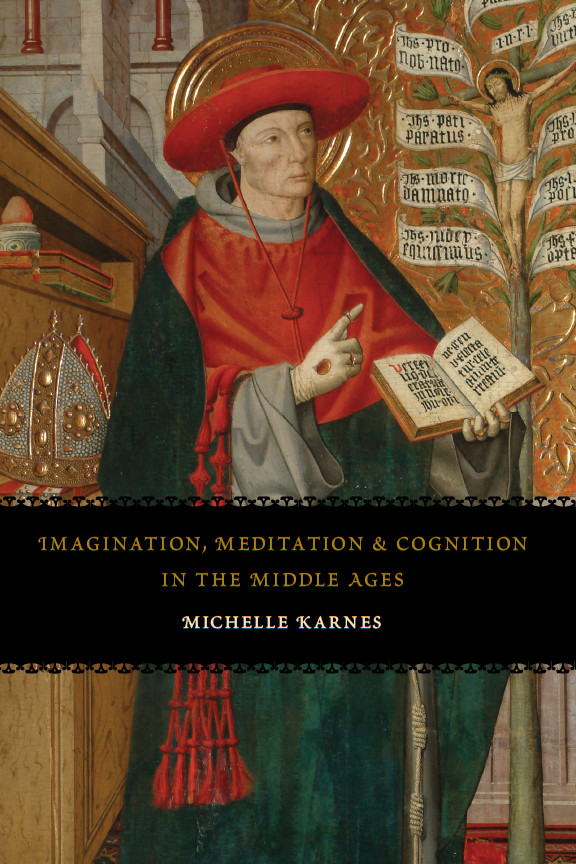
In Imagination, Meditation, and Cognition in the Middle Ages, Michelle Karnes revises the history of medieval imagination with a detailed analysis of its role in the period’s meditations and theories of cognition. Karnes here understands imagination in its technical, philosophical sense, taking her cue from Bonaventure, the thirteenth-century scholastic theologian and philosopher who provided the first sustained account of how the philosophical imagination could be transformed into a devotional one. Karnes examines Bonaventure’s meditational works, the Meditationes vitae Christi, the Stimulis amoris, Piers Plowman, and Nicholas Love’s Myrrour, among others, and argues that the cognitive importance that imagination enjoyed in scholastic philosophy informed its importance in medieval meditations on the life of Christ. Emphasizing the cognitive significance of both imagination and the meditations that relied on it, she revises a long-standing association of imagination with the Middle Ages. In her account, imagination was not simply an object of suspicion but also a crucial intellectual, spiritual, and literary resource that exercised considerable authority.
REVIEWS
“A learned and well-written book about the philosophy of imagination and the late-medieval practice of devotional meditation. Karnes’s argument is powerful and convincing, and makes a valuable addition to a lively field in current medieval studies.”
— Nicholas Watson, Harvard University
“Karnes’s brilliantly counterintuitive argument asserts that the writing out of the role of imagination in late-medieval English meditation does not indicate the weakness of imagination, but rather its potency. This illuminating survey traces its importance in scholastic philosophy and earlier meditative writing to demonstrate that affective theology and the work of reason or mind are not incompatible. This study will be valuable in reconsiderations of the influence of philosophy on other kinds of writing and thinking throughout the Middle Ages.”
— D. Vance Smith, Princeton University
“Michelle Karnes has given us a book of deep learning, lucidity, and intelligence. It reveals the learned origins and the intellectual cogency of meditative forms long thought simplifying and popularizing, and explains why minds of the first rank cultivated them. Never before has medieval devotional literature seemed so smart as Karnes shows it to be. In a single graceful arc, Imagination, Meditation, and Cognition in the Middle Ages sweeps away a conventional account of late-medieval religious writing and supplies what we need to build a better one.”
— Steven Justice, University of California, Berkeley
“[Karnes] attends very carefully to her evidence, and shows us is in detail how guides to meditation shape (and think about shaping) cognitive process, to make us feel like or unlike, close or far away from, what an analyst might call the ‘self-object’ of devotion.”
— Aranye Fradenburg, postmedieval
“Lively and provocative. . . . This is an important contribution to the burgeoning literature on medieval cognition, and will bring these materials helpfully into play as part of the exegetical toolkit of literary scholars.”
— Vincent Gillespie, University of Oxford, Review of English Studies
“Imagination, Meditation, and Cognition in the Middle Ages serves as a salutary reminder that, as a way of systematically structuring the perceived world, scientific thought was not restricted to the groves of academe in the Middle Ages; it pervaded every corner of medieval culture.”
— A. Mark Smith, Isis
“Tightly argued and philosophically sophisticated.”
— Barbara Newman, Northwestern University, Church History
“Skillful, persuasive, and thoroughly enlightening. . . . To borrow a term from Bonaventure, Imagination, Meditation, and Cognition in the Middle Ages is multiformis: at once a lucid primer to medieval Scholastic theories of knowledge, an illuminating study of Bonaventure’s thought and influence, an original essay in the history of imagination, and an indispensable addition to the growing scholarly literature on medieval Passion meditation.”
— Robert Glenn Davis, Fordham University, Modern Philology
“Michelle Karnes has succeeded admirably in a difficult and tripartite task: she has written a meticulous, learned, intelligent, and profoundly useful book of intellectual history; she has shown that the intellectual history she limns is, at its core, a literary history; and she has made manifest how that literary history can—and should—reshape our understandings of three of the most widely distributed Middle English devotional texts, namely, Piers Plowman, Nicholas Love’s Mirror of the Blessed Life of Jesus Christ, and The Prickynge of Love.”
— Eleanor Johnson, Columbia University, Year of Langland Studies
"An excellent, very well-informed and well-argued study, a must-read for anyone who would understand the psychological assumptions underlying late medieval devotional and contemplative literature in particular, but also any literature of the period that deals with the cross-fertilization of imagination and spirituality—which is to say, with virtually all of late medieval literature."
— Michael G. Sargent, Studies in the Age of Chauncer
“Karnes is a fresh and stimulating reader of texts. . . . Her summaries of the Aristotelian tradition are sound and compelling, and her awareness of Bonaventure’s deep Aristotelianism is a welcome reminder to us all of the shared patrimony of Bonaventure and Aquinas.”
— Kevin Hughes, Thomist
“Emphasizing the cognitive significance of both imagination and the meditations that relied on it, Karnes revises a long-standing association of imagination with the Middle Ages. In her account, imagination was not simply an object of suspicion but also a crucial intellectual, spiritual, and literary resource that exercised considerable authority. . . .An impressive work of original scholarship, Imagination, Meditation, and Cognition in the Middle Ages is enhanced for academia with the inclusion of a twenty-two page Bibliography and a five page Index. A particularly thoughtful and thought-provoking study. . .very highly recommended.”
— Helen Dumont, Midwest Book Review
TABLE OF CONTENTS
Acknowledgments
Abbreviations
To the Reader
Introduction - Michelle Karnes
DOI: 10.7208/chicago/9780226425337.003.0001
[imagination, Middle Ages, hostile, suspicious, distrustful, medieval imagination, affective power]
The power of imagination has often been viewed more negatively than positively, and it has inspired more trepidation than confidence. This is the reason why the Middle Ages was “hostile” to or “suspicious” or “distrustful” of imagination. This book establishes not only that medieval imagination had a unique authority, but that imaginative meditations on Christ were more ambitious and purposeful than scholarship on them has recognized. Focusing on the philosophical tradition in which imagination was most important, the Aristotelian tradition, and the body of medieval literature in which imagination was most prominent, this book focuses on medieval thought about imagination to link two bodies of writing. Imagination is familiar as an affective power, but not as a cognitive one. One is better positioned to appreciate the role that imagination occupies not only in gospel meditations, but in medieval culture more broadly by understanding its positive features along with its negative ones. (pages 1 - 22)
This chapter is available at:
https://academic.oup.com/chica...
Aristotelian Imagination - Michelle Karnes
DOI: 10.7208/chicago/9780226425337.003.0002
[cognitive work, Neoplatonic tradition, imagination, Aristotelianism, intellectual cognition, sensory data, cognitive operations]
This chapter describes the cognitive work of imagination in the Neoplatonic tradition before turning to the Aristotelian one. It studies the philosophies of Avicenna, Averroes, Albertus Magnus, and Thomas Aquinas, detailing the process by which imagination contributed to intellectual apprehension for each. It states that imagination functioned crucially within scholastic Aristotelianism to bridge the potentially gaping divide between sensory and intellectual cognition. The obvious challenge in this philosophy is to explain how the mind progresses from sensory to intellectual apprehension based on the same piece of sensory data. The senses know an object's material attributes, its size, color, and so on, but the intellect understands what the object is, that is, its essence or quiddity. Thus, details of the cognitive operations of imagination are given which shows that scholastic philosophers regularly discussed the imagination's cognitive work. (pages 23 - 62)
This chapter is available at:
https://academic.oup.com/chica...
A Bonaventuran Synthesis - Michelle Karnes
DOI: 10.7208/chicago/9780226425337.003.0003
[Bonaventure philosophy, Augustine theory, Aristotelian imagination, imaginative power, knowledge acquisition, Augustinian philosophy]
This chapter studies the Bonaventure's philosophy by examining the role of images in Augustine's theory of knowledge and argues that Bonaventure drew on Augustine's theory as well as Aristotelian imagination to create an especially potent imaginative power. Aristotelian philosophy makes images pervasive in the act of knowledge acquisition, and by interpreting them through Augustinian philosophy; Bonaventure is able to locate Christ's presence to the mind in its cognitive images. Bonaventure links the two philosophies, with the result that mental images are not just intellectually but mystically resonant by drawing on the fact that both Augustine and the Latin translations of Aristotle refer to these images as “species.” Bonaventure links the two philosophies, with the result that mental images are not just intellectually, but mystically resonant. On the basis of these images, it is concluded that the mind achieves understanding at the same time that it knows Christ. (pages 63 - 110)
This chapter is available at:
https://academic.oup.com/chica...
Imagination in Bonaventure's Meditations - Michelle Karnes
DOI: 10.7208/chicago/9780226425337.003.0004
[Pre-Bonaventuran gospel, meditations, Bonaventure's innovations, Christ, mental images, divinity, cognitive resources]
This chapter explores pre-Bonaventuran gospel meditations before considering Bonaventure's innovations in the genre. In Bonaventure's writings gospel meditation serves to traverse the distance between Christ's humanity and divinity, a feat it accomplishes in part through imagination. Because Christ functions in the mind to draw understanding out of sense knowledge, the mind that directs itself to Christ uses Christ to proceed from the sensory knowledge of his humanity to the spiritual understanding of his divinity. Imagining Christ's life accordingly takes advantage of the mind's own cognitive resources to draw the meditant closer to God. It is only to be expected that Bonaventure would translate his philosophy into an express devotional program whose own dependence on mental images and imagination can hardly appear accidental in light of Bonaventure's expansive philosophy of mental images. (pages 111 - 140)
This chapter is available at:
https://academic.oup.com/chica...
Exercising Imagination: The Meditationes vitae Christi and Stimulus amoris - Michelle Karnes
DOI: 10.7208/chicago/9780226425337.003.0005
[post-Bonaventuran meditations, Meditationes vitae Christi, Stimulus amoris, Christ, heaven, meditant, salvation]
This chapter describes the post-Bonaventuran meditations, especially the Meditationes vitae Christi and the Stimulus amoris. It argues that they make imagination into a trainable tool with the fact that such meditations build upon the power of imagination that Bonaventure had given them. As the meditations' readers and hearers deliberately attach themselves to Christ through meditation, they become capable of sharing, eventually, his journey to heaven, finding in such meditation a path toward salvation. Suffering with Christ through meditation on his life and passion, the meditant could satisfy her obligation to travel to heavenly glory through the cross. Properly used, then, imagination promised substantial spiritual rewards, and for that reason it merited careful cultivation. Thus, these meditations view imagination as a faculty to be trained, one whose value was well-attested and whose power needed to be harnessed. (pages 141 - 178)
This chapter is available at:
https://academic.oup.com/chica...
From “Wit to Wisedom”: Langland's Ymaginatif - Michelle Karnes
DOI: 10.7208/chicago/9780226425337.003.0006
[Piers Plowman, Ymaginatif, Langland scholarship, Christ, meditation, imagination, meditative work, biblical narrative]
This chapter discusses a poem, Piers Plowman that relies on imagination overtly. Piers Plowman's Ymaginatif serves the familiar function of drawing the mind—here Will's mind—from natural, sensory cognition to clergy, or revealed, spiritual understanding, though he has occasioned much debate in Langland scholarship. Will's learned ability to use his imaginative faculty properly allows him to see the spiritual in the natural in the remainder of the poem. His own meditation on Christ's life indicates that he has learned to use his imagination effectively. If the argument given here is right, then Will's newfound ability to immerse himself in biblical narrative is a result of his learning to use imagination properly. Piers Plowman thus, depicts an imagination that is at the height of its powers. The special relationship between imagination's cognitive and meditative work that this book has been exploring does not long survive Langland. (pages 179 - 206)
This chapter is available at:
https://academic.oup.com/chica...
Imagination in Translation: Love's Myrrour and The Prickynge of Love - Michelle Karnes
DOI: 10.7208/chicago/9780226425337.003.0007
[Middle English, gospel meditations, power of imagination, cognitive work, Christ, translations, meditation]
This chapter focuses on Middle English translations of the two gospel meditations, that is, the Meditationes vitae Christi and Stimulus amoris. It argues that the translations make substantial changes to their sources, with the effect of limiting the power of imagination. The main aim of the chapter is to mark an end to the period of imaginative meditations that are considered in this book. Imagination's high-level cognitive work started to garner less attention toward the end of the fourteenth century, when imagination became a less pressing concern in universities. The translations considered in this chapter scale back the theological ambition of gospel meditations, reflecting both contemporary philosophical trends and the church's more suspicious attitude toward mystical experience. They accordingly reconfigure imagination, making it consonant with the works' different aims. In these translations, imagination remains useful for meditating on Christ's earthly life, but it no longer provides a bridge to his divinity. (pages 207 - 236)
This chapter is available at:
https://academic.oup.com/chica...
Conclusion - Michelle Karnes
DOI: 10.7208/chicago/9780226425337.003.0008
This chapter is available at:
https://academic.oup.com/chica...
Bibliography
Index