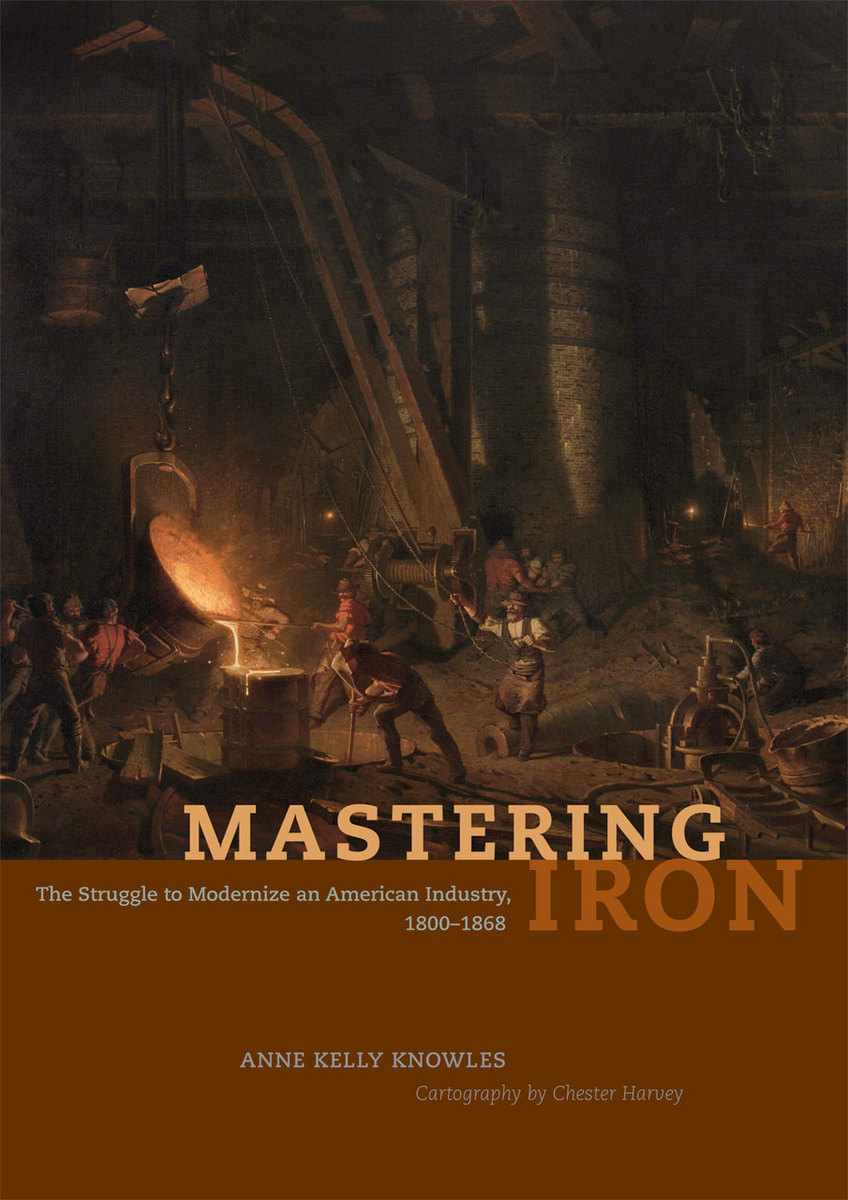
Mastering Iron
The Struggle to Modernize an American Industry, 1800-1868
University of Chicago Press, 2012
Cloth: 978-0-226-44859-6 | Electronic: 978-0-226-44861-9
DOI: 10.7208/chicago/9780226448619.001.0001
Cloth: 978-0-226-44859-6 | Electronic: 978-0-226-44861-9
DOI: 10.7208/chicago/9780226448619.001.0001
AVAILABLE FROM
University of Chicago Press (cloth, ebook)Amazon Kindle
Barnes & Noble Nook
Brytewave (CafeScribe-Follett Higher Ed)
Chegg Inc
DeGruyter Multi-User Ebook Program
ebrary
EBSCO eBooks (formerly NetLibrary)
Google Play
Kno
University Press Scholarship Online (UPSO)
ABOUT THIS BOOKAUTHOR BIOGRAPHYREVIEWSTABLE OF CONTENTS
ABOUT THIS BOOK
Veins of iron run deep in the history of America. Iron making began almost as soon as European settlement, with the establishment of the first ironworks in colonial Massachusetts. Yet it was Great Britain that became the Atlantic world’s dominant low-cost, high-volume producer of iron, a position it retained throughout the nineteenth century. It was not until after the Civil War that American iron producers began to match the scale and efficiency of the British iron industry.
In Mastering Iron, Anne Kelly Knowles argues that the prolonged development of the US iron industry was largely due to geographical problems the British did not face. Pairing exhaustive manuscript research with analysis of a detailed geospatial database that she built of the industry, Knowles reconstructs the American iron industry in unprecedented depth, from locating hundreds of iron companies in their social and environmental contexts to explaining workplace culture and social relations between workers and managers. She demonstrates how ironworks in Alabama, Maryland, Pennsylvania, and Virginia struggled to replicate British technologies but, in the attempt, brought about changes in the American industry that set the stage for the subsequent age of steel.
Richly illustrated with dozens of original maps and period art work, all in full color, Mastering Iron sheds new light on American ambitions and highlights the challenges a young nation faced as it grappled with its geographic conditions.
AUTHOR BIOGRAPHY
Anne Kelly Knowles is a historical geographer who teaches at Middlebury College, where she has been a member of the Department of Geography since 2002. A 2015 Guggenheim Fellow, she is the author of Calvinists Incorporated: Welsh Immigrants on Ohio’s Industrial Frontier, also published by the University of Chicago Press, and the editor of Placing History: How Maps, Spatial Data, and GIS Are Changing Historical Scholarship.
REVIEWS
“Anne Kelly Knowles has molded a thoroughly original geographic analysis of the emergent iron industry in nineteenth-century America. She rolls out a sweeping national portrait through a series of stunning maps and thoroughly satisfying prose before hammering out the diverging regional patterns through an examination of individual company records. Her insights both challenge and build upon prior historical interpretations. This is exactly what great historical geography should be.”
— Craig E. Colten, Louisiana State University
“Anne Kelly Knowles’s Mastering Iron will immediately take its place as one of the landmark works in the industrial history of the United States. Its merits are many: the research in both primary and secondary sources is thorough and thoughtful; the writing is consistently clear, vigorous, and engaging; and she asks the right questions about her subject and provides compelling answers. The result is the most analytically sophisticated geographic portrait we have ever had of this critically important, amazingly diverse, and grossly understudied American industry.”
— Charles Dew, Williams College
“Anne Kelly Knowles brings a new approach to our understanding of American ironmaking by coupling geography with the history of technology. Through the first two-thirds of the nineteenth century, Americans transformed their underdeveloped ironworks into a major industry in the world economy. They borrowed the technology and organization techniques of the highly successful works in South Wales, only to discover that differences in natural resources, geography, weather, climate, and community structure thwarted direct technology transfer across the Atlantic. Knowles draws on her experience in Wales and her skills as a geographer to show us the barriers that had to be overcome by the American entrepreneurs and their immigrant workers. She introduces us to the people involved, and with an array of beautiful maps, shows us who went where and what had to be moved about by canals and railroads to achieve the success in ironmaking that would be the foundation of the subsequent American world-class steel industry.”
— Robert Gordon, Yale University
“Scholars have extensively documented the United States’ rise to world leadership in the iron and steel industry in the late nineteenth century, but their neglect of the antebellum iron industry left a puzzle. By standards of the superior British, French, and German industries, America’s iron industry was woefully uncompetitive. Anne Kelly Knowles brilliantly resolves the puzzle through her use of theory and rich archival evidence covering the period between 1800 and 1868. From this she fashions a richly textured story of the challenges of the antebellum actors to develop the practices and technologies of the iron industry, their search for mineral resources, and their struggles to market iron. Knowles unequivocally demonstrates that by the end of the Civil War the iron industry was poised to exploit the possibilities of the territorial expansion of the dynamic national economy.”
— David R. Meyer, Washington University in St. Louis
“Anne Kelly Knowles has built a reputation over the past decade for highly innovative applications of GIS in historical scholarship. . . . This new book is distinguished by the depth of its historical scholarship, and the way in which GIS is fully integrated into the research process. . . . Beautifully presented and compellingly written.”
— International Journal of Geographical Information Science“Knowles’s enthralling, well-researched history will entertain and inform a range of audiences from general readers and undergraduates to graduate students, researchers, and faculty. Highly recommended.”
— T. E. Sullivan, Towson University, Choice“[Knowles] clearly knows the relevant literature and makes good use of archival sources. The book is beautiful, with many color and black-and-white illustrations and maps. . . . Knowles has authored an important study on the antebellum phase of the nineteenth-century American iron industry.”
— Bruce E. Seely, Michigan Technological University, American Historical Review“A masterful exemplar of ‘doing historical geography’ that stands to become an exceptional teaching resource for the way it highlights the fundamental nature of geographic considerations in contrast to the broader brushstrokes of history and economy. Historical GIS peeks through the text from behind the scenes in its role as invaluable research tool without becoming a major topical focus in itself, making the book also an excellent embodiment of the trend toward historical geography scholarship quietly incorporating GIS technology. . . . Knowles’s book, even more than what it contributes to our understanding of iron in the antebellum United States or its role in the Civil War, will give students a concrete and eloquent example through which to trace the thoughts and concepts, the differences in focus, and the processes of investigation that make historical geography different from history.”
— G. Rebecca Dobbs, University of North Carolina at Chapel Hill, Historical Geography“The most comprehensive and informative book about the US iron industry during this period that I have read. . . . I highly recommend Mastering Iron for scholars of historical, industrial, and urban geography. It succeeds admirably in accomplishing what Knowles sets out to do: elucidating the industrial geography of the US antebellum iron industry, as well as establishing a clearer understanding of the geographic, technological, social, and economic circumstances under which the spectrum of iron production took place prior to the Civil War. Knowles skillfully extracts important information from the Iron Master’s Guide, and then pieces it together to produce an enlightening narrative regarding the nature of the industry as a whole, as well as providing case studies of representative firms. . . . The figures in the book are excellent—there are many historical photographs and period color paintings that bring the places Knowles describes in the book to life. Whether a historical geographer, or just someone who is looking for keen insight into the industrial development of the United States, time invested in reading Mastering Iron will be well spent.”
— John Benhart, Indiana University of Pennsylvania, AAG Review of Books“That the Welsh played a vital role as industrial frontiersmen in America is well known. This book underlines their importance and the enormity of their achievement. Paradoxically, it does so by revealing the obstacles Welsh workers had to surmount as they sought to reproduce in the New World what they had known in the Old.”
— Welsh History Review“Mastering Iron is essential reading for historians of America’s industrial development. . . . Knowles’s narrative blends transatlantic technology transfer and local circumstances. In the end, this very creative and soundly researched book makes a convincing case that this particular phase of the history of iron production needs to be regarded as a critical aspect of American industrialization.”
— Register of the Kentucky Historical SocietyTABLE OF CONTENTS
Iron in America - Anne Kelly Knowles, Chester Harvey
Mapping the Iron Industry - Anne Kelly Knowles, Chester Harvey
The Worlds of Ironworkers - Anne Kelly Knowles, Chester Harvey
High Hopes and Failure - Anne Kelly Knowles, Chester Harvey
The Elements of Success - Anne Kelly Knowles, Chester Harvey
Iron for The Civil War - Anne Kelly Knowles, Chester Harvey
American Iron - Anne Kelly Knowles, Chester Harvey
Acknowledgments
Appendix: A Note on Historical GIS
Notes
Glossary
Bibliography
Map Sources
Index